Classroom Podcast Studios: Publishing Student Voice to a Real Audience
Discover how Classroom Podcast Studios turn student ideas into publishable learning through speaking, writing, collaboration, and real audience engagement.

I. Introduction
A lot of student work disappears as soon as it is graded. A strong discussion ends when the bell rings. A thoughtful explanation stays trapped in a notebook. A well-researched response reaches one audience of one: the teacher. Classroom Podcast Studios offer a different possibility. Instead of treating student thinking as disposable, they turn it into something publishable, shareable, and worth revisiting.
Want done-for-you lesson plans for less than $2? Click Here to explore.
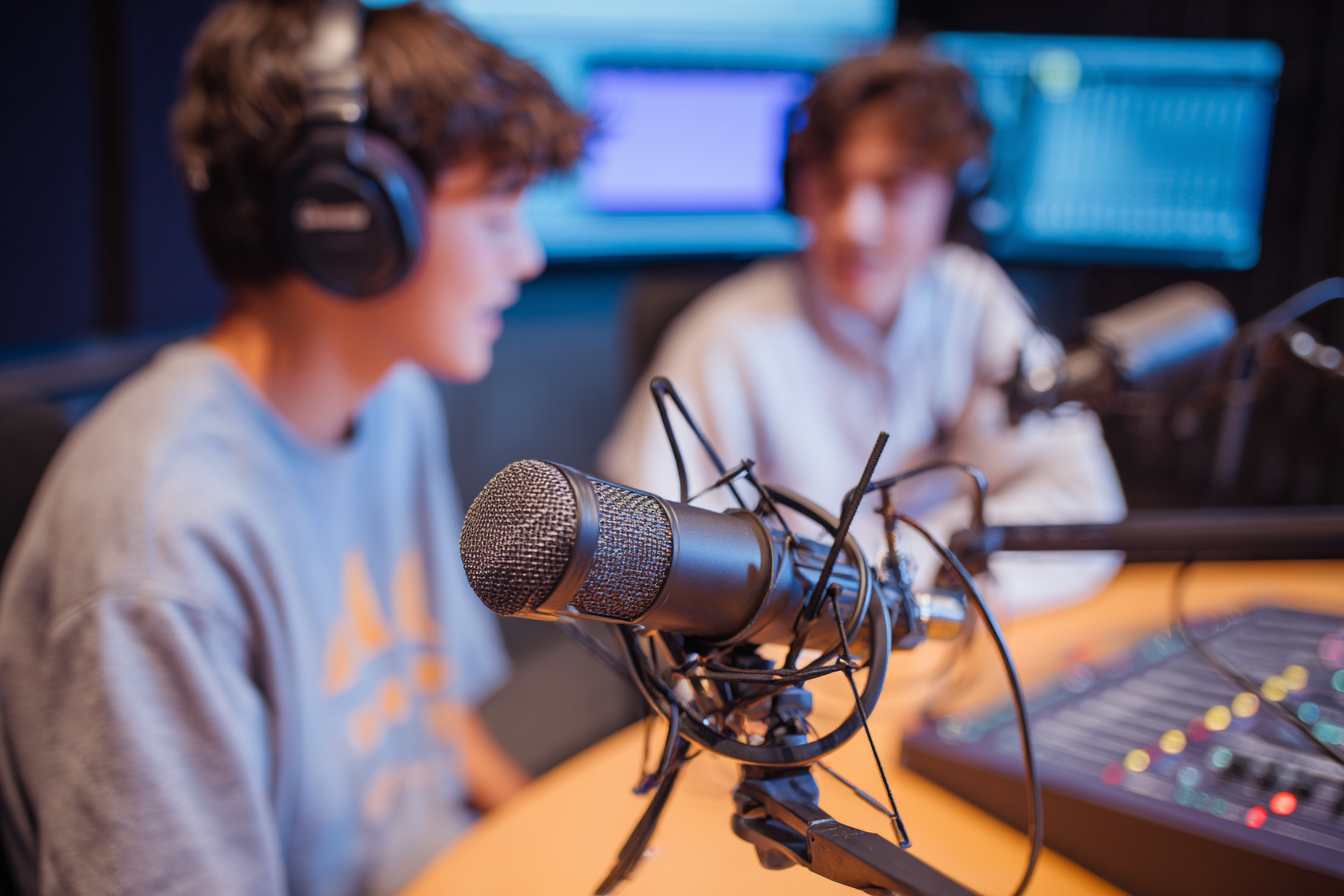
In this model, students script, record, and edit short podcast episodes tied to class content. A literature class might produce book talks or character interviews. A science class might create short explainers on ecosystems or lab results. A social studies class might build “news desk” episodes on historical events. The work becomes a living archive of learning that can be shared with families, classmates, partner classrooms, or a broader school audience. Research on educational podcasting suggests that student-created audio projects can support engagement, collaboration, literacy, and language production, though the direct evidence on academic performance is still more mixed than the enthusiasm around the medium sometimes suggests (Besser et al., 2022; Heilesen, 2010).
II. Why Podcasting Changes the Feel of Classroom Work
Podcasting changes the assignment because it changes the audience. When students know that other people may actually hear their work, they tend to think more carefully about clarity, pacing, explanation, and tone. That authentic-audience effect shows up repeatedly in the podcasting literature: students often put more effort into planning and revising when they are creating something public-facing rather than submitting a private worksheet or essay (Acevedo de la Peña & Cassany, 2024; Phillips, 2017).
The format also naturally pulls together multiple literacy demands. A good episode usually requires research, outlining, script writing, rehearsal, speaking, listening, editing, and reflection. That is one reason podcasting fits so well across content areas. It is not just a “tech activity.” It is a structured way to make students organize ideas, communicate them coherently, and revise for meaning, not just correctness (Besser et al., 2022; Phillips, 2017).
At the same time, good podcast projects can give some students a more comfortable entry point than live presentations. Because audio can be scripted, rehearsed, re-recorded, and edited, students often have more time to think and less pressure than they would in a one-shot speech. That matters especially for learners who need extra processing time, are developing confidence as speakers, or benefit from being able to refine their language before sharing it publicly (Phillips, 2017; Acevedo de la Peña & Cassany, 2024).
III. What a Classroom Podcast Studio Actually Is
A Classroom Podcast Studio does not have to mean a soundproof room with expensive equipment. In most schools, it simply means a repeatable classroom workflow for planning, recording, revising, and publishing student audio. The “studio” is really a system: clear episode types, script expectations, simple recording routines, editing norms, and a publishing plan that fits the age of the students and the privacy rules of the school. That flexible implementation is one reason podcasting has been documented across elementary, secondary, and higher education settings (Besser et al., 2022).
The strongest studios are built around academic purpose first and technology second. A podcast episode should answer a real content question, teach something, summarize a debate, analyze a text, or document a project. If the assignment is only “make a podcast,” students often spend too much energy on surface-level style and not enough on substance. When the learning target is clear, the audio format becomes an amplifier for thinking rather than a distraction from it (Heilesen, 2010; Besser et al., 2022).
IV. What Students Build Beyond “Speaking Skills”
Podcast projects are appealing because they develop more than oral fluency alone. In a well-designed unit, students build a cluster of academic and transferable skills at once.
- Stronger organization of ideas Students have to decide what belongs at the beginning, middle, and end of an episode so listeners can follow the logic.
- Better script writing and revision Podcast scripts force students to write for the ear, which often exposes weak transitions, vague wording, and unsupported claims.
- Listening and self-monitoring Hearing a recording of their own work helps students notice pacing, repetition, pronunciation, and clarity in ways they may miss on paper.
- Collaboration and production planning Group episodes require role division, time management, feedback, and shared decision-making.
- Digital literacy Students learn how to record, edit, name files, manage assets, and publish responsibly.
- Audience awareness Because podcasts are meant to be heard, students tend to become more deliberate about tone, explanation, and engagement.
These benefits align with findings from podcasting research that link student-created audio to motivation, collaboration, digital competence, and multimodal literacy development, while also reminding educators that the medium works best when paired with good scaffolds and clear learning goals (Phillips, 2017; Smythe & Neufeld, 2010; Dversnes & Blikstad-Balas, 2023).
V. Designing Episodes for a Real Audience
The biggest design question is not “What app should I use?” It is “Who is this episode for?” When students know whether they are speaking to classmates, younger students, families, or a public school audience, the work gets sharper. The explanation becomes more intentional. Vocabulary choices improve. Examples become more thoughtful. In research on student podcasting, open or semi-open publication spaces have been associated with increased motivation because students recognize that the final product may reach listeners beyond the teacher (Acevedo de la Peña & Cassany, 2024; Phillips, 2017).
That does not mean every episode needs to be posted publicly on the open web. A real audience can be a class website, a private LMS folder, a QR code for families at open house, or a shared archive for another grade level. The key is that the work is positioned as communication, not just compliance. Students should feel that they are making something for someone, not merely filling time with a trendy format.
VI. A Practical Workflow from Idea to Published Episode
Podcast studios work best when the production cycle is simple and consistent. Students do not need a different process every time. They need a dependable sequence they can learn and improve.
1. Start with a tight episode purpose An episode should do one clear job: explain a concept, review a text, summarize a debate, tell a historical story, or reflect on a project. Narrower prompts usually produce stronger audio than broad “talk about this unit” directions.
2. Build in script checkpoints Students should draft before they record. Teachers can check for structure, content accuracy, transitions, and audience fit before time is spent on audio production. Research-based descriptions of student podcast projects repeatedly show script writing and revision as central stages, not optional extras (Acevedo de la Peña & Cassany, 2024).
Check out our engaging printable posters. CLICK HERE to explore!
3. Rehearse for the ear Reading silently is not enough. Students need to hear where a script sounds stiff, too long, or unclear. Rehearsal improves the final product and often reduces the number of retakes.
4. Record in small, manageable conditions A quiet corner, a hallway spot, a library room, or even a teacher-monitored rotation can work. The quality of the routine matters more than the sophistication of the room.
5. Edit lightly at first Especially for a first project, focus on trimming dead space, fixing obvious mistakes, and adding simple intros or outros. Overediting can turn the assignment into a technical exercise instead of a communication task.
6. Publish and reflect Students should listen to their own finished work, get a response from an audience, and note what they would improve next time. That final reflection is where the studio becomes a learning cycle rather than a one-off artifact.
This kind of scaffolded workflow aligns closely with the sequence described in published classroom podcasting studies: familiarization with the genre, teacher modeling, topic selection, script drafting, revision, recording, editing, publication, and feedback tasks after release (Acevedo de la Peña & Cassany, 2024).
VII. Episode Formats That Fit School Best
Not every class needs the same kind of show. The most sustainable classroom podcast studios usually rely on a small menu of repeatable formats.
- Book Talks Students recommend, critique, or compare texts for classmates or younger readers.
- Debate Summaries Students synthesize both sides of an issue and explain where the strongest evidence sits.
- Science Explainers Students break down processes, lab findings, or misconceptions in concise, listener-friendly language.
- History News Reports Students report on events as if they are live correspondents, using evidence from the unit.
- Interview Episodes Students interview peers, teachers, community members, or even role-play historical or literary figures.
- Reflection Episodes Students document what they learned from a project, experiment, performance, or field experience.
These formats work because they give students a recognizable structure while still leaving room for voice and creativity. They also help teachers align audio tasks to specific standards instead of reinventing the assignment every time.
VIII. Case Studies from the Research
Case Study: Grade 7 Social Studies “Studycasts” In Cain’s qualitative case study, a seventh-grade teacher used student-created “studycasts” to support review in a unit on Africa. Students worked in teams to create story-based podcasts that embedded class content, and the teacher published them through a classroom website and RSS feed. The study identified practicality, storytelling, and motivation as major themes, suggesting that podcast creation can make review more engaging while also giving students a new way to organize content for themselves and peers (Cain, 2020).
Case Study: Middle Years ELL Classroom in Canada Smythe and Neufeld studied a podcast project in a Canadian Grade 7 classroom serving English language learners. Over four months, students wrote stories, turned them into multimodal pieces, and used podcasting as part of a broader digital literacy effort. The researchers found real potential for academic literacy growth and expanded semiotic resources, but they also warned that the transformative impact was limited when classroom assessment systems and dominant print-based norms were left unchanged. That is an important reminder: podcasting works best when the surrounding classroom structures also value multimodal work (Smythe & Neufeld, 2010).
Case Study: Health-Professions English Course in Austria Phillips studied student-produced podcasts in a tertiary English-for-health-professionals course. Students created nutrition- and lifestyle-related podcast episodes, uploaded them to Moodle for classmates and faculty, and later completed a digital storytelling podcast reflecting on their career path. The study reported that 91.1% of students ultimately agreed that creating podcasts was a valuable learning experience, despite initial hesitation, and highlighted gains in confidence, fluency, and perceived engagement for many participants (Phillips, 2017).
Case Study: Student Podcasting in Spanish as a Foreign Language Acevedo de la Peña and Cassany analyzed three university teachers’ use of podcasts in Spanish language instruction, including a corpus of 227 podcasts, most of them student-created. They describe a recurring production cycle that included listening to model podcasts, selecting topics, drafting scripts, revising repeatedly, recording, editing, publishing, and then responding to the finished products. Their findings point to strong potential for speaking practice, but also show how heavily podcast projects draw on reading and writing during scripting and revision. They additionally note that open-access publication can raise motivation because students recognize that native speakers may hear the final work (Acevedo de la Peña & Cassany, 2024).
Case Study: High School Literature and Exploratory Talk Dversnes and Blikstad-Balas examined eight groups of Norwegian high school students who developed podcasts about contemporary poems over four weeks. Analyzing 50 hours of recorded group talk, they found that exploratory talk was especially strong earlier in the process, while presentational talk increased later as students prepared finished products. That pattern is useful for classroom design: podcasting can create rich discussion during planning if teachers preserve enough open space for interpretation before students lock into polished performance mode (Dversnes & Blikstad-Balas, 2023).
IX. Starting Small Without Fancy Equipment
One reason podcasting appeals to teachers is that the entry point can be modest. A first studio cycle can be as simple as student pairs recording two-minute episodes on classroom devices with basic headphones and a quiet recording plan. If the structure is strong, the learning can still be excellent. Research on educational podcasting consistently points to pedagogy and scaffolding as more important than production polish alone (Besser et al., 2022; Heilesen, 2010).
A practical small-start plan might look like this: one episode format, one audience, one script template, one shared rubric, and one publishing location. Once students understand the cycle, teachers can layer in interviews, music, sound design, or more ambitious editing. Starting smaller also helps keep the workload focused on communication and content rather than turning the project into a contest for the best special effects.
X. Common Pitfalls and How to Avoid Them
Podcast studios are powerful, but they can go off track in predictable ways.
- Pitfall: Students talk without enough planning Fix: Require outlines or scripts before recording. Strong audio usually begins with strong thinking on paper.
- Pitfall: The project becomes more about tech than learning Fix: Grade primarily for content, explanation, organization, and audience awareness. Keep editing expectations proportional.
- Pitfall: Only confident speakers thrive Fix: Build in rehearsal, retakes, partner roles, and shorter episode lengths so students can grow into the format.
- Pitfall: The audience is unclear Fix: Tell students exactly who the episode is for and where it will live.
- Pitfall: Multimodal work is treated as “extra” rather than legitimate Fix: Align the podcast to real standards and use rubrics that value thinking, not just polish.
That last point matters a lot. Smythe and Neufeld’s study is a useful caution that a podcast project can create real opportunities for literacy and identity work, but its effect is weaker when the broader classroom still privileges only traditional print products (Smythe & Neufeld, 2010).
XI. Conclusion
Classroom Podcast Studios give student thinking somewhere to go. Instead of vanishing after grading, ideas can be shaped into episodes that explain, persuade, reflect, and connect. That makes podcasting more than a novelty. It becomes a way to strengthen writing, speaking, listening, collaboration, and audience awareness all at once.
The best part is that teachers do not need a professional studio to begin. They need a clear purpose, a repeatable workflow, and an audience that makes the work feel real. When those pieces are in place, student podcasting can turn ordinary classroom responses into publishable learning artifacts—ones that students remember because their voices were not just heard in class, but worth hearing beyond it. Research to date does not justify overselling podcasting as a magic fix, but it does support it as a flexible, motivating, and academically meaningful structure when it is carefully scaffolded and tied to real learning goals (Heilesen, 2010; Besser et al., 2022).
Want to save time on lesson planning this week? CLICK HERE to explore our library of 1000s of lesson plans for less than $2!
Transform your classroom into an inspiring, vibrant learning space with our beautifully designed printable posters! Perfect for engaging your students and enhancing your teaching environment, our poster bundles cover everything from historical philosophers to animals. CLICK HERE to explore our exclusive collections on Teachers Pay Teachers and give your students the motivational boost they need!
Sources
Acevedo de la Peña, I., & Cassany, D. (2024). Student podcasting for foreign language teaching-learning at university. Journal of Technology and Science Education, 14(1), 123–141. https://doi.org/10.3926/jotse.2509
Besser, E. D., Blackwell, L. E., & Saenz, M. (2022). Engaging students through educational podcasting: Three stories of implementation. Technology, Knowledge and Learning, 27(3), 749–764. https://doi.org/10.1007/s10758-021-09503-8
Cain, J. P. (2020). A qualitative study on the effect of podcasting strategies (studycasts) to support 7th grade student motivation and learning outcomes. Middle School Journal, 51(3), 19–25. https://doi.org/10.1080/00940771.2020.1735867
Dversnes, G., & Blikstad-Balas, M. (2023). The potential of podcasts for exploratory talk in high school. Computers in the Schools, 40(3), 282–302. https://doi.org/10.1080/07380569.2023.2196963
Heilesen, S. (2010). What is the academic efficacy of podcasting? Computers & Education, 55(3), 1063–1068. https://doi.org/10.1016/j.compedu.2010.05.002
Phillips, B. (2017). Student-produced podcasts in language learning: Exploring student perceptions of podcast activities. IAFOR Journal of Education, 5(3), 157–171. https://doi.org/10.22492/ije.5.3.08
Smythe, S., & Neufeld, P. (2010). “Podcast time”: Negotiating digital literacies and communities of learning in a middle years ELL classroom. Journal of Adolescent & Adult Literacy, 53(6), 488–496. https://doi.org/10.1598/JAAL.53.6.5