Lesson Plan (Grades 9-12): Topology in Origami
Grades 9–12 explore topology through origami, building Möbius strips and tori to test orientability and compute Euler characteristic.

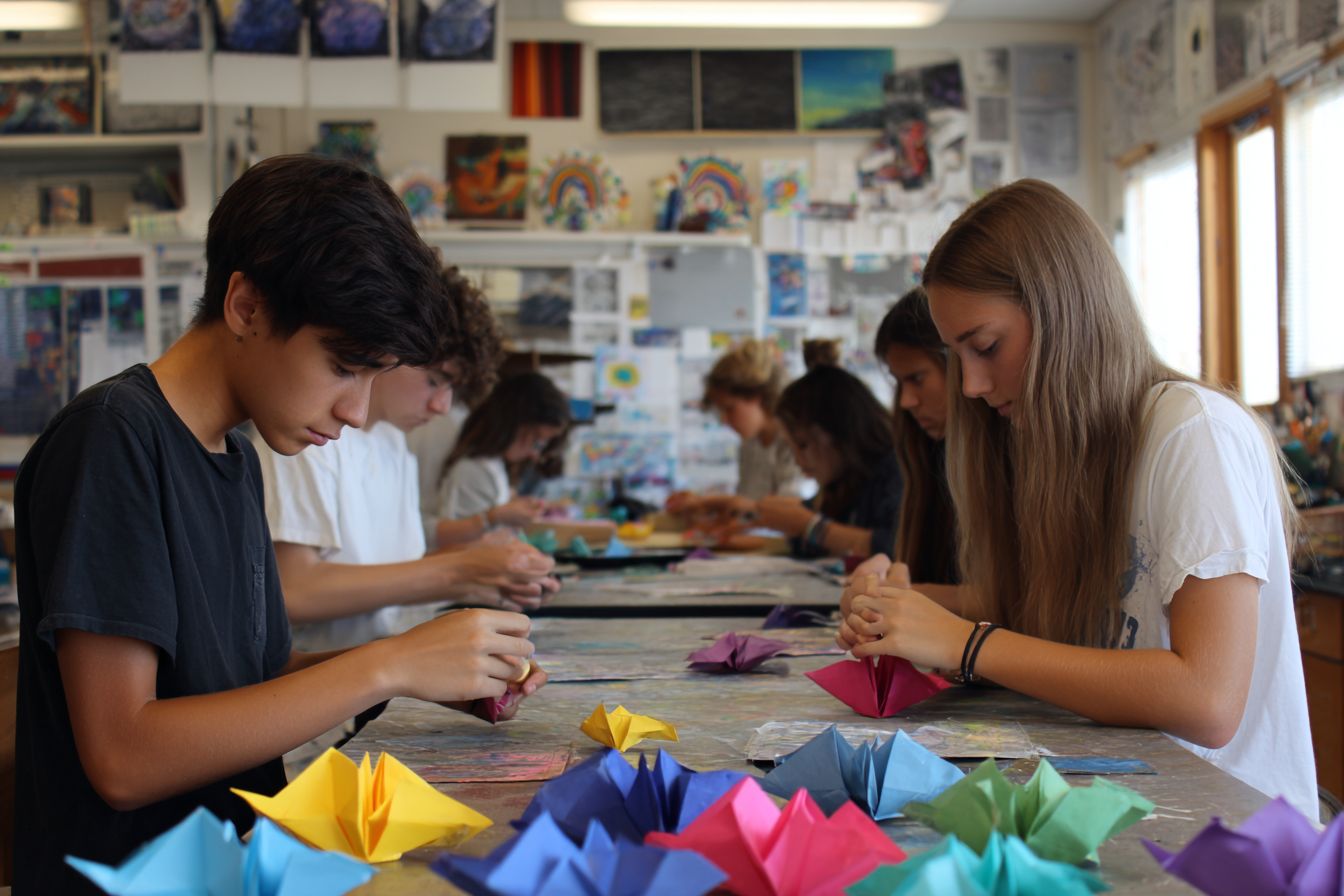
Lesson Title: Topology in Origami
Grade Levels: 9–12
Subject Area: Mathematics (Topology) & Art
1. Introduction
Topology is often called “rubber‐sheet geometry” because it studies properties preserved under continuous deformation—stretching, bending, and twisting without tearing or gluing. In Topology in Origami, students bring abstract surfaces to life by folding paper models of classic topological shapes: the Möbius strip, the torus, and a paper approximation of the Klein bottle.
Over four sessions, learners will:
- Construct each surface by precise paper folding and gluing or taping.
- Explore orientability by tracing a path or coloring the surface.
- Identify boundary components (loops where edges remain) versus closed surfaces.
- Approximate the Euler characteristic (χ = V – E + F) using simple triangulation or subdivision methods.
- Document each step in writing and diagram form, reflecting on how a piece of paper transforms into a one-sided or multi-holed surface.
By blending hands-on art with rigorous mathematical inquiry, students gain deep insight into how topological invariants inform real-world applications: from Möbius conveyor belts to toroidal fusion reactors to molecular ring structures. This unit fosters spatial reasoning, precise communication, and creative problem-solving—key skills for advanced STEM study and interdisciplinary exploration.
2. Learning Targets
By the end of this lesson, each student will be able to:
- Construct Key Topological Surfaces
- Follow step-by-step folding and joining instructions to create a Möbius strip, a paper torus, and a punctured Klein bottle approximation.
- Demonstrate Orientability and Boundary Concepts
- Use color tracing or ribbon-thread tests to show that the Möbius strip is non-orientable with one boundary, while the torus is orientable with no boundary.
- Compute Euler Characteristics
- Subdivide each surface into a network of vertices, edges, and faces (e.g., via drawn triangulation), and calculate χ = V – E + F, verifying known values (Möbius: χ = 0 with boundary; torus: χ = 0; Klein bottle punctured: χ = 1).
- Document and Communicate Constructions
- Prepare clear, labeled diagrams and written reflections describing folds, joins, and topological observations.
- Connect Topology to Applications
- Identify and discuss at least two real-world examples—such as Möbius conveyor systems, toroidal reactors, or molecular Möbius strips—explaining how topology informs design and function.
Each student will lead the construction and analysis of one model and collaborate on documenting all three, ensuring equitable participation and shared learning.
3. Standards Alignment
This unit integrates high school mathematics and cross-disciplinary practices:
- CCSS.MATH.CONTENT.HSG-CO.A.2 Precisely describe transformations and use them to model topological deformations—folds that preserve paper continuity.
- CCSS.MATH.CONTENT.HSG-GMD.A.3 Use geometric measurement and formulas to compare surface areas before and after folding, reinforcing that paper area remains constant under folding.
- NGSS.MS-PS1-3 Gather and interpret information about conservation of matter under deformation; in topology, paper is deformed but not torn or fused.
- MP.4 (Model with Mathematics) Represent continuous surfaces with physical origami models to explore non-intuitive properties.
- MP.6 (Attend to Precision) Emphasize accurate folds, clean joins, and careful counting of vertices, edges, and faces for Euler characteristic calculations.
By situating topology within art and scientific contexts, students engage with both abstract reasoning and tangible applications, fulfilling rigorous learning goals.