Restorative Practices 101: Reducing Discipline Referrals Through Community Circles
Tiered restorative justice for schools: community circles, restorative chats, and reflection sheets that reduce referrals and rebuild trust.

I. Introduction
Traditional discipline approaches—detentions, suspensions, and referrals—often address only the surface behavior, leaving underlying issues unaddressed. When students receive punitive consequences without support, they may disengage, leading to higher absenteeism and chronic referrals. Restorative practices shift focus from punishment to repairing harm, emphasizing empathy, accountability, and relationship-building. By integrating community circles and guided dialogues, schools can create spaces where students learn to recognize the impact of their actions and collaboratively resolve conflicts.
Want done-for-you lesson plans for less than $2? Click Here to explore.
This article introduces a tiered restorative justice model: starting with whole-class community circles for proactive relationship-building and low-stakes accountability, extending to small-group “Restorative Chats” for conflict resolution, and, when necessary, culminating in individual restorative conferences. We’ll share sample scripts, circle norms, and “Reflection Sheet” templates that students complete before re-entering class. By replacing punitive measures with empathetic dialogue, educators can strengthen trust, cultivate emotional literacy, and significantly lower discipline referrals.
II. Understanding Restorative Practices
Restorative practices are based on the belief that strong relationships and community bonds deter misconduct and foster accountability. Instead of isolating or punishing the misbehaving student, restorative approaches bring together those affected—victims, offenders, and community members—to discuss harm and determine how to repair it. This model aligns with social-emotional learning by teaching empathy, active listening, and mutual respect.
Research shows that schools adopting restorative frameworks experience significant declines in suspension rates and improvements in school climate. The core elements include building a shared sense of responsibility, using structured dialogues to address harm, and promoting a culture where mistakes become learning opportunities. Unlike zero-tolerance policies, restorative practices emphasize healing and reintegration, shifting the focus from punishment to empowerment.
III. Tiered Restorative Justice Model
A tiered restorative justice model offers multiple entry points depending on the severity and frequency of behaviors. These tiers ensure that interventions are neither too heavy-handed nor too minimal, meeting students where they are and escalating only when necessary.
- Tier 1: Whole-Class Community Circles • Purpose: Relationship building, norm setting, and addressing minor issues. • Description: Weekly circles of 15–20 minutes where the entire class discusses shared values, reflects on classroom dynamics, and addresses low-stakes conflicts.
- Tier 2: Small-Group Restorative Chats • Purpose: Conflict resolution for 2–4 students involved in a disagreement or minor harm. • Description: Facilitated 20–30-minute sessions where students discuss incidents, acknowledge impact, and agree on repair actions.
- Tier 3: Individual Restorative Conferences • Purpose: Intensive, personalized dialogue for serious infractions or repeated misconduct. • Description: In-depth conferences—including parents or guardians, counselors, and affected peers—designed to chart long-term support and make amends.
By escalating from community-building circles to targeted chats and individual conferences, schools can proactively address day-to-day challenges while also handling more complex restorative needs effectively.
IV. Whole-Class Community Circles
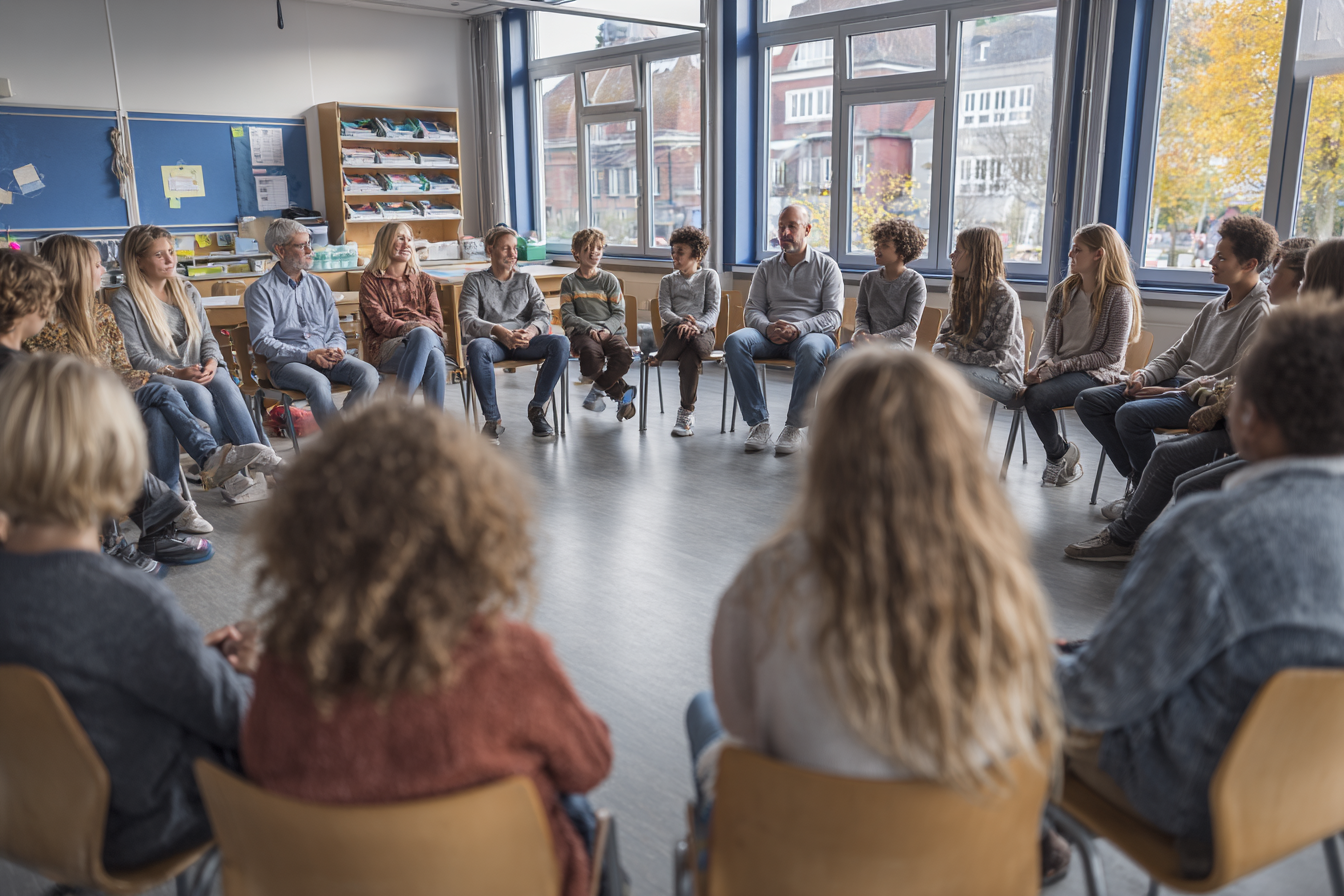
Whole-class community circles are the bedrock of proactive restorative practice, establishing a safe environment where everyone’s voice is valued. These circles typically convene weekly or biweekly—often at the start of a homeroom or advisory period—to foster trust, build relationships, and reinforce shared values.
Participants sit in a literal or virtual circle so no one is positioned at the “head” of the group. The teacher or trained student leader (facilitator) opens with a consistent prompt, setting the tone for open, honest communication. By rotating facilitation roles—such as talking-piece holder, timekeeper, and summarizer—students learn responsibility and active listening, building empathy as they respond to peers’ experiences.
These sessions also serve as low-stakes accountability checks. Instead of punishing minor infractions, students discuss the impact of their actions on classmates, collectively problem-solving rather than shifting blame. When a student interrupts or disrupts, the facilitator might gently say, “Let’s take a beat and remember our circle norms,” prompting self-correction. Over time, the shared ownership of norms reduces the need for reactive disciplinary measures.
Circle Components
- Circle Norms: • Speak from an “I” perspective: “I think…,” “I feel…,” “I need…” • Listen actively without interrupting. • Show respect through body language—eye contact, nodding, open posture. • Maintain confidentiality: “What’s said in the circle stays in the circle.”
- Sample Scripts: • Opening Prompt: “Today, let’s share one thing that made us feel included this week.” • Reflective Question: “What is one way we can show respect to someone who looks or thinks differently than us?” • Conflict Acknowledgment: “Earlier, when we disagreed about seating, how did that affect our circle’s trust?”
- Roles and Responsibilities: • Facilitator (Teacher or Student Leader): Opens the circle with a prompt, ensures norms are followed, keeps the discussion on track. • Speaker/Talking-Piece Holder: Shares perspective; only the person holding the talking piece speaks. • Summarizer: Listens and restates main points at the end, ensuring everyone’s message is heard. • Timekeeper: Monitors time so each participant has an opportunity to speak.
- Guiding Prompts: • “What is one thing you appreciate about our classroom community?” • “Describe a moment this week when you felt heard or unseen.” • “How can we help someone who feels upset or left out?”
By embedding these components into regular routines, circles become second nature, and students internalize norms of empathy and respect.
V. Small-Group “Restorative Chats”
When conflicts arise—such as arguments, name-calling, or minor vandalism—small-group Restorative Chats provide a structured forum for repairing harm. These sessions, typically lasting 20–30 minutes, focus on understanding the impact of actions and collaboratively identifying steps to restore relationships.
Pre-Conversation Preparation
- Participant Invitations: Invite all affected students with a respectful note: “We’d like to meet to talk about what happened and how to move forward together.”
- Private Briefing: Meet each student individually beforehand to explain the restorative intent, answer questions, and allow them to prepare their thoughts.
- Reflection Sheet Distribution: Give each participant a “Reflection Sheet” to complete before the chat, guiding them to describe what happened and how they feel.
Sample Chat Script
- Opening: “Thank you all for coming. We’re here to understand what happened, how everyone was affected, and what we can do to make things right. Let’s speak honestly and listen carefully.”
- Prompt 1: “Can each of you share your perspective on what happened?”
- Prompt 2: “How did your actions affect [other student(s)]—their feelings, learning, or safety?”
- Prompt 3: “What do you need to do to repair the harm and rebuild trust?”
- Closing: “Let’s agree on specific actions we’ll each take. We’ll meet again in one week to see how this plan is going.”
Roles and Responsibilities
- Facilitator: Guides the conversation, ensures norms are upheld, and clarifies misunderstandings.
- Participants: Each student shares their perspective and listens without interruption.
- Note-Taker (Optional): Records key agreements and action steps for future reference.
Follow-Up Steps
- Action Plan: Co-create a written plan listing repair actions (e.g., apologies, restitution, or community service).
- Check-In Meetings: Schedule brief follow-ups—one week after—for participants to assess progress and adjust if necessary.
- Reintegration: Once harm is repaired, reaffirm the restored relationships in a brief circle or classroom announcement.
Through these structured dialogues, students learn empathy, accountability, and problem-solving—replacing retribution with rehabilitation.
VI. Reflection Sheets
Reflection Sheets prompt students to consider their behavior’s impact and commit to making amends. Completing these forms encourages self-awareness, accountability, and proactive planning before they rejoin the community.
Basic Reflection Sheet
- Prompt: “Describe what happened.”
- Prompt: “How did it make you feel?” (Include an emotion vocabulary list: angry, hurt, frustrated, disappointed, etc.)
- Prompt: “Who else was affected and how?”
- Prompt: “What could you do differently next time?”
- Space for Student Signature and Date.
Harm/Repair Reflection Sheet
- Prompt: “What harm was caused?”
- Prompt: “What specifically do you need to do to make it right?”
- Prompt: “Who can help you follow through on this plan?”
- Columns for “Action” and “Timeline.”
Re-Entry Reflection Sheet
- Prompt: “What have you learned from our discussion?”
- Prompt: “How will you act differently now?”
- Prompt: “What support do you need to stay on track?”
- Space to record facilitator’s notes on commitments and follow-up dates.
Reflection Sheets can be completed electronically or on paper. Teachers review them before allowing students to return to the classroom, ensuring they understand expectations and have a clear plan for improvement. This process helps students internalize restorative lessons and fosters genuine behavioral change.
VII. Implementation Steps
Successful implementation of restorative practices begins with strong leadership commitment and professional development. Administrators should organize training sessions for all staff—teachers, counselors, aides, and administrators—to introduce restorative principles, circle facilitation, and the tiered model. Engaging everyone ensures a shared understanding of goals and processes, creating a unified front for change.
Next, form a Restorative Practices Team to coordinate rollout, maintain materials, and monitor fidelity. This team typically includes an administrator, two teachers, a counselor, and a community representative. Their first task is to pilot the model in one grade or department, refining logistics and collecting feedback. As the approach proves effective, the school can expand to additional classrooms.
Implementation Steps:
- Form a Leadership Team: • Identify administrators, teachers, counselors, and community partners to lead the initiative. • Define roles: training coordinator, circle facilitator, data manager, and communication lead.
- Train Staff in Restorative Practices: • Conduct a 2–3 hour workshop covering restorative philosophy, circle norms, and dialogue techniques. • Provide sample scripts, circle norms posters, and Reflection Sheet templates for classroom use.
- Launch Tier 1: Whole-Class Community Circles: • Schedule weekly 20-minute circles targeting relationship-building and norm setting. • Use prepared prompts (e.g., “What makes you feel safe in our classroom?”) to guide discussions.
- Collect and Analyze Baseline Discipline Data: • Track referrals, suspensions, and attendance rates before implementation. • Use secure spreadsheets to document types of incidents, involved students, and outcomes.
- Introduce Tier 2: Small-Group Restorative Chats: • Identify students with moderate behavior concerns (e.g., repeated minor infractions). • Train selected teachers or counselors to facilitate 20–30 minute restorative dialogues.
- Integrate Reflection Sheets Protocol: • Distribute Reflection Sheet templates to all staff; train teachers on when and how to assign them. • Review completed sheets during small-group sessions before students re-enter class.
- Implement Tier 3: Individual Restorative Conferences: • For serious incidents (bullying, vandalism, physical altercations), schedule conferences involving all affected parties. • Use comprehensive scripts to guide deeper accountability and support planning with parents and counselors.
- Evaluate and Refine: • Conduct quarterly reviews of referral data, surveying students and staff for feedback. • Adjust prompts, norms, and training as needed to respond to emerging challenges and successes.
By following these steps and maintaining open lines of communication, schools can systematically embed restorative practices into daily routines, ensuring sustainability and impact.
VIII. Overcoming Common Challenges
Staff Skepticism Transitioning from punitive discipline to restorative approaches often meets resistance. Educators accustomed to traditional models may doubt efficacy or worry about lost instructional time. To address this, share research on decreased suspensions, improved attendance, and enhanced school climate in schools using restorative practices. Invite early adopters to present testimonials during staff meetings. Observing a successful circle firsthand can shift perceptions and build buy-in.
Time Constraints Teachers frequently cite lack of time as a barrier. Embed circles into existing routines—morning meetings, homeroom periods, or advisory blocks—so they don’t feel like additional sessions. Keep circles concise: 15–20 minutes is sufficient for meaningful dialogue. Provide the “Restorative Toolkit” (laminated norms, prompt cards, and reflection sheets) so facilitators can run efficient circles without lengthy prep.
Enjoy science fiction? Check out my space books HERE on Amazon!
Inconsistency of Practices Consistency is critical yet challenging when staff turnover is high. Develop a shared digital repository—accessible to all staff—containing scripts, norms, and Reflection Sheet templates. Schedule “Restorative Rounds,” where teachers observe each other’s circles and offer feedback. Peer coaching fosters continuous improvement and helps maintain fidelity to the model.
Student Reluctance Some students may see circles as “talking without action,” leading to disengagement. Start with low-stakes circles that focus on simple prompts—“One thing I appreciate about our classroom”—to build comfort. Encourage student co-facilitators to lead parts of the circle, boosting ownership. Celebrate student contributions publicly (e.g., “Kudos for insightful circle sharing”) to reinforce positive participation.
Resource Limitations Smaller schools or underfunded districts may lack dedicated spaces or materials. Use existing rooms—empty classrooms, library nooks, or outdoor seating—for circles. Create portable “Restorative Kits” containing a talking piece, laminated norms, prompt cards, and Reflection Sheet copies in a binder. This mobility ensures any staff member can facilitate circles anywhere without needing specialized spaces.
By anticipating these challenges and proactively embedding supports, schools can sustain restorative practices and realize their transformative potential.
IX. Case Studies
Elementary, middle, and high schools across diverse contexts have experienced significant benefits from restorative practices. Here are three examples illustrating how community circles and dialogues reduce referrals and improve climate.
1. Urban Elementary School—Building Trust After Playground Fights
- Context: A K–5 Title I school averaged 20 monthly discipline referrals for playground conflicts. Suspensions and time-out removed students from instructional time but failed to address underlying tensions.
- Implementation: The school introduced weekly whole-class circles focusing on themes like “Respect” and “Conflict Resolution.” When fights occurred, small-group Restorative Chats were held with involved students, using scripts that emphasized empathy: “How did [peer] feel when that happened?” Reflection Sheets guided students to write personal apologies and plan repair actions (e.g., sharing equipment).
- Outcome: Within two months, referrals dropped to 8 per month. Teachers reported fewer playground altercations, and student surveys indicated a 70% increase in feelings of safety. Attendance improved by 5 percent as students felt more connected to peers.
2. Suburban Middle School—Addressing Verbal Harassment
- Context: A diverse 6–8 school faced high absenteeism tied to bullying and verbal harassment. Existing policies relied on detentions, which did not deter repeated offenses.
- Implementation: Tier 1 circles began each day with prompts like “What makes you feel respected?” Students practiced active listening. When incidents occurred, small-group Chats involved both victim and offender, guided by the following script:
- “Describe what happened from your perspective.”
- “How did the words used affect you emotionally?”
- “What actions can we take to repair the harm?” Reflection Sheets captured commitments to positive behavior, such as “I will apologize directly” or “I will speak up if someone is being teased.”
- Outcome: Harassment-related suspensions decreased by 60% over a semester. Attendance among targeted students improved by 15% as they felt their concerns were heard and addressed. Teachers observed greater empathy and peer support in halls and cafeterias.
3. Rural High School—Reducing Vandalism Incidents
- Context: A rural 9–12 school struggled with frequent vandalism—graffiti, damaged lockers, and wear in restrooms—leading to punitive suspensions but no lasting change.
- Implementation: The school initiated monthly whole-grade-level circles focused on “Our Shared Spaces” and “Respect for Property.” Students discussed why vandalism occurred, often citing boredom or peer pressure. When vandalism incidents happened, individual restorative conferences brought together the perpetrator, affected staff (e.g., custodians), and a counselor. Scripted prompts included:
- “What led you to damage school property?”
- “Who was affected by this, and in what ways?”
- “How can you repair the harm and help keep our school clean?” Students agreed to repaint walls or help repair fixtures as part of their action plans. Reflection Sheets documented their learning and restitution commitments.
- Outcome: Vandalism incidents dropped by 70% within one academic year. Custodial staff reported more positive interactions with students, and overall pride in school environment increased. The principal noted a decline in punitive referrals and a rise in voluntary student-led clean-up initiatives.
These case studies illustrate that when schools replace punitive responses with restorative dialogues, the entire community benefits—suspensions decrease, trust grows, and students develop lasting conflict-resolution skills.
X. Practical Tips for Educators
Embedding restorative practices in everyday routines requires clear strategies and consistent support. Use these tips to streamline implementation, maintain fidelity, and ensure positive outcomes.
- Start Small and Scale Up • Launch a pilot in one grade level or department before expanding schoolwide. • Focus on one circle per week initially; increase frequency as staff gain confidence.
- Create a “Restorative Toolkit” • Assemble laminated circle norms, prompt cards, and Reflection Sheet templates in a portable binder. • Include a talking piece (e.g., a small object or plush) that signifies speaking turns.
- Train All Staff • Include custodians, recess aides, and bus drivers in basic restorative training to ensure consistent language and approach across contexts. • Provide refresher sessions mid-year to address new challenges and share successes.
- Use Clear, Simple Scripts • Keep scripts concise: for example, “Who was affected?” “How were they affected?” “What can we do to repair?” • Display scripts visibly in the restorative toolkit so facilitators can reference them quickly.
- Model Vulnerability • Teachers and leaders should share personal experiences—e.g., “I was frustrated when I lost my keys, and I felt embarrassed.” • This openness demonstrates that making mistakes is normal and that everyone can seek repair.
- Rotate Facilitation Roles • Encourage student leaders to co-facilitate circles alongside a teacher. • Assign roles—timekeeper, summarizer, note-taker—to distribute responsibility and build ownership.
- Monitor Data Regularly • Track referrals, suspensions, and absenteeism monthly, noting trends and correlating them with restorative implementation. • Share data transparently with staff and students to celebrate successes and identify areas for improvement.
- Engage Families • Host “Restorative Nights” where parents participate in mini-circles and complete Reflection Sheets alongside their children. • Share positive stories from circles in newsletters or social media to showcase the approach’s impact.
- Provide Follow-Up Support • Schedule brief check-ins with students after restorative interventions to reinforce commitments and recognize progress. • Offer additional counseling or mentoring for students with repeated incidents.
- Celebrate Restorative Outcomes • Highlight stories of reconciliation—e.g., “After our circle, Sarah and Maria became partners in the science fair”—during morning announcements or assemblies. • Post quotes from student reflections (anonymized if needed) on a “Restorative Wall” to inspire others.
By integrating these practical tips, educators can establish a restorative culture that replaces punitive discipline with empathy, repair, and shared responsibility.
XI. Conclusion
Restorative practices represent a transformative shift from punitive discipline to community-centered healing. Through tiered interventions—starting with whole-class community circles, progressing to small-group Restorative Chats, and culminating in individual restorative conferences—schools build emotional literacy, reduce suspensions, and strengthen relationships. The sample scripts, circle norms, and Reflection Sheet templates outlined here offer concrete tools for facilitating meaningful dialogue and encouraging accountability.
Implementing this model begins with shared commitment: train staff, pilot community circles, and gather feedback. As restorative practices become embedded, educators will observe fewer disciplinary referrals, lower absenteeism, and deeper trust among students and staff. When schools prioritize empathy over exclusion, conflict transforms into an opportunity for learning and growth. By valuing repair over punishment, restorative practices ensure that every student feels supported, heard, and empowered to contribute positively to a safe, inclusive learning community.
Start today by convening your first whole-class circle—use one of the sample prompts, invite everyone’s voice, and witness the seeds of trust being sown. With each circle and chat, you’ll pave the way for a school culture where everyone belongs, mistakes lead to learning, and discipline becomes a pathway to healing.
Want to save time on lesson planning this week? CLICK HERE to explore our library of 1000s of lesson plans for less than $2!
Transform your classroom into an inspiring, vibrant learning space with our beautifully designed printable posters! Perfect for engaging your students and enhancing your teaching environment, our poster bundles cover everything from historical philosophers to animals. CLICK HERE to explore our exclusive collections on Teachers Pay Teachers and give your students the motivational boost they need!