Unit Plan 1 (Grade 1 Art): My Artistic World
Grade 1 students create art inspired by personal experiences and imagination, explaining how their pictures connect to real-life memories and creative ideas.

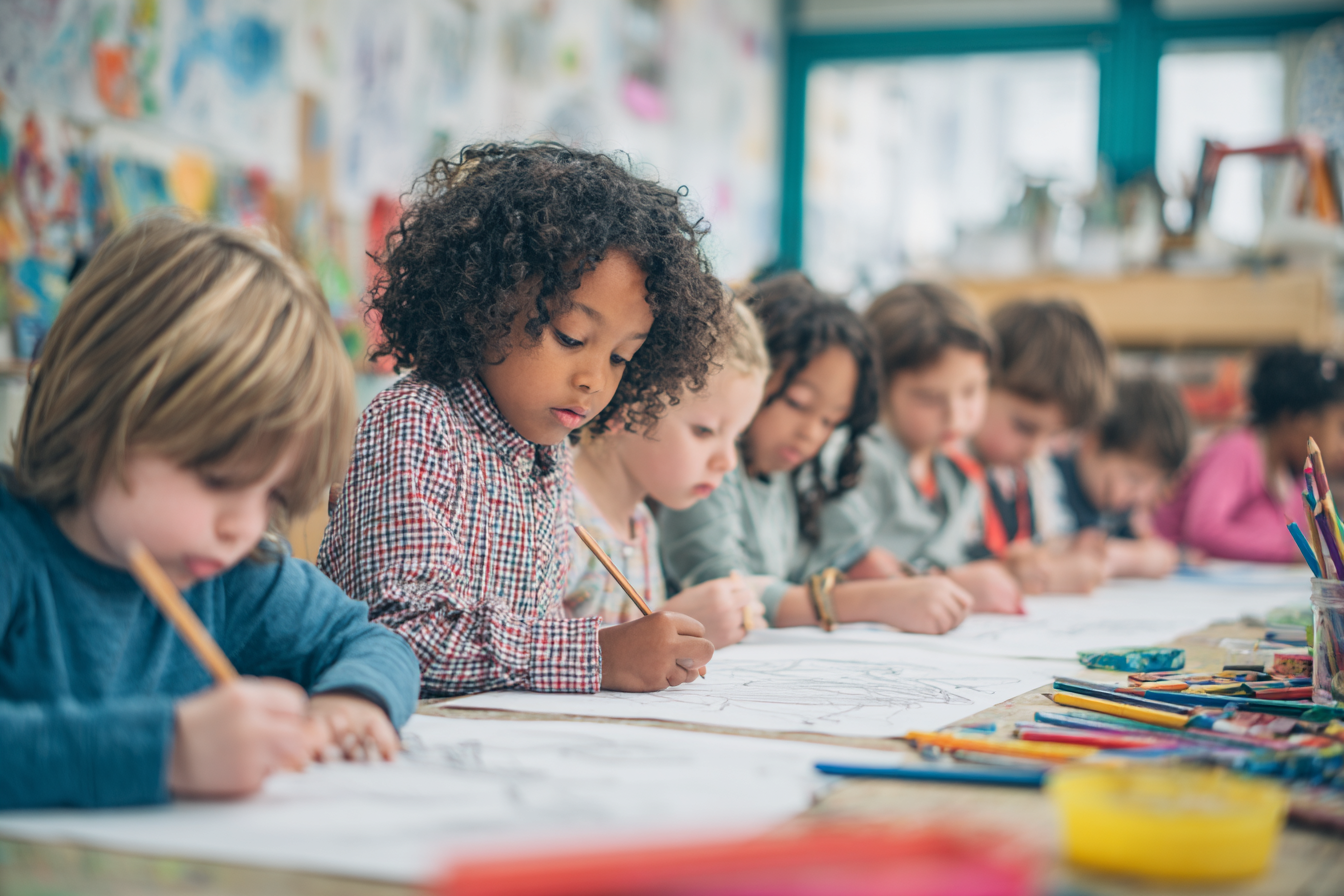
Focus: Create artwork inspired by personal experiences and imagination, and begin to explain how pictures connect to students’ own lives and ideas.
Grade Level: 1
Subject Area: Art (Visual Arts • Connecting • Creating)
Total Unit Duration: 1–3 weeks, 45–60 minutes per session
I. Introduction
In this unit, first graders explore their “artistic world” by making pictures about things they know and things they imagine. They think about people, places, and activities from real life—family, home, playground, school—as well as imaginary ideas like made-up animals or magic places. Students learn that artists can use both memories and imagination to create artwork. They practice saying, in simple words, what their picture shows and how it connects to their life or their ideas. By the end, students see themselves as artists who can think of ideas, put them on paper, and talk about what they created.
Essential Questions
- Where do artists get ideas for their artwork?
- How can my art show things from my real life and from my imagination?
- What does it mean to make art about my world—people, places, and ideas that matter to me?
- How can I use simple words to tell someone what my picture shows and why I made it?
II. Objectives and Standards
Learning Objectives — Students will be able to:
- Think of art ideas based on personal experiences (family, home, school, activities) and imagination (made-up animals, places, or stories).
- Choose one idea for a “My Artistic World” picture that mixes real and/or imaginary elements.
- Create an artwork that shows at least one real person, place, or activity or one imaginary idea that is important to them.
- Use simple sentence starters to explain what their picture is about and how it connects to their life or imagination.
- Share their artwork with classmates, listening and responding kindly to others’ stories and ideas.
Standards Alignment — 1st Grade (NCAS-Aligned)
- VA:Cn10.1a — Create artwork inspired by personal experiences and explain those connections.
- Example: Students draw a family event and describe it.
- VA:Cr1.1a — Generate artistic ideas based on imagination, stories, and personal experiences.
- Example: Students draw a picture of an imaginary animal.
Success Criteria — Student Language
- I can think of art ideas from my life and from my imagination.
- I can make a picture that shows something from my world—real or pretend.
- I can use simple words to tell what my picture is about.
- I can say how my art is connected to my life or my ideas.
- I can listen to other artists and respond with kind words.
III. Materials and Resources
Tasks & Tools (teacher acquires/curates)
- Idea images and prompts (photos or drawings) showing:
- Families, homes, playgrounds, classrooms, pets, neighborhood.
- Imaginary creatures, fantasy places, fairy tales, storybook settings.
- Chart paper for an “Idea Bank” that lists:
- “From My Life” (family, home, school, favorite place, favorite game).
- “From My Imagination” (made-up animal, magic place, superhero, silly machine).
- Drawing paper or cardstock for final “My Artistic World” artworks.
- Pencils, crayons, colored pencils, markers.
- Optional: collage materials (scrap paper, magazines, glue sticks) for students who benefit from cutting and gluing.
- Simple oral reflection cards or posters with sentence starters:
- “My picture shows ___.”
- “This is from my life because ___.”
- “I imagined ___.”
Preparation
- Prepare and post an anchor chart:
- “Where Artists Get Ideas” (My Life • My Imagination • Stories).
- Create an “Idea Bank” chart divided into “From My Life” and “From My Imagination.”
- Set out art materials on tables, arranged so students can reach them easily.
- Decide how students will share their work (whole-group share, small groups, or a “mini gallery” walk).
Common Misconceptions to Surface
- “Art has to be perfect or look like a grown-up’s.” → Art is about ideas, effort, and expression, not about being perfect.
- “Art can only be about real things.” → Art can show both real and imaginary things.
- “My idea is silly or wrong.” → All appropriate ideas are welcome; different ideas make art interesting.
- “If my picture doesn’t look like someone else’s, it is bad.” → Every artist has their own style and story.
Key Terms (highlight in lessons) idea, imagination, memory, experience, world, story, real, pretend, artist, share
IV. Lesson Procedure
(Each session follows: Launch → Explore/Make → Discuss/Share → Reflect. Timing for a 45–60 minute class.)
Session 1 — Idea Hunting: My Life and My Imagination (Core Session — Addresses Standards: VA:Cn10.1a, VA:Cr1.1a)
Launch (8–10 min)
- Show a few simple artworks or pictures:
- One about a real scene (family at dinner, kids on a playground).
- One about an imaginary scene (flying animals, magic castle).
- Ask:
- “Which picture looks like it could happen in real life?”
- “Which picture looks like it comes from someone’s imagination?”
- Introduce the chart “Where Artists Get Ideas” and explain that artists can use both memories and imagination.
- Tell students they will be making a picture about their artistic world using ideas from their life, their imagination, or both.
Explore/Make (30–35 min)
- Part A: Idea Bank Brainstorm (VA:Cr1.1a, VA:Cn10.1a)
- As a class, brainstorm ideas for the “Idea Bank” chart:
- “What is something from your life you might draw?”
- “What could you imagine that is made up?”
- Teacher writes or draws simple icons for student suggestions in both columns.
- As a class, brainstorm ideas for the “Idea Bank” chart:
- Part B: Idea Choice and Sketch
- Students quietly think about one idea from their life and/or imagination.
- They share with a partner:
- “I might draw ___ from my life” or “I might draw ___ from my imagination.”
- Students make a light pencil sketch of their idea on their final paper (or separate sketch paper, if preferred).
Discuss/Share (5–7 min)
- Invite a few students to share what they are planning to draw:
- “My picture is going to show ___ from my life.”
- “My picture will show ___ from my imagination.”
- Celebrate the variety of ideas.
Reflect (3–5 min)
- Quick prompt (spoken, with optional drawing):
- “Today, I thought of an art idea about ___ (life or imagination).”
Optional Session 2 — Creating “My Artistic World” Picture
Launch (5–7 min)
- Review the “Where Artists Get Ideas” chart and the “Idea Bank.”
- Remind students:
- “Your picture can show your world—things you do, people you love, places you go, or things you imagine.”
- Model adding at least one real and/or imaginary detail to a simple sketch.
Explore/Make (25–30 min)
- Step 1: Finish Drawing (VA:Cr1.1a, VA:Cn10.1a)
- Students continue or redraw their “My Artistic World” picture, adding:
- People, animals, or characters.
- Place or setting (indoors, outdoors, pretend world).
- A few helpful details (objects, weather, background).
- Students continue or redraw their “My Artistic World” picture, adding:
- Step 2: Add Color
- Students use crayons, colored pencils, or markers to add color, trying to:
- Color with care.
- Show the mood of their idea (bright, calm, etc.), if appropriate.
- Teacher circulates, asking:
- “What part shows something from your life?”
- “What part shows something from your imagination?”
- Students use crayons, colored pencils, or markers to add color, trying to:
Discuss/Share (10–12 min)
- In pairs, students show their work-in-progress and say:
- “My picture shows ___ from my life.”
- “I imagined ___.”
- Partners give one kind comment:
- “I like how you drew ___.”
Reflect (3–5 min)
- Prompt (spoken or drawn):
- “One part of my picture that is important to me is ___.”
Optional Session 3 — Sharing Our Artistic Worlds
Launch (5–7 min)
- Explain that students will share their pictures like real artists in a mini gallery.
- Teach simple sentence starters on a chart:
- “My picture shows ___.”
- “This is from my life because ___.”
- “I imagined ___.”
Explore/Make (25–30 min)
- Step 1: Set Up a Mini Gallery (VA:Cn10.1a, VA:Cr1.1a)
- Place student artworks around the room (on desks or walls).
- Students walk quietly, looking at classmates’ pictures.
- Step 2: Artist Talks
- In a small group or whole class, each child holds up their picture and shares:
- What their picture shows.
- Whether it comes from their life, their imagination, or both.
- Teacher supports students who need help with words.
- In a small group or whole class, each child holds up their picture and shares:
Discuss/Share (10–12 min)
- Ask the class:
- “What are some things you learned about your classmates’ worlds?”
- “Did you see any ideas that were similar or different from yours?”
Reflect (3–5 min)
- Whole-class prompt:
- “I am an artist who likes to make pictures about ___.”
V. Differentiation and Accommodations
Advanced Learners
- Encourage them to include both a real part and an imaginary part in the same picture (e.g., family at home plus a dragon in the backyard).
- Invite them to add a short written label or simple sentence describing their idea.
- Challenge them to explain why they chose their idea:
- “I chose this because it is special to me when ___.”
Targeted Support
- Provide a simple choice board with pictures (family, pet, playground, home, castle, flying animal, magic garden).
- Offer clear sentence frames:
- “My picture shows ___.”
- “This is from my life because ___.”
- “I imagined ___.”
- Work with a small group to rehearse their artist statements verbally before the share time.
- Allow drawing-only “planning” before any talking, so shy students feel ready.
Multilingual Learners
- Use a visual word bank with pictures and words (family, home, pet, school, imagine, dream, pretend).
- Encourage students to first talk about their idea in their home language, then help them say a shorter sentence in English.
- Accept labeled drawings or a mix of languages to explain their picture.
- Model and have students repeat short phrases:
- “My art shows ___.”
- “From my life.” / “From my imagination.”
IEP/504 & Accessibility
- Provide larger paper, thicker crayons, or adapted grips as needed.
- Break tasks into short steps:
- Step 1: Choose an idea.
- Step 2: Draw the biggest shapes.
- Step 3: Add one or two details.
- Step 4: Add color.
- Allow students to describe their picture orally, with an adult or peer scribing if needed.
- Give extra time and quiet space for students who are easily overwhelmed.
VI. Assessment and Evaluation
Formative Checks (each session)
- Session 1 — Idea Bank responses and sketching show students generating ideas from personal experiences and imagination.
- Optional Session 2 — In-progress artworks show students developing chosen ideas into images that reflect their life and/or imagination.
- Optional Session 3 — Artist talks and gallery walk discussions show students explaining, in simple language, what their artwork is about and where the idea came from.
Summative — “My Artistic World” Artwork & Reflection Task (0–2 per criterion, total 10)
- Idea Generation (VA:Cr1.1a)
- 2: Student clearly uses ideas from personal experiences, imagination, or both to plan their artwork.
- 1: Student chooses an idea with some prompting but has difficulty connecting it to experiences or imagination.
- 0: Student is unable to select or describe an idea, even with support.
- Connection to Personal Experience or Imagination (VA:Cn10.1a)
- 2: Student can explain in simple words how their picture shows something from their life and/or imagination.
- 1: Student gives a very general or unclear explanation of what the picture is about.
- 0: Student cannot explain any connection, even with prompting.
- Visual Expression of Idea
- 2: Artwork includes recognizable people, places, or characters that match the student’s described idea.
- 1: Artwork has some connection to the idea, but it is hard to see without explanation.
- 0: Artwork does not clearly relate to any stated idea.
- Engagement and Effort
- 2: Student stays with the task, adds multiple elements or details, and shows clear effort in drawing and coloring.
- 1: Student participates but rushes or adds minimal detail.
- 0: Student does not engage meaningfully, even with support.
- Sharing and Listening
- 2: Student shares at least one sentence about their artwork and listens respectfully while others share.
- 1: Student shares briefly or needs help sharing and listens some of the time.
- 0: Student does not share or listen respectfully, even with reminders.
Feedback Protocol (TAG)
- Tell one strength (e.g., “You had a great idea from your life and drew your family clearly.”).
- Ask one question (e.g., “What part of your picture did you imagine?”).
- Give one suggestion (e.g., “Next time, you could add one more detail to show where this is happening.”).
VII. Reflection and Extension
Reflection Prompts
- What is one idea from your life that you liked drawing?
- What is one thing from your imagination that you liked drawing?
- How did it feel to share your artistic world with the class?
- What kind of picture would you like to make next time about your world?
Extensions
- Class “Artistic World” Mural: Combine small drawings from each student into one large mural showing everyone’s real and imaginary ideas together.
- Story Time Connection: After reading a favorite story, students add a new page showing themselves inside the story world.
- Family Connections: Send a small reflection page home where students draw themselves making art and families write or dictate a short note: “We see ___ in your artistic world.”
Standards Trace — When Each Standard Is Addressed
- VA:Cn10.1a — Session 1 (brainstorming ideas from personal experiences and adding them to the Idea Bank), Optional Session 2 (creating “My Artistic World” pictures that show real people, places, or activities from students’ lives), Optional Session 3 (artist talks that explain how their artwork connects to their own experiences).
- VA:Cr1.1a — Session 1 (generating artistic ideas from imagination, stories, and personal experiences), Optional Session 2 (developing chosen ideas into drawings that blend real and imagined elements), Optional Session 3 (sharing and discussing how imaginative choices shaped their artwork).