Unit Plan 1 (Grade 3 Art): Artistic Identity & Interests
Grade 3 art unit where students explore personal experiences and interests, brainstorm and sketch ideas, create an “About Me” artwork, and set artistic goals.

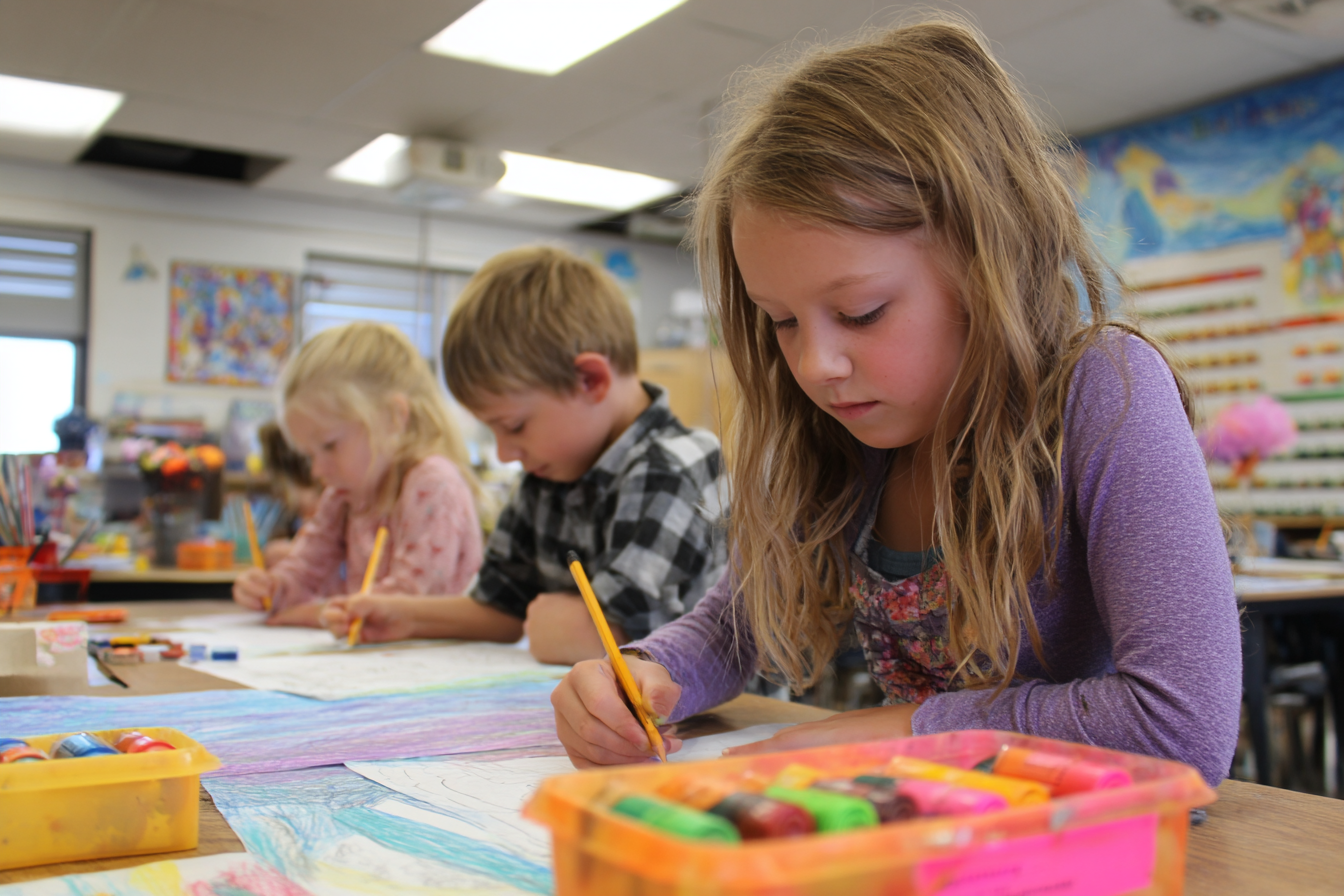
Focus: Explore personal experiences, interests, and beginning artistic goals for the year while generating simple art ideas through brainstorming and sketching.
Grade Level: 3
Subject Area: Art (Visual Arts • Connecting/Creating)
Total Unit Duration: 1–3 weeks, 50–60 minutes per session
I. Introduction
In this unit, students begin to see themselves as artists with their own stories, interests, and ideas. Through guided discussion, simple drawing prompts, and sketching practice, they explore what they like to do, where they like to be, and who is important to them—and learn how these experiences can inspire artwork. Students create a small “About Me as an Artist” piece and set one or two simple art goals for the year, building ownership and excitement for future projects.
Essential Questions
- Who am I as an artist, and what kinds of things do I like to draw, paint, or make?
- How can my personal experiences, memories, and interests give me ideas for artwork?
- How does brainstorming and sketching help me plan what to create?
- What is one art goal I have for myself this year in Grade 3?
II. Objectives and Standards
Learning Objectives — Students will be able to:
- Share personal experiences, interests, and favorite places or activities as possible art ideas.
- Generate several simple sketches based on their own stories, observations, or interests.
- Create an “About Me as an Artist” artwork that shows at least one personal experience or interest.
- Describe in simple language how their artwork is connected to their real life.
- Identify at least one art goal for the year (e.g., “I want to get better at drawing animals,” “I want to use more color”).
Standards Alignment — 3rd Grade (NCAS-Aligned)
- VA:Cn10.3a — Create artwork inspired by personal experiences and describe those influences.
- Example: Students create artwork based on a memorable event.
- VA:Cr1.3a — Generate artistic ideas by exploring observations, stories, and personal interests through brainstorming and sketching.
- Example: Students sketch ideas for artwork based on a favorite place.
Success Criteria — Student Language
- I can tell about my life and interests and use them as ideas for art.
- I can make brainstorm sketches to try different ideas before I choose one.
- I can create an artwork that shows something true about me (a memory, favorite place, or interest).
- I can explain in simple words how my artwork is connected to my real experiences.
- I can name at least one art goal I have for this year in Grade 3.
III. Materials and Resources
Tasks & Tools (teacher acquires/curates)
- Drawing paper or sketchbook pages for brainstorming.
- Heavier paper or special “final” paper for the “About Me as an Artist” piece.
- Basic drawing and coloring supplies:
- Pencils, erasers.
- Crayons, colored pencils, markers.
- Optional: watercolor sets, oil pastels for simple color washes or accents.
- Visual prompts:
- Picture cards or slide images of places, activities, animals, family moments, etc.
- Teacher sample of a simple “About Me as an Artist” artwork with a short written note.
- Graphic organizers:
- “My Interests & Experiences” brainstorming sheet (favorite places, people, activities, things).
- Simple “Art Goal” mini-sheet (“This year in art I want to…”).
- Anchor charts:
- “Where Do Art Ideas Come From?” (memories, interests, stories, imagination, observations).
- “Brainstorm & Sketch” (many small ideas before choosing one).
- “About Me as an Artist” (what I like, what I want to get better at).
Preparation
- Prepare individual brainstorm sheets for students to list or draw interests/experiences.
- Model a quick brainstorm page with 4–6 tiny sketches from your own “life as an artist.”
- Decide how final “About Me as an Artist” artworks will be stored or displayed (portfolio or small bulletin board).
- Set up materials so students can easily move from sketching to final drawing/coloring.
Common Misconceptions to Surface
- “Art ideas have to be made up or pretend only.” → Art can come from real life as well as imagination.
- “If my idea is simple (like my favorite park), it doesn’t count.” → Simple, real experiences can make strong, meaningful artwork.
- “I have to make my art look like someone else’s.” → Each artist has their own interests and style; it’s okay to be different.
- “Brainstorming is a waste of time.” → Sketching ideas helps find stronger, clearer artwork plans.
Key Terms (highlight in lessons) artist, personal experience, interest, memory, brainstorm, sketch, idea, goal, identity, story
IV. Lesson Procedure
(Each session follows: Launch → Explore/Make → Discuss/Share → Reflect. Timing for a 50–60 minute class.)
Session 1 — Who Am I as an Artist? (Core Session — Addresses Standards: VA:Cn10.3a, VA:Cr1.3a)
- Launch (8–10 min)
- Ask: “What kinds of things do you like to draw or make when you have free time?”
- Record answers (animals, video game characters, sports, family, nature, etc.) on chart paper.
- Introduce the idea of artistic identity: “Your artistic identity is who you are as an artist—what you like, what you care about, and what you enjoy making.”
- Show a simple teacher sample: an artwork about a favorite place or memory with a short note explaining it.
- Explore/Make (30–35 min)
- Part A — Personal experiences & interests brainstorm (VA:Cn10.3a):
- Students receive the “My Interests & Experiences” sheet.
- They draw or write quick ideas in boxes such as:
- Favorite place
- Favorite thing to do
- Important person or pet
- A strong memory (happy, exciting, peaceful, etc.)
- Encourage drawing little symbols or tiny pictures, not big detailed art yet.
- Part B — Idea sketches (VA:Cr1.3a):
- On the back of the sheet or in sketchbooks, students create 4–6 small sketches based on their brainstorm (about the size of sticky notes).
- Prompts: “Try one sketch of your favorite place,” “One of a favorite activity,” “One of a memory.”
- Teacher circulates, asking questions like: “Which sketch feels most like you? Which could you turn into a bigger artwork?”
- Part A — Personal experiences & interests brainstorm (VA:Cn10.3a):
- Discuss/Share (5–7 min)
- In pairs, students show 1–2 sketches and explain what experience or interest inspired each one.
- List a few examples on the board: “This sketch is about ___ (experience/interest).”
- Reflect (3–5 min)
- Quick write or quick draw:
- “Today I realized I like to make art about ___ because ___.”
- Quick write or quick draw:
Optional Session 2 — Creating “About Me as an Artist” Artwork (Extension — Deepen Standards: VA:Cn10.3a, VA:Cr1.3a)
- Launch (5–7 min)
- Review brainstorm charts and sketches from Session 1.
- Explain: “Today we’ll choose one idea from our sketches to create a bigger, more detailed piece that shows something true about us as artists.”
- Explore/Make (30–35 min)
- Part A — Planning the composition:
- Students choose one favorite sketch to develop into their “About Me as an Artist” artwork.
- On the final paper, they lightly redraw the main idea, thinking about where to place big shapes and people/objects.
- Part B — Adding details and color (VA:Cn10.3a):
- Students add details that help tell the story of their experience or interest (background objects, setting clues, facial expressions, etc.).
- They add color with crayons, markers, or colored pencils, working toward careful craftsmanship.
- Teacher prompts:
- “What could you add to show where this is?”
- “What details show what you like or how you felt?”
- Part A — Planning the composition:
- Discuss/Share (8–10 min)
- Small table share: each student holds up their in-progress piece and completes a simple sentence:
- “My artwork is about ___ (experience/interest) because ___.”
- Peers give one noticing (e.g., “I can tell you like soccer because the ball and field are big and clear.”).
- Small table share: each student holds up their in-progress piece and completes a simple sentence:
- Reflect (3–5 min)
- Students write one short sentence on the back of their paper:
- “This artwork shows who I am as an artist because ___.”
- Students write one short sentence on the back of their paper:
Optional Session 3 — Artist Statements & Goals for the Year (Extension — Solidify Standards: VA:Cn10.3a, VA:Cr1.3a)
- Launch (5–7 min)
- Explain: “Artists often write a short artist statement to help others understand their work.”
- Show a short example: “My artwork shows my favorite park, where I like to play with my friends. I chose this because being outside makes me feel happy and calm.”
- Explore/Make (25–30 min)
- Part A — Artist statements (VA:Cn10.3a):
- Students receive a simple artist statement template:
- My artwork shows…
- This is important to me because…
- I used… (materials, like markers and colored pencils).
- Teacher or peers can scribe for students who need writing support; drawings plus dictated sentences are allowed.
- Students receive a simple artist statement template:
- Part B — Art goals for the year (VA:Cr1.3a):
- Students complete a small goal card:
- “This year in art, I want to get better at…”
- “I will practice by…”
- Encourage goals related to ideas and skills (e.g., “drawing people better,” “using more background details”).
- Students complete a small goal card:
- Part A — Artist statements (VA:Cn10.3a):
- Discuss/Share (10–12 min)
- Students share their artist statement or goal with a partner or small group.
- Optional: Post goals on a small “Grade 3 Art Goals” board for future reference.
- Reflect (3–5 min)
- Final reflection prompt:
- “One thing I learned about myself as an artist is ___. My goal for this year is ___.”
- Final reflection prompt:
V. Differentiation and Accommodations
Advanced Learners
- Encourage more detailed multi-panel sketches showing different sides of their artistic identity (home, school, hobbies).
- Invite them to include words or symbols in their artwork that stand for deeper interests (e.g., musical notes, team logos, nature symbols).
- Ask advanced students to write a slightly longer artist statement comparing two different interests or experiences in their life.
Targeted Support
- Offer simpler brainstorm options (checklists with pictures) for students who struggle generating ideas.
- Provide drawing prompts like “Draw a place you like to go after school” or “Draw something you love to do with your family.”
- Use sentence frames:
- “My artwork is about ___.”
- “This is important to me because ___.”
- “In art, I want to get better at ___.”
- Allow extra time for sketching and choosing an idea; help students narrow down if they feel overwhelmed.
Multilingual Learners
- Allow students to first discuss or jot brainstorm ideas in their home language, then choose key words to share in English.
- Provide a picture-supported vocabulary sheet (artist, memory, favorite place, goal, etc.).
- Accept bilingual artist statements (home language and English together) as long as some key ideas are understandable.
- Pair students strategically so a peer can help translate or model phrases.
IEP/504 & Accessibility
- Provide adapted drawing tools (chunky crayons, triangle pencils, easy-grip markers).
- Break tasks into clear short steps: “1. Brainstorm, 2. Sketch small ideas, 3. Choose one, 4. Draw bigger, 5. Add color.”
- Offer visual checklists so students can track their progress.
- Allow verbal or recorded artist statements if writing is a barrier; teacher or aide can write down their words.
VI. Assessment and Evaluation
Formative Checks (each session)
- Session 1 — Brainstorm sheets and sketches show students using personal experiences and interests as idea sources.
- Optional Session 2 — In-progress “About Me as an Artist” artworks show clear connection to a real experience or interest, plus growing attention to detail.
- Optional Session 3 — Artist statements and goal cards show students beginning to describe influences and set simple art goals.
Summative — “About Me as an Artist” Piece & Reflection (0–2 per criterion, total 10)
- Personal Connection (VA:Cn10.3a)
- 2: Artwork clearly shows a personal experience, interest, or memory; student can explain the connection.
- 1: Artwork has some personal connection but it is vague or only partly explained.
- 0: Personal connection is unclear or not present.
- Idea Generation (VA:Cr1.3a)
- 2: Student used brainstorming and multiple sketches to choose a strong idea.
- 1: Student did limited sketching or changed ideas without planning.
- 0: No evidence of brainstorming or sketching before final work.
- Craftsmanship & Effort
- 2: Artwork shows careful effort in drawing and coloring; most areas are complete and neat.
- 1: Some care is shown, but there are rushed or unfinished areas.
- 0: Work is very rushed or incomplete with little effort.
- Artist Statement Clarity (VA:Cn10.3a)
- 2: Statement clearly explains what the artwork shows and why it is important to the student.
- 1: Statement is present but very short or unclear.
- 0: No meaningful artist statement.
- Art Goal Setting (VA:Cr1.3a)
- 2: Goal is specific and realistic (e.g., “I want to add more backgrounds,” “I want to practice drawing hands.”).
- 1: Goal is very general (e.g., “get better at art”) or partly unclear.
- 0: No goal given.
Feedback Protocol (TAG)
- Tell one strength (e.g., “Your drawing really shows how much you enjoy playing soccer.”).
- Ask one question (e.g., “Is there another detail you could add to show where this is happening?”).
- Give one suggestion (e.g., “Next time, you could add more color in the background to show the setting.”).
VII. Reflection and Extension
Reflection Prompts
- What kinds of things from your life do you most like to make art about?
- How did brainstorming and sketching help you find a good idea for your final piece?
- What is one art strength you already have, and one thing you want to work on this year?
Extensions
- Artist Identity Collage: Students create a small collage around their drawing using words and pictures (from magazines or hand-drawn) that show their interests.
- Art Goal Bookmark: Students design a bookmark with their art goal written on it to keep in their sketchbook as a reminder.
- Class “Who We Are as Artists” Wall: Display finished artworks with short artist statements so classmates and visitors can see the variety of artistic identities in the room.
Standards Trace — When Each Standard Is Addressed
- VA:Cn10.3a — Session 1 (brainstorming personal experiences and interests as art ideas), Optional Session 2 (creating “About Me as an Artist” artwork showing a real-life connection), Optional Session 3 (artist statements describing why their subject is important).
- VA:Cr1.3a — Session 1 (generating multiple sketches from observations, stories, and interests), Optional Session 2 (choosing and developing one idea into a full artwork), Optional Session 3 (setting specific art goals that guide future idea generation and practice).