Unit Plan 36 (Grade 3 Music): Music Sharing Day
Grade 3 music unit where students perform for peers with expression, accuracy, and proper performance decorum while practicing respectful audience etiquette.

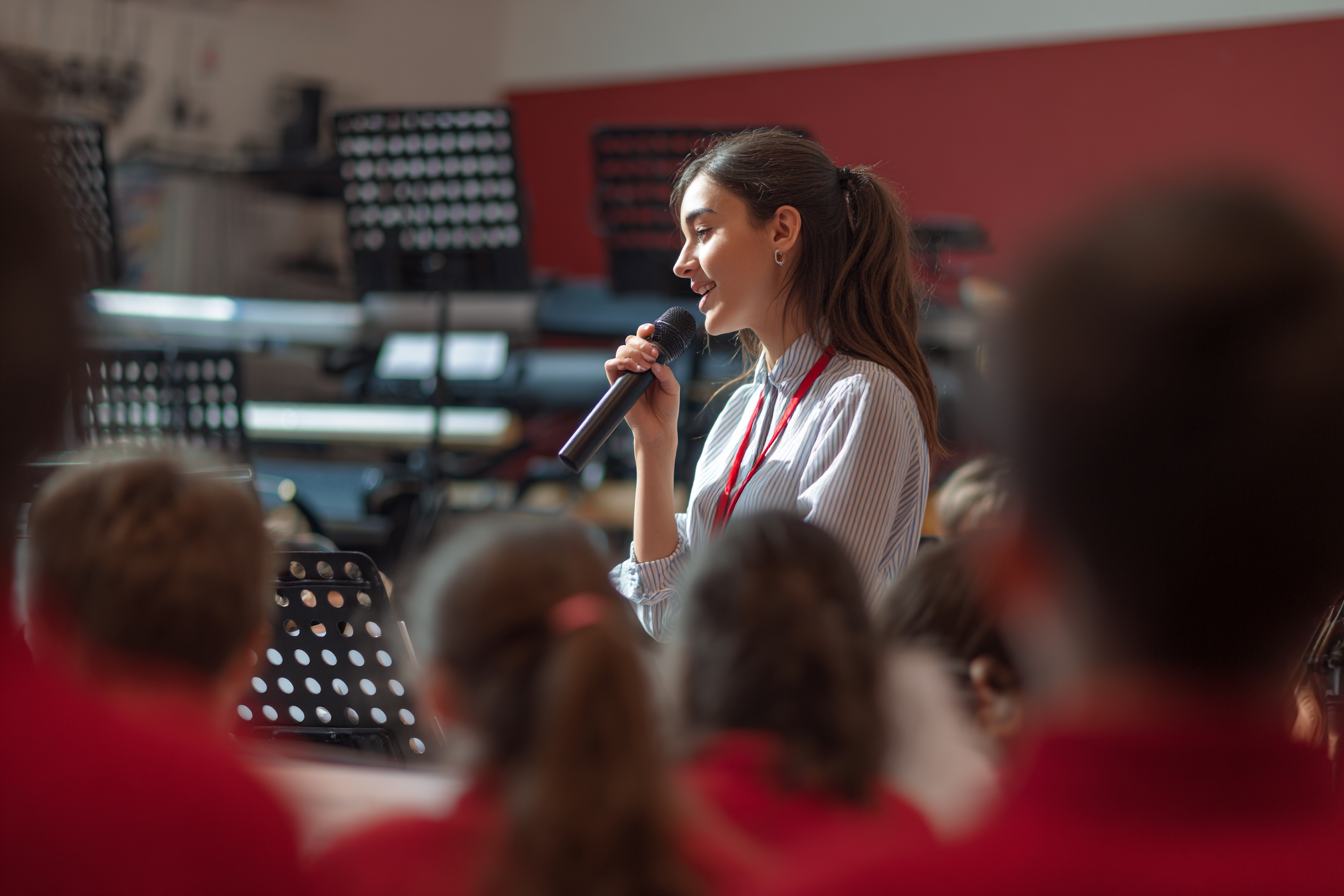
Focus: Perform music for peers with expression, technical accuracy, and appropriate performance decorum and audience etiquette.
Grade Level: 3
Subject Area: Music (Performing • Expression • Decorum)
Total Unit Duration: 1–3 sessions (3+ weeks), 50–60 minutes per session
I. Introduction
In this unit, students participate in a Music Sharing Day, performing for classmates as their audience. They focus on performing with technical accuracy and expression, while also demonstrating proper performance decorum—posture, focus, and respectful behavior on stage—and audience etiquette—quiet listening, appropriate applause, and encouragement. Through guided practice, mini-performances, and a sharing event, students experience what it means to be both a performer and a supportive audience member in a real musical context.
Essential Questions
- What does it mean to perform music with expression and technical accuracy?
- How should performers behave on stage to show proper performance decorum?
- How should an audience behave to show respect for performers and the music?
- How does sharing music with others change the way we prepare and perform?
II. Objectives and Standards
Learning Objectives — Students will be able to:
- Perform a familiar song or piece for classmates with mostly accurate pitch, rhythm, and steady beat.
- Use expressive elements (dynamics, tempo, tone, facial energy) to communicate the character of the music.
- Demonstrate appropriate performance decorum while entering, performing, and exiting the performance area.
- Demonstrate appropriate audience etiquette, including attentive listening, silence during performances, and supportive applause.
- Reflect on their experience as both performer and audience member, naming one strength and one goal.
Standards Alignment — Grade 3 Music (NAfME-Aligned)
- MU:Pr6.1.3a — Perform music with expression and technical accuracy.
- Example: Singing in tune with appropriate dynamics.
- MU:Pr6.1.3b — Demonstrate performance decorum and audience etiquette appropriate to the context and venue.
- Example: Showing proper posture and focus during a concert.
Success Criteria — Student Language
- I can perform my music with mostly correct notes, rhythms, and steady beat.
- I can show expression in my performance using dynamics, tempo, tone, and energy.
- I can show good performance decorum (posture, focus, respectful behavior on stage).
- I can show good audience etiquette (quiet listening, kind applause, no distractions).
- I can say one thing I did well as a performer and one thing I want to improve next time.
III. Materials and Resources
Tasks & Tools (teacher acquires/curates)
- Repertoire & notation
- One or more familiar class performance pieces (songs, instrumental patterns, or simple ensembles).
- Lyric sheets and/or notation for each piece (projected or printed).
- Optional: backing tracks or simple accompaniments.
- Performance & decorum supports
- Visual cue cards for: “Stand Tall,” “Ready,” “Rest Position,” “Listen,” “Applause.”
- A simple Performance & Audience Behavior chart outlining expectations.
- “Performer & Audience Reflection” sheets for student reflection after sharing.
- Classroom setup
- A designated performance area (front of room, risers, or marked floor space).
- Clear seating or floor spots for the audience.
- Optional recording device to capture performances for later reflection.
Preparation
- Select the piece(s) students will perform on Music Sharing Day (ideally ones they have rehearsed in previous units).
- Prepare and post the Performance & Audience Behavior anchor chart (e.g., “What Performers Do,” “What the Audience Does”).
- Plan the order of performances (whole class, sections, small groups, or featured parts).
- Decide whether another class, teacher, or staff member will be invited as a guest audience.
Common Misconceptions to Surface
- “If I’m not singing/playing, I don’t have to pay attention.” → Audience members have an important job too.
- “Performing means being silly on stage.” → Performance decorum means showing respect for the music, audience, and yourself.
- “If I’m nervous, I can’t do a good job.” → Many performers feel nervous; good preparation and focus help us succeed anyway.
- “Clapping or talking during a performance is okay if I’m excited.” → Excitement is great, but we show it with proper applause at the right time.
Key Terms (highlight in lessons) performance, expression, technical accuracy, decorum, audience etiquette, posture, focus, applause, nerves, confidence
IV. Lesson Procedure
(Each session is designed for a 50–60 minute class period.)
Session 1 — Setting Up Music Sharing Day (Pr6.1 & Pr6.1)
- Launch (8–10 min)
- Ask: “Have you ever been to a concert or seen a performance? What did the performers and the audience do?”
- List student ideas under two headings on the board:
- “Performers Do…” (stand still, focus, sing/play, bow).
- “Audience Does…” (listen, stay quiet, clap at the end).
- Introduce Music Sharing Day and explain that the class will prepare to perform and listen like real concert musicians.
- Explore, Part A: Performance & Audience Expectations (10–12 min)
- Present the Performance & Audience Behavior chart.
- Discuss performance decorum: posture, still hands, eyes on conductor, quiet between songs, respectful bow or acknowledgement.
- Discuss audience etiquette: no talking during performances, watching performers, clapping at the right times. (MU:Pr6.1.3b).
- Explore, Part B: Reviewing the Music (12–15 min)
- Sing or play the main sharing piece(s) as a whole class (review from previous units).
- Ask students to listen for:
- Accuracy (notes, rhythms, entrances).
- Expression (dynamics, tone, energy). (MU:Pr6.1.3a).
- After the run-through, briefly identify one strength and one area to polish as a class.
- Explore, Part C: Practice with Decorom & Expression (10–12 min)
- Run a short segment of the piece focusing on:
- Standing and entering in performance positions.
- Singing/playing with expression (soft vs. loud, smooth vs. accented).
- Practice ending the piece, staying still, and then bowing or acknowledging the audience as a group.
- Switch roles briefly:
- Half the class performs; half acts as audience, following etiquette. Then switch.
- Run a short segment of the piece focusing on:
- Discuss (5–7 min)
- Ask:
- “What did performers do today that showed good decorum?”
- “What did audience members do that made it easier to perform?”
- Ask:
- Reflect (3–5 min)
- Quick write or discussion:
- “On Music Sharing Day, I will show I am a good performer by __, and a good audience member by __.”
- Quick write or discussion:
Optional Session 2 — Dress Rehearsal & Peer Sharing (Pr6.1 & Pr6.1)
- Launch (5–7 min)
- Review the Performance & Audience Behavior chart.
- Explain that this session is a dress rehearsal—a practice that feels like the real thing.
- Explore, Part A: Warm-Up & Final Polishing (10–12 min)
- Do a quick warm-up emphasizing:
- Posture and breathing.
- Expressive singing/playing (crescendo, decrescendo, tempo control).
- Run through any previously identified tricky sections, focusing on both accuracy and expression.
- Do a quick warm-up emphasizing:
- Explore, Part B: Small-Group or Section Performances (15–18 min)
- Divide the class into small groups or sections (by row, voice part, or instrument group).
- Each group:
- Walks to the performance area demonstrating performance decorum.
- Performs the assigned portion of the song/piece.
- Returns to their seats quietly.
- While each group performs, the rest of the class practices audience etiquette. (MU:Pr6.1.3b).
- Explore, Part C: Class Run-Through (10–12 min)
- Reassemble as a full ensemble and perform the entire piece as if it were Music Sharing Day:
- Enter, perform, and exit using all expectations for decorum and expression. (MU:Pr6.1.3a & MU:Pr6.1.3b).
- Reassemble as a full ensemble and perform the entire piece as if it were Music Sharing Day:
- Discuss (5–7 min)
- As a class, answer:
- “What went well in our dress rehearsal?”
- “What is one small thing we can still improve before Music Sharing Day (e.g., starting together, holding the last note)?”
- As a class, answer:
- Reflect (3–5 min)
- Students complete a short prompt:
- “As a performer, I feel ready to __. I still want to remember to __.”
- Students complete a short prompt:
Optional Session 3 — Music Sharing Day (Pr6.1 & Pr6.1)
- Launch (5–7 min)
- Welcome students to Music Sharing Day.
- Briefly review that today is about sharing music, doing their best, and supporting each other as performers and audience members.
- Explore, Part A: Final Preparation (8–10 min)
- Have students quietly practice starting position, posture, and mental focus.
- Remind them:
- “If you feel nervous, take a deep breath and think about all the rehearsals that prepared you.”
- Explore, Part B: Performances for Peers (20–25 min)
- Depending on your plan:
- The whole class performs one or more pieces for another class, a guest, or for themselves acting as a formal audience.
- Optionally, include a small-group feature or solo if already prepared.
- Throughout:
- Performers show technical accuracy and expression to the best of their ability. (MU:Pr6.1.3a).
- Performers and audience show decorum and etiquette (quiet while others perform, respectful applause at the end). (MU:Pr6.1.3b).
- Depending on your plan:
- Explore, Part C: Appreciation & Peer Comments (5–7 min)
- After main performances, allow a few short, positive comments:
- “I noticed our class stayed together really well on __.”
- “I liked how we got softer at the end of the song.”
- Keep comments focused on musical strengths and respectful language.
- After main performances, allow a few short, positive comments:
- Discuss (5–7 min)
- Whole-class:
- “How did it feel to perform for an audience?”
- “How did it feel to be in the audience and support your classmates?”
- Whole-class:
- Reflect (3–5 min)
- Students complete a Performer & Audience Reflection:
- “As a performer, I am proud of __.”
- “As an audience member, I showed respect by __.”
- “Next time I share music, I want to improve __.”
- Students complete a Performer & Audience Reflection:
V. Differentiation and Accommodations
Advanced Learners
- Invite advanced students to:
- Lead a brief warm-up or help model performance decorum.
- Add extra expressive detail (more nuanced dynamics, phrasing) to featured parts.
- Encourage them to reflect more deeply on interpretation (“How did you show the mood of the piece?”).
Targeted Support
- Provide clear, step-by-step visuals for performance behavior (e.g., 1. Stand, 2. Eyes on teacher, 3. Sing/play, 4. Stay still, 5. Bow).
- Allow students who are especially nervous to perform in a smaller group or from a less front-and-center position.
- Offer sentence stems:
- “I showed good decorum when I __.”
- “I showed good audience etiquette when I __.”
- Practice short “mini-performances” in front of just a few classmates before the full group.
Multilingual Learners
- Use picture icons for performer and audience expectations (standing figure, ear/eye icons, clapping hands).
- Model simple reflection sentences:
- “I was quiet and listened.”
- “I stood tall and sang with a strong voice.”
- Allow them to share reflections orally or with drawings plus a few English words.
- Pair them with supportive classmates to rehearse entrances and exits.
IEP/504 & Accessibility
- Provide flexibility in how students participate:
- Some may sing, some may play instruments, some may help with non-musical roles (e.g., holding cue cards, setting up).
- Allow seating or adaptive posture for students who need it on “stage.”
- Provide enlarged or high-contrast lyrics/notation for performers who need visual support.
- Offer alternative reflection options (e.g., one-on-one verbal reflection, drawing with labels).
VI. Assessment and Evaluation
Formative Checks (ongoing in all sessions)
- Are students:
- Demonstrating improving technical accuracy and expression in rehearsals and performances?
- Following expectations for performance decorum (posture, focus, quiet between pieces)?
- Showing audience etiquette (listening, not interrupting, clapping appropriately)?
- Reflecting on their experience and naming at least one strength and one goal?
Summative — Music Sharing Day Performance Task (0–2 per criterion, total 10)
- Technical Accuracy (MU:Pr6.1.3a)
- 2: Performs with mostly accurate pitch and rhythm, maintaining a steady beat; any errors are minor.
- 1: Some noticeable errors but the piece remains recognizable and mostly together.
- 0: Frequent errors or loss of beat make the performance hard to follow.
- Expression (MU:Pr6.1.3a)
- 2: Uses clear expressive elements (dynamics, tempo, tone, facial energy) that fit the character of the piece.
- 1: Some expressive intent is present, but mostly remains at one level.
- 0: Little or no visible expression.
- Performance Decorum (MU:Pr6.1.3b)
- 2: Demonstrates appropriate posture, focus, and respectful behavior during entrance, performance, and exit.
- 1: Mostly appropriate behavior with minor lapses (e.g., small fidgets) that do not seriously disrupt the performance.
- 0: Frequent off-task behaviors (talking, fidgeting, distracting others) during performance.
- Audience Etiquette (MU:Pr6.1.3b)
- 2: As an audience member, consistently listens quietly, watches performers, and claps at appropriate times.
- 1: Generally respectful but needs occasional reminders.
- 0: Disruptive or inattentive behavior during others’ performances.
- Reflection on Performance & Role
- 2: Clearly identifies at least one strength and one realistic goal as both performer and/or audience member.
- 1: Reflection is present but general or incomplete (only strength or only goal).
- 0: No meaningful reflection offered.
Feedback Protocol (TAG)
- Tell one strength (e.g., “Your class stayed very focused and together during the last chorus.”).
- Ask one question (e.g., “How did you handle feeling nervous on stage?”).
- Give one suggestion (e.g., “Next time, try holding the last note just a little longer for a stronger ending.”).
VII. Reflection and Extension
Reflection Prompts
- What did you learn about yourself as a performer during Music Sharing Day?
- What did you learn about yourself as an audience member?
- How did our class show that we respect music, each other, and our audience?
- What will you remember the next time you perform for others—in music class or outside of school?
Extensions
- Family or School Sharing: If possible, repeat or adapt the performance for families or another class, using the same expectations.
- Performance Review Journal: Have students write or draw a short “concert review” of their own class performance, focusing on decorum and expression.
- Cross-Curricular Link: Connect to social-emotional learning by discussing how supporting others and handling nerves during performances relates to other parts of life (sports events, class presentations).
Standards Trace — When Each Standard Is Addressed
- MU:Pr6.1.3a — Session 1 (class run-throughs focusing on accuracy and expression), Optional Session 2 (small-group and full-class dress rehearsals), Optional Session 3 (Music Sharing Day performances for peers).
- MU:Pr6.1.3b — Session 1 (introducing and practicing performance decorum and audience etiquette), Optional Session 2 (dress rehearsal behavior as performers and audience), Optional Session 3 (demonstrating decorum and etiquette during Music Sharing Day performances).