Unit Plan 36 (Grade 4 Art): Reflection & Artistic Growth Analysis
Grade 4 art unit where students reflect on artistic growth, connect artwork to personal experiences, evaluate craftsmanship, composition, and clarity, and set goals for Grade 5.

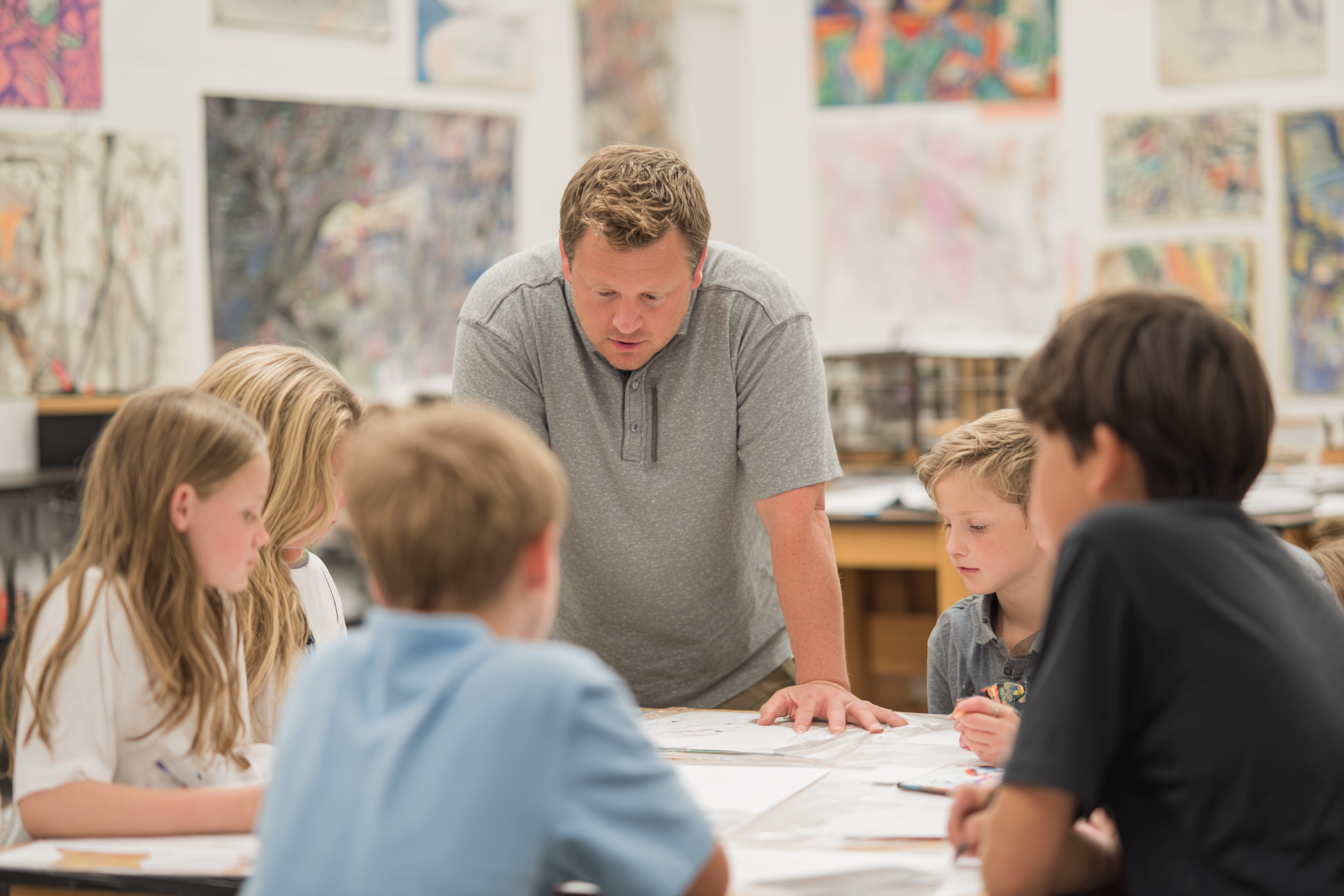
Focus: Reflect on artistic development across the year, connect artwork to personal experiences and interests, and evaluate work using simple craftsmanship, composition, and clarity criteria to prepare for Grade 5.
Grade Level: 4
Subject Area: Art (Visual Arts • Connecting/Responding)
Total Unit Duration: 1–3 weeks, 50–60 minutes per session
I. Introduction
In this unit, students look back over their year of artwork to see how they have grown as artists and how their personal experiences and interests have shaped what they created. Using simple criteria—craftsmanship, composition, and clarity of idea—they evaluate selected pieces, noticing patterns in their work and areas of improvement. Students then create a short reflection artifact (written, visual, or a mix) that summarizes their artistic journey and sets goals for Grade 5 art, helping them step into the next year with confidence and purpose.
Essential Questions
- How has my artwork changed and improved over this year?
- In what ways do my interests, experiences, and feelings show up in the art I make?
- How can simple criteria like craftsmanship, composition, and clarity help me evaluate my own artwork fairly?
- What strengths and next steps do I see as I get ready for Grade 5 art?
II. Objectives and Standards
Learning Objectives — Students will be able to:
- Review a selection of their own artworks and identify evidence of growth in skills (craftsmanship, composition, detail).
- Describe how at least one artwork was inspired by a personal experience, interest, or feeling, and explain that influence in simple terms.
- Use a basic evaluation checklist (craftsmanship, composition, clarity) to assess selected pieces.
- Create a short Artistic Growth Reflection (chart, paragraph, or visual organizer) that names strengths and areas for improvement.
- Set at least one specific goal for Grade 5 art connected to what they learned about themselves as artists.
Standards Alignment — 4th Grade (NCAS-Aligned)
- VA:Cn10.4a — Create artwork inspired by personal experiences or interests and describe those influences.
- Example: Students create artwork inspired by a favorite activity.
- VA:Re9.4a — Evaluate artwork using simple criteria such as craftsmanship, composition, and clarity.
- Example: Students use a checklist to assess artwork effectiveness.
Success Criteria — Student Language
- I can find examples in my artwork that show how I have improved this year.
- I can explain how at least one piece of my art was inspired by a real experience, interest, or feeling.
- I can use simple criteria like craftsmanship, composition, and clarity to talk about my work.
- I can create a reflection that clearly shows my art strengths and next steps.
- I can set at least one realistic goal for myself as an artist going into Grade 5.
III. Materials and Resources
Tasks & Tools (teacher acquires/curates)
- Student art portfolios from the year: finished pieces, sketchbook pages, or photos of larger works.
- Evaluation tools:
- Simple Art Checklist with criteria such as:
- Craftsmanship (neatness, control, careful use of materials).
- Composition (organized space, focal point, balance).
- Clarity of idea (can viewers tell what it is or what it’s about?).
- “My Artistic Growth” reflection sheets or graphic organizers (e.g., “Then vs. Now,” “Strengths & Next Steps”).
- Simple Art Checklist with criteria such as:
- Writing and drawing supplies: pencils, erasers, colored pencils, markers.
- Optional reflection formats:
- Blank paper for reflection posters or visual timelines.
- Notecards for short artist statements.
- Anchor charts:
- “What Is Craftsmanship?”
- “What Is Composition?” (focal point, balance, use of space).
- “Clarity of Idea” (can someone tell what you want to show?).
- “How My Life Shows Up in My Art” (interests, memories, feelings).
Preparation
- Organize portfolios so each student can easily access most of their year’s work.
- Prepare printed checklists and “My Artistic Growth” reflection sheets.
- Choose 1–2 sample student or teacher artworks that clearly show beginning vs. later growth (with permission if using student work).
- Decide on a final reflection format (written paragraph, mini-poster, or combination).
Common Misconceptions to Surface
- “If I see mistakes, it means I’m not good at art.” → Seeing mistakes shows you are noticing and growing as an artist.
- “Only perfect-looking art shows growth.” → Growth can show in many ways: risk-taking, more detail, better ideas, and improved effort.
- “My art has nothing to do with my real life.” → Often our interests, hobbies, memories, and feelings slip into what we draw and paint.
- “Evaluation is just judging.” → Evaluation using clear criteria helps us celebrate strengths and plan next steps.
Key Terms (highlight in lessons) reflection, growth, craftsmanship, composition, clarity, criteria, personal experience, interest, influence, goal, self-evaluation
IV. Lesson Procedure
(Each session follows: Launch → Explore/Make → Discuss/Share → Reflect. Timing for a 50–60 minute class.)
Session 1 — Looking Back: Portfolio Review & Growth Noticing (Core Session — Addresses Standards: VA:Cn10.4a, VA:Re9.4a)
- Launch (8–10 min)
- Show two sample artworks (early-year vs. later-year) and ask:
- “What differences do you notice between these two pieces?”
- List possible growth signs: more detail, better coloring, improved composition, clearer idea, more personal connections.
- Explain that students will review their own artwork to look for growth and personal influences.
- Show two sample artworks (early-year vs. later-year) and ask:
- Explore/Make (30–35 min)
- Part A — Portfolio review:
- Students spread out their artworks from across the year.
- They quickly sort them into rough categories (early, middle, later) or by project type.
- Using the anchor charts, students circle or sticky-note places where they see:
- Strong craftsmanship.
- Strong composition.
- Clear ideas or personal connections.
- Part B — Growth noting (VA:Re9.4a, VA:Cn10.4a):
- Students choose 2–3 artworks to focus on (ideally from different times in the year).
- On a simple “Then vs. Now” or “Growth Noticing” sheet, they record:
- Title or description of the piece.
- What they notice about craftsmanship, composition, and clarity.
- Whether it shows a personal experience or interest (and how).
- Part A — Portfolio review:
- Discuss/Share (5–7 min)
- In pairs, students share one artwork and one growth noticing:
- “At the beginning of the year, I…, but now I…”
- In pairs, students share one artwork and one growth noticing:
- Reflect (3–5 min)
- Quick write:
- “One way I have grown as an artist this year is ___. I can see it in this artwork because ___.”
- Quick write:
Optional Session 2 — Evaluating & Writing About Selected Artwork (Extension — Deepen VA:Re9.4a & VA:Cn10.4a)
- Launch (5–7 min)
- Review the Art Checklist and discuss how criteria help us evaluate fairly.
- Model evaluating one sample artwork aloud using the checklist:
- “For craftsmanship, I notice… For composition, I see… For clarity, I think…”
- Explore/Make (30–35 min)
- Part A — Checklist evaluation (VA:Re9.4a):
- Students pick one favorite or important artwork from their portfolio.
- They complete an Art Checklist for that piece, rating or describing:
- Craftsmanship
- Composition
- Clarity of idea
- They mark one strength and one area to improve for each category.
- Part B — Short artist reflection (VA:Cn10.4a, VA:Re9.4a):
- On a reflection sheet or in their sketchbook, students respond to prompts such as:
- “This artwork was inspired by…” (experience, interest, memory, feeling).
- “One thing I did well in this piece is…”
- “One thing I would change or improve if I made it again is…”
- On a reflection sheet or in their sketchbook, students respond to prompts such as:
- Part A — Checklist evaluation (VA:Re9.4a):
- Discuss/Share (8–10 min)
- Small group share: each student reads 1–2 sentences from their reflection.
- Group members listen for mentions of personal influence and criteria words and give one positive comment.
- Reflect (3–5 min)
- Prompt:
- “Using criteria helped me see that my artwork is strong in ___ and needs work in ___. This helps me because ___.”
- Prompt:
Optional Session 3 — Artistic Growth Summary & Grade 5 Goal Setting (Extension — Solidify VA:Cn10.4a & VA:Re9.4a)
- Launch (5–7 min)
- Explain that students will now create a Growth Summary to take their learning into Grade 5 art.
- Show a sample “Artistic Growth” mini-poster or reflection page with sections for strengths, personal influences, and goals.
- Explore/Make (25–30 min)
- Part A — Growth Summary creation:
- Students complete a “My Artistic Growth” sheet or mini-poster that includes:
- “This year, I improved at…” (craftsmanship, composition, idea clarity, or something else).
- “My art was inspired by…” (list of interests, experiences, or feelings).
- “My strongest artwork is…” (with a short explanation why, using criteria words).
- Students complete a “My Artistic Growth” sheet or mini-poster that includes:
- Part B — Grade 5 goal-setting:
- Students write 1–2 specific goals for Grade 5 art, using prompts like:
- “Next year, I want to work on…”
- “I will try to improve my ___ by…”
- Students write 1–2 specific goals for Grade 5 art, using prompts like:
- Part A — Growth Summary creation:
- Discuss/Share (10–12 min)
- Students share their top strength and one goal in a circle or small group.
- Class briefly talks about how these goals show they are ready for the next level of art.
- Reflect (3–5 min)
- Final reflection prompt:
- “The biggest thing I learned about myself as an artist this year is ___. I feel ready for Grade 5 art because ___.”
- Final reflection prompt:
V. Differentiation and Accommodations
Advanced Learners
- Encourage advanced students to:
- Compare two or more artworks in a short paragraph, explaining how their style or thinking changed.
- Identify specific design choices (color schemes, balance, focal point) that show growth.
- Write a longer artist statement that connects multiple artworks to a common theme or personal influence.
Targeted Support
- Provide simplified reflection sheets with sentence starters and visuals.
- Allow students to work with a partner or small group to talk through growth before writing.
- Use visual examples of early vs. later work (teacher or anonymous student samples) to model what “growth” looks like.
- Offer sentence frames such as:
- “I got better at ___ because now I can ___.”
- “This artwork shows my interest in ___ because ___.”
Multilingual Learners
- Allow students to brainstorm reflection ideas in their home language first, then translate key phrases into English with help.
- Provide a picture-supported vocabulary list for key terms (growth, craftsmanship, composition, clarity, goal).
- Accept partially bilingual reflections, focusing on clear ideas rather than perfect grammar.
- Encourage oral sharing with a peer in a shared language before writing.
IEP/504 & Accessibility
- Provide extra time and quiet space for reflection tasks.
- Offer audio options: students can record their reflections or dictate to a peer/teacher who writes them down.
- Break tasks into shorter steps: “Step 1: Choose artworks. Step 2: Circle growth areas. Step 3: Complete two sentence frames.”
- Use large-print checklists and organizers for students with visual needs.
VI. Assessment and Evaluation
Formative Checks (each session)
- Session 1 — Portfolio review notes and growth sheets show students identifying specific examples of improvement and personal influence.
- Optional Session 2 — Checklists and reflections show students using craftsmanship, composition, and clarity criteria to evaluate their own work.
- Optional Session 3 — Growth summaries and goals show students naming strengths and planning realistic next steps for Grade 5 art.
Summative — Artistic Growth Reflection (0–2 per criterion, total 10)
- Recognition of Growth (VA:Re9.4a)
- 2: Clearly identifies at least one area of artistic growth with a concrete example from their artwork.
- 1: Mentions growth in general terms but without a clear example.
- 0: No meaningful recognition of growth is evident.
- Connection to Personal Experience/Interests (VA:Cn10.4a)
- 2: Clearly explains how at least one artwork was inspired by a personal experience, interest, or feeling.
- 1: Mentions a personal connection but it is vague or not clearly tied to specific artwork.
- 0: No personal influence or connection is described.
- Use of Evaluation Criteria (VA:Re9.4a)
- 2: Uses terms like craftsmanship, composition, or clarity correctly when reflecting on artwork.
- 1: Refers to quality or effectiveness but does not clearly use criteria words or uses them incorrectly.
- 0: No evidence of using criteria to evaluate work.
- Quality of Reflection Artifact
- 2: Reflection (written or visual) is clear, organized, and shows thoughtful consideration of strengths and areas to improve.
- 1: Reflection is partly complete or somewhat disorganized but shows some thinking about their art.
- 0: Reflection is missing, extremely minimal, or off-topic.
- Goal Setting for Grade 5
- 2: Sets at least one specific and realistic goal connected to their reflection (e.g., “I want to work on backgrounds by…”).
- 1: Goal is present but very general (e.g., “get better at art”) or not clearly connected to reflection.
- 0: No goal is stated.
Feedback Protocol (TAG)
- Tell one strength (e.g., “You clearly explained how your love of animals shows up in your drawings.”).
- Ask one question (e.g., “Is there another piece that also shows this interest?”).
- Give one suggestion (e.g., “Next year, you might focus on adding more background details to support your main idea.”).
VII. Reflection and Extension
Reflection Prompts
- Which artwork best shows who you are as an artist right now? Why?
- How have your interests and experiences shaped the kinds of things you like to draw, paint, or build?
- What is one art skill you feel proud of, and one you are excited to keep working on in Grade 5?
Extensions
- Artistic Growth Timeline: Students create a visual timeline showing 3–4 artworks from throughout the year and short captions about growth at each point.
- Letter to My Future Artist Self: Students write a short letter to their “Grade 5 self” about what they learned this year and what they hope to do next.
- Growth Gallery Corner: Create a small display showing “early work” vs. “later work” side by side with student-written captions explaining their growth.
Standards Trace — When Each Standard Is Addressed
- VA:Cn10.4a — Session 1 (noticing how personal experiences and interests influenced artworks throughout the year), Optional Session 2 (writing about how a selected artwork was inspired by a real experience or interest), Optional Session 3 (summarizing how their life connects to their art in the growth summary and goals).
- VA:Re9.4a — Session 1 (informal evaluation of portfolios with attention to improvement), Optional Session 2 (using checklists and criteria to evaluate selected pieces), Optional Session 3 (reflecting on strengths and areas to improve using evaluation language in their Artistic Growth Reflection).