Unit Plan 36 (Grade 4 Music): Music Sharing Day
Grade 4 Music Sharing Day unit: students perform with accuracy, expression, and interpretation while practicing performance decorum and respectful audience etiquette.

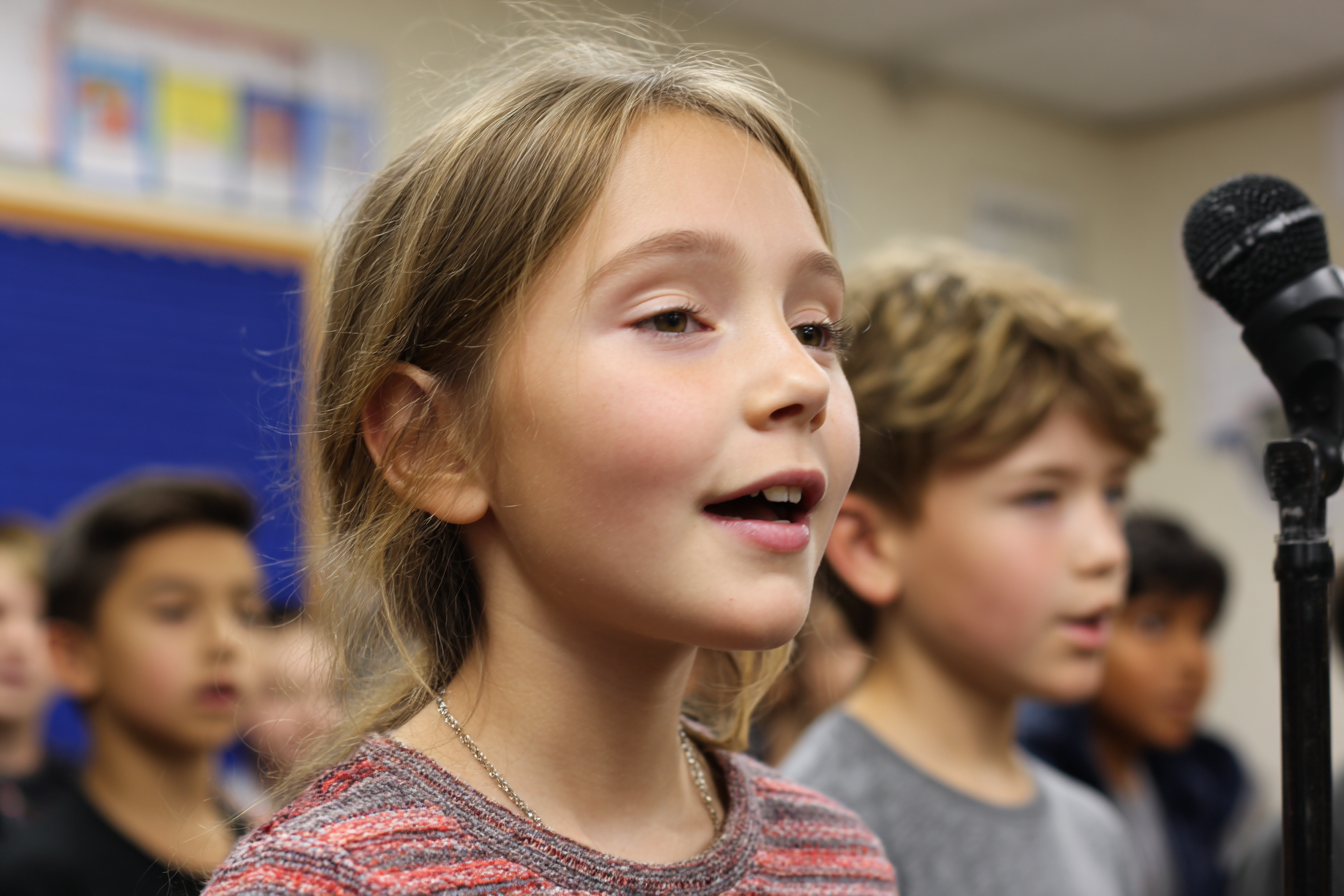
Focus: Perform selected music with expression, technical accuracy, and appropriate interpretation, while demonstrating performance decorum and audience etiquette that fit the context of a class sharing day or informal concert.
Grade Level: 4
Subject Area: Music (Performance • Expression • Concert Skills)
Total Unit Duration: 1–3 sessions (3+ weeks), 50–60 minutes per session
I. Introduction
Students celebrate their year of music learning with a Music Sharing Day. They prepare and present songs, patterns, or short pieces (solo or group) in an informal “mini-concert” setting. Along the way, they review performance expectations (posture, focus, entrances, exits) and audience etiquette (listening, responding, encouraging). They think about how to show confidence and respect for the music, their classmates, and the performance space. The unit blends musical performance with social-emotional skills like poise, supportiveness, and pride in their work.
Essential Questions
- What does it mean to perform with expression, technical accuracy, and interpretation?
- How do we show performance decorum and audience etiquette that fit a class concert or sharing day?
- How can we show confidence and respect when we are performing and when we are listening?
- How can sharing music with others help us reflect on what we have learned this year?
II. Objectives and Standards
Learning Objectives — Students will be able to:
- Prepare and perform selected pieces (songs, instrument patterns, or short ensembles) with mostly correct notes/rhythms, steady tempo, and clear phrasing.
- Use expression (dynamics, articulation, tone, facial expression/body language) to communicate the character of the music.
- Demonstrate appropriate performance decorum (posture, focus, starting/ending together, bowing/acknowledging audience) and audience etiquette (quiet listening, applause at appropriate times).
- Adjust performance choices (expression, volume, space use) to fit the context and venue of a classroom sharing day.
- Reflect on their performance and behavior as performers and audience members, identifying strengths and goals for future performances.
Standards Alignment — Grade 4 Music (NAfME-Aligned)
- MU:Pr6.1.4a — Perform music, alone or with others, with expression, technical accuracy, and appropriate interpretation.
- Example: Performing a song with correct notes, rhythm, and style.
- MU:Pr6.1.4b — Demonstrate performance decorum and audience etiquette appropriate for the context, venue, and genre.
- Example: Showing proper concert behavior when performing or listening.
Success Criteria — Student Language
- I can perform my music with mostly correct notes, rhythms, and a steady beat.
- I can show expression with my voice or instrument (using dynamics, tone, and phrasing) that matches the music.
- I can show good concert behavior when I perform (posture, focus, starting and ending together) and when I listen (quiet, respectful, clapping at the right time).
- I can explain one interpretive choice I made (for example, “We played the ending softly so it felt calm.”).
- I can share one strength of my performance and one goal for next time I perform in front of others.
III. Materials and Resources
Tasks & Tools (teacher acquires/curates)
- Repertoire & performance materials
- A set of class pieces from earlier units (songs, recorder/barred instrument pieces, rhythm ensembles) to choose from for sharing.
- Notation/lyrics for each piece, posted or printed for final rehearsal as needed.
- Optional simple accompaniment tracks or backing patterns.
- Performance space & visuals
- Clear performance area at the front of the room or in a designated space.
- Seating arrangement for audience that encourages focus and respectful listening.
- Anchor charts:
- “Performer Decorum” (enter, posture, focus, perform, acknowledge, exit).
- “Audience Etiquette” (eyes on performers, quiet listening, no side conversations, clap appropriately).
- Reflection & feedback tools
- Simple self-assessment forms for performers (technical accuracy, expression, decorum).
- Short audience checklists for etiquette (for students to self-check afterward).
- Optional TAG feedback slips (Tell–Ask–Give) for peers if time allows.
Preparation
- Select a manageable number of sharing pieces and decide whether students will perform:
- As a whole class,
- In small groups,
- Or with a few optional solos/duets (as appropriate).
- Review and, if needed, lightly rehearse chosen pieces before this unit so class time can focus on polishing and sharing, not learning from scratch.
- Post or prepare “Run of Show” (order of performances) on the board so students can see when they will perform.
- Discuss with students what kind of audience behavior is expected, and how this fits the context of a classroom sharing day.
Common Misconceptions to Surface
- “Music Sharing Day is just for fun; I don’t need to try my best.” → Sharing day is fun and a chance to show our best musical skills and behavior.
- “If I get nervous, it’s okay to laugh or talk during someone else’s performance.” → We manage our nerves while still showing respect to performers.
- “The only thing that matters is not making mistakes.” → Expression, confidence, and decorum also matter a lot.
- “Audience etiquette doesn’t matter because it’s just our class.” → Proper concert behavior is important in any context, big or small.
Key Terms (highlight in lessons) performance, expression, technical accuracy, interpretation, decorum, audience etiquette, context, venue, confidence, posture, applause
IV. Lesson Procedure
(Each session is designed for a 50–60 minute class period.)
Session 1 — Planning & Practicing for Music Sharing Day (All Standards)
- Launch (8–10 min)
- Ask: “What makes a performance feel special and respectful, even in our classroom?”
- Introduce or review the Performer Decorum and Audience Etiquette anchor charts.
- Explain that students will prepare for a Music Sharing Day, where they will perform for classmates and possibly another invited audience (another class, families, or staff, if appropriate).
- Explore, Part A: Choosing Pieces & Reviewing Expectations (15–18 min)
- Present the list of available pieces for sharing (class songs, instrument pieces, rhythm ensembles).
- Decide how students will perform (whole class, small groups, optional solos/duets) and share the order of performances.
- For each piece, briefly review:
- Key technical spots (tricky rhythms, entrances, endings).
- Main expression goals (mood, dynamic plan, style).
- As a class, practice concert entrances and exits:
- Walking on/standing ready.
- Watching for a cue to begin.
- Holding posture until the end and acknowledging applause.
- Explore, Part B: Focused Practice on Performance & Decorum (20–22 min)
- Run each chosen piece as a mini-rehearsal performance:
- Students imagine there is an audience watching.
- Focus on both accuracy and expression, plus posture and focus.
- After each run:
- Ask students to quickly rate themselves on a simple thumbs-up/side/down for accuracy, expression, and decorum.
- Identify one thing to fix or polish (e.g., messy ending, talking between songs, unclear dynamic change) and address it with a quick focused rehearsal.
- Run each chosen piece as a mini-rehearsal performance:
- Discuss (8–10 min)
- Whole-class discussion:
- “What will you do to show confidence even if you feel nervous?”
- “What does respectful audience etiquette look like during others’ performances?”
- Emphasize that both performers and listeners are responsible for making sharing day successful.
- Whole-class discussion:
- Reflect (3–5 min)
- Quick reflection:
- “One thing I will remember to do as a performer is ___. One thing I will remember to do as an audience member is ___.”
- Quick reflection:
Optional Session 2 — Dress Rehearsal & Audience Practice (Reinforcing Standards)
- Launch (5–7 min)
- Announce: “Today is our dress rehearsal for Music Sharing Day.”
- Review key words on the board: expression, accuracy, decorum, audience etiquette.
- Explore, Part A: Full Dress Rehearsal (25–30 min)
- Run the entire program in order like a real performance:
- Performers enter, perform, and exit according to the plan.
- Audience practices etiquette: quiet listening, watching, and clapping only at appropriate times.
- Do not stop for small mistakes; focus on maintaining performance flow.
- Optionally, record the dress rehearsal for later listening.
- Run the entire program in order like a real performance:
- Explore, Part B: Guided Reflection & Quick Fixes (10–12 min)
- After the run-through, have students complete a brief self-assessment:
- Rate themselves on accuracy, expression, decorum, and audience behavior (for when they were listening).
- Ask for specific observations:
- “Our entrances were strong when we… ”
- “We need to work on our endings because…”
- Choose one or two moments to run again, focusing on:
- Clear beginning and ending cues.
- Strong expression in a key section.
- After the run-through, have students complete a brief self-assessment:
- Discuss (5–7 min)
- Ask: “What changes can we make between today’s dress rehearsal and the actual sharing day to feel more ready?”
- Reinforce that performers can be proud and supportive of one another.
- Reflect (3–5 min)
- Exit slip:
- “My main goal for the actual Music Sharing Day is to remember to ___ (musical or decorum goal).”
- Exit slip:
Optional Session 3 — Music Sharing Day & Celebration (Reinforcing Standards)
- Launch (5–7 min)
- Welcome students (and any invited guests) to Music Sharing Day.
- Briefly remind everyone of performance decorum and audience etiquette.
- Explore, Part A: Music Sharing Performances (30–35 min)
- Follow the planned program order.
- For each performance:
- Performers enter, set up, and perform their piece with attention to accuracy, expression, and interpretation.
- Audience listens quietly, then gives appropriate applause at the end.
- Teacher may briefly introduce each piece or let students introduce themselves and/or the music.
- Explore, Part B: Appreciation & Peer Recognition (8–10 min)
- After all performances:
- Invite students to share one positive comment about someone else’s performance (focusing on expression, accuracy, or decorum).
- Optionally, distribute simple “musician compliments” notes or certificates (e.g., “Strong Expression,” “Confident Performer,” “Respectful Listener”).
- After all performances:
- Discuss (5–7 min)
- Whole-class talk:
- “How did we show that we were ready to perform today?”
- “What felt best about sharing music with others?”
- Whole-class talk:
- Reflect (3–5 min)
- Final reflection:
- “One thing I am proud of from Music Sharing Day is ___. One thing I want to remember for future performances is ___.”
- Final reflection:
V. Differentiation and Accommodations
Advanced Learners
- Encourage advanced students to take on leadership roles (e.g., introducing pieces, helping cue entrances, supporting younger/less confident performers).
- Invite them to make more nuanced interpretive choices (e.g., subtle dynamic shaping, phrasing decisions) and explain these choices briefly to the class.
- Offer opportunities for optional solos or small ensemble features with slightly more challenging material where appropriate.
Targeted Support
- Provide simpler performance roles (steady beat parts, simple ostinatos, echo patterns) for students who need accessible entry points.
- Use visual or written checklists for decorum (e.g., picture of standing tall, eyes on teacher, quiet mouth).
- Pre-practice entrances and exits with small groups or individuals who feel anxious, so they know exactly what to do.
- Offer sentence stems:
- “I felt more confident when I ___.”
- “One thing I remembered about audience behavior was ___.”
Multilingual Learners
- Use icons and images on anchor charts (e.g., eye for watching, ear for listening, hand clapping for applause, person standing tall for posture).
- Allow students to rehearse introductions or brief comments about their piece in a mix of home language and English, as appropriate to your setting.
- Provide a simple word bank for reflection (nervous, proud, quiet listening, strong beat, soft/loud, fast/slow).
- Encourage peer support so multilingual learners can model and practice concert behaviors alongside classmates.
IEP/504 & Accessibility
- Adjust performance roles (e.g., seated performance, simplified part, conducting a simple beat) to accommodate physical or emotional needs.
- Provide visual schedules for the order of events so transitions feel predictable.
- Offer a quieter or less public performance option (e.g., performing only for the class rather than additional guests) for students with significant performance anxiety.
- Ensure the performance area is physically accessible and any necessary adaptive equipment is in place.
VI. Assessment and Evaluation
Formative Checks (ongoing in all sessions)
- Performance accuracy & expression — Observe improvements in notes, rhythms, tempo, and expressive details during rehearsals and sharing day.
- Performance decorum — Note posture, focus, starting and ending together, and respectful behavior on stage.
- Audience etiquette — Monitor listening behavior, appropriate applause, and general attentiveness.
- Self-reflection — Review student self-assessments and reflections for awareness of strengths and goals.
Summative — Music Sharing Day Performance & Behavior (0–2 per criterion, total 10)
- Technical Accuracy (MU:Pr6.1.4a)
- 2: Performs with mostly correct notes/rhythms and a steady beat; minor errors do not disrupt the piece.
- 1: Some accuracy but noticeable errors or unstable tempo; piece is still recognizable.
- 0: Frequent errors or unstable beat significantly disrupt the performance.
- Expression & Interpretation (MU:Pr6.1.4a)
- 2: Demonstrates clear expression (dynamics, phrasing, tone, articulation) and an interpretation that fits the character of the music.
- 1: Some expressive choices are present but inconsistent or limited.
- 0: Little or no attention to expression; performance sounds flat or out of character.
- Performance Decorum (MU:Pr6.1.4b)
- 2: Shows appropriate posture, focus, and stage behavior (quiet entry, ready position, staying still during performance, acknowledging applause, calm exit).
- 1: Mostly appropriate decorum with a few lapses (e.g., minor fidgeting, small side comments).
- 0: Frequent decorum issues (talking, distracting behavior, not watching cues) that interfere with the performance.
- Audience Etiquette (MU:Pr6.1.4b)
- 2: Consistently demonstrates respectful audience behavior (quiet listening, appropriate applause, attention to performers) throughout the sharing day.
- 1: Generally respectful but with occasional lapses (whispering, inattention).
- 0: Repeated audience behavior issues that distract from performances.
- Reflection & Personal Growth
- 2: Provides thoughtful reflection, identifying at least one strength and one clear goal related to performance or decorum; uses some musical vocabulary.
- 1: Reflection is present but brief or general; may identify only a strength or only a goal.
- 0: Little or no reflection; cannot articulate strengths or goals.
Feedback Protocol (TAG)
- Tell one strength (e.g., “Your posture and focus made your performance feel very professional.”).
- Ask one question (e.g., “How did you decide on that dynamic change in the middle?”).
- Give one suggestion (e.g., “Next time, try holding the ending a little longer before relaxing to keep the moment special.”).
VII. Reflection and Extension
Reflection Prompts
- How did you feel before, during, and after your performance on Music Sharing Day? What helped you manage any nervous feelings?
- What did you notice about decorum and audience behavior that made the sharing day feel respectful and successful?
- Which part of your performance (accuracy, expression, confidence) are you most proud of?
- How might the performance skills you used today help you in other situations (speaking in class, presenting projects, playing sports, etc.)?
Extensions
- Performance Journal: Have students write a short performance journal entry describing the experience, what they learned, and what they want to remember for future performances.
- Sharing Beyond the Classroom: Record a favorite performance (with appropriate permissions) and share it with families or another class as a way to celebrate students’ work.
- Future Performance Planning: Invite students to imagine or help design a future concert or sharing event (song choices, order, decorum expectations), reinforcing their understanding of context, venue, and etiquette.
Standards Trace — When Each Standard Is Addressed
- MU:Pr6.1.4a — Session 1 (practicing pieces with focus on accuracy and expression), Optional Session 2 (dress rehearsal run-through and refinement of expressive choices), Optional Session 3 (Music Sharing Day performances showing expression, technical accuracy, and interpretation).
- MU:Pr6.1.4b — Session 1 (introducing and modeling performance decorum and audience etiquette), Optional Session 2 (practicing decorum and etiquette during dress rehearsal), Optional Session 3 (demonstrating appropriate performer and audience behavior during Music Sharing Day).