Unit Plan 1 (Grade 5 Music): Music Routines & Listening
Grade 5 students build music routines, listening focus, and performance habits while connecting personal interests and experiences to music they hear and perform.

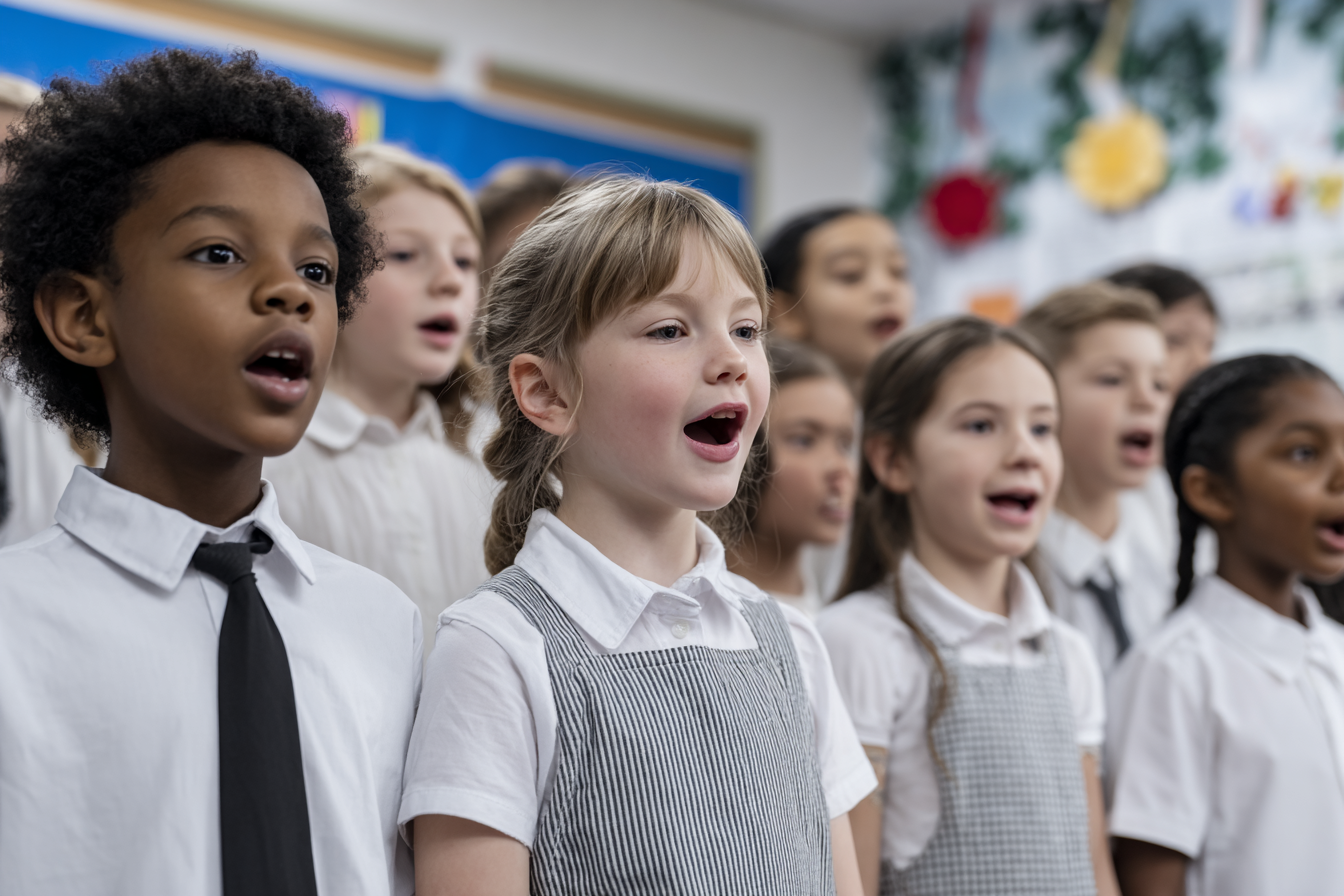
Focus: Establish rehearsal expectations, listening focus, and performance habits, while connecting personal interests and experiences to music we listen to and choose to perform.
Grade Level: 5
Subject Area: Music (General • Listening • Performing)
Total Unit Duration: 1 required session (core), plus up to 2 optional extension sessions; 50–60 minutes per session
I. Introduction
In this opening unit, students build the foundation for the year in Grade 5 Music. They learn and practice routines for entering, exiting, and moving in the music room; expectations for rehearsal behavior and audience etiquette; and strategies for focused listening. Using short listening examples and simple performance choices, students explore how their own interests, experiences, and skills connect to the music they hear and the music they sing or play.
Essential Questions
- How do our routines and habits help us learn and perform better in music class?
- How can we connect our interests and experiences to the music we listen to and choose to perform?
- What makes a piece of music a good fit for a specific group of performers and an audience?
II. Objectives and Standards
Learning Objectives — Students will be able to:
- Follow and explain key music room routines (entering/exiting, handling instruments, forming groups) and rehearsal expectations.
- Demonstrate basic listening focus (quiet body, eyes on teacher/performer, tracking sound changes) during short musical excerpts.
- Explain, with at least one piece of evidence from the music or their life, how a selected listening example connects to their interests, experiences, purposes, or contexts (MU:Re7.1.5a).
- Identify at least two factors—such as student interest, audience, context, and technical difficulty—that influence choices of music to perform (MU:Pr4.1.5a).
- Participate in a simple repertoire-choice discussion, stating one reason why a piece is or is not a good fit for the class to perform.
Standards Alignment — Grade 5 Music (NAfME-Aligned)
- MU:Re7.1.5a — Explain, citing evidence, how selected music connects to and is influenced by interests, experiences, purposes, or contexts.
- Example: Explaining how instrumentation, tempo, or style signals celebratory music or relates to a personal memory.
- MU:Pr4.1.5a — Explain how the selection of music to perform is influenced by interest, knowledge, context, and technical skill.
- Example: Choosing music appropriate for both the audience (school assembly, class share) and performers’ abilities.
Success Criteria — Student Language
- I can follow our music room routines and explain why they help us learn.
- I can listen with focus and describe something I notice in the music (instrument, tempo, mood).
- I can explain how a piece of music connects to my interests or experiences, using at least one specific detail.
- I can give a reason why a piece of music is or isn’t a good choice for our class to perform.
III. Materials and Resources
Tasks & Tools (teacher acquires/curates)
- Posted Music Room Expectations / Routines chart (enter, sit/stand, transition, instrument care, participation, audience behavior).
- Short listening excerpts (30–90 seconds each) of contrasting pieces, such as:
- A lively celebration piece (e.g., marching band or upbeat pop).
- A calmer, reflective slow piece.
- A short vocal or instrumental piece that might be age-appropriate repertoire for the class.
- Simple Listening Map or Noticing Sheet (e.g., “I hear… / I feel… / This reminds me of…”).
- Projector/speakers or other playback system.
- 2–3 sample pieces (scores, lyrics, or recordings) that could realistically be performed by a Grade 5 class—varying in difficulty and style.
- Sticky notes or small cards for quick responses and exit tickets.
Preparation
- Post or prepare to present clear music room routines and rehearsal expectations (visual support is ideal).
- Select listening examples that:
- Have clear, noticeable features (tempo changes, instrumentation, mood).
- Represent different contexts (celebration, ceremony, background music, performance piece).
- Choose 2–3 potential performance selections suitable for Grade 5 skill level, with at least one that is slightly challenging and one that is very accessible.
- Prepare sentence stems on the board or handouts, such as:
- “This music connects to me because ___.”
- “This would be a good performance piece because ___.”
Common Misconceptions to Surface
- “Routines are just rules; they don’t help us make music.” → Routines create safety and structure, so we have more time and focus for making music.
- “Everyone likes the same kind of music.” → People have different interests and experiences that shape how they hear music.
- “Harder music is always better.” → Good performance choices consider audience, purpose, and technical skill, not just difficulty.
- “Background music isn’t important.” → Context and purpose (background vs. performance) affect how we listen and why the music was chosen.
Key Terms (highlight in lessons) routine, rehearsal, etiquette, audience, listening focus, context, performance, interest, experience, technical skill, repertoire, evidence
IV. Lesson Procedure
(Each day follows: Launch → Explore → Discuss → Reflect. Session 1 is required and fully addresses the standards; Sessions 2 and 3 are optional extensions.)
Session 1 — Core Lesson: Routines, Listening Focus, and Choosing Music (MU:Re7.1.5a, MU:Pr4.1.5a)
- Launch (10–12 min)
- Greet students at the door using the entrance routine you want to establish; quietly model where to go and how to sit.
- Once seated, briefly introduce your name, the class, and the purpose of music this year.
- Present the Music Room Routines & Expectations chart.
- Demonstrate each routine (entering, sitting/standing, moving to instruments, responding to a cut-off signal).
- Have students try each routine quickly, emphasizing safety and efficiency.
- Ask:
- “How do these routines help us spend more time actually making music?”
- “What happens if we don’t have clear routines?”
- Explore — Part A: Focused Listening & Personal Connections (15–18 min)
- Explain that part of music class is learning to listen on purpose, not just “hearing sounds.”
- Distribute a simple Listening Map/Noticing Sheet.
- Play Listening Example #1 (e.g., a celebratory piece).
- First time: students just listen.
- Second time: they write or draw on their sheet:
- “I hear…” (sounds/instruments/tempo).
- “I feel…” (emotion/mood).
- “This reminds me of…” (experience, place, event).
- Ask a few volunteers to share.
- Briefly connect to MU:Re7.1.5a:
- Highlight that students are using evidence from the music (fast, loud, instruments) and from their experiences to explain how the piece connects to them.
- Explore — Part B: Choosing Music to Perform (15–18 min)
- Tell students: “Later this year, we will perform music. We want to choose pieces that fit our interests, abilities, and audience.”
- Play or show a short excerpt from Sample Piece A (a realistic performance piece).
- Ask: “Who might enjoy hearing this? Why?”
- Ask: “On a scale of 1–3, how difficult do you think this would be for fifth graders to perform? Why?”
- Repeat briefly with Sample Piece B (different style or difficulty).
- In small groups or pairs, students choose one sample piece they believe could be a good performance choice and discuss:
- “Why would this be a good fit for our class?”
- “Is there anything that might make it too hard or not right for our audience?”
- Groups jot one or two reasons on a sticky note.
- Discuss (8–10 min)
- Gather sticky notes and sort them on the board under headings like Interest, Audience, Technical Skill, Context (e.g., school assembly, classroom performance).
- Make thinking visible:
- “We see many of you chose Piece A because it’s exciting and fits our skill level.”
- “Some of you noticed Piece B might be too difficult right now because of the fast rhythms.”
- Explicitly connect to MU:Pr4.1.5a: students just explained how interest, knowledge, context, and skill influence selecting music to perform.
- Reflect (5–8 min)
- Quick written or verbal reflection:
- “One routine that will help me in music this year is ___ because ___.”
- “One reason a piece of music might be a good choice for us to perform is ___.”
- If time allows, students share with a partner or in a short circle.
- Quick written or verbal reflection:
Optional Session 2 — Deepening Listening & Context Connections (MU:Re7.1.5a)
- Launch (5–7 min)
- Brief routine review: have students enter, sit, and get ready to listen using established procedures; praise specific positive behaviors.
- Ask: “What do we remember about how our experiences affect what we think about a piece of music?”
- Explore (20–25 min)
- Introduce two new listening examples that clearly differ in context and purpose (e.g., a national anthem vs. a movie soundtrack; a lullaby vs. a pep band tune).
- For each piece:
- Play once for overall impression.
- Play again while students complete a Context & Connection Chart:
- “Where might this music be used or heard?” (stadium, ceremony, movie, classroom, celebration).
- “What in the music makes you think that?” (e.g., instruments, tempo, dynamics, text).
- “Does this connect to any experience you’ve had?”
- Encourage students to cite evidence: “The brass instruments and strong beat make me think of a parade.”
- Discuss (10–12 min)
- Share responses and highlight how students are using both musical details and personal/context clues.
- Compare: “How does the purpose of the music change how we listen to it?”
- Reinforce MU:Re7.1.5a language: “We are explaining, with evidence, how the music connects to experiences, purposes, or contexts.”
- Reflect (5–8 min)
- Reflection prompt: “Choose one piece we heard today and write 2–3 sentences explaining how it connects to your life, a place you know, or a purpose you recognize.”
- Collect for formative assessment of responding standard.
Optional Session 3 — Repertoire Choice Mini-Project (MU:Pr4.1.5a, MU:Re7.1.5a)
- Launch (5–7 min)
- Review: “What things should we think about when choosing a piece to perform?” (interest, skill, audience, context).
- Post these on the board as a checklist.
- Explore (25–30 min)
- Place students in small groups and give each group a Repertoire Card with:
- The title and style of a possible piece (e.g., folk song, pop arrangement, choral piece).
- A short description of difficulty (range, tempo, rhythms) and potential audience (school assembly, class share, younger students, etc.).
- Groups work through a Repertoire Choice Organizer:
- “What might students like about this piece?”
- “What might be challenging about this piece for our class?”
- “In what setting (audience/context) would this piece work best?”
- “Do you recommend this piece for our class to perform this year? Why or why not?”
- Optional: Let groups listen to a short excerpt of their assigned piece while filling out the organizer.
- Place students in small groups and give each group a Repertoire Card with:
- Discuss (10–12 min)
- Each group briefly shares their recommendation and one or two reasons, citing interest, context, or technical skill.
- As a class, identify common patterns:
- “We keep mentioning that faster pieces might need more rehearsal time.”
- “Many of you think songs with meaningful lyrics are better for assemblies.”
- Connect back explicitly to MU:Pr4.1.5a and MU:Re7.1.5a: students are evaluating music for performance based on interest, knowledge, context, skill, and sometimes personal connections.
- Reflect (5–8 min)
- Exit ticket: “If you could choose one kind of song for us to perform this year, what would it be and why would it fit our class and audience?”
V. Differentiation and Accommodations
Advanced Learners
- Ask them to compare two listening excerpts and write a short paragraph citing multiple pieces of evidence for context and purpose.
- Have them lead small-group discussions about repertoire choices, ensuring all voices are heard.
- Invite them to suggest one additional piece (from a teacher-approved list or library) and justify its inclusion with detailed reasoning.
Targeted Support
- Break routines into smaller steps with visuals (e.g., numbered icons for enter → sit → listen → respond).
- Provide sentence starters for explanations:
- “This music reminds me of ___ because ___.”
- “This would be good for our class to perform because ___.”
- Use fewer, shorter listening excerpts with clear contrasts (fast vs. slow; loud vs. soft).
- Allow verbal responses instead of written ones when appropriate.
Multilingual Learners
- Include visual supports (pictures of parades, ceremonies, concerts, movies) to anchor context discussions.
- Encourage students to make connections to music from their own cultures, even if they describe it in their home language first.
- Provide key vocabulary with simple definitions and icons: audience, performance, routine, context.
- Accept short phrases, labeled sketches, or bilingual notes as evidence of understanding.
IEP/504 & Accessibility
- Allow flexible seating or standing arrangements to accommodate sensory or physical needs.
- Provide recordings and routines ahead of time, if possible, for students who benefit from pre-teaching.
- Offer alternative ways to respond (drawing, audio recording, one-on-one conference) for students with writing or processing challenges.
- Use timers or visual countdowns to support transitions during activities and listening.
VI. Assessment and Evaluation
Formative Checks
- Routines & Etiquette: Observe students during entrance/exit and transitions; note who can independently follow routines and who needs reminders.
- Listening Focus: During listening tasks, check for quiet bodies, eyes on the source, and thoughtful completion of noticing sheets.
- Connections & Evidence (MU:Re7.1.5a): Review written or verbal explanations for specific musical details and personal/context connections.
- Repertoire Choice Reasoning (MU:Pr4.1.5a): Listen for and collect reasons that reference interest, audience, context, and technical skill.
Summative — Music Routines & Listening Reflection (0–2 per criterion, total 10)
- Routines & Etiquette
- 2: Consistently follows music room routines and rehearsal/audience expectations with no more than one minor reminder.
- 1: Usually follows routines but needs occasional reminders.
- 0: Frequently disregards routines or requires repeated prompts.
- Listening Focus
- 2: Demonstrates focused listening (quiet body, attention on music/teacher) and completes noticing tasks with relevant observations.
- 1: Shows partial focus with some appropriate observations, but may be occasionally distracted.
- 0: Has difficulty maintaining focus and provides few or no relevant observations.
- Connections & Evidence (MU:Re7.1.5a)
- 2: Clearly explains how a piece of music connects to interests, experiences, purposes, or contexts, citing at least one specific musical or personal detail.
- 1: Gives a general or vague connection with limited detail or evidence.
- 0: Does not describe a meaningful connection or gives an off-topic response.
- Repertoire Choice Reasoning (MU:Pr4.1.5a)
- 2: Explains a performance choice using at least two factors (e.g., interest, audience, context, technical skill).
- 1: Gives one relevant reason but does not fully connect to the standard’s factors.
- 0: Offers no relevant reason or cannot explain why a piece is or isn’t a good choice.
- Communication of Ideas
- 2: Ideas are clear and understandable (spoken or written); uses music vocabulary such as audience, performance, routine, context correctly.
- 1: Ideas are mostly understandable but may lack clarity or appropriate terms.
- 0: Ideas are difficult to understand or unrelated to the task.
VII. Reflection and Extension
Reflection Prompts
- Which music room routine do you think is most important, and why?
- How did your own interests and experiences help you understand or connect to one of the listening examples?
- What do you think is the most important question to ask when deciding if a piece of music is right for our class to perform?
Extensions
- Personal Playlist Connection: Students bring or describe (with teacher approval) one school-appropriate song they like and explain its context (where/when/how it is used) and why it fits their interests.
- Mini Curator Task: Students imagine they are planning music for a school event (assembly, field day, classroom celebration) and list 2–3 types of pieces that would fit, explaining why.
- Routine Poster: In small groups, students design a mini-posters illustrating one key music room routine and how it helps the class make better music.
Standards Trace — When Each Standard Is Addressed
- MU:Re7.1.5a — Session 1 (focused listening, personal/context connections), Optional Session 2 (context & connection charts), Optional Session 3 (repertoire choice reasoning with evidence and connections).
- MU:Pr4.1.5a — Session 1 (evaluating and discussing sample performance pieces), Optional Session 3 (repertoire choice mini-project using interest, context, and technical skill to justify selections).