Unit Plan 36 (Grade 5 Orchestra): Orchestra Reflection & Growth
Grade 5 orchestra reflection unit where students assess musical growth, connect practice habits to progress, and set clear middle school goals.

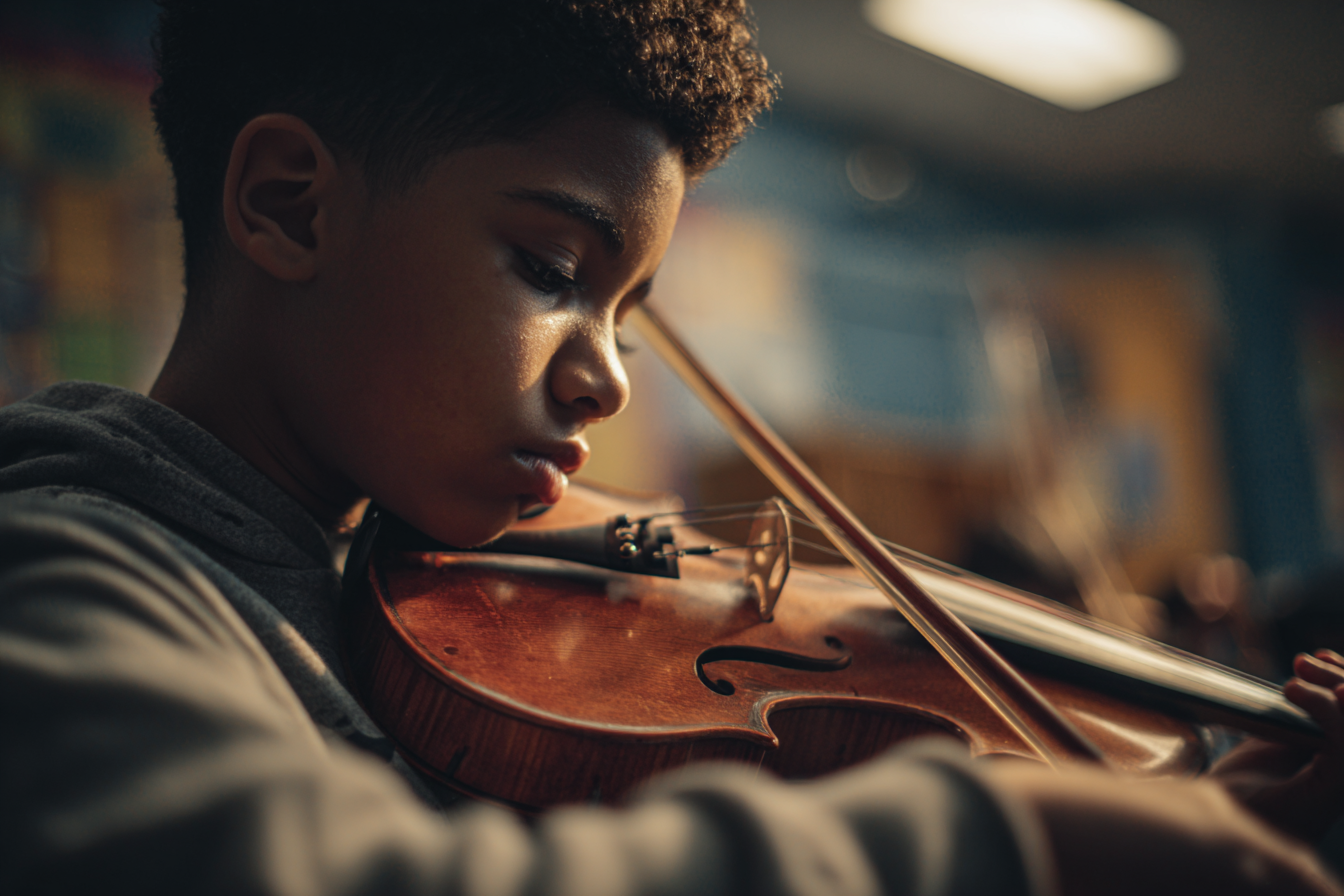
Focus: Reflect on musical growth over the year and set specific goals for middle school orchestra.
Grade Level: 5
Subject Area: Orchestra
Total Unit Duration: 1–2 weeks, 30-minute sessions
I. Introduction
Students look back on their first year of orchestra, identifying moments of growth in tone, rhythm, bow control, and ensemble skills. Through guided reflection, discussion, and simple self-assessment tools, they describe how their interests, practice habits, and experiences have shaped who they are as string players. Finally, students set clear, realistic goals for middle school orchestra, connecting these goals to specific strategies they can use moving forward.
Essential Questions
- How have my skills and confidence as a string player grown this year?
- How did my interests, effort, and practice habits affect my musical growth?
- What goals do I have for middle school orchestra, and how will I work toward them?
II. Objectives and Standards
Learning Objectives — Students will be able to:
- Identify at least two areas of musical growth (e.g., tone, rhythm, bowing, confidence) from the beginning to the end of the year.
- Explain how their personal interests, choices, and practice habits influenced that growth.
- Set 1–2 specific, realistic goals for middle school orchestra and connect them to actions (practice strategies, rehearsal habits).
- Create a short Reflection & Goal Plan that clearly describes growth, current strengths, and next steps.
Standards Alignment — Grade 5 Orchestra (custom, NAfME-style)
- OR:Cn10.5a — Describe how personal interests and goals influence instrument choice and musical growth as a string player.
- Example: Students explain why they chose violin, viola, cello, or bass and set one goal.
Success Criteria — Student-Friendly Language
- I can name specific ways I have improved as a string player this year.
- I can explain how my interests, effort, and practice helped me grow.
- I can set clear goals for middle school orchestra and describe how I will work toward them.
- I can create a reflection and goal plan that is organized and easy for someone else to understand.
III. Materials and Resources
Tasks & Tools (teacher acquires/curates)
- Simple reflection sheet or booklet with prompts (e.g., “Before/Now,” “My Strengths,” “My Challenges,” “My Goals”).
- Class checklist/rubric summarizing core skills: tone, rhythm, bow control, posture, note reading, ensemble habits.
- Copies of old practice logs, playing tests, or teacher notes (if available) for students to reference growth.
- Short student-friendly descriptions of middle school orchestra expectations (e.g., from the middle school director or flyer).
- Optional: “Letter to Future Me” template or mini-poster template for goal display.
Preparation
- Prepare an anchor chart:
- “Musical Growth” — examples: stronger tone, better rhythm, more confident, follow conductor, help section.
- “Good Goals” — specific, doable, connected to a skill (e.g., “Use slower bow on soft parts,” “Practice D major scale 3x/week”).
- Gather a few student work samples (with names covered) to model talking about growth using evidence.
- If possible, coordinate with the middle school orchestra director to share a short note or video about expectations.
Common Misconceptions to Surface
- “Growth only means playing harder songs.” → Growth also includes tone, posture, focus, and confidence.
- “Goals are just ‘be better’ or ‘play harder music’.” → Strong goals are specific and connected to actions.
- “If I struggled this year, I can’t do well in middle school.” → Improvement is ongoing; effort and strategies matter.
Key Terms (highlight in lessons) growth, goal, practice habit, reflection, strength, challenge, effort, ensemble, confidence, next step
IV. Lesson Procedure
(Each session is designed for a 30-minute class period; Sessions 1–2 address all standards, with Sessions 3–5 optional for reinforcement or extension.)
Session 1 — Looking Back: How Have I Grown? (Cn10.5a)
- Launch (5–7 minutes)
- Brief class discussion: “Think back to our first week of orchestra. What was hard then? What feels easier now?”
- Show the “Musical Growth” anchor chart and quickly review examples of growth (tone, rhythm, posture, confidence, etc.).
- Explore (15–18 minutes)
- Students receive a reflection sheet with “Before / Now” prompts (e.g., “At the beginning of the year I… Now I can…”).
- Individually, students:
- Circle or highlight areas of growth from a skill checklist.
- Write at least two short sentences describing specific improvements (e.g., “My bow is straighter now,” “I can keep a steady beat in songs.”).
- If available, students briefly review old work (earlier playing test scores, teacher comments, or practice logs) to find evidence of growth.
- Discuss (3–5 minutes)
- In pairs, students share one area of growth and explain how they know (evidence or example).
- A few volunteers share with the class; teacher emphasizes using specific language (“My tone is clearer on D and A strings,” not just “I got better”).
- Reflect (2–4 minutes)
- Students complete a quick prompt: “One way I have grown as a string player this year is ___ because ___.”
Session 2 — Looking Forward: Goals for Middle School Orchestra (Cn10.5a)
- Launch (5–7 minutes)
- Quick whole-class check-in: “What do you wonder or feel about middle school orchestra?”
- Share a brief description or short message from middle school orchestra about expectations (e.g., more independence, more music, more performances).
- Explore (15–18 minutes)
- Review the “Good Goals” anchor chart (specific, realistic, connected to a skill and an action).
- Students use their Session 1 reflection to:
- Choose 1–2 focus areas (e.g., intonation, rhythm, tone, leadership, confidence).
- Write at least one specific goal for middle school orchestra (e.g., “Practice with a metronome 3 times a week to keep steady beat,” “Watch the conductor more so I do not rush entrances.”).
- Add one action step for each goal (what they will actually do to work toward it).
- Discuss (3–5 minutes)
- In small groups, students share one goal and action step.
- Class creates a quick list on the board: “Strong Goal Examples” pulled from student work.
- Reflect (2–4 minutes)
- Students complete: “One goal I have for middle school orchestra is ___ and I will work toward it by ___.”
Optional Session 3 — My Orchestra Story (Cn10.5a)
- Launch (4–6 minutes)
- Explain: “Today we’ll create a short ‘My Orchestra Story’ that tells how you started, what you’ve learned, and where you’re going.”
- Explore (18–20 minutes)
- Students use a template or notebook to write or illustrate:
- How they felt at the beginning of the year.
- One or two important moments (first concert, a tough piece, a time they helped a classmate).
- Their favorite musical memory from the year.
- A sentence or two about their goals for middle school.
- Teacher circulates, prompting students to use specific musical words (tone, rhythm, bow, ensemble, etc.).
- Students use a template or notebook to write or illustrate:
- Discuss (3–5 minutes)
- Volunteers share a short part of their story aloud; classmates respond with one positive comment about growth.
- Reflect (2–3 minutes)
- Students add one final sentence: “I am proud of ___ in orchestra.”
Optional Session 4 — Peer Celebration & Feedback Circle (Cn10.5a)
- Launch (4–6 minutes)
- Explain that the class will have a celebration circle to recognize growth and share encouragement.
- Explore (18–20 minutes)
- Students sit in a circle with their reflection sheets or “My Orchestra Story.”
- Each student shares:
- One strength they have developed.
- One goal for middle school.
- After each share, one peer gives specific positive feedback (“I noticed your bow got much smoother,” “You helped our section during the concert.”).
- Discuss (3–5 minutes)
- Whole class: “What did you hear about how people grew this year?” Emphasize varied types of growth (not just speed or difficulty of songs).
- Reflect (2–3 minutes)
- Students write one sentence: “A strength someone noticed in me was ___, and I want to keep building it by ___.”
Optional Session 5 — Letter to Future Self (Cn10.5a)
- Launch (3–5 minutes)
- Explain the idea of a letter to future self: something they could read next year to remember their growth and goals.
- Explore (18–20 minutes)
- Students write a short letter or create a mini-poster addressed to “Future Me in Middle School Orchestra” that includes:
- One or two things they are proud of from this year.
- Their main goal(s) for middle school orchestra.
- At least one encouraging message to themselves (“Keep practicing even when it’s hard,” etc.).
- Option: collect letters to return later or allow students to take them home.
- Students write a short letter or create a mini-poster addressed to “Future Me in Middle School Orchestra” that includes:
- Discuss (3–5 minutes)
- Invite volunteers to share a sentence or two from their letters.
- Reflect (2–3 minutes)
- Final prompt: “One thing I want to remember about myself as a musician is ___.”
V. Differentiation and Accommodations
Advanced Learners
- Encourage students to set multi-step goals (e.g., practice schedule + audition preparation + leadership aim).
- Ask them to reference specific pieces, skills, or concerts in their reflections and goals.
- Invite them to write an additional paragraph on how they might support younger players next year (leadership focus).
Targeted Support
- Provide sentence starters (e.g., “At the beginning of the year, I… Now I can…,” “One skill I want to improve is… because…”).
- Allow students to dictate responses to an adult or partner before writing them down.
- Offer a simplified reflection sheet with checkboxes and picture cues for skills (bow, notes, rhythm, listening).
Multilingual Learners
- Allow students to brainstorm or draft ideas in their home language first, then translate key sentences into English with support.
- Use visual supports (icons for tone, rhythm, bow, practice, etc.) on reflection tools and anchor charts.
- Pair students with a supportive peer to talk through their growth and goals before writing.
IEP/504 & Accessibility
- Break tasks into smaller steps with a checklist (e.g., “Step 1: Circle growth areas; Step 2: Write 1 sentence about growth; Step 3: Write 1 goal.”).
- Provide extra time or allow work to continue over multiple sessions if writing stamina is limited.
- Offer alternative formats for the final plan (e.g., audio recording, drawing plus labels, or a teacher-scribed reflection).
VI. Assessment and Evaluation
Formative Checks (each session)
- Session 1 — Reflection sheets show at least two specific areas of growth named with simple evidence or examples.
- Session 2 — Goal plans include at least one clear, specific goal and an action step connected to that goal.
- Optional Session 3 — “My Orchestra Story” includes at least one growth moment and one favorite musical memory.
- Optional Session 4 — Students give and receive specific feedback about strengths during the celebration circle.
- Optional Session 5 — Letters or mini-posters clearly state at least one strength and one future goal.
Summative — Year-End Reflection & Middle School Goal Plan (0–2 per criterion, total 10)
- Reflection on Growth (Cn10.5a)
- 2: Clearly describes two or more areas of growth with specific examples (e.g., tone, rhythm, confidence, ensemble habits).
- 1: Mentions at least one area of growth but with limited detail or unclear examples.
- 0: Little or no meaningful reflection on growth.
- Connection to Interests & Experiences (Cn10.5a)
- 2: Explains how personal interests, experiences, or practice habits helped shape musical growth.
- 1: Makes a brief or general connection to interests or effort, but not clearly explained.
- 0: No connection made between interests/experiences and growth.
- Goal Quality for Middle School (Cn10.5a)
- 2: States at least one specific, realistic goal for middle school orchestra and includes a clear action step.
- 1: States a goal but it is very general (“get better”) or missing an action step.
- 0: No clear goal stated.
- Action Plan & Next Steps (Cn10.5a)
- 2: Describes concrete steps (practice strategies, rehearsal habits) that match the stated goal(s).
- 1: Mentions trying harder or practicing more, but steps are vague or not well connected to the goal.
- 0: No meaningful action steps described.
- Communication & Organization
- 2: Reflection and goal plan are organized, readable, and use some musical vocabulary (e.g., tone, rhythm, bowing, ensemble).
- 1: Ideas are mostly understandable but may be brief, disorganized, or missing some details.
- 0: Hard to follow or incomplete; does not communicate ideas clearly.
Feedback Protocol (TAG)
- Tell one strength (e.g., “You gave very specific examples of how your tone improved.”).
- Ask one question (e.g., “What practice strategy will help you reach your shifting goal?”).
- Give one suggestion (e.g., “Try adding one more action step for your rhythm goal.”).
VII. Reflection and Extension
Reflection Prompts
- What is one thing about your musical growth this year that makes you proud? Why?
- How did your choices (practice, focus in rehearsal, trying new things) affect your progress?
- What are you most excited or nervous about for middle school orchestra, and how can your goals help you?
Extensions
- Middle School Q&A: Invite the middle school orchestra director (in person or via video) to answer student questions and respond to a few goals or letters.
- Growth Timeline: Students create a visual timeline showing 3–5 key moments of growth during the year (first note, first concert, a hard piece, etc.).
- Goal Display: With student permission, display anonymous goals or reflections on a bulletin board titled “Future Middle School Musicians” to celebrate commitment and inspire next year’s beginners.
Standards Trace — When Each Standard Is Addressed
- OR:Cn10.5a — Sessions 1–2, Optional Sessions 3–5 (reflection on growth, connections to interests/experiences, and goal-setting for middle school orchestra).