Unit Plan 36 (Grade 6 Art): Reflection & Growth Analysis
Grade 6 art portfolio reflection unit where students evaluate growth, connect artwork to personal experiences, use criteria for self-assessment, and set goals for Grade 7 readiness.

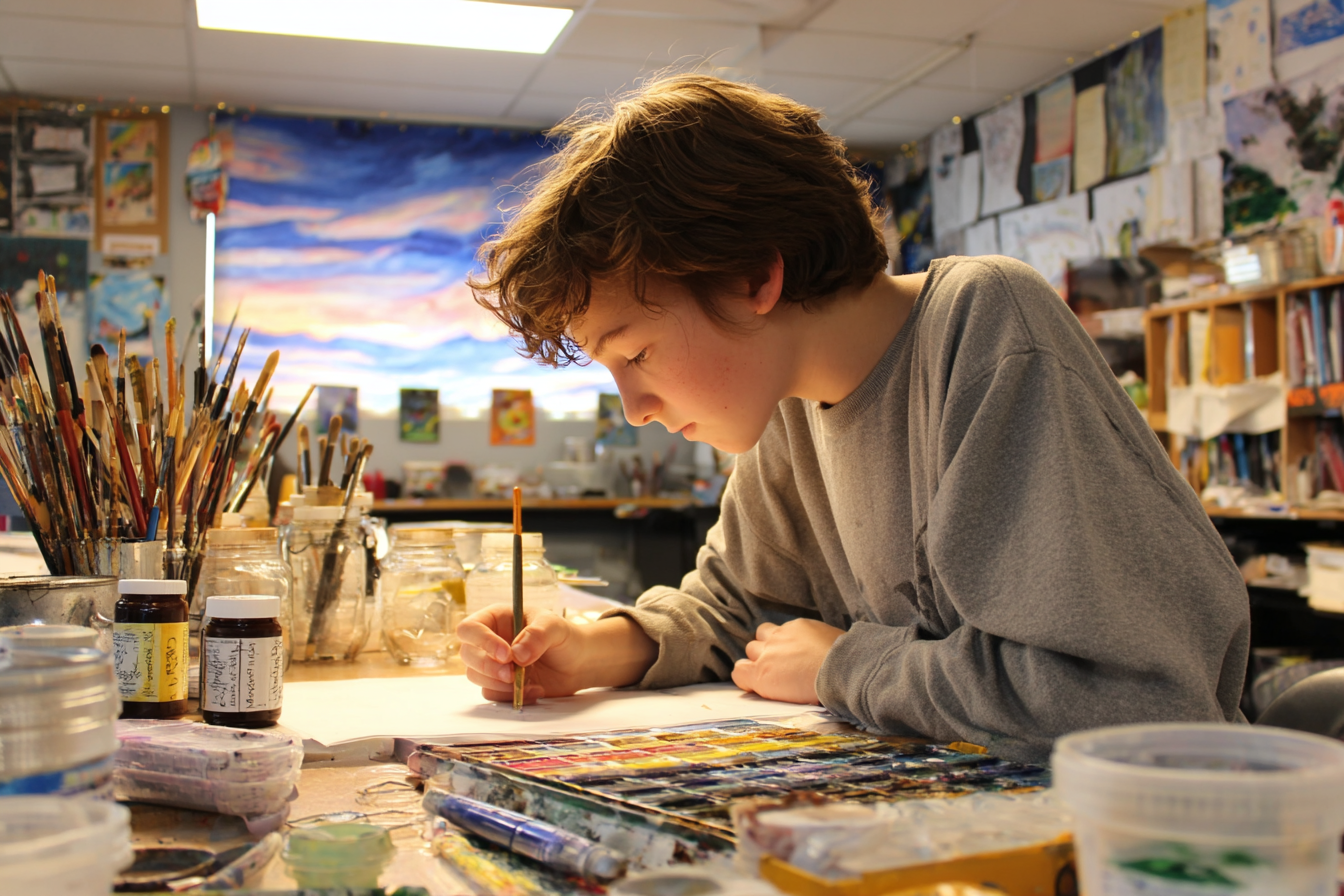
Focus: Reflect on artistic growth and readiness for Grade 7, connecting personal interests/experiences to artwork and using criteria for self-evaluation.
Grade Level: 6
Subject Area: Art (Visual Arts • Reflection • Portfolio)
Total Unit Duration: 5 sessions (one week), 50–60 minutes per session
I. Introduction
In this culminating unit, students step back to reflect on their artistic journey across the year. Using portfolios, checklists, and guided prompts, they identify how their artwork connects to their personal interests and experiences, and where they have grown in craftsmanship, composition, and communication. Students practice evaluating their own work with simple criteria, giving and receiving constructive feedback, and setting clear goals for Grade 7 art. By the end, each student creates a short written or visual reflection that documents their growth and outlines next steps as a developing artist.
Essential Questions
- How does my artwork show my interests, experiences, and personality as an artist?
- In what ways have my skills and ideas grown from the beginning of the year to now?
- How can simple criteria and feedback help me evaluate my own artwork fairly and kindly?
- What are my strengths as an artist, and what do I want to improve in Grade 7?
- How can reflecting on my work help me feel more ready and confident for the next level of art?
II. Objectives and Standards
Learning Objectives — Students will be able to:
- Identify and describe ways their artwork is inspired by personal interests or experiences, and how those influenced design choices (VA:Cn10.6a).
- Use simple criteria (e.g., craftsmanship, effort, communication, creativity) to evaluate their own portfolio pieces (VA:Re9.6a).
- Provide and receive constructive feedback using a class rubric or checklist (VA:Re9.6a).
- Select representative works that show growth over time and explain why they were chosen.
- Set specific, realistic goals for Grade 7 art based on self-evaluation and peer feedback (VA:Cn10.6a, VA:Re9.6a).
Standards Alignment — 6th Grade (NCAS-Aligned)
- VA:Cn10.6a — Create artwork inspired by personal interests or experiences and explain how those influenced design choices.
- Example: Students design artwork representing a favorite hobby.
- VA:Re9.6a — Evaluate artwork using simple criteria and provide constructive feedback.
- Example: Students use a checklist to critique clarity and composition.
Success Criteria — Student Language
- I can explain how my artwork connects to my interests, experiences, or identity.
- I can use a checklist or rubric to evaluate my artwork and say what is working well and what needs improvement.
- I can give kind, specific feedback to classmates that helps them see their strengths and next steps.
- I can choose pieces from my portfolio that show my growth over time and explain why they matter.
- I can set clear goals for what I want to get better at in Grade 7 art.
III. Materials and Resources
Tasks & Tools (teacher acquires/curates)
- Students’ art portfolios or collections from throughout the year.
- Simple self-evaluation rubric or checklist with criteria such as:
- Craftsmanship/neatness
- Composition/organization
- Creativity/originality
- Communication of idea or feeling
- Effort and persistence
- Reflection templates or prompts for:
- “Beginning vs. Now” comparison
- “Artwork inspired by my interests/experiences”
- “Strengths and next steps”
- Goal-setting forms for Grade 7 readiness (e.g., “Next year I will…”).
- Anchor charts:
- “What Shows Artistic Growth?” (e.g., cleaner lines, more detail, bolder ideas).
- “Helpful Feedback Sentence Starters” (“One strength is…”, “One next step could be…”).
- Optional digital tools for portfolio slideshows or photo documentation.
Preparation
- Organize or have students collect all major artworks into portfolios labeled with their names.
- Prepare copies of self-evaluation rubrics, reflection sheets, and goal-setting forms.
- Create anchor charts with student-friendly language for criteria and feedback starters.
- Choose 1–2 sample artworks (teacher or anonymized student work) to model self-evaluation and growth analysis.
- Arrange seating to allow for quiet reflection and later partner conferences.
Common Misconceptions to Surface
- “If my early artwork doesn’t look perfect, I failed.” → Early work shows where we started; growth comes from practice and reflection.
- “Reflection is just saying ‘I did good’ or ‘I did bad.’” → Reflection means noticing specific changes and naming strengths and next steps.
- “Only big changes count as growth.” → Small improvements (cleaner lines, better color choices, stronger messages) are also important growth.
- “Goals are just wishes.” → Good goals are specific and doable, and they come from honest self-evaluation.
Key Terms (highlight in lessons) reflection, growth, criteria, feedback, self-evaluation, strengths, next steps, personal interests, experiences, goals, readiness
IV. Lesson Procedure
(Each day follows: Launch → Explore/Work Time → Discuss → Reflect. Timing for a 50–60 minute block.)
Session 1 — Looking Back: Portfolio Overview (VA:Cn10.6a)
- Launch (6–8 min)
- Show two artworks (beginning-of-year and later-in-year) from the same artist. Ask: “What differences do you notice? What might this tell us about growth?”
- Introduce the idea that we will look at our own portfolios to see how our art connects to our interests and experiences and how we have grown.
- Explore / Work Time (25–30 min)
- Students spread out their year’s artwork and briefly sort into groups:
- “Early in the year”
- “Middle of the year”
- “Later in the year”
- Using a simple “Beginning vs. Now” reflection sheet, students choose:
- One early piece and one later piece to compare.
- Note at least two ways they see growth (e.g., more detail, better color choices, clearer ideas).
- Students circle or star any pieces clearly connected to their personal interests or experiences (hobbies, family, culture, feelings).
- Students spread out their year’s artwork and briefly sort into groups:
- Discuss (8–10 min)
- In small groups, students share one early vs. later comparison and one example of how their art showed something personal about them.
- Teacher charts common growth patterns (e.g., “better shading,” “more original ideas”).
- Reflect (3–5 min)
- Exit slip: “One way my art has grown since the beginning of the year is ___.”
Session 2 — Self-Evaluation with Criteria (VA:Re9.6a)
- Launch (5–7 min)
- Display a sample artwork and model using the self-evaluation checklist (e.g., “On craftsmanship I’d give this a 2 because the lines are neat and colors are filled in carefully.”).
- Emphasize that criteria are tools for learning and growth, not just for judging.
- Explore / Work Time (25–30 min)
- Students select 3–4 key artworks from their portfolio that best represent their year.
- Using the self-evaluation rubric/checklist, they rate each piece on criteria such as craftsmanship, composition, creativity, communication, and effort.
- For each piece, students write one strength and one area for improvement using sentence starters:
- “One strength in this piece is…”
- “One thing I could improve is…”
- Discuss (8–10 min)
- In pairs, students share one artwork and their self-evaluation notes.
- Partners practice giving constructive feedback by adding one more strength and one gentle suggestion.
- Reflect (3–5 min)
- Quick write: “Using criteria helped me notice that I am good at ___ and I want to work on ___.”
Session 3 — Connecting Artwork to Interests & Experiences (VA:Cn10.6a, VA:Re9.6a)
- Launch (6–8 min)
- Prompt: “Think of a piece you made this year that feels most like you. What is happening in it that connects to your life?”
- Brief share-out to show different ways artwork can be inspired by personal experiences or interests.
- Explore / Work Time (25–30 min)
- Students choose one or two portfolio pieces that strongly connect to their personal interests or experiences.
- Using a reflection template, they answer prompts such as:
- “This artwork is inspired by my interest/experience in…”
- “I showed this interest/experience by choosing these colors, subjects, or materials…”
- “Looking back, I see growth in this piece because…”
- Students add one or two criteria-based comments (from their checklist) to show how this piece demonstrates growth.
- Discuss (8–10 min)
- In table groups, students share one reflection sentence explaining how a specific artwork connects to who they are.
- Teacher highlights that connecting art to personal experiences is part of VA:Cn10.6a.
- Reflect (3–5 min)
- Exit slip: “One artwork that shows who I am is ___ because ___.”
Session 4 — Peer Feedback & Goal Setting (VA:Re9.6a, VA:Cn10.6a)
- Launch (5–7 min)
- Review the anchor chart “Helpful Feedback Sentence Starters” and remind students of respectful feedback expectations.
- Explain that feedback will help them set realistic goals for Grade 7 art.
- Explore / Work Time (25–30 min)
- Students choose 2–3 artworks plus their reflection notes to share in a peer conference (pairs or trios).
- Each student takes a turn showing work and briefly summarizing:
- What the piece is about and how it connects to their interests/experiences.
- What they think are strengths and areas for growth (based on criteria).
- Peers provide constructive feedback using sentence frames:
- “I notice you’ve improved in…”
- “One thing that really works is…”
- “A next step for Grade 7 could be…”
- After conferences, students use a goal-setting form to write 2–3 specific goals for Grade 7 (e.g., “I will work on adding more background detail” or “I will practice shading to show form”).
- Discuss (8–10 min)
- Volunteers share one of their goals and explain which artwork or feedback helped them create it.
- Teacher reinforces that goals should connect to personal interests and self-evaluation using criteria.
- Reflect (3–5 min)
- Quick write: “One goal I am setting for Grade 7 art is ___ because I noticed ___ about my work.”
Session 5 — Grade 7 Readiness Reflection (VA:Cn10.6a, VA:Re9.6a)
- Launch (5–7 min)
- Prompt: “Imagine you are writing a short note to your future Grade 7 art teacher. What would you want them to know about you as an artist?”
- Explore / Work Time (25–30 min)
- Students create a final reflection (written paragraph, illustrated reflection page, or simple one-page “artist profile”) including:
- A summary of how their art shows their interests and experiences.
- At least two concrete examples of growth from early to later work.
- A summary of feedback they received and how they used it.
- Their Grade 7 goals and what they hope to learn or improve.
- Optionally, students decorate their reflection page with small sketches or symbols representing their interests as artists.
- Students create a final reflection (written paragraph, illustrated reflection page, or simple one-page “artist profile”) including:
- Discuss (8–10 min)
- Students share one sentence from their reflection that they feel proud of (e.g., a growth statement or a goal).
- Class discusses how reflection helps them feel more prepared and confident for Grade 7 art.
- Reflect (3–5 min)
- Final prompt: “One thing I’ve learned about myself as an artist this year is ___, and I want to remember this next year.”
V. Differentiation and Accommodations
Advanced Learners
- Ask them to create a mini growth portfolio: pair early and later works with written analysis of specific changes in composition, technique, and concept.
- Invite them to write an extended “letter to future self” reflecting on long-term artistic goals beyond Grade 7.
- Encourage deeper reflection on patterns in their interests, such as recurring subjects or themes across multiple pieces.
Targeted Support
- Chunk reflection tasks into smaller steps with checklists (“Step 1: Choose two artworks; Step 2: Name one strength for each; Step 3: Name one goal.”).
- Provide sentence frames for self-evaluation and goal setting (e.g., “I improved at ___ because now I can…”, “Next year I want to practice ___ so I can ___.”).
- Allow students to dictate responses to an adult or use speech-to-text tools if writing stamina is a barrier.
Multilingual Learners
- Allow initial reflections to be drafted in the home language, then support students in translating key ideas into English.
- Provide a bilingual word bank for reflection and criteria vocabulary (e.g., “strength,” “goal,” “improvement,” “detail,” “color,” “message”).
- Accept visual reflections that combine short phrases, drawings, and symbols to show growth and goals.
IEP/504 & Accessibility
- Offer graphic organizers with icons for strengths, challenges, and goals.
- Give extended time and quiet spaces for reflection activities.
- Allow alternative formats for final reflection (audio recording, short interview with the teacher, comic strip reflection) while still addressing VA:Cn10.6a and VA:Re9.6a.
VI. Assessment and Evaluation
Formative Checks (daily)
- Session 1 — “Beginning vs. Now” reflections show students can identify at least one area of growth in their work.
- Session 2 — Self-evaluation checklists show students using simple criteria to describe strengths and areas for improvement.
- Session 3 — Written reflections link at least one artwork to a personal interest or experience and note growth.
- Session 4 — Goal-setting forms reflect feedback-based goals that are specific and realistic.
- Session 5 — Final reflections show students synthesizing connections between interests, growth, feedback, and future goals.
Summative — Reflection & Growth Portfolio (0–2 per criterion, total 10)
- Connection to Personal Interests/Experiences (VA:Cn10.6a)
- 2: Clearly explains how at least one artwork is inspired by personal interests or experiences and describes how those influenced design choices.
- 1: Mentions interests or experiences but explanation is brief or general.
- 0: No clear connection to personal interests or experiences.
- Use of Criteria in Self-Evaluation (VA:Re9.6a)
- 2: Uses class criteria (craftsmanship, composition, creativity, communication, effort) to identify specific strengths and areas for improvement in multiple works.
- 1: Uses criteria in a limited or general way, with few specific examples.
- 0: Does not meaningfully use criteria in reflection.
- Evidence of Growth Over Time
- 2: Provides at least two specific examples of growth from early to later work, supported by references to particular pieces.
- 1: Indicates growth but with general statements and limited evidence.
- 0: Little or no discussion of growth over time.
- Grade 7 Goals
- 2: Sets clear, realistic goals for Grade 7 art that are connected to self-evaluation and feedback (e.g., specific skills, habits, or themes).
- 1: Goals are present but vague or not clearly tied to self-evaluation.
- 0: No meaningful goals identified.
- Clarity & Organization of Reflection
- 2: Reflection (written, visual, or recorded) is organized, easy to follow, and clearly communicates ideas about growth and readiness.
- 1: Reflection is mostly understandable but may be choppy or missing some details.
- 0: Reflection is very brief, disorganized, or off-topic.
Feedback Protocol (TAG)
- Tell one insight or strength in the reflection (e.g., “You clearly explained how your sports drawings show your interests.”).
- Ask one question (e.g., “Which piece are you most excited to improve on in 7th grade?”).
- Give one suggestion (e.g., “You could add one more specific example of growth between your early and later work.”).
VII. Reflection and Extension
Reflection Prompts
- Which artwork best shows your growth as an artist this year? Why?
- How has connecting art to your interests and experiences made your work more meaningful to you?
- What did you learn about yourself from evaluating your own artwork with criteria?
- How do your Grade 7 goals show that you are ready to keep growing and challenging yourself?
Extensions
- Letter to Future Self: Students write a letter to their future Grade 7 self about what kind of artist they want to become and how they plan to use their goals.
- Growth Timeline: Create a visual timeline of 4–5 artworks from the year with short notes showing specific improvements at each step.
- Mini-Portfolio for Home: Assemble a small “take-home portfolio” with selected works and reflection copies to share with families.
- Digital Reflection: Students create a simple digital slideshow or photo collage of their artwork with captions describing growth and Grade 7 goals.
Standards Trace — When Each Standard Is Addressed
- VA:Cn10.6a — Sessions 1, 3, 4, 5
- Session 1: Students begin noticing how their artwork reflects their interests and experiences while reviewing portfolios.
- Session 3: Students explicitly connect chosen artworks to personal interests/experiences and describe how those influenced design choices.
- Session 4: Students use those personal connections to help set meaningful, individualized goals for Grade 7 art.
- Session 5: Final reflections synthesize how personal interests and experiences shaped their artwork and future goals, fully addressing VA:Cn10.6a.
- VA:Re9.6a — Sessions 2–5
- Session 2: Students use simple criteria to evaluate multiple works, identifying strengths and areas for improvement.
- Session 3: Students incorporate criteria-based comments into reflections on interest-inspired artwork.
- Session 4: Students give and receive constructive feedback during peer conferences and translate this into specific goals.
- Session 5: Final reflections reference criteria, feedback, and growth evidence to describe readiness for Grade 7, fully addressing VA:Re9.6a.