Unit Plan 1 (Grade 6 Band): Band Routines & Expectations
Establish strong rehearsal routines, focus, and collaboration in 6th grade band so students build responsibility, teamwork, and ensemble success.

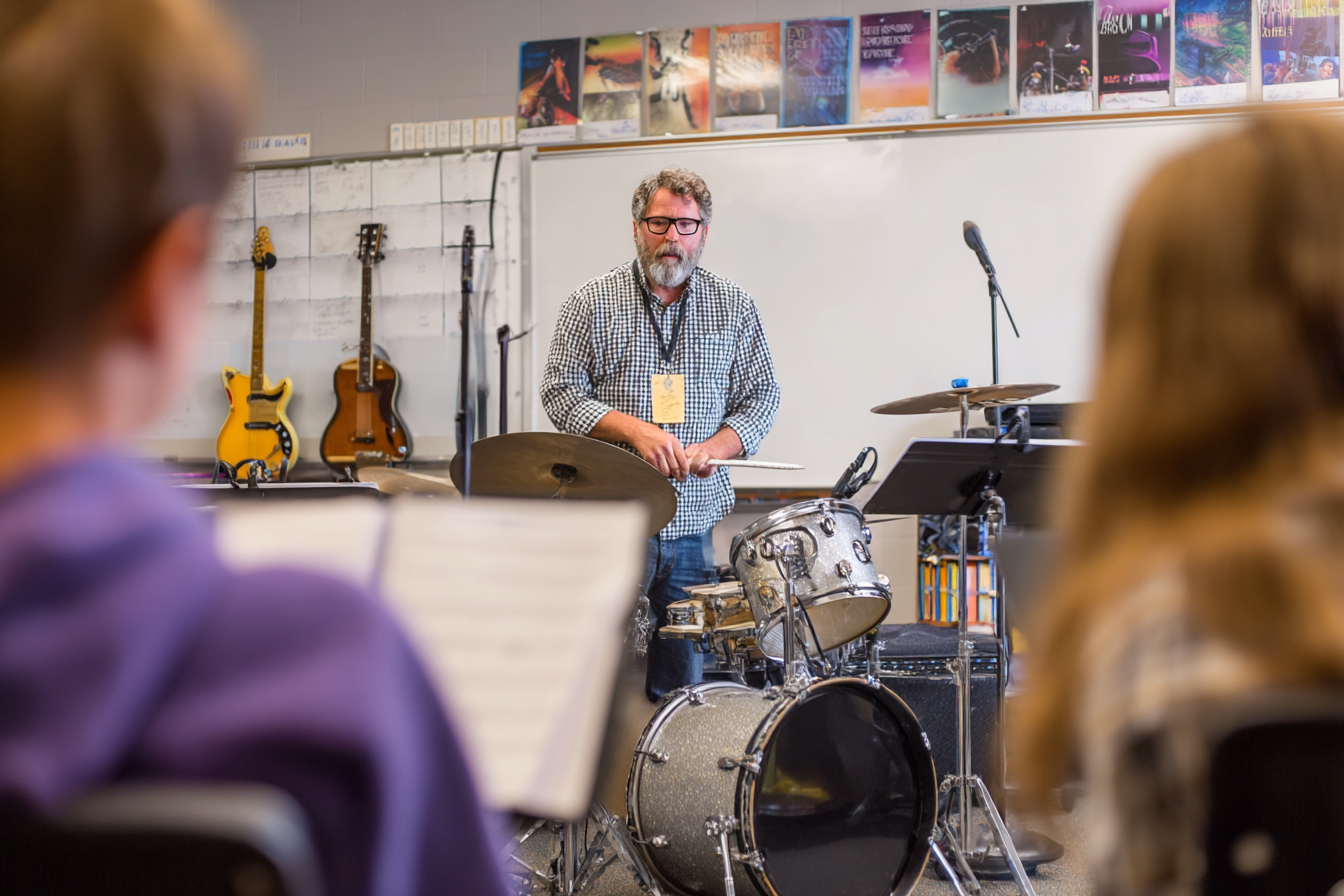
Focus: Establish rehearsal procedures, ensemble focus, and collaboration habits so students function as a responsible, unified band.
Grade Level: 6
Subject Area: Band (Rehearsing • Performing • Connecting)
Total Unit Duration: 5 sessions (one week), 50–60 minutes per session
I. Introduction
In this opening unit, students learn what it means to be a 6th grade band member in terms of routines, expectations, and responsibility. They practice how to enter the room, set up, warm up, follow conductor cues, and work with their section to keep rehearsals efficient and positive. Students also reflect on their personal interests and goals as musicians and connect those goals to daily rehearsal habits. By the end of the week, they can describe and demonstrate the routines that help the band sound and work at its best.
Essential Questions
- What makes a band rehearsal feel focused, respectful, and productive?
- How do daily routines (setup, warm-up, listening, watching) affect how our band sounds?
- What responsibilities do I have as a band member to support my section and the full ensemble?
- How can my personal interests and goals as a musician shape the way I rehearse and participate in band?
II. Objectives and Standards
Learning Objectives — Students will be able to:
- Describe and follow classroom and rehearsal routines for entering, setting up, warming up, and cleaning up in band.
- Demonstrate appropriate rehearsal and performance etiquette, including focused listening, watching the conductor, and respectful collaboration with peers.
- Identify ways to support their section and ensemble (helping with music stands, counting rests, staying quiet during instructions).
- Set at least one personal band goal (tone, reading, confidence, participation) and connect it to specific rehearsal behaviors.
- Explain how personal interests and goals influence their commitment and choices as a band musician.
Standards Alignment — 6th Grade Band (custom, NAfME-style)
- BD:Pr6.6b — Demonstrate appropriate rehearsal and performance etiquette as a band member, including respectful collaboration and focus.
- Example: Students follow conductor cues, track rests, and support ensemble success.
- BD:Cn10.6a — Describe how personal interests and goals influence musical choices and growth as a band musician.
- Example: Students set a goal (stronger tone, faster fingerings, confidence) and explain why it matters.
Success Criteria — Student Language
- I can enter, set up, and put away my instrument following our class routines without being reminded.
- I can show rehearsal etiquette by listening, watching the conductor, and helping my section stay focused.
- I can explain one way I help our ensemble (counting rests, balancing volume, staying quiet when others play).
- I can name at least one personal band goal and connect it to how I act in rehearsal.
- I can describe how my interests and goals affect the way I participate in band.
III. Materials and Resources
Tasks & Tools (teacher acquires/curates)
- Beginning-of-year band music or short exercises that allow frequent stopping and starting.
- Warm-up sheets (long tones, simple scales, unison rhythm patterns).
- Posted Band Routines & Expectations chart (entry, setup, warm-up, rehearsal behavior, cleanup).
- Seating chart and labeled chairs/stands.
- Goal-setting form or “My Band Goals” worksheet.
- Simple rehearsal rubric (focus, participation, etiquette, collaboration) in student-friendly language.
- Whiteboard or chart paper for listing class expectations and goals.
Preparation
- Arrange room with clear traffic flow for entering/exiting and a consistent seating layout.
- Post or prepare to project Band Routines (step-by-step for start/end of class).
- Decide on signals (raised hand, count, clapping pattern) for attention and transitions.
- Prepare a brief teacher model of what “professional posture” and “ready to play” look like.
- Copy goal-setting sheets for all students.
Common Misconceptions to Surface
- “Band rehearsal is just playing songs.” → Rehearsal is also about listening, watching, and following routines that help everyone succeed.
- “The conductor is the only one responsible for how rehearsal goes.” → Every band member’s focus and behavior impacts the group.
- “My personal goals don’t matter if the band plays okay.” → Individual goals and effort shape the overall ensemble sound.
- “Talking a little during directions doesn’t hurt.” → Even small distractions can break focus and slow down learning.
Key Terms (highlight in lessons) routine, rehearsal etiquette, focus, ensemble, section, cue, posture, goal, collaboration, responsibility
IV. Lesson Procedure
(Each day follows: Launch → Explore → Discuss → Reflect. Timing for a 50–60 minute block.)
Session 1 — What Is a Band Routine? (Pr6.6b • Cn10.6a)
- Launch (6–8 min)
- Ask: “Think about a time something ran very smoothly (a game, event, or class). What routines made it work well?”
- Briefly connect to band: “Our goal is to make rehearsals smooth so we can spend more time making music.”
- Explore (25–30 min)
- Walk students through the Band Routines & Expectations chart:
- Entering the room and going directly to seat.
- Setting up instrument and music stand.
- “Ready position” vs. “rest position.”
- Signals for attention and when to play or stop.
- Cleanup and dismissal routine.
- Practice the full routine without instruments, then with instruments.
- Run a short call-and-response exercise (teacher plays or claps, students respond) to practice watching cues and stopping together.
- Walk students through the Band Routines & Expectations chart:
- Discuss (10–12 min)
- Ask: “Which parts of our new routines feel easy? Which might we forget without practice?”
- Connect to BD:Pr6.6b — etiquette and focus as part of being a band member, not just a rule.
- Reflect (5–8 min)
- Exit slip: “One routine I can already do well is __. One routine I need to remember is __.”
Session 2 — Focus, Cues, and Ensemble Responsibility (Pr6.6b)
- Launch (5–7 min)
- Quick prompt: “What does it look like when an ensemble is not focused?” (short, humorous examples allowed).
- Compare with a quick teacher demo of focused posture and eyes on conductor.
- Explore (25–30 min)
- Practice a simple warm-up pattern (e.g., whole-note long tones, simple rhythm line) focusing on:
- Eyes on conductor cues.
- Starting and stopping exactly together.
- Staying silent during instructions and when other sections play.
- Alternate between full band and section-only playing so non-playing students practice quiet listening and tracking rests.
- Use a brief self-check: students use fingers or a quick scale to show how ready/focused they feel (1–5).
- Practice a simple warm-up pattern (e.g., whole-note long tones, simple rhythm line) focusing on:
- Discuss (10–12 min)
- Ask: “How did watching the conductor and staying quiet help our band?”
- Highlight examples of students who showed strong rehearsal etiquette and support for others.
- Reflect (5–8 min)
- Quick write: “Today I supported our ensemble by __. Next time, I will try to improve __.”
Session 3 — Collaboration & Section Habits (Pr6.6b • Cn10.6a)
- Launch (5–7 min)
- Ask: “What does it mean to be a good teammate in band?” List a few ideas (helping quietly, sharing stands, staying organized).
- Explore (25–30 min)
- In sections or row groups, review routines: sharing stands, organizing music, helping neighbors count rests.
- Each section completes a short “Section Success” checklist:
- We are on time and ready when the director steps on the podium.
- Our stands and chairs are set up correctly.
- We stay quiet while other sections are working.
- Play a short line or piece that features call-and-response or layered entrances so sections must listen and respond to each other.
- Discuss (10–12 min)
- Groups share one strength and one goal for their section habits.
- Teacher connects this to ensemble responsibility and BD:Pr6.6b (collaboration and focus).
- Reflect (5–8 min)
- Exit slip: “Our section is strong at __. We want to improve __ so we can help the whole band.”
Session 4 — Personal Goals & Band Growth (Cn10.6a)
- Launch (5–7 min)
- Ask: “Why did you choose band, or decide to keep doing it this year? What do you hope to get better at?”
- Emphasize that musicians can have many different goals (tone, reading, confidence, friendships, leadership).
- Explore (25–30 min)
- Students complete a “My Band Goals” sheet that includes:
- One personal musical goal (e.g., “play higher notes clearly,” “read rhythms more confidently”).
- One participation/behavior goal (e.g., “raise my hand more,” “stay quieter during instructions”).
- How their routines and habits in rehearsal will help reach those goals.
- After writing, students pair/share their goals with a partner or small group, practicing respectful listening.
- Play a short warm-up or piece while students try to act on one part of their goal (e.g., posture, watching more, steady tone).
- Students complete a “My Band Goals” sheet that includes:
- Discuss (10–12 min)
- Volunteers share how their goals connect to their daily band habits.
- Connect this explicitly to BD:Cn10.6a — personal interests and goals influence how we grow in band.
- Reflect (5–8 min)
- Quick reflection: “My main band goal this quarter is __. In rehearsal, that means I will __.”
Session 5 — Routines in Action: Mini Run-Through & Reflection (Pr6.6b • Cn10.6a)
- Launch (5–7 min)
- Review the Band Routines & Expectations chart one more time.
- Explain: “Today we will show what we’ve learned by doing a mini run-through like a short performance for ourselves.”
- Explore (25–30 min)
- Students enter, set up, and warm up using full routines with minimal teacher reminders.
- Perform 1–2 short pieces or lines as a “mini concert,” focusing on:
- Following cues.
- Keeping focus and quiet transitions.
- Showing professional posture and behavior.
- Teacher uses a simple rehearsal rubric to note overall strengths and next steps.
- Discuss (10–12 min)
- Whole group: “What routines did we show really well today? Where do we still need reminders?”
- Link the success of the mini run-through to students’ personal and ensemble goals.
- Reflect (5–8 min)
- Final reflection for the week: “One rehearsal habit I am proud of is __, and one I will keep working on is __.”
V. Differentiation and Accommodations
Advanced Learners
- Invite them to act as section leaders for routines (helping neighbors set up stands, check posture, and track rests).
- Ask them to model professional behavior and give positive reminders to peers when appropriate.
- Challenge them to set an additional leadership goal (e.g., “I will help my section stay focused by…”) on their goal sheet.
Targeted Support
- Provide a visual checklist for routines (with icons for entry, setup, warm-up, playing, cleanup).
- Use role-play to practice right and wrong rehearsal behaviors, then have students choose the better option.
- Offer sentence frames for reflections and goals such as:
- “I can help my section by __.”
- “In rehearsal, I sometimes get distracted when __, so I will __.”
- Give extra prompts or cues (verbal and visual) for attention and transitions.
Multilingual Learners
- Pair visuals with key vocabulary (routine, cue, section, ensemble, goal) on an anchor chart.
- Allow students to brainstorm or draft goals in their home language, then translate key ideas into English with support.
- Encourage partner discussion of routines and goals before writing, so language can be rehearsed orally.
- Use gesture and demonstration (showing posture, cues, quiet listening) to support understanding beyond words.
IEP/504 & Accessibility
- Adjust seating and stand placement for physical access and comfort.
- Break routines into small steps with clear, written or pictured prompts.
- Allow alternative ways to express reflections and goals (e.g., audio recording, brief conference, or checklists instead of long writing).
- Provide extra repetition and consistent cues to help students remember routines and expectations.
VI. Assessment and Evaluation
Formative Checks (daily)
- Session 1 — Observation of entry/setup and practice of routines; students can name at least one Band Routine.
- Session 2 — Students show improved focus and cue-following during warm-ups and exercises.
- Session 3 — Section checklists show awareness of collaboration habits and section responsibilities.
- Session 4 — Goal sheets are complete and show a clear link between personal goals and rehearsal behaviors.
- Session 5 — Mini run-through demonstrates progress in etiquette, focus, and routines; reflections show awareness of habits.
Summative — Band Routines & Expectations Participation & Reflection (0–2 per criterion, total 10)
- Rehearsal Etiquette (BD:Pr6.6b)
- 2: Consistently demonstrates appropriate etiquette (listening, no side talk during instructions, respectful behavior) throughout rehearsals.
- 1: Usually demonstrates appropriate etiquette, with occasional reminders needed.
- 0: Frequently needs reminders; behavior often distracts from rehearsal.
- Focus & Cues (BD:Pr6.6b)
- 2: Regularly watches the conductor, starts and stops with the group, and tracks rests accurately.
- 1: Sometimes watches cues and tracks rests; occasional late starts or missed cut-offs.
- 0: Rarely attends to cues; often unsure when to start/stop or re-enter.
- Collaboration & Support (BD:Pr6.6b)
- 2: Actively supports the ensemble (shares stands fairly, helps neighbors, stays quiet when others play); contributes positively to group focus.
- 1: Generally cooperative, but sometimes forgets to support others or follow section norms.
- 0: Collaboration is limited; behaviors sometimes interfere with others’ ability to focus or play.
- Personal Goal Setting (BD:Cn10.6a)
- 2: Clearly states at least one personal band goal and explains how rehearsal habits connect to that goal.
- 1: States a goal but gives a vague or incomplete connection to rehearsal habits.
- 0: Does not set a meaningful goal or cannot explain how it relates to band.
- Reflection on Growth (BD:Cn10.6a)
- 2: Reflection describes at least one concrete way the student has grown or plans to grow in band, with specific examples.
- 1: Reflection mentions growth or future effort but in general terms or with limited detail.
- 0: Reflection is missing, very brief, or does not address growth.
Feedback Protocol (TAG)
- Tell one strength (e.g., “You consistently watched the conductor and helped your section stay focused.”).
- Ask one question (e.g., “What routine helps you feel most ready to play when rehearsal starts?”).
- Give one suggestion (e.g., “Try planning one way to remind yourself about quiet listening during other sections’ parts.”).
VII. Reflection and Extension
Reflection Prompts
- Which band routine helps you the most, and why?
- How does your personal band goal change the way you behave in rehearsal?
- What is one way our class already works well together as an ensemble, and one way we can improve?
- How might the routines and habits you are practicing in band help you in other classes or activities?
Extensions
- Band Routine Poster: In small groups, create a visual poster or digital slide showing one key routine (entry, setup, warm-up, cleanup) and why it matters.
- Practice Habit Checklist: Design a simple daily or weekly checklist for at-home practice that connects to your band goal.
- Welcome Guide for New Members: Write a short “Welcome to 6th Grade Band” guide explaining routines and expectations to a future new student.
- Goal Check-In: Revisit goals mid-quarter and update with a brief reflection on progress and next steps.
Standards Trace — When Each Standard Is Addressed
- BD:Pr6.6b — Sessions 1–3, 5
- Session 1: Learning and practicing routines and etiquette for entry, setup, and rehearsal.
- Session 2: Applying etiquette through focus, quiet listening, and following cues.
- Session 3: Building collaboration habits within sections to support ensemble success.
- Session 5: Demonstrating etiquette and focus during the mini run-through.
- BD:Cn10.6a — Sessions 1, 4–5
- Session 1: Connecting routines to the kind of band experience students want to have.
- Session 4: Setting personal band goals and linking them to rehearsal choices.
- Session 5: Reflecting on how routines and goals shape ongoing growth as band musicians.