Unit Plan 36 (Grade 6 Orchestra): End-of-Year Performance & Reflection
Grade 6 orchestra unit: perform repertoire, reflect on growth in technique, ensemble unity, musicianship, and set goals for next year.

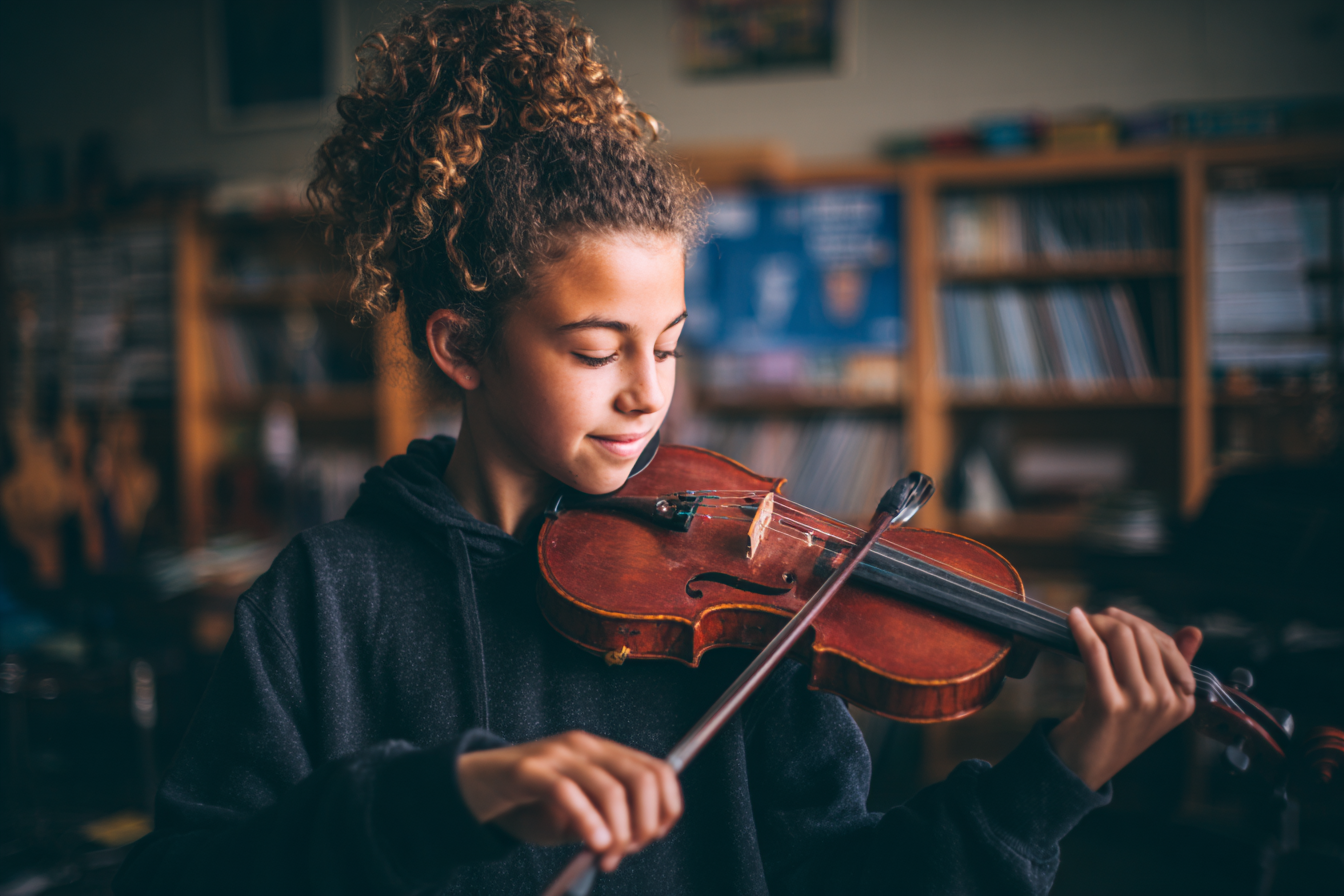
Focus: Perform and reflect on growth in technique, ensemble unity, and musicianship.
Grade Level: 6
Subject Area: Orchestra (Performance • Reflection • Identity/Growth)
Total Unit Duration: 5 sessions (one week), 50–60 minutes per session
I. Introduction
In this culminating unit, Grade 6 orchestra students celebrate their year of playing by preparing and presenting an end-of-year performance, then reflecting on their growth as musicians. They demonstrate accurate pitch, steady rhythm, characteristic tone, and unified bowing, while also showing appropriate rehearsal and performance etiquette. After performing, students look back at personal goals, rehearsal habits, and key moments from the year to describe how their interests and goals shaped their growth as string players and how they are preparing for next year.
Essential Questions
- What does it look and sound like when a middle school orchestra performs with strong technique, ensemble unity, and musicianship?
- How do rehearsal and performance etiquette (watching the conductor, tracking rests, supporting the section) affect the success of a performance?
- In what ways have my personal interests and goals influenced my growth as a string player this year?
- How can reflecting on our musical journey help us set meaningful goals for future orchestra experiences?
II. Objectives and Standards
Learning Objectives — Students will be able to:
- Perform selected end-of-year repertoire with accurate pitch, steady rhythm, characteristic tone, and unified bowing in an ensemble setting.
- Demonstrate appropriate rehearsal and performance etiquette, including following the conductor, tracking rests, and supporting section and ensemble success.
- Reflect on personal growth in technique, ensemble skills, and musicianship, using specific examples from rehearsals and performances.
- Explain how their interests and goals as string players influenced practice habits, musical choices, and participation in orchestra this year.
- Set at least one forward-looking goal for continued growth in orchestra (e.g., tone, intonation, leadership, practice routines) and describe why it matters.
Standards Alignment — Grade 6 Orchestra (custom, NAfME-style)
- OR:Pr6.6a — Perform orchestra music with accurate pitch, steady rhythm, characteristic tone, unified bowing, and basic expression in an ensemble setting.
- Example: Students perform a two-part string arrangement with steady tempo and matching bow directions.
- OR:Pr6.6b — Demonstrate appropriate rehearsal and performance etiquette, including following the conductor, tracking rests, and supporting section/ensemble success.
- Example: Students watch for cues, count rests accurately, and adjust bowing to match the section.
- OR:Cn10.6a — Describe how personal interests and goals influence musical choices and growth as a string player.
- Example: Students set a goal (stronger tone, cleaner bowing, better intonation) and explain why it matters.
Success Criteria — Student Language
- I can play our end-of-year music with mostly accurate notes and rhythms, good tone, and matching bowings with my section.
- I can show good performance etiquette by watching the conductor, tracking my rests, and staying focused before, during, and after we play.
- I can describe at least two ways I grew as a string player this year (for example, tone, intonation, confidence, leadership).
- I can explain how my interests and goals affected how I practiced, played, and participated in orchestra.
- I can set a clear goal for next year and say why it is important for my musical growth.
III. Materials and Resources
Tasks & Tools (teacher acquires/curates)
- Selected end-of-year repertoire (1–2 main pieces appropriate for Grade 6) for performance.
- Performance rubrics focusing on tone, intonation, rhythm, bow unity, expression, and etiquette.
- Audio or video recording device for documenting dress rehearsal or performance.
- Reflection sheets or prompts for student writing or audio reflections (personal growth, favorite moments, goals).
- Copies of any beginning-of-year goal-setting sheets or earlier reflections (if available) for comparison.
- Anchor charts:
- “What a Strong Performance Looks & Sounds Like” (pitch, rhythm, tone, bowing, expression, etiquette).
- “Performance Etiquette Checklist” (focus, posture, watching, listening, entering/exiting, audience awareness).
- “My Growth as a String Player” (technique, ensemble skills, confidence, leadership, practice habits).
Preparation
- Choose the featured performance piece(s) and mark key spots that show ensemble growth (technical passages, dynamic sections, expressive moments).
- Prepare and copy performance rubrics and reflection templates for students.
- Decide whether the end-of-year performance will be for a live audience (families, another class) or an in-class performance with recording.
- If possible, gather early-year recordings or notes to compare with current performance.
Common Misconceptions to Surface
- “The year is almost over, so how we perform doesn’t really matter.” → End-of-year performances show growth and build habits for next year.
- “Reflection is just saying if we liked it or not.” → Reflection should include specific examples of growth and areas for future work.
- “Performance etiquette is only about being quiet.” → It also includes watching the conductor, tracking rests, and supporting the ensemble.
- “My interests outside of school don’t connect to orchestra.” → Hobbies, music preferences, and goals can shape practice habits and musical choices.
Key Terms (highlight in lessons) performance, repertoire, tone, intonation, ensemble unity, bow unity, expression, etiquette, reflection, goal, growth, musician identity, audience
IV. Lesson Procedure
(Each day follows: Launch → Explore → Discuss → Reflect. Timing for a 50–60 minute block.)
Session 1 — Looking Back & Setting Performance Focus (OR:Pr6.6a, OR:Pr6.6b, OR:Cn10.6a)
- Launch (8–10 min)
- Quick class conversation: “Think back to the beginning of the year. How did we sound then? How do we sound now?”
- Generate a chart with student responses under Technique, Ensemble Unity, and Musicianship/Expression.
- Explore (25–30 min)
- Run through the main performance piece(s) once (record if helpful).
- Students complete a quick rubric for today’s run, rating performance in pitch, rhythm, tone, bow unity, expression, and etiquette.
- In small groups, students identify two strengths and two areas to focus on before the final performance.
- Discuss (8–10 min)
- Whole-class share: write the top ensemble goals on the board (e.g., “stronger dynamic contrast,” “cleaner entrances,” “better watching in the ending”).
- Connect these goals to Pr6.6a (performance quality) and Pr6.6b (etiquette and focus).
- Reflect (5–7 min)
- Students start a short reflection: “One way I have grown since the beginning of the year is ___, and for our final performance I want to focus on ___.”
Session 2 — Focused Rehearsal & Dress Rehearsal Skills (OR:Pr6.6a, OR:Pr6.6b)
- Launch (5–7 min)
- Review ensemble goals from Session 1 and the Performance Etiquette Checklist (entering, tuning, focus, bowing, applause).
- Ask: “What can we control to make our performance feel professional?”
- Explore (25–30 min)
- Targeted rehearsal of key sections in the repertoire:
- Loop technical passages with slow practice for intonation and rhythm.
- Check bowing alignment and practice a short passage with everyone watching the conductor.
- Run a mini dress rehearsal sequence: entrance → tuning → piece → bow → exit.
- Emphasize consistent etiquette (Pr6.6b) throughout.
- Targeted rehearsal of key sections in the repertoire:
- Discuss (8–10 min)
- Ask students: “What improved in our playing today? Where did our etiquette or focus make a difference?”
- Class notes one or two final details to polish before the performance.
- Reflect (5–7 min)
- Exit ticket: “During today’s rehearsal, I noticed our ensemble was strongest in ___ and needs one more rehearsal on ___.”
Session 3 — End-of-Year Performance (OR:Pr6.6a, OR:Pr6.6b)
- Launch (5–7 min)
- Brief calm warm-up (scale or chorale) focusing on tone and listening across the ensemble.
- Remind students: “Today we show our growth. Focus on watching, listening, and supporting your section.”
- Explore (25–30 min)
- Conduct the end-of-year performance:
- If a live audience is present, follow full concert procedures (entrance, tuning, program order, bowing, exit).
- If in-class, treat it as a formal performance and record audio or video.
- Maintain high expectations for pitch, rhythm, tone, bow unity, and expression (Pr6.6a) and etiquette (Pr6.6b).
- Conduct the end-of-year performance:
- Discuss (8–10 min)
- After the performance, ask a few quick questions:
- “What moment felt the strongest in our playing?”
- “Where did we feel the most together as an ensemble?”
- If time, replay a short part of the recording and invite a few observations.
- After the performance, ask a few quick questions:
- Reflect (5–7 min)
- Students jot a quick note: “One moment in our performance that made me feel proud was ___ because ___.”
Session 4 — Reflection on Growth & Identity as String Players (OR:Cn10.6a)
- Launch (5–7 min)
- Show or play a short clip of the performance (or compare with an early-year clip if available).
- Ask: “What differences do you hear between then and now?”
- Explore (25–30 min)
- Students complete a guided reflection using prompts such as:
- “At the start of the year, I struggled with ___. Now I can ___.”
- “A goal I set for myself was ___. I worked toward it by ___.”
- “My interests (favorite styles, songs, or musicians) influenced my playing this year by ___.”
- Encourage students to mention technique, ensemble skills, and musicianship with specific examples (measures, pieces, rehearsals).
- Students complete a guided reflection using prompts such as:
- Discuss (8–10 min)
- In pairs or small groups, students share one growth statement and one way their goals or interests shaped their year.
- Whole-class share of a few reflections to highlight varied paths of growth.
- Reflect (5–7 min)
- Students add: “Next year, one thing I want to keep doing is ___, and one new goal I have is ___.”
Session 5 — Looking Ahead: Goals for Future Orchestra (All standards)
- Launch (5–7 min)
- Brief circle prompt: “In one or two words, what will you remember most about orchestra this year?” (tone, friends, concerts, challenge, confidence, etc.).
- Explore (25–30 min)
- Students create a “Letter to Future Me” (or short video/audio message) including:
- One or two proud moments from this year’s performance(s).
- A summary of their biggest growth in technique, ensemble skills, or musicianship.
- At least one specific goal for next year (e.g., “develop stronger vibrato,” “lead my section,” “practice more consistently at home”).
- Collect letters to return at the start of next year, or have students keep them for themselves.
- Students create a “Letter to Future Me” (or short video/audio message) including:
- Discuss (8–10 min)
- Optional sharing: volunteers read or summarize a part of their letter (no pressure to share personal details).
- Teacher highlights themes: perseverance, teamwork, listening, courage, and ongoing growth.
- Reflect (5–7 min)
- Final reflection prompt: “Because of this year in orchestra, I now see myself as a musician who ___.”
V. Differentiation and Accommodations
Advanced Learners
- Invite students to take on leadership roles during dress rehearsal (tuning leader, section cueing, bowing check captain).
- Ask them to write a more detailed reflection comparing two performances (early vs. late year) using musical vocabulary (intonation, balance, texture).
- Encourage them to set multi-step goals for next year (e.g., “audition for honor orchestra,” “mentor a younger player”).
Targeted Support
- Provide a simplified reflection template with sentence starters and checkboxes for growth areas (tone, rhythm, bow control, listening).
- During performance prep, highlight key measures with color coding for entrances, rests, and bowings.
- Allow students to reflect with a partner conversation before writing short phrases or bullet points.
Multilingual Learners
- Offer a bilingual word bank for important terms such as tone, rhythm, bow, conductor, goal, practice.
- Let students draft reflections in their home language first, then translate key ideas into English with support.
- Accept short written responses + labeled drawings (e.g., a self-portrait playing with words like “confident,” “leader,” “team”) as valid reflection artifacts.
IEP/504 & Accessibility
- Break reflection tasks into small steps with visual checklists (e.g., “Step 1: Circle a growth area; Step 2: Write one sentence about it”).
- Provide enlarged music and visual seating charts for students who need help orienting in the ensemble.
- Offer alternative reflection formats such as audio recordings, interviews, or graphic organizers instead of long written paragraphs.
- Allow flexible seating or sensory supports during the performance and reflection sessions as needed.
VI. Assessment and Evaluation
Formative Checks (daily)
- Session 1 — Student rubrics and discussion show understanding of current strengths and needs in performance quality and etiquette.
- Session 2 — Observations indicate improved bow unity, intonation, and focus; students can name at least one etiquette behavior they improved.
- Session 3 — Performance demonstrates application of Pr6.6a and Pr6.6b; quick notes capture immediate impressions of success and growth.
- Session 4 — Reflection drafts show students can describe personal growth with at least one specific example.
- Session 5 — Letters or final reflections include at least one future goal connected to their identity and growth as string players.
Summative — End-of-Year Performance & Reflection (0–2 per criterion, total 10)
- Performance Accuracy & Musicianship (OR:Pr6.6a)
- 2: Performs repertoire with mostly accurate pitch and rhythm, characteristic tone, and clearly unified bowings, showing appropriate expression for the music.
- 1: Performance shows some correct pitches, rhythm, and tone but with noticeable inconsistencies or weak ensemble unity in places.
- 0: Performance has frequent pitch/rhythm errors and lacks clear tone quality or ensemble togetherness.
- Rehearsal & Performance Etiquette (OR:Pr6.6b)
- 2: Consistently follows conductor cues, tracks rests accurately, maintains appropriate posture and focus, and supports section/ensemble success.
- 1: Usually follows etiquette expectations but with occasional lapses in focus, tracking, or responsiveness.
- 0: Rarely demonstrates appropriate etiquette; behavior distracts from ensemble success.
- Reflection on Growth & Identity (OR:Cn10.6a)
- 2: Clearly describes personal growth as a string player with specific examples (e.g., tone, intonation, practice habits, confidence) and explains how interests/goals influenced that growth.
- 1: Describes growth in general terms or mentions interests/goals, but examples are vague or incomplete.
- 0: Provides little or no meaningful reflection on growth or personal goals.
- Future Goal Setting
- 2: States at least one specific, realistic goal for future orchestra participation and explains why it matters for their musical development.
- 1: Provides a goal, but it is very general or only partly explained.
- 0: No clear goal is stated or the goal is unrelated to musical growth.
- Communication & Use of Musical Language
- 2: Reflection (written or recorded) is clear and organized, using appropriate musical terms (tone, intonation, rhythm, ensemble, expression) to describe experiences.
- 1: Reflection is understandable but uses limited musical vocabulary or has some organizational issues.
- 0: Reflection is very brief, off-topic, or hard to follow.
Feedback Protocol (TAG)
- Tell one strength (e.g., “Your section’s listening and matching bow direction made the sound very unified.”).
- Ask one question (e.g., “What practice habit helped you the most with intonation this year?”).
- Give one suggestion (e.g., “Next year, try setting a weekly practice goal to keep building your tone.”).
VII. Reflection and Extension
Reflection Prompts
- How has your technique (posture, bow hold, left-hand shape, tone) changed from the start of the year to now?
- When did you feel the most connected to the ensemble, and what were you doing to support that unity?
- How did your interests and goals shape your choices in orchestra (what you practiced, how you listened, how you participated)?
- What is one piece of advice you would give to a new 6th grade string player joining orchestra next year?
Extensions
- Growth Portfolio: Compile a mini portfolio including early and late recordings (if available), rubrics, and written reflections to document your musical journey.
- Mentor Message: Write a short note or record a message for next year’s ensemble about what helped you grow and how they can succeed in orchestra.
- Personal Practice Plan: Create a simple practice plan for summer or next year that connects directly to your future goal (e.g., schedule, exercises, pieces to revisit).
Standards Trace — When Each Standard Is Addressed
- OR:Pr6.6a — Sessions 1–3, 5 (repertoire run-throughs, end-of-year performance, demonstrating accurate pitch, steady rhythm, characteristic tone, unified bowing, and expression).
- OR:Pr6.6b — Sessions 1–3 (discussing and demonstrating rehearsal/performance etiquette, following conductor cues, tracking rests, supporting ensemble success).
- OR:Cn10.6a — Sessions 1, 4–5 (reflecting on personal interests, goals, and growth as a string player; setting future goals and connecting them to musical choices).