Unit Plan 1 (Grade 6 Orchestra): Orchestra Routines & Growth Goals
Grade 6 orchestra students build strong rehearsal routines, section roles, and goal-setting habits to grow as independent string players—practicing etiquette, conductor cues, and self-reflection that supports confident ensemble participation all year.

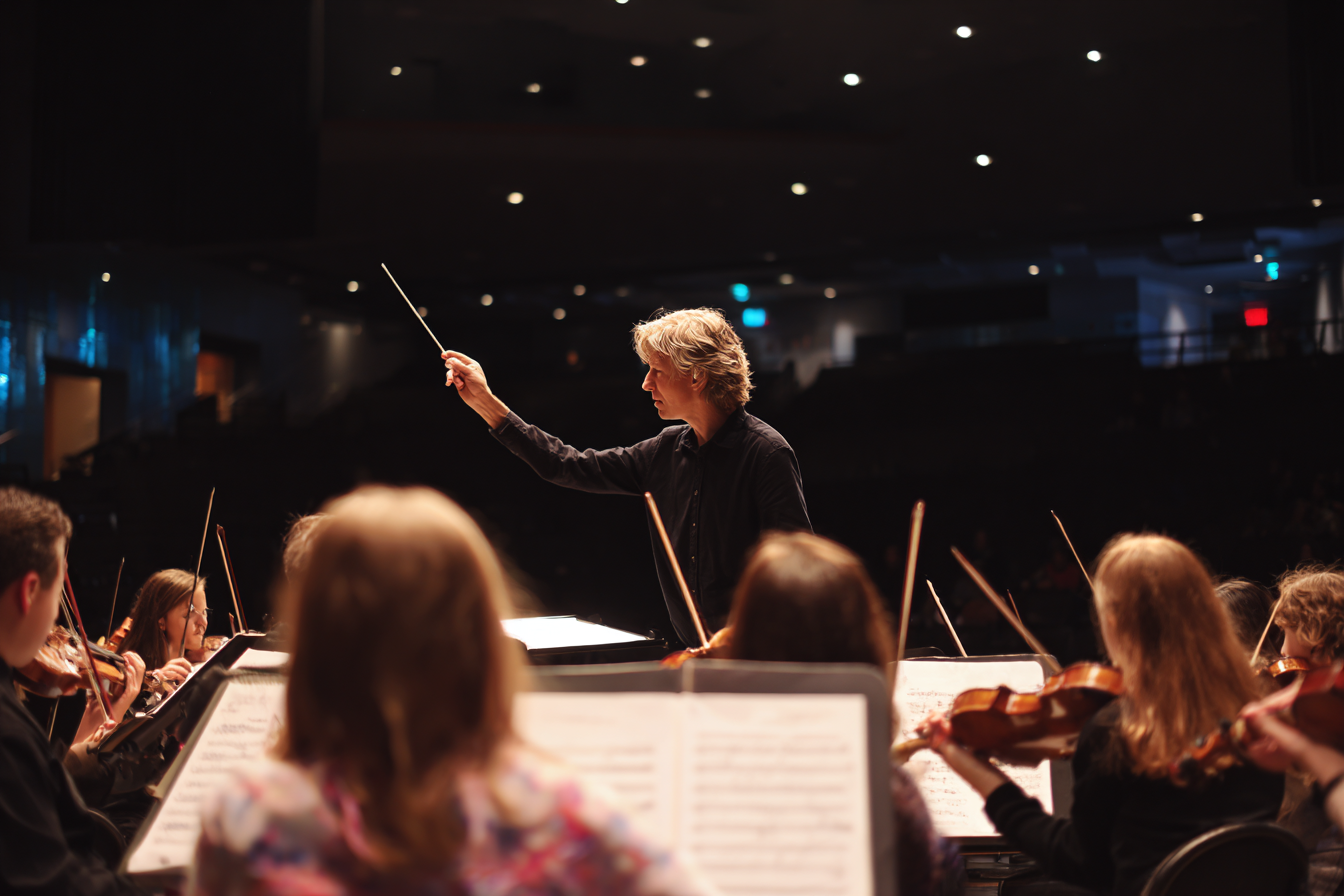
Focus: Establish clear rehearsal expectations, section roles, and personal goal-setting routines to support growth as independent string players.
Grade Level: 6
Subject Area: Orchestra (Routines • Rehearsal Skills • Identity/Goals)
Total Unit Duration: 5 sessions (one week), 50–60 minutes per session
I. Introduction
In this opening unit, Grade 6 orchestra students learn how our orchestra runs: how to enter, set up, tune, watch the conductor, track rests, match bowings, and support their section. Students practice core routines while also reflecting on who they are as string players and what they want to improve this year. Using short playing checks, simple self-reflections, and class discussions, they connect personal interests and goals to their role in the ensemble and begin building habits that will support growth all year.
Essential Questions
- What does appropriate rehearsal and performance etiquette look and sound like in a Grade 6 orchestra?
- How do my choices and behavior in rehearsal affect my section and the whole ensemble?
- How can my interests and goals as a musician guide what I focus on this year?
- What routines and habits will help me grow as an independent, responsible string player?
II. Objectives and Standards
Learning Objectives — Students will be able to:
- Demonstrate rehearsal routines (set-up, tuning, watching the conductor, tracking rests) with minimal teacher reminders.
- Show appropriate rehearsal and performance etiquette, including quiet listening, focus, and supporting section and ensemble needs.
- Describe at least two personal interests or goals as a string player and explain why they matter.
- Complete a simple self-check of current strengths and growth areas in tone, bowing, and intonation.
- Create a personal growth goal and one or two actions (practice habits or rehearsal behaviors) to work toward it.
Standards Alignment — Grade 6 Orchestra (custom, NAfME-style)
- OR:Pr6.6b — Demonstrate appropriate rehearsal and performance etiquette, including following the conductor, tracking rests, and supporting section/ensemble success.
- Example: Students watch for cues, count rests accurately, and adjust bowing to match the section.
- OR:Cn10.6a — Describe how personal interests and goals influence musical choices and growth as a string player.
- Example: Students set a goal (stronger tone, cleaner bowing, better intonation) and explain why it matters.
Success Criteria — Student Language
- I can follow our orchestra routines for entering, setting up, tuning, and starting rehearsal.
- I can show rehearsal etiquette by watching the conductor, tracking rests, and supporting my section.
- I can name at least one strength and one thing I want to improve on my instrument.
- I can explain a personal goal (tone, intonation, bowing, confidence, etc.) and why it is important for me.
- I can describe how my interests and goals affect how I play and practice in orchestra.
III. Materials and Resources
Tasks & Tools (teacher acquires/curates)
- Teacher-selected warm-ups and a short, accessible ensemble piece or excerpt suitable for early Grade 6.
- Seating chart and section assignments (or temporary seating plan if still adjusting).
- Visual routine charts:
- “Orchestra Entry & Set-Up”
- “Tuning & Ready Position”
- “Watching the Conductor & Tracking Rests”
- Simple self-reflection forms or goal-setting sheets (e.g., “My strengths,” “My challenges,” “My goals”).
- Rehearsal etiquette checklist for teacher and/or peer observation.
- Sticky notes, index cards, or digital form for quick goal statements.
Preparation
- Decide on and post clear class routines (entering, cases, chairs/stands, tuning order, end-of-class routine).
- Prepare a brief teacher demonstration of strong vs. weak rehearsal etiquette and discuss with students.
- Create or copy self-reflection and goal-setting forms that are short and student-friendly.
- Choose a short, comfortable playing excerpt for individual or small-group tone/intonation checks.
Common Misconceptions to Surface
- “Etiquette only matters in concerts, not in rehearsal.” → Rehearsal etiquette is what makes performances possible and successful.
- “The conductor is the only one responsible for keeping everyone together.” → Students also must watch, listen, and count to support the ensemble.
- “Goals are just about being ‘good’ or ‘bad’ at orchestra.” → Goals are about specific skills and habits we can work on over time.
- “My personal interests don’t matter in orchestra.” → Interests and goals shape how students practice, participate, and lead in the ensemble.
Key Terms (highlight in lessons) rehearsal etiquette, conductor, cue, rest, section, ensemble, routine, focus, goal, practice habit, growth, string player
IV. Lesson Procedure
(Each day follows: Launch → Explore → Discuss → Reflect. Timing for a 50–60 minute block.)
Session 1 — Welcome to Orchestra: Routines & Expectations (OR:Pr6.6b)
- Launch (8–10 min)
- Greet students and introduce the idea of orchestra as a team.
- Ask: “What makes a rehearsal feel calm, focused, and productive? What makes it feel confusing or stressful?” Record quick responses.
- Explore (25–30 min)
- Walk through the Orchestra Entry & Set-Up routine: where cases go, how to get chairs/stands, how to place music.
- Model and practice tuning procedures (listening, staying quiet, following the tuning order).
- Have students do a short play-through of open strings or a very simple warm-up to practice watching the conductor for start/stop cues.
- Introduce a basic rehearsal etiquette checklist (watching, listening, quiet while others tune, no extra playing).
- Discuss (10–12 min)
- Ask: “Which parts of our routines felt smooth today? Where did we need more practice?”
- Connect to OR:Pr6.6b: following the conductor, tracking rests, supporting section/ensemble success.
- Reflect (5 min)
- Exit slip: “One routine I did well today was __. One routine I want to remember for next time is __.”
Session 2 — Following the Conductor & Supporting the Section (OR:Pr6.6b)
- Launch (5–7 min)
- Briefly review entry and tuning routines.
- Ask: “Why is it important that everyone watches the conductor and counts rests carefully, not just the teacher?”
- Explore (25–30 min)
- Lead call-and-response conducting exercises (e.g., start/stop on cue, change dynamics with hand signals).
- Use a short ensemble passage where students must track a few measures of rests and then enter together. Practice several times focusing on:
- Watching the conductor.
- Counting rests silently.
- Matching bow direction and articulation with the section.
- Have students work briefly in sections to check bowings and help each other line up entrances.
- Discuss (10–12 min)
- Ask: “What helped us come in together? How did your section help you stay on track?”
- Highlight specific examples of students supporting their section or ensemble.
- Reflect (5 min)
- Quick write: “Today I supported my section/ensemble by __. Next time, I want to remember to __.”
Session 3 — Who Am I as a String Player? Strengths & Challenges (OR:Cn10.6a)
- Launch (6–8 min)
- Ask: “When you think about yourself as a string player, what are you proud of? What feels challenging?”
- Explain that knowing our strengths and challenges helps us set meaningful goals.
- Explore (25–30 min)
- Guide students through a short self-check using a simple playing task (e.g., a scale, bowing pattern, or short excerpt):
- Focus on tone, bow control, and intonation.
- Students fill out a reflection form noting:
- One thing they feel confident about (e.g., “My bow hold is steady,” “I stay in rhythm”).
- One thing that feels challenging (e.g., “My third finger is unsure,” “My sound is scratchy when I play loud”).
- Prompt them to note personal interests (favorite styles, pieces, role in section) that motivate them.
- Guide students through a short self-check using a simple playing task (e.g., a scale, bowing pattern, or short excerpt):
- Discuss (10–12 min)
- In pairs or small groups: share one strength and one challenge (optional to keep challenges private if needed).
- Whole-group: “How can our strengths help the group? How can we support each other with challenges?”
- Reflect (5 min)
- Exit slip: “One way my interests and strengths can help our orchestra this year is __.”
Session 4 — Setting Personal Growth Goals & Action Steps (OR:Cn10.6a, OR:Pr6.6b)
- Launch (5–7 min)
- Review: strengths/challenges from Session 3.
- Ask: “What makes a good goal—one that you can actually work toward and see progress on?”
- Explore (25–30 min)
- Introduce a simple goal-setting template:
- “This year, I want to improve my __ (tone, intonation, bowing, counting, confidence, leadership).”
- “This matters because __.”
- “To work toward this goal, I will __ in rehearsal and __ at home.”
- Model one example (e.g., “I want to improve my tone by keeping my bow in the lane and using more bow.”).
- Students write one main goal and identify 1–2 concrete actions connected to rehearsal routines and practice habits.
- If time allows, have students share in small groups and encourage peers to offer one helpful suggestion for each person’s action steps.
- Introduce a simple goal-setting template:
- Discuss (10–12 min)
- Ask: “How do our goals connect to the routines and etiquette we’ve been practicing?”
- Emphasize that following conductor cues, tracking rests, and supporting the section are part of working toward many goals.
- Reflect (5 min)
- Students copy their goal onto a sticky note or “goal card” to keep in their folder.
- Quick sentence: “My main orchestra goal is __ and I will work on it by __.”
Session 5 — Mini Performance, Reflection & Growth Commitments (All standards)
- Launch (5–7 min)
- Explain that today is a chance to put routines, etiquette, and goals together in a short mini performance.
- Review expectations: quiet set-up, tuning, watching the conductor, tracking rests, supporting sections.
- Explore (25–30 min)
- Students perform a short in-class mini performance (could be warm-ups plus a short piece or excerpt).
- Emphasize:
- OR:Pr6.6b — etiquette, following cues, tracking rests, ensemble support.
- Awareness of personal growth goals (e.g., focusing on tone, counting, bowings).
- After playing, students complete a brief performance reflection:
- What routine did I follow well?
- What part of my goal did I successfully work on?
- What do I still want to keep improving next week?
- Discuss (10–12 min)
- Whole-group debrief: “What did we do well as an ensemble?” “What routines already feel natural?”
- Highlight how students’ interests and goals showed up in the way they played and behaved.
- Reflect (5–7 min)
- Final prompt: “This week, I learned that being a good orchestra member means __. One habit I promise to continue is __.”
V. Differentiation and Accommodations
Advanced Learners
- Invite advanced students to help model routines (tuning, posture, watching cues) and gently coach peers in their section.
- Encourage them to set a more specific or multi-step goal (e.g., “improve shifted intonation in measure 12–16 of our piece”).
- Ask them to write a short reflection paragraph connecting their goal to future ensembles (e.g., “skills I’ll need for 7th grade orchestra or youth orchestra”).
Targeted Support
- Provide visual checklists (“1. Get chair/stand, 2. Open case, 3. Sit in playing position…”) for students who need more structure.
- Offer sentence frames for goal-setting and reflection:
- “I feel strong at __ because __.”
- “I want to get better at __ so that __.”
- “In rehearsal, I can help myself by __.”
- Allow additional practice time in small groups or with the teacher for students who feel unsure about routines.
Multilingual Learners
- Pair students strategically so that peers can translate or clarify directions and routines as needed.
- Provide a word bank with key terms (e.g., “conductor, cue, rest, section, goal, focus”) with simple definitions and icons.
- Allow students to brainstorm goals or reflections in their home language first, then translate key ideas into English with support.
IEP/504 & Accessibility
- Break multi-step routines into small, manageable chunks and practice them repeatedly over time.
- Offer options for shorter written responses or oral reflection for students who struggle with extended writing.
- Ensure physical set-up (chairs, stands, pathways) supports students with mobility or sensory needs.
- Provide enlarged music or highlighted cues for students who need visual support to track entrances and rests.
VI. Assessment and Evaluation
Formative Checks (daily)
- Session 1 — Teacher observation of entry, set-up, and tuning routines shows how well students can follow basic orchestra procedures.
- Session 2 — Rehearsal etiquette checklist and observation reveal how consistently students watch the conductor, track rests, and support their section.
- Session 3 — Self-check reflections demonstrate whether students can identify strengths and challenges honestly.
- Session 4 — Goal-setting sheets show if students can create clear, meaningful goals and action steps connected to playing and routines.
- Session 5 — Mini performance reflections indicate how students connect performance behavior and personal goals to growth.
Summative — Routines & Growth Goals Check (0–2 per criterion, total 10)
- Rehearsal Etiquette & Routines (OR:Pr6.6b)
- 2: Consistently follows entry, set-up, tuning, and rehearsal expectations; demonstrates appropriate etiquette with minimal reminders.
- 1: Follows routines and etiquette some of the time but needs occasional reminders.
- 0: Frequently disregards routines and etiquette; requires many prompts.
- Following Conductor & Tracking Rests (OR:Pr6.6b)
- 2: Regularly watches the conductor, responds to cues, and counts rests accurately to support clean entrances and cutoffs.
- 1: Watches and counts some of the time but is inconsistent; entrances may be late/early occasionally.
- 0: Rarely watches or counts; entrances and cutoffs are often unclear.
- Self-Understanding as a String Player (OR:Cn10.6a)
- 2: Clearly identifies at least one strength and one challenge, and explains how these affect their musical experiences.
- 1: Names a strength and/or challenge but with limited detail or unclear connection to playing.
- 0: Provides little or no meaningful description of strengths or challenges.
- Goal Setting (OR:Cn10.6a)
- 2: States a specific, realistic goal and at least one concrete action step connected to rehearsal/practice habits.
- 1: States a general or vague goal with limited or unclear action steps.
- 0: Goal is missing, unrealistic, or not connected to musical growth.
- Reflection on Growth & Responsibility
- 2: Reflects thoughtfully on how routines, etiquette, and personal goals will support growth as a string player and ensemble member.
- 1: Reflection mentions growth or responsibility but in general terms or without clear examples.
- 0: Reflection does not show awareness of personal responsibility or growth.
Feedback Protocol (TAG)
- Tell one strength (e.g., “You followed the tuning routine very carefully and helped your stand partner stay focused.”).
- Ask one question (e.g., “What small change in your practice could help you reach your tone goal?”).
- Give one suggestion (e.g., “Next rehearsal, try watching the conductor every time you count rests to line up your entrances even more.”).
VII. Reflection and Extension
Reflection Prompts
- What does being a responsible orchestra member mean to you now? How is that different from the start of the week?
- How do your personal interests and goals shape the way you behave and play in rehearsal?
- Which routine or habit do you think will help you the most this year, and why?
Extensions
- Goal Bookmark: Students design a small bookmark or folder insert with their main orchestra goal and 1–2 action steps to see each rehearsal.
- Routine Poster: In small groups, students create mini-posters illustrating one part of the orchestra routine (entry, tuning, watching, tracking rests) to hang in the room.
- Practice Plan Starter: Students outline a very simple at-home practice plan (even 5–10 minutes, 2–3 times a week) that connects directly to their goal.
Standards Trace — When Each Standard Is Addressed
- OR:Pr6.6b — Sessions 1–2, 4–5 (learning and practicing routines; following conductor cues; tracking rests; supporting sections during mini performance and rehearsal).
- OR:Cn10.6a — Sessions 3–5 (reflecting on strengths and challenges; identifying interests and goals; creating growth goals and action steps; connecting identity and habits to future musical growth).