Unit Plan 1 (Grade 6 Science): Science Skills & Investigation Routines
Launch Grade 6 science with safety, notebooks, measurement, graphing, and simple Earth–Sun–Moon models to build skills for engineering and space systems.

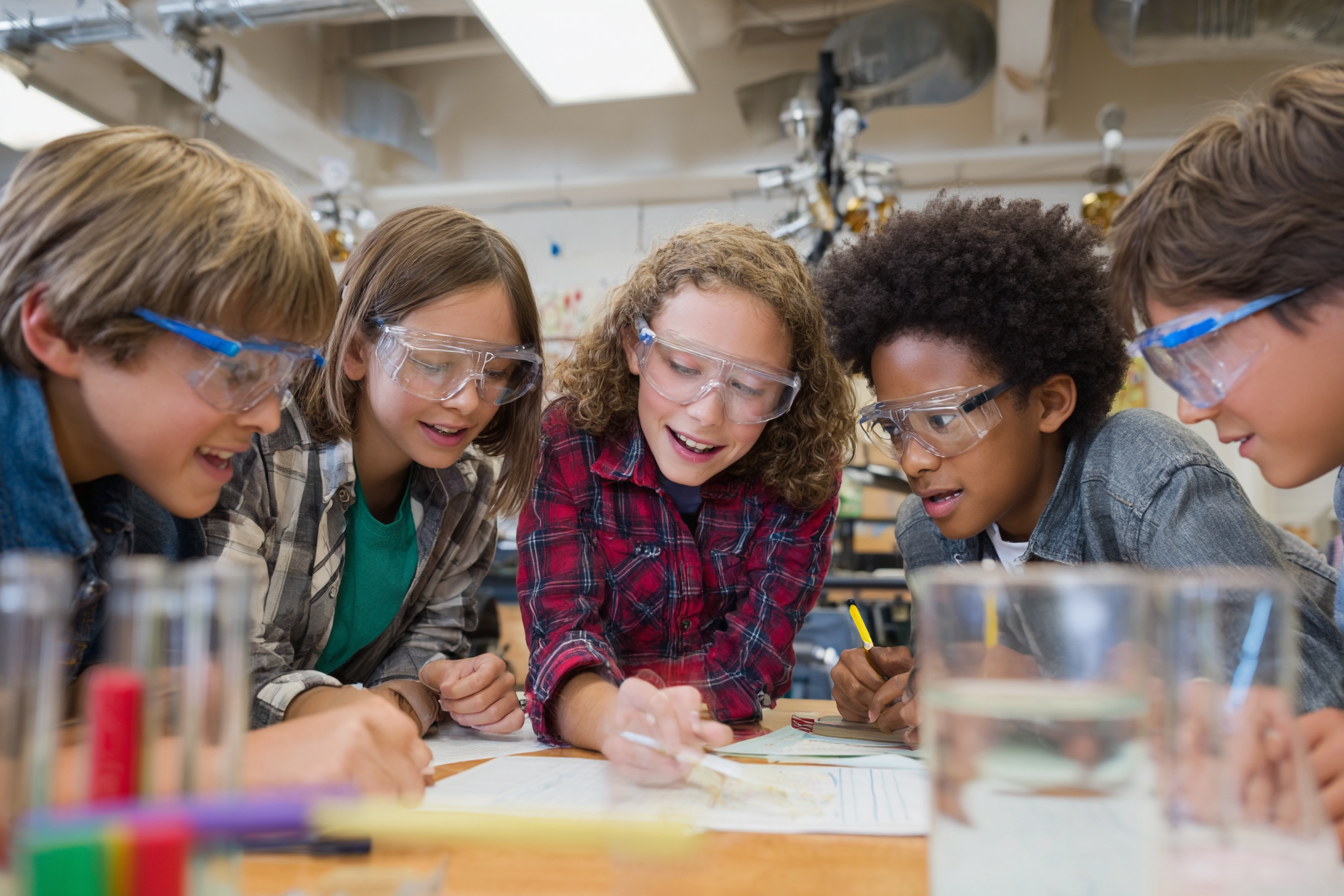
Focus: Establish science safety, notebook routines, measurement and graphing skills, and modeling practices that will support later work with engineering design problems and Earth–Sun–Moon system models.
Grade Level: 6
Subject Area: Science (Science Practices • Engineering Prep • Earth & Space Prep)
Total Unit Duration: 5 sessions (one week), 50–60 minutes per session
I. Introduction
This launch unit builds the science habits students will use all year. They set up notebooks, practice lab safety, and learn to use measurement tools (length, mass, volume, temperature) with attention to units and precision. Students also build simple data tables and graphs, and use models (diagrams, physical setups, and gestures) to explain ideas. As a preview of the year, they briefly explore how scientists and engineers define design problems and how models can help them think about the Earth–Sun–Moon system. These routines prepare students for deeper work on MS-ETS1-1 and MS-ESS1-1 in later units.
Essential Questions
- What does it mean to work like a scientist or engineer in our classroom?
- How do safe routines, clear measurements, and organized data help us do better science?
- How can models (drawings, diagrams, and physical setups) help us explain patterns in systems like the Earth–Sun–Moon?
- What makes a good design problem, and why do criteria and constraints matter?
II. Objectives and Standards
Learning Objectives — Students will be able to:
- Describe and follow classroom and lab safety rules, and set up an organized science notebook for investigations.
- Use basic measurement tools (meter stick, balance, graduated cylinder, thermometer, stopwatch) correctly, recording data with appropriate units and reasonable precision.
- Create simple data tables and bar/line graphs from measurement data, labeling axes and titles clearly.
- Develop and use simple models (e.g., diagrams or physical motions) to represent parts of the Earth–Sun–Moon system and to preview cyclic patterns (phases, seasons) at a basic level.
- Identify the parts of a design problem (need, criteria, constraints) in a simple classroom scenario, preparing for more formal engineering design work.
Standards Alignment — 6th Grade (NGSS-based custom, prep focus)
- MS-ETS1-1 (prep) — Define design problems with criteria and constraints that ensure successful solutions.
- Prep Example: Identify criteria (must protect an object, must fit on a desk) and constraints (limited materials, time) in a simple design scenario.
- MS-ESS1-1 (prep) — Develop and use a model of the Earth–Sun–Moon system to describe cyclic patterns of lunar phases, eclipses, and seasons.
- Prep Example: Use a basic body/ball model to show relative positions of Earth, Sun, and Moon during day/night and basic phases.
Success Criteria — Student Language
- I can set up and use my science notebook to record questions, data, and conclusions.
- I can name and follow safety rules during investigations.
- I can measure length, mass, volume, and temperature with the correct tools and label my units.
- I can turn data into a clear table or graph with titles and labeled axes.
- I can use a simple model to show where Earth, the Sun, and the Moon are and explain why models are useful.
- I can pick out the criteria and constraints in a simple design problem.
III. Materials and Resources
Tasks & Tools (teacher acquires/curates)
- Safety & notebooks:
- Lab safety contract/handout; safety symbols chart.
- Student science notebooks or binders with paper and dividers.
- Measurement tools:
- Meter sticks or metric rulers, triple-beam or digital balances, graduated cylinders or measuring cups (metric), thermometers, stopwatches.
- Various objects to measure (e.g., blocks, water, metal objects, classroom items).
- Data & graphing:
- Sample data sets for practice (e.g., heights of objects, temperature vs. time).
- Graph paper or digital graphing tools.
- “Data Table & Graph Checklist” reference sheet.
- Modeling & Earth–Sun–Moon preview:
- Balls of different sizes (e.g., basketball, tennis ball, marble) to act as Sun, Earth, Moon.
- Flashlight or lamp for “Sun” light source (with safety guidelines).
- Diagram handouts of the Earth–Sun–Moon system (simplified).
- Engineering/problem definition:
- Short scenario cards for simple classroom design problems (e.g., “Design a bookmark that won’t fall out,” “Protect an egg from a short drop”).
- “Criteria & Constraints” organizer.
Preparation
- Set up lab safety expectations and procedures in advance; decide on non-negotiable rules.
- Prepare a notebook setup model (table of contents, date headings, sections for Question/Plan/Data/Conclusion).
- Create or select simple data sets that are easy to graph and interpret.
- Decide which Earth–Sun–Moon model demonstration you will use (class demonstration vs. small-group modeling).
- Prepare anchor charts:
- “Lab Safety Rules.”
- “Measuring Like a Scientist” (tool + unit + precision).
- “Parts of a Graph” (title, axes, labels, scale).
- “What Is a Model?” (helps us visualize, has strengths and limits).
- “Design Problems: Criteria & Constraints.”
Common Misconceptions to Surface
- “Science is just memorizing facts.” → Emphasize that science is about asking questions, investigating, modeling, and using evidence.
- “If I get ‘close enough’ in measurement, it doesn’t matter.” → Stress precision, units, and repeatability.
- “Graphs are just for math class.” → Show how graphs are tools for seeing patterns in science data.
- “Models are exactly like the real thing.” → Discuss that models are simplified, with strengths and limits.
- “Design problems are just fun builds.” → Highlight the importance of criteria and constraints even in simple challenges.
Key Terms (highlight in lessons) safety, investigation, observation, measurement, unit, data table, graph, model, Earth–Sun–Moon system, criterion/criteria, constraint, design problem
IV. Lesson Procedure
(Each day follows: Launch → Explore → Discuss → Reflect. Timing for a 50–60 minute block.)
Session 1 — Safety, Notebooks, and “What Is Science Here?” (Routines)
- Launch (6–8 min)
- Quick write or think–pair–share: “When you hear ‘science class,’ what do you picture?” Collect a few responses and introduce the idea of a science community in the classroom.
- Explore (22–25 min)
- Review the Lab Safety Rules anchor chart and safety contract. Discuss symbols (goggles, broken glass, heat, etc.).
- Students complete a short safety scenarios activity (choose safe vs. unsafe behaviors and explain why).
- Model how to set up science notebooks: name, table of contents, page layout (date, title, sections). Students format their first page.
- Discuss (10–12 min)
- Whole class: “What does it look like and sound like when we are doing science safely and respectfully?” Add student ideas to an anchor chart.
- Reflect (5 min)
- Exit ticket: “One safety rule that is important and why” + “One way I will keep my notebook organized this year.”
Session 2 — Measuring Like a Scientist (Tools & Data Tables)
- Launch (6–8 min)
- Show a ruler, balance, and graduated cylinder. Ask: “What could go wrong if we don’t measure carefully?” Collect ideas (wrong conclusions, unsafe experiments).
- Explore (25–30 min)
- Stations: Students rotate through measurement practice stations (or work as a whole class if materials are limited):
- Station A: Measure length of objects in centimeters.
- Station B: Measure mass of objects in grams.
- Station C: Measure volume of water in milliliters.
- Station D: Observe and record temperature changes (e.g., room temp vs. warm water).
- At each station, students record data in a simple table in their notebooks with headings and units.
- Stations: Students rotate through measurement practice stations (or work as a whole class if materials are limited):
- Discuss (10–12 min)
- Debrief: What was easy? What was tricky (reading scales, meniscus, zeroing a balance)?
- Highlight how units and consistent tools matter for comparing data.
- Reflect (5 min)
- Exit ticket: “Today I used a __ to measure __ in __ (unit). Next time I’ll be more careful about __.”
Session 3 — Graphing and Seeing Patterns (Data → Graphs)
- Launch (5–7 min)
- Show a small data table and a matching graph. Ask: “What is easier to see in the graph than in the table?” (patterns, trends).
- Explore (25–30 min)
- Choose one class data set from Session 2 (e.g., temperature over time, lengths of several objects). As a class, construct the data table on the board.
- Model how to create a graph:
- Decide which variable goes on the x-axis and y-axis.
- Label axes with names and units.
- Choose a reasonable scale.
- Plot points and draw bars or connect points.
- Students then create their own individual graphs in notebooks (bar or simple line graph, depending on the data).
- Provide the Data Table & Graph Checklist so students self-check titles, labels, and neatness.
- Discuss (10–12 min)
- Students share with a partner: “What does your graph show? What pattern do you see?”
- Whole class: connect graphs back to evidence and claims (“Our graph suggests that…”).
- Reflect (5 min)
- Quick write: “My graph shows that as __, __. This is important because __.”
Session 4 — Modeling the Earth–Sun–Moon System (Modeling & MS-ESS1-1 Prep)
- Launch (6–8 min)
- Ask: “How can we show something HUGE and far away, like the Earth–Sun–Moon system, in our classroom?” Introduce the idea that models help us think about big or distant things.
- Explore (25–30 min)
- Demonstration or small groups: use balls and a light source to build a simple Earth–Sun–Moon model:
- Assign roles/objects: one student is the Sun (light), one holds Earth, one holds Moon.
- Slowly move the “Moon” around “Earth” while Earth orbits the “Sun.”
- Students sketch the setup in notebooks, labeling Sun, Earth, Moon and arrows showing motion (not worrying yet about full accuracy of phases).
- Students identify a few cyclic patterns the model could help them explore later (day/night, basic idea of phases, seasons).
- Discuss strengths and limitations of this model (size not to scale, distances wrong, can’t show everything at once).
- Demonstration or small groups: use balls and a light source to build a simple Earth–Sun–Moon model:
- Discuss (10–12 min)
- Whole class: “What can this model explain well? What does it not show well?” Connect to MS-ESS1-1 preview.
- Reflect (5 min)
- Exit ticket: “One thing our Earth–Sun–Moon model helps me understand is __. One thing it does not show perfectly is __.”
Session 5 — Design Problems, Criteria & Constraints (ETS1-1 Prep) & Synthesis
- Launch (5–7 min)
- Present a simple design scenario (projected or read aloud), such as: “You need to design a locker organizer that keeps supplies from falling out when the door is opened.” Ask: “What makes this a design problem?”
- Explore (25–30 min)
- Students read 2–3 short design scenario cards (e.g., protect a fragile object, shade a plant on the windowsill, keep a water bottle from rolling). For one chosen scenario, they use the Criteria & Constraints organizer to identify:
- Need/Goal: What problem are we trying to solve?
- Criteria: What must the solution be able to do?
- Constraints: What limits do we have (time, materials, size, cost)?
- Optional quick design sketch (no full build yet): Students draw one rough idea for solving the problem and label how it meets the criteria.
- Students read 2–3 short design scenario cards (e.g., protect a fragile object, shade a plant on the windowsill, keep a water bottle from rolling). For one chosen scenario, they use the Criteria & Constraints organizer to identify:
- Discuss (10–12 min)
- Whole class: share examples of criteria and constraints from different scenarios, emphasizing how engineers must consider both.
- Connect back to year preview: “Later this year, we’ll define design problems related to Earth and space, resources, and systems, using this same structure.”
- Reflect (5 min)
- Final reflection: “One science skill I feel stronger in after this week is __ because __. One question I’m excited to investigate this year is __.”
V. Differentiation and Accommodations
Advanced Learners
- Ask them to:
- Add estimated uncertainty or range to their measurements (“about 12.3–12.4 cm”).
- Create two different graphs from the same data (e.g., bar vs. line) and explain which is more informative.
- Extend the Earth–Sun–Moon model sketch to include a labeled phase or season explanation.
- Write a more detailed design problem that includes multiple criteria/constraints and propose a second, alternative solution.
Targeted Support
- Provide measurement mini-checklists at each station (“1. Zero tool. 2. Align object. 3. Read scale at eye level.”).
- Use partially completed data tables and graph templates so students only fill in missing pieces.
- Offer sentence frames such as:
- “I measured __ with a __ in __.”
- “The graph shows that when __ increases, __.”
- “Our model is like the real Earth–Sun–Moon system because __, but different because __.”
- Work with small groups to practice notebook setup and model drawings step by step.
Multilingual Learners
- Provide a visual/bilingual glossary for key terms (safety, measure, unit, data, graph, model, Earth, Sun, Moon, design, criteria, constraints).
- Use icons and diagrams heavily on handouts (e.g., small ruler picture next to “length”).
- Allow oral responses and partner talk in the home language before writing in English.
- Offer sentence frames:
- “We used a model of __ to show __.”
- “The design problem is to __. Our criteria are __. Our constraints are __.”
IEP/504 & Accessibility
- Provide large-print, high-contrast versions of charts and data tables.
- Break tasks into small steps with checklists and frequent check-ins.
- Allow students to use digital tools (e.g., calculator, graphing apps, speech-to-text) for measurements, graphing, and reflections when appropriate.
- Offer options for demonstrating understanding (e.g., oral explanation of a graph, a labeled photo of their model instead of detailed drawing).
VI. Assessment and Evaluation
Formative Checks (daily)
- Session 1 — Safety scenario responses and notebook setup show understanding of rules and organization expectations.
- Session 2 — Measurement tables show correct use of tools and units for length, mass, volume, and temperature.
- Session 3 — Student graphs include labeled axes, titles, and plotted data that matches tables.
- Session 4 — Earth–Sun–Moon sketches and notes show students can use and critique a simple model.
- Session 5 — Criteria & Constraints organizers correctly identify the parts of a design problem for at least one scenario.
Summative — Science Skills & Routines Check (0–2 per criterion, total 10)
- Safety & Notebook Use
- 2: Consistently follows safety rules; notebook is set up with clear dates, titles, and sections.
- 1: Generally safe and organized, but with some missed steps or incomplete entries.
- 0: Frequent safety reminders needed; notebook is disorganized or rarely used.
- Measurement Skills
- 2: Uses tools correctly and records measurements with appropriate units and reasonable precision.
- 1: Uses tools but with occasional errors in reading scales or missing units.
- 0: Limited or inaccurate measurement attempts.
- Data Tables & Graphs
- 2: Creates accurate data tables and graphs with labeled axes and titles; graph matches table data.
- 1: Graph or table is present but with some missing labels or minor errors.
- 0: No meaningful table or graph produced.
- Modeling the Earth–Sun–Moon System
- 2: Produces a labeled model or diagram and explains at least one way it helps and one way it is limited.
- 1: Model or diagram present but explanations of strengths/limits are partial.
- 0: No usable model or explanation.
- Understanding Design Problems (ETS1-1 Prep)
- 2: Clearly identifies need, criteria, and constraints in a design scenario and can give an example solution idea.
- 1: Identifies some elements (e.g., criteria or constraints) but not all.
- 0: Shows little understanding of what makes a design problem.
Feedback Protocol (TAG)
- Tell one strength (e.g., “Your graph makes it easy to see how the temperature changed over time.”).
- Ask one question (e.g., “Can you explain why you chose that scale for your axis?”).
- Give one suggestion (e.g., “Add units to your measurements so others know exactly what you recorded.”).
VII. Reflection and Extension
Reflection Prompts
- Which science routine (safety, measurement, graphing, modeling, or design problem thinking) do you feel most confident about now? Why?
- Which routine still feels challenging, and what is one step you can take to improve?
- How do you think these routines will help you when we start investigating Earth in space and other topics this year?
Extensions
- Home Measurement Challenge: Measure three items at home (length or mass) using any available tools; record and bring back data to share.
- Graphing Practice: Create a new graph using any simple data set (number of steps per day, minutes of reading, hours of sleep) and label all parts.
- Model Gallery: In small groups, create a mini-poster that shows a different model (e.g., water cycle, simple food chain) and has a “Strengths” and “Limitations” box, reinforcing the idea that all models are imperfect but useful.