Unit Plan 36 (Grade 7 Art): Reflection & Artistic Growth Analysis
Grade 7 art portfolio reflection unit where students analyze growth, define artistic identity, evaluate work with evidence, and set goals for Grade 8 success.

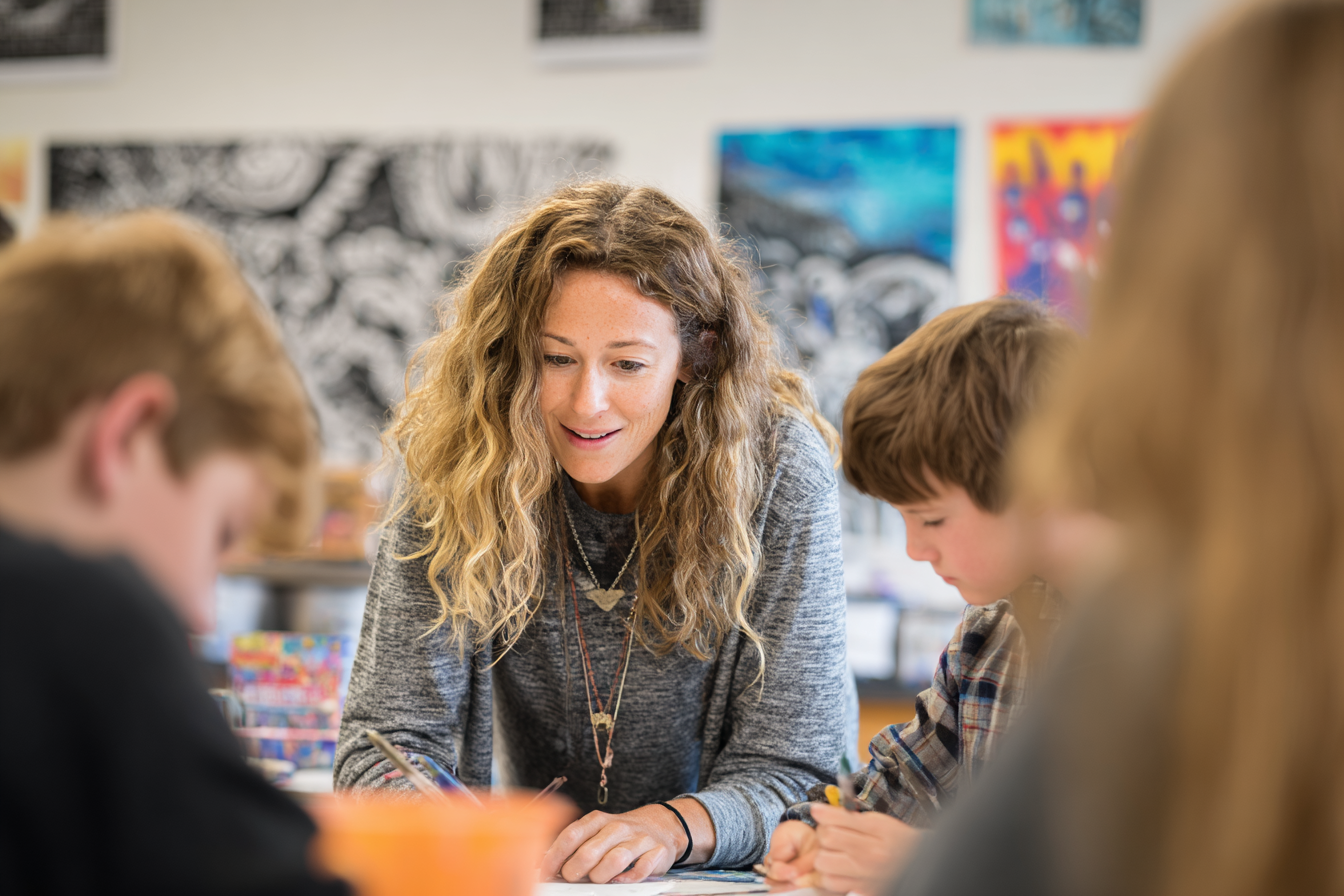
Focus: Reflect on artistic identity and readiness for Grade 8 by analyzing personal work, giving/receiving feedback, and setting future goals.
Grade Level: 7
Subject Area: Art (Visual Arts • Reflection • Portfolio Growth)
Total Unit Duration: 5 sessions (one week), 50–60 minutes per session
I. Introduction
In this final unit, students take a step back to analyze their artistic growth, reflect on their artistic identity, and consider their readiness for Grade 8 art. Using portfolios from the year, they revisit key projects, evaluate strengths and challenges with a criteria-based rubric, and practice giving constructive, evidence-based feedback to peers. Students connect their artwork to their interests, experiences, and viewpoints, identifying recurring themes and stylistic choices that represent who they are as artists. The unit concludes with a written and visual reflection that captures their growth and sets clear goals for the next year.
Essential Questions
- Who am I as an artist right now, and how has that identity developed over the year?
- How can I use criteria and evidence to evaluate my artwork and the artwork of others fairly and respectfully?
- In what ways do my artworks reflect my personal interests, experiences, and viewpoints?
- What patterns do I notice in my strengths and areas for growth, and how can I use that information to prepare for Grade 8 art?
- How can reflection help me make more intentional decisions in my future creative work?
II. Objectives and Standards
Learning Objectives — Students will be able to:
- Select a representative set of artworks that show personal interests, experiences, and viewpoints, explaining why each piece matters to their artistic identity (VA:Cn10.7a).
- Use a rubric and criteria (composition, craftsmanship, originality, communication) to evaluate their own artwork and provide constructive, evidence-based feedback to peers (VA:Re9.7a).
- Identify patterns in their portfolio that show growth over time, including technical, conceptual, and risk-taking improvements (VA:Re9.7a).
- Write a reflective statement that connects selected works to their personal experiences, interests, or viewpoints and explains how these influences shaped decisions (VA:Cn10.7a, VA:Re9.7a).
- Set specific goals for Grade 8 art that build on their reflections and feedback, describing how they want to grow as artists next year (VA:Cn10.7a).
Standards Alignment — 7th Grade (NCAS-Aligned)
- VA:Cn10.7a — Create artwork that reflects personal interests, experiences, or viewpoints and explain those influences.
- Example: Students design artwork inspired by hobbies or identity.
- VA:Re9.7a — Evaluate artwork using established criteria and provide constructive, evidence-based feedback.
- Example: Students use a rubric to assess composition strength.
Success Criteria — Student Language
- I can choose artworks that represent my interests, experiences, or viewpoints and explain why I chose them.
- I can use a rubric to evaluate my artwork and give peers helpful, respectful feedback with specific evidence.
- I can describe how my art has improved or changed this year, including skills and ideas.
- I can write about how my work reflects who I am and what I care about.
- I can set clear, realistic goals for how I want to grow in Grade 8 art.
III. Materials and Resources
Tasks & Tools (teacher acquires/curates)
- Students’ portfolios or collections of work from throughout the year (sketches, projects, finished pieces, digital prints).
- Reflection packet with:
- Portfolio inventory sheet.
- Self-evaluation rubric (composition, craftsmanship, originality, communication, effort/growth).
- Peer feedback form (TAG structure with evidence prompts).
- Final reflection and goal-setting templates.
- Sticky notes or small reflection cards for quick comments.
- Anchor charts:
- “Artistic Identity Questions” (What do I notice about my style? What subjects do I choose? What messages do I send?).
- “Constructive Feedback = Kind + Specific + Helpful” (model TAG with examples).
- “Looking for Growth” (early vs. later work: technique, risk-taking, complexity, confidence).
Preparation
- Organize or return student work so they can access early, middle, and recent projects.
- Prepare and copy rubrics and reflection forms for each student.
- Choose a few anonymous “sample portfolios” or pieces to model evaluation and feedback.
- Decide how students will store or send their final reflections (folder, digital doc, letter to future self).
Common Misconceptions to Surface
- “If I talk about areas for growth, it means I’m bad at art.” → Honest reflection shows maturity and growth, not failure.
- “Feedback should only say nice things.” → Good feedback is kind and specific, including helpful suggestions based on evidence.
- “My art doesn’t really connect to my life.” → Subject choices, colors, styles, and moods often reflect interests, experiences, or viewpoints, even if indirectly.
- “Growth only means better realism.” → Growth can mean more confidence, experimentation, clearer messages, or stronger compositions, not just realism.
Key Terms (highlight in lessons) artistic identity, portfolio, criteria, rubric, evaluation, evidence-based feedback, reflection, growth, strengths, goals, viewpoint, personal interest
IV. Lesson Procedure
(Each day follows: Launch → Explore/Work Time → Discuss → Reflect. Timing for a 50–60 minute block.)
Session 1 — Portfolio Review & Artistic Identity Snapshot (VA:Cn10.7a)
- Launch (6–8 min)
- Show a simple “artist timeline” example (early sketch vs. later piece from the same artist/student).
- Ask: “What changes do you notice?” “What might those changes say about this artist’s interests and growth?”
- Introduce the idea of artistic identity and portfolio as a story of who you are as an artist.
- Explore / Work Time (25–30 min)
- Students lay out their year’s work (or flip through a portfolio) and complete a Portfolio Inventory: list or thumbnail sketches of 6–10 key pieces.
- Using guiding questions on the reflection sheet, they mark:
- Which pieces show personal interests (hobbies, fandoms, favorite subjects).
- Which pieces reflect experiences or emotions they’ve had.
- Which pieces feel most like “me” as an artist.
- They choose 3–5 “Spotlight Pieces” that best represent their identity and highlight them on their inventory sheet.
- Discuss (8–10 min)
- In pairs, students briefly share their Spotlight Pieces and explain why they chose them (“This shows my love of nature,” “This shows how I deal with anxiety,” etc.).
- As a class, gather a few examples of how art reflects interests, experiences, and viewpoints.
- Reflect (3–5 min)
- Exit slip: “One thing I learned about my artistic identity from looking over my work is ___.”
Session 2 — Self-Evaluation with Criteria & Rubrics (VA:Re9.7a)
- Launch (5–7 min)
- Review the evaluation rubric categories (composition, craftsmanship, originality, communication, effort/growth).
- Ask: “Why is it important to use criteria instead of just ‘I like it’ or ‘I don’t like it’ when evaluating art?”
- Explore / Work Time (25–30 min)
- Model quickly with an example piece (teacher or anonymous student work):
- Think aloud while using the rubric: “In composition, I see a clear focal point because… so I’d score this as…”
- Students choose 2–3 of their Spotlight Pieces and complete a self-evaluation using the rubric for each.
- On the reflection sheet, they write 1–2 sentences for each piece citing specific evidence:
- “My craftsmanship score is high because I blended values smoothly in the background.”
- “My originality could improve because I relied heavily on a reference image without many personal changes.”
- Model quickly with an example piece (teacher or anonymous student work):
- Discuss (8–10 min)
- Small-group share: students discuss one piece and one rubric category where they feel they improved the most this year.
- Highlight how evidence-based comments feel more useful than vague praise or criticism.
- Reflect (3–5 min)
- Quick write: “An area where I see clear growth this year is ___ because ___.”
Session 3 — Peer Feedback Circles & Growth Analysis (VA:Re9.7a)
- Launch (6–8 min)
- Review anchor chart “Constructive Feedback = Kind + Specific + Helpful” and the TAG protocol (Tell, Ask, Give).
- Model a short feedback example using a sample piece: “Tell: One strength is… Ask: Have you thought about… Give: One suggestion is…”
- Explore / Work Time (25–30 min)
- Students form small feedback circles (3–4 students).
- Each student presents 1–2 Spotlight Pieces and shares:
- One thing they’re proud of.
- One area they’re curious about or unsure of.
- Peers use the Peer Feedback Form to provide:
- One strength with evidence.
- One question.
- One suggestion linked to rubric criteria (composition, craftsmanship, etc.).
- Students collect feedback forms and add them to their reflection packets.
- Discuss (8–10 min)
- Whole-group debrief: “What kinds of feedback were most helpful?” “What made feedback feel respectful?”
- Connect to VA:Re9.7a—evaluating artwork using criteria and evidence, not just opinion.
- Reflect (3–5 min)
- Exit slip: “One piece of feedback I received that will actually help me grow is ___ because ___.”
Session 4 — Written Reflection on Identity & Growth (VA:Cn10.7a, VA:Re9.7a)
- Launch (5–7 min)
- Explain that students will now write a final reflection that ties together identity, evaluation, and growth.
- Review reflection prompts on the packet and connect them back to artistic identity and criteria-based evaluation.
- Explore / Work Time (25–30 min)
- Students use their inventory, rubric scores, and feedback forms to respond to structured prompts such as:
- “Describe 2–3 ways your artwork reflects your interests, experiences, or viewpoints.”
- “Explain at least one area where your skills improved, using examples from early and later work.”
- “What did you learn from evaluating your own work and your peers’ work using criteria?”
- “What patterns do you see in the kinds of subjects, colors, or styles you choose?”
- They write a 1–2 page reflection (or equivalent structured responses) and may add small sketches or mini-images of Spotlight Pieces to illustrate their points.
- Students use their inventory, rubric scores, and feedback forms to respond to structured prompts such as:
- Discuss (8–10 min)
- In pairs, students share one paragraph or key idea from their reflection and listen for common themes (growth in confidence, willingness to take risks, clearer messages, etc.).
- Teacher highlights the variety of ways students define growth and identity.
- Reflect (3–5 min)
- Quick write: “The biggest way I’ve changed as an artist this year is ___.”
Session 5 — Grade 8 Readiness & Future Goals (VA:Cn10.7a, VA:Re9.7a)
- Launch (5–7 min)
- Ask: “What do you imagine Grade 8 art will be like?” “What kind of artist do you want to be a year from now?”
- Explain that students will create a short ‘Letter to Future Me’ or Grade 8 Artist Plan.
- Explore / Work Time (25–30 min)
- Students review their reflection and feedback and then complete a Grade 8 Readiness & Goal-Setting form or letter including:
- 2–3 strengths they want to keep building.
- 2–3 specific goals for Grade 8 (e.g., “experiment more with mixed media,” “improve figure drawing,” “take more creative risks with composition”).
- One way they plan to keep their art connected to their interests, experiences, or viewpoints.
- Optional: Students add a small symbolic doodle or mini self-portrait that represents their current artistic identity and what they hope to grow into.
- Students review their reflection and feedback and then complete a Grade 8 Readiness & Goal-Setting form or letter including:
- Discuss (8–10 min)
- Volunteers share one goal and one strength with the class.
- Teacher affirms that Grade 8 art builds on these strengths and goals, reinforcing continuity of growth.
- Reflect (3–5 min)
- Final reflection: “I feel ready for Grade 8 art because ___, and one thing I promise my future artist self is ___.”
V. Differentiation and Accommodations
Advanced Learners
- Encourage a more analytical reflection, comparing two or three works in detail and discussing stylistic evolution.
- Invite them to draft a short artist statement suitable for a portfolio or online gallery.
- Challenge them to propose a personal project idea for Grade 8 that aligns with their goals and identity.
Targeted Support
- Provide sentence frames for reflection and feedback, such as:
- “This piece shows my interest in ___ because ___.”
- “One way I improved is ___ (example: my shading in the background).”
- Allow students to focus on fewer Spotlight Pieces (2–3 instead of more).
- Offer guided reflection conferences with the teacher to talk through ideas before writing.
Multilingual Learners
- Allow students to brainstorm and draft initial ideas in their home language, then translate key parts with support.
- Provide a visual glossary for identity, criteria, feedback, strengths, goals.
- Accept mixed-language reflections as long as major points are understandable.
- Pair with supportive peers for oral discussion of growth before writing.
IEP/504 & Accessibility
- Break reflection tasks into smaller chunks over multiple days with clear checklists.
- Offer alternative formats: voice recording, video reflection, or bullet-point notes instead of long paragraphs, with teacher support to shape them.
- Provide extended time for reading rubrics and writing reflections.
- Use enlarged print and clear graphic organizers for inventory and goal setting.
VI. Assessment and Evaluation
Formative Checks (daily)
- Session 1 — Portfolio inventories and Spotlight selections show students can identify works connected to interests and experiences.
- Session 2 — Self-evaluations show use of criteria and evidence rather than vague judgments.
- Session 3 — Peer feedback forms demonstrate ability to provide constructive, evidence-based comments.
- Session 4 — Reflection drafts show students are connecting specific artworks to identity and growth.
- Session 5 — Goal-setting sheets/letters show thoughtful planning for Grade 8 readiness.
Summative — Artistic Growth Reflection & Portfolio Analysis (0–2 per criterion, total 10)
- Connection to Personal Interests/Experiences (VA:Cn10.7a)
- 2: Clearly explains how selected artworks reflect personal interests, experiences, or viewpoints, with specific examples.
- 1: Mentions some connections but explanations are general or limited.
- 0: Makes little or no connection between artwork and personal life or viewpoints.
- Use of Criteria & Evidence (VA:Re9.7a)
- 2: Uses rubric criteria and specific visual evidence to evaluate own work and/or peers’ work.
- 1: Refers to criteria but evidence is vague or only partially developed.
- 0: Evaluation is based mainly on preference with no clear criteria or evidence.
- Analysis of Growth (VA:Re9.7a)
- 2: Identifies clear patterns of growth (technical, conceptual, or risk-taking) with concrete comparisons across time.
- 1: Mentions growth but without detailed examples or clear patterns.
- 0: Provides little or no meaningful discussion of growth.
- Clarity and Depth of Reflection
- 2: Reflection is organized, thoughtful, and shows honest self-awareness about strengths and areas for improvement.
- 1: Reflection is understandable but may be brief, surface-level, or somewhat disorganized.
- 0: Reflection is very limited, off-topic, or missing.
- Future Goals & Readiness for Grade 8 (VA:Cn10.7a)
- 2: States specific, realistic goals for Grade 8 art and explains how they connect to current identity and growth.
- 1: Goals are present but vague or not clearly connected to current work.
- 0: Goals are missing or unrelated to reflection.
Feedback Protocol (TAG)
- Tell one strength (e.g., “Your reflection clearly shows how your art connects to your love of nature.”).
- Ask one question (e.g., “Is there another project that also shows your growth in composition?”).
- Give one suggestion (e.g., “Consider adding one more example when you describe how your shading improved.”).
VII. Reflection and Extension
Reflection Prompts
- How would you describe your artistic identity at the end of Grade 7?
- Which artwork from this year do you think your future self will remember most, and why?
- How did using criteria and feedback change the way you see your own art?
- What is one risk you took this year that made you grow as an artist?
Extensions
- Letter to Future Artist Self: Seal the Grade 8 goals and reflections in an envelope or digital file to revisit next year.
- Mini Portfolio Book: Create a small booklet with photos/sketches of Spotlight Pieces and short captions about identity and growth.
- Peer Tribute Wall: Students write short notes celebrating a classmate’s growth (“I saw you improve in…”) and post them around a class display.
- Family Reflection Share: Assign an optional home reflection where students share their portfolio with a family member and record one piece of outside feedback to add to their packet.
Standards Trace — When Each Standard Is Addressed
- VA:Cn10.7a — Sessions 1, 4, 5
- Session 1: Identifying portfolio pieces that reflect personal interests, experiences, or viewpoints.
- Session 4: Writing reflections that explain how influences shaped artistic decisions.
- Session 5: Setting future goals connected to artistic identity and interests for Grade 8.
- VA:Re9.7a — Sessions 2–4
- Session 2: Using rubrics and criteria to evaluate own work with evidence.
- Session 3: Providing constructive, evidence-based feedback to peers.
- Session 4: Analyzing growth patterns and strengths using criteria and portfolio evidence.