Unit Plan 36 (Grade 7 Orchestra): End-of-Year Performance & Reflection
Grade 7 orchestra students perform end-of-year repertoire with accuracy, expressive intent, and professional etiquette while reflecting on growth, musical identity, and section leadership goals.

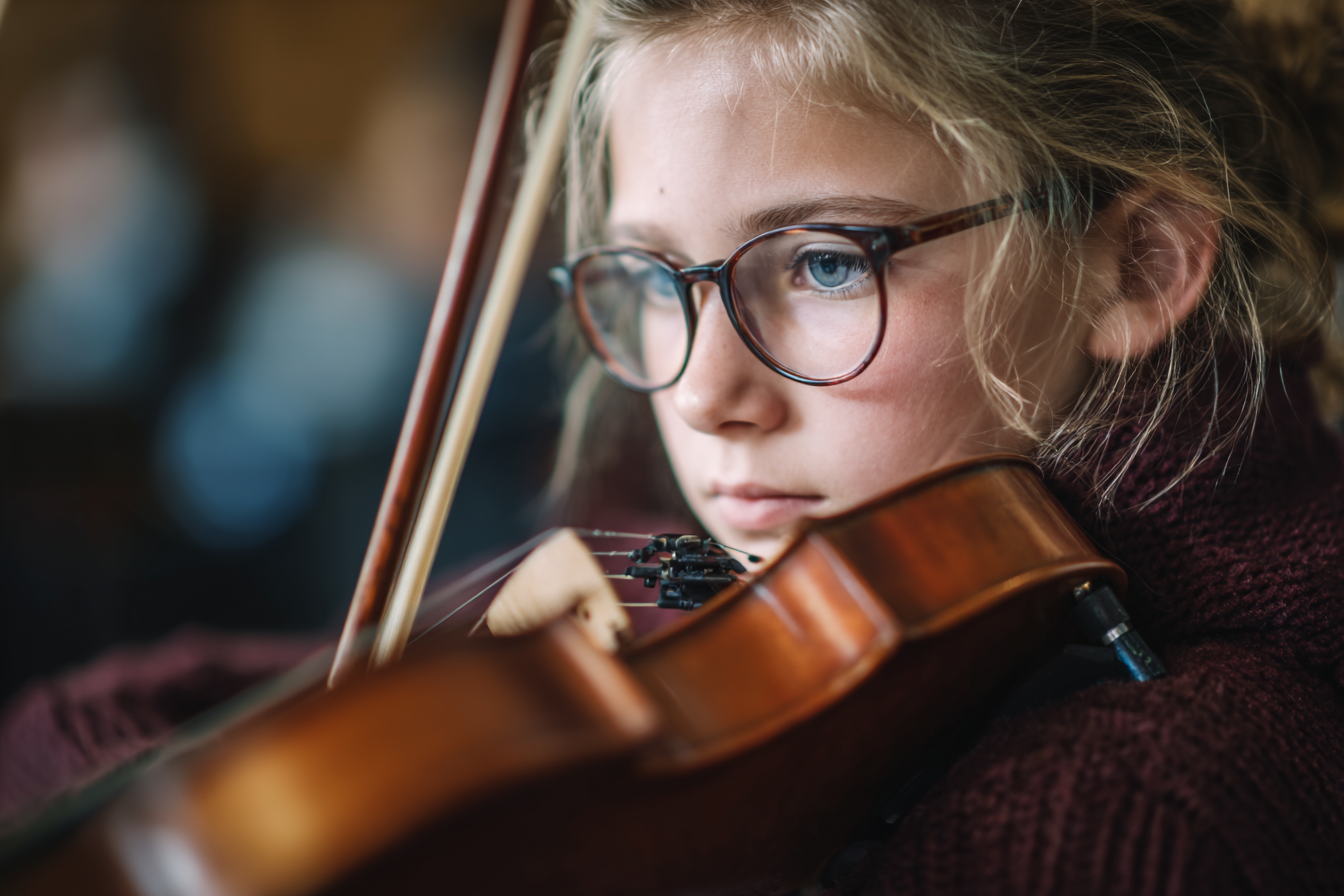
Focus: Perform concert repertoire with independence, expressive intent, and professional etiquette while reflecting on personal growth, identity, and leadership as an orchestra member.
Grade Level: 7
Subject Area: Orchestra (Performance • Leadership • Identity/Reflection)
Total Unit Duration: 5 sessions (one week), 50–60 minutes per session
I. Introduction
In this capstone unit, Grade 7 orchestra students bring together everything they have learned about technique, ensemble skills, interpretation, and leadership. They prepare for and/or present an end-of-year performance, focusing on accurate pitch/rhythm, characteristic tone, unified bowing, and expressive intent while modeling appropriate etiquette on and off stage. After the performance, students engage in guided reflection on how their interests, experiences, and goals have shaped their growth and leadership as string musicians and what this means for their future in orchestra.
Essential Questions
- What does it mean to perform as an independent, expressive ensemble member rather than “just playing your part”?
- How do rehearsal and performance etiquette, including section leadership and following cues, support ensemble success?
- In what ways have my personal interests, experiences, and goals influenced my musical growth and leadership this year?
- How can reflecting on this year help me set meaningful goals for my future as a musician and leader?
II. Objectives and Standards
Learning Objectives — Students will be able to:
- Perform concert repertoire with accurate pitch and rhythm, characteristic tone, unified bowing, and expressive intent appropriate to the style.
- Demonstrate appropriate rehearsal and performance etiquette, including following conductor cues, tracking rests, and supporting section and ensemble needs.
- Describe how their personal interests, experiences, and goals have influenced their musical choices and growth during the year.
- Use performance rubrics and reflection tools to evaluate personal and ensemble growth in technique, expression, and leadership.
- Set forward-looking goals for continued musical development and leadership in future ensembles.
Standards Alignment — Grade 7 Orchestra (custom, NAfME-style)
- OR:Pr6.7a — Perform orchestra music with accurate pitch, rhythm, characteristic tone, unified bowing, and expressive intent, showing developing stylistic understanding.
- Example: Students perform a two- or three-part arrangement with steady tempo and dynamic contrast.
- OR:Pr6.7b — Demonstrate appropriate rehearsal and performance etiquette, including leadership within sections, following conductor cues, tracking rests, and supporting ensemble success.
- Example: Students lead section warm-ups and ensure bowings match across the section.
- OR:Cn10.7a — Explain how personal interests, experiences, and goals influence musical choices, growth, and leadership as a string musician.
- Example: Students set a goal (stronger shifts, better vibrato readiness, section leadership) and explain why it matters.
Success Criteria — Student Language
- I can perform our music with accurate notes and rhythms, consistent tone, matching bowings, and clear expression.
- I can show professional etiquette (focus, posture, quiet during rests, watching the conductor, supporting my section) in rehearsal and performance.
- I can explain how my own interests and experiences shaped my musical choices and growth this year.
- I can use rubrics and reflections to describe how I have improved as a player and ensemble member.
- I can set specific goals for my future as a string musician and potential leader.
III. Materials and Resources
Tasks & Tools (teacher acquires/curates)
- End-of-year concert repertoire (2–3 pieces or movements appropriate for Grade 7).
- Performance rubrics aligned to OR:Pr6.7a and OR:Pr6.7b (pitch, rhythm, tone, bow unity, expression, etiquette, leadership, ensemble support).
- Reflection templates for personal growth, leadership, and identity (e.g., “Beginning of year vs. now,” “My growth story,” “Future goals”).
- Recording device and playback system (for final performance or in-class run).
- Simple self/peer evaluation forms for performance etiquette and leadership behaviors.
- Anchor charts:
- “Professional Performance Etiquette” (stage entrance, posture, focus, reacting to mistakes, acknowledging audience).
- “My Growth as a Musician & Leader” (skills, confidence, independence, leadership moments).
Preparation
- Finalize repertoire and mark key spots where independence, listening, and leadership are especially important (e.g., entrances, tempo changes, dynamic shifts).
- Prepare rubrics and reflection forms; decide whether students will reflect individually, in small groups, or both.
- Plan logistics for the end-of-year performance (in-class performance, concert, or recording event).
- Decide how students will share growth stories (short written pieces, speeches, or small-group circles).
Common Misconceptions to Surface
- “Once the concert is over, the learning is over.” → Reflection helps us understand growth and set the stage for future success.
- “Performance is just about not making mistakes.” → Performance is also about expression, connection, and leadership.
- “Etiquette only matters for the audience.” → Rehearsal and performance etiquette keeps the ensemble together and supports everyone’s success.
- “My personal interests and goals don’t really matter in orchestra.” → They shape how you practice, the roles you take on, and the musician you become.
Key Terms (highlight in lessons) performance, etiquette, leadership, independence, expression, stylistic understanding, reflection, growth, goal-setting, musical identity, ensemble member
IV. Lesson Procedure
(Each day follows: Launch → Explore → Discuss → Reflect. Timing for a 50–60 minute block.)
Session 1 — Revisiting Growth & Performance Goals (All standards, emphasis OR:Cn10.7a)
- Launch (6–8 min)
- Ask: “Think back to the beginning of the year—what did you find hardest in orchestra? What comes easier now?”
- Explain that this week is about both a strong performance and an honest look at how far we’ve come.
- Explore (25–30 min)
- Briefly review key repertoire excerpts, focusing on independence (tracking rests, watching cues, confident entrances).
- Students complete a short “Then and Now” reflection:
- At the start of the year, I struggled with… Now I can…
- One way I’ve grown in technique, ensemble skills, and leadership.
- Introduce or revisit the performance rubric; students preview criteria and mark where they think they are currently on each category.
- Run key sections of the music with attention to independence (students responsible for counting, cueing, and listening).
- Discuss (10–12 min)
- Whole-group: “Where do we see evidence of our growth in this music? Where do we still need to tighten up before the final performance?”
- Connect these observations to Pr6.7a (accuracy + expression) and Pr6.7b (etiquette + leadership).
- Reflect (5 min)
- Exit slip: “One way I’ve grown as an independent, expressive ensemble member is ___. Before our final performance, I want to improve __.”
Session 2 — Performance Etiquette & Leadership in Action (OR:Pr6.7b, OR:Pr6.7a)
- Launch (5–7 min)
- Ask: “What does an audience notice about how we act and not just how we sound?”
- Review the “Professional Performance Etiquette” anchor chart (entrances, posture, focus, responding to mistakes, acknowledging conductor and audience).
- Explore (25–30 min)
- Practice a mock stage entrance and setup:
- How students walk on, sit, quiet themselves, and watch for the first cue.
- Run key sections with emphasis on Pr6.7b behaviors:
- Following conductor cues for tempo and cutoffs.
- Tracking rests independently and counting silently.
- Supporting section needs (e.g., helping align bowings, modeling good posture).
- Use a quick etiquette checklist as students observe each other in a short passage:
- Watching conductor?
- Stillness and focus between pieces?
- Quiet communication and leadership inside sections?
- Practice a mock stage entrance and setup:
- Discuss (10–12 min)
- Ask: “How does our behavior on stage affect the performance, not just our sound?”
- Highlight specific examples of positive leadership students demonstrated.
- Reflect (5 min)
- Quick write: “During today’s rehearsal, one way I showed or want to show performance etiquette and leadership is __ because __.”
Session 3 — End-of-Year Performance (OR:Pr6.7a, OR:Pr6.7b)
- Launch (5–7 min)
- Frame the class: “Today is our end-of-year performance (in-class or concert). Your job is to perform as independent, expressive ensemble members and to show everything you’ve learned.”
- Brief review of focus points: watching cues, unified bowing, dynamic contrast, confident posture.
- Explore (30–35 min)
- Students perform their end-of-year program (in-class performance, recording session, or live concert if timed with the unit):
- Emphasis on Pr6.7a: accurate pitch/rhythm, characteristic tone, unified bowing, expressive intent, stylistic understanding.
- Emphasis on Pr6.7b: appropriate etiquette, leadership within sections, following cues, tracking rests, ensemble support.
- If possible, record the performance for later reflection.
- Students perform their end-of-year program (in-class performance, recording session, or live concert if timed with the unit):
- Discuss (8–10 min)
- Short post-performance circle or quick impressions:
- “What felt strongest about our performance?”
- “Where did we really feel like a team?”
- Save deeper analysis for the next session to allow emotions to settle.
- Short post-performance circle or quick impressions:
- Reflect (3–5 min)
- Very short reflection: “Right now, I feel __ about our performance because __.”
Session 4 — Listening Back & Personal Growth Stories (OR:Cn10.7a, OR:Pr6.7a/6.7b)
- Launch (5–7 min)
- Explain that students will listen back to part or all of the performance and reflect on growth and identity as musicians.
- Ask: “What do you hope to hear in this recording that shows how far you’ve come?”
- Explore (25–30 min)
- Play key excerpts from the recording (or full performance if time allows).
- Students use the performance rubric to rate the performance in selected categories, noting evidence (e.g., “Intonation mostly solid at letter C,” “Great dynamic contrast in ending”).
- Students complete a personal growth reflection that includes:
- One area of technical growth (intonation, rhythm, tone, bowing).
- One area of ensemble/leadership growth (entrances, following cues, helping section).
- How personal interests, experiences, and goals influenced their growth (link to OR:Cn10.7a).
- A short “growth story” (“At the start of the year, I…, now I…”).
- Discuss (10–12 min)
- In small groups or a circle, students share highlights of their growth stories and one moment in the performance that shows that growth.
- Emphasize that growth includes both skill and identity/leadership as musicians.
- Reflect (5 min)
- Exit slip: “One part of the performance that best shows my growth is __ because __.”
Session 5 — Looking Ahead: Identity & Future Goals (OR:Cn10.7a)
- Launch (5–7 min)
- Ask: “After everything you’ve learned this year, what kind of musician and leader do you want to be next year?”
- Briefly review OR:Cn10.7a: how personal interests, experiences, and goals shape musical choices and leadership.
- Explore (25–30 min)
- Students complete a “Letter to My Future Musician Self” or future goals plan that includes:
- What they are proud of from this year’s performance and growth.
- Two specific technique or ensemble goals for next year (e.g., “more confident shifting,” “stronger section leadership”).
- How their interests (favorite styles, roles, pieces) and experiences this year influence those goals.
- Optional: students create a small “Next Year Goal Card” to give to their future director/teacher or to keep.
- Students complete a “Letter to My Future Musician Self” or future goals plan that includes:
- Discuss (10–12 min)
- Invite volunteers to share one goal and one piece of advice they would give to a new orchestra student.
- Highlight how reflecting on identity and goals supports ongoing growth and leadership.
- Reflect (5–7 min)
- Final reflection: “This year, I grew as an independent, expressive ensemble member by __. Next year, I want to grow by __, and I will do this by __.”
V. Differentiation and Accommodations
Advanced Learners
- Invite advanced students to help lead reflections (small-group facilitators) or model thoughtful, detailed growth stories.
- Ask them to create a brief performance critique comparing an early-year recording with the end-of-year performance, citing specific evidence.
- Encourage them to set multi-year goals (e.g., skills needed for high school orchestra or youth symphony).
Targeted Support
- Provide sentence frames for reflections:
- “At the beginning of the year, I could not __, but now I can __ because __.”
- “In the performance, I showed good __ when I __.”
- Use simplified rubrics with fewer categories for some students.
- Allow shorter written responses or bullet-point reflections for students who need it.
Multilingual Learners
- Allow students to brainstorm or draft reflections in their home language before translating key ideas into English.
- Provide a word bank for growth and feelings (e.g., “confident, proud, nervous, improved, independent, leader”).
- Encourage visual reflection options, such as drawing a “before-and-after” musician self-portrait with labels.
IEP/504 & Accessibility
- Offer audio or video reflection options for students who struggle with writing.
- Provide extended time or chunked steps for completing reflection tasks.
- Use enlarged music and clear, high-contrast visuals for rubrics and reflection forms.
- Allow flexible seating or movement breaks, especially during performance listening and extended writing.
VI. Assessment and Evaluation
Formative Checks (daily)
- Session 1 — “Then and Now” reflections and rubric previews show awareness of growth areas and remaining needs.
- Session 2 — Teacher observation and etiquette checklists indicate how well students demonstrate Pr6.7b behaviors in rehearsal.
- Session 3 — Performance observation and/or recording provide evidence of Pr6.7a and Pr6.7b in action.
- Session 4 — Growth reflections and rubric use show students’ ability to analyze performance and connect to personal growth.
- Session 5 — Future goal letters/plans demonstrate connection between identity, experiences, and future leadership/learning.
Summative — End-of-Year Performance & Reflection (0–2 per criterion, total 10)
- Performance Accuracy & Expression (OR:Pr6.7a)
- 2: Performs with generally accurate pitch and rhythm, consistent tone, unified bowing, and clear expressive intent appropriate to style.
- 1: Performance shows partial accuracy and expression with some noticeable but non-disruptive issues.
- 0: Frequent pitch/rhythm errors and little expression make the performance hard to follow.
- Performance Etiquette & Leadership (OR:Pr6.7b)
- 2: Consistently demonstrates appropriate etiquette (focus, posture, following cues, tracking rests) and supports section/ensemble success.
- 1: Shows some appropriate etiquette but inconsistently; limited evidence of leadership or support.
- 0: Etiquette is often inappropriate or distracting; little regard for ensemble needs.
- Growth Reflection (OR:Cn10.7a)
- 2: Clearly explains how personal interests, experiences, and goals influenced their musical choices and growth this year, with specific examples.
- 1: Mentions interests/goals but connection to musical growth is general or incomplete.
- 0: Little or no meaningful reflection on personal interests, experiences, or goals.
- Evidence-Based Evaluation
- 2: Uses specific moments from the performance (measures, sections, behaviors) as evidence when describing growth and areas for improvement.
- 1: Refers to the performance in general terms with limited specific evidence.
- 0: Provides minimal or no evidence from the performance.
- Future Goal-Setting
- 2: States clear, realistic future goals and explains how they connect to current strengths, challenges, and musical identity.
- 1: Goals are present but vague or only loosely connected to this year’s experience.
- 0: Goals are missing, unrealistic, or not clearly related to orchestra growth.
Feedback Protocol (TAG)
- Tell one strength (e.g., “Your reflection shows that you really understand how your leadership improved in section rehearsals.”).
- Ask one question (e.g., “What specific step will help you reach your shifting goal next year?”).
- Give one suggestion (e.g., “Try choosing one passage to focus on when you practice independent counting and entrances.”).
VII. Reflection and Extension
Reflection Prompts
- How have you changed as a musician and as an ensemble member since the beginning of the year?
- What was your strongest moment in the end-of-year performance, and what does it show about your growth?
- How did your interests, experiences, and goals influence the way you played or the role you took in the ensemble?
- What advice would you give to next year’s 7th grade orchestra students about how to grow as independent, expressive ensemble members?
Extensions
- Legacy Message: Students create a short written or video message for next year’s ensemble, sharing tips for success and encouraging them to grow as musicians and leaders.
- Personal Growth Timeline: Students design a visual timeline of the year, marking key pieces, skills, and leadership moments, with brief notes.
- Bridge to Future Ensembles: For students continuing in orchestra, compile a folder or digital portfolio (recordings, rubrics, reflections) to share with their future director as a snapshot of who they are as musicians now.
Standards Trace — When Each Standard Is Addressed
- OR:Pr6.7a — Sessions 1–3 (rehearsing and performing concert repertoire with accuracy, tone, unified bowing, and expressive intent; listening back to evaluate performance in Session 4).
- OR:Pr6.7b — Sessions 2–3 (practicing and demonstrating rehearsal and performance etiquette, leadership within sections, following conductor cues, tracking rests, and supporting ensemble success).
- OR:Cn10.7a — Sessions 1, 4–5 (reflecting on how personal interests, experiences, and goals influenced musical choices and growth; writing growth stories and future goals; connecting identity to leadership and performance decisions).