Unit Plan 1 (Grade 7 Science): Science Skills & Inquiry Routines
Launch Grade 7 science with lab safety, careful observation, modeling, and CER to build skills for cell investigations and engineering design all year.

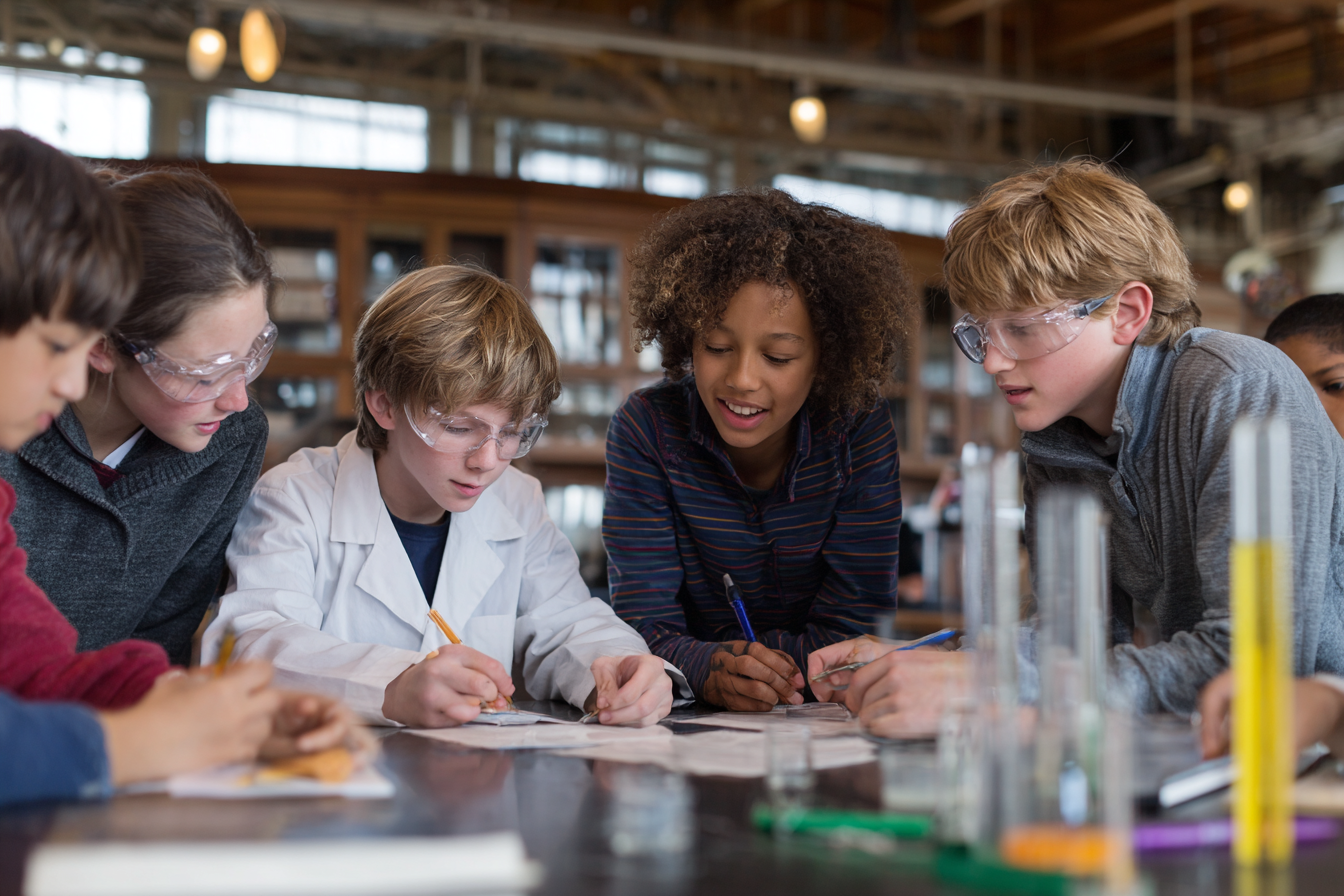
Focus: Build lab safety, observation, modeling routines, and evidence-based reasoning to launch the year’s investigations—especially upcoming work on cells and engineering design problems.
Grade Level: 7
Subject Area: Science (General Science Skills • Life Science Prep • Engineering Design)
Total Unit Duration: 5 sessions (one week), 50–60 minutes per session
I. Introduction
In this opening unit, students build the habits and routines they will need for productive science learning all year. They practice lab safety, careful observation, and scientific modeling while revisiting core ideas: living things are made of cells and design problems must have clear criteria and constraints. Through simple investigations (including introductory microscope/cell observations) and a small classroom design challenge, students learn how to ask questions, plan and record investigations, and use evidence to support claims. By the end of the week, the class has shared expectations, lab norms, and inquiry routines that will support upcoming work with MS-LS1-1 and MS-ETS1-1.
Essential Questions
- What does it mean to think and work like a scientist or engineer in our classroom?
- How do lab safety rules, observation routines, and models help us collect better evidence?
- Why do scientists say that all living things are made of cells, and how could we investigate that idea?
- Why do engineers need clear criteria and constraints when they define a design problem?
II. Objectives and Standards
Learning Objectives — Students will be able to:
- Demonstrate and explain key lab safety expectations and responsible handling of equipment (including microscopes and glassware).
- Use qualitative and quantitative observations and organized data tables to record what they see during simple investigations (including introductory cell observations).
- Create and revise simple models (drawings, diagrams, labeled sketches) to represent what they observe, including the idea that living things are made of cells.
- Use evidence-based reasoning to write or explain a basic claim–evidence–reasoning (CER) statement.
- Work with a team to define a design problem (related to lab routines or observation tools), listing clear criteria and constraints in preparation for later engineering work.
Standards Alignment — 7th Grade (NGSS-based custom, prep focus)
- MS-LS1-1 (prep) — Conduct an investigation to provide evidence that living things are made of cells, either one cell or many different numbers and types of cells.
- In this unit, students build the skills and routines (safety, observation, recording, basic microscope use) that will support later full LS1-1 investigations.
- MS-ETS1-1 — Define the criteria and constraints of a design problem with sufficient precision to ensure a successful solution.
- Here, students practice defining small, classroom-scale design problems tied to lab routines and tools.
Success Criteria — Student Language
- I can explain and follow our class lab safety rules and show I know how to handle equipment responsibly.
- I can make careful observations (what I see, measure, or notice) and record them in an organized data table.
- I can draw and label simple models (like a cell sketch or setup diagram) and revise them when I learn more.
- I can write or say a claim and support it with evidence and reasoning from an investigation.
- I can help my group define a design problem by listing what our solution must do (criteria) and what limits we have (constraints).
III. Materials and Resources
Tasks & Tools (teacher acquires/curates)
- Lab safety & routines:
- Lab safety contract or guidelines; safety symbols chart.
- Safety equipment for demonstration: goggles, aprons, gloves, eye wash location, broken glass container.
- Observation & data collection:
- Simple materials for observation practice (e.g., leaves, pennies, rocks, everyday objects, classroom plants).
- Rulers, hand lenses, timers; optional prepared slides (onion skin, elodea, cheek cell demo if allowed).
- Microscopes (class set or stations) or digital microscope/camera if available.
- Data table templates and CER writing frames.
- Modeling & design prep:
- Blank diagram templates (for setups, cells, tools).
- Large chart paper/whiteboards for group models.
- “Mini Design Brief” describing a simple classroom design problem (e.g., “Design a tool or routine that helps students safely organize microscope slides and materials,” or “Design a system to quickly check that every student has followed safety prep before labs”).
- Criteria & Constraints graphic organizer.
Preparation
- Set up lab space and clearly label safety equipment and stations.
- Create anchor charts:
- “Lab Safety Expectations” (Do/Don’t with icons).
- “Good Observations” (specific, measurable, no guesses).
- “What Is a Model?” (a simplified representation that helps explain or predict).
- “CER: Claim–Evidence–Reasoning” with a simple example.
- “Criteria vs. Constraints” with examples.
- Prepare one intro cells investigation (even if very simple) such as:
- Observing prepared slides or high-resolution images of single-celled vs. multicellular organisms and sketching what they see.
- Decide on one shared mini design problem (or offer 2–3 options) tied to lab routines, observation tools, or classroom organization.
Common Misconceptions to Surface
- “Safety rules are just about not getting in trouble.” → Safety rules protect everyone’s health, learning, and results; they are part of professional science practice.
- “Observations are the same as opinions or guesses.” → Observations are what you actually see, hear, feel (when safe), or measure, not interpretations.
- “Models must be perfect drawings or tiny replicas.” → Models are simplified, revisable representations that help think about something we can’t see directly.
- “Evidence is just any fact I know.” → Evidence is information collected from the investigation (data, patterns, observations) that supports a specific claim.
- “Criteria and constraints are just rules.” → Criteria describe what success looks like; constraints describe limits (materials, time, safety, space).
Key Terms (highlight in lessons) lab safety, observation, qualitative, quantitative, model, evidence, claim, reasoning, cell, multicellular, unicellular, design problem, criteria, constraints, prototype
IV. Lesson Procedure
(Each day follows: Launch → Explore → Discuss → Reflect. Timing for a 50–60 minute block.)
Session 1 — Lab Safety & Science Classroom Norms (Routines Setup)
- Launch (6–8 min)
- Quick prompt: “Think of a time when something went wrong in a science lab (real or from TV). What happened, and how could it have been prevented?”
- Brief share-out; introduce the idea that safety = serious, professional science behavior.
- Explore (22–25 min)
- Teacher-led safety tour: point out eyewash, exits, broken glass container, chemical storage, etc.
- Students receive lab safety contract and safety symbols sheet.
- In pairs, students sort a set of “Lab Scenario Cards” into Safe vs. Unsafe, then annotate unsafe cards with “What should happen instead.”
- As a class, co-create or revise an anchor chart of Lab Safety Expectations (Do’s and Don’ts).
- Discuss (10–12 min)
- Whole-class discussion: “Which safety rules are most important in our room and why?”
- Connect to professional science: real scientists use protocols and checklists just like we will.
- Reflect (5 min)
- Exit ticket: “One safety rule I will commit to following and why it matters is ___.”
Session 2 — Observation Routines & Data Tables (Skills for LS1-1)
- Launch (5–7 min)
- Show two examples: a vague observation (“It looks weird”) vs. a specific observation (“The leaf edge has small teeth, about 1 mm apart”). Ask:
- “Which is more useful to another scientist? Why?”
- Show two examples: a vague observation (“It looks weird”) vs. a specific observation (“The leaf edge has small teeth, about 1 mm apart”). Ask:
- Explore (25–30 min)
- Observation Stations: students rotate through 3–4 simple observation stations (e.g., leaves, rocks, pennies, plant stems, prepared images of cells).
- At each station, students practice:
- Writing qualitative observations (color, shape, texture, patterns).
- Writing quantitative observations (measurements: length, count, time).
- They record in a teacher-provided data table template (columns for object, qualitative, quantitative, questions).
- At one station, include intro “cell” images or simple prepared slides; students sketch what they see or notice.
- Discuss (10–12 min)
- Debrief: What makes an observation strong? Create an anchor chart for Good Observations (specific, measurable, avoids explanation words like “because” or “maybe”).
- Connect to MS-LS1-1 prep: we will later use these skills to observe cells and collect evidence that living things are made of cells.
- Reflect (5 min)
- Quick write: “One observation I made today that shows I was being careful and scientific is ___. It might help us later when we ___.”
Session 3 — Modeling What We Observe: From Objects to Cells (Prep for LS1-1)
- Launch (6–8 min)
- Ask: “Why do scientists draw pictures, diagrams, or models of what they see—even when they could take a photo?”
- Show an example of a simple cell diagram vs. what it looks like under a microscope and ask students to notice differences.
- Explore (22–25 min)
- Mini-lesson:
- A model is a simplified representation that helps explain or predict.
- Models can show structure, function, or relationships.
- Students revisit a small set of observations from Session 2 (e.g., leaf, rock, cell image). For each, they:
- Draw a simple labeled sketch (model) of the object.
- Note what parts they chose to include and what they left out (and why).
- For cells prep: show one or two high-quality images or simple microscope views of a single-celled organism and a multicellular tissue. Students:
- Sketch what they see (shapes, boundaries, repeated units).
- Label “cell” or “many cells” where appropriate.
- Write a tentative claim: “Based on this model, I think living things are made of cells because ___.”
- Mini-lesson:
- Discuss (10–12 min)
- Share a few models and discuss what makes them helpful (labels, focus on key features, clarity).
- Connect to MS-LS1-1: we will later conduct full investigations to collect evidence that all living things are made of cells, and models will be a key tool.
- Reflect (5 min)
- Exit slip: “One way my model helped me think about cells or structures today was ___.”
Session 4 — Claims, Evidence, Reasoning & Intro Design Problems (CER + ETS1-1)
- Launch (5–7 min)
- Write three words on the board: Claim – Evidence – Reasoning. Ask:
- “What do each of these words mean in everyday language? How might scientists use them?”
- Write three words on the board: Claim – Evidence – Reasoning. Ask:
- Explore (25–30 min)
- Mini-lesson with a simple example (not yet cells):
- Claim: The mystery powder is baking soda.
- Evidence: It fizzed when vinegar was added; it looked like sample A.
- Reasoning: If a substance is baking soda, it reacts with vinegar to produce bubbles; the fizzing shows this reaction.
- Students use a CER sentence frame to write a short CER from a class demonstration or one of their observation stations (e.g., “Plants have structured parts,” or “This object is metal,” depending on prior activities).
- Transition to engineering design: present a Mini Design Brief such as:
- “Design a simple equipment organization system (tray, checklist, or station layout) that helps our class set up and clean up labs safely and efficiently.”
- As a class or in small groups, students complete a Criteria & Constraints organizer for this problem:
- Criteria examples: easy to use, keeps materials organized, supports safety rules, quick setup/cleanup.
- Constraints examples: only classroom materials, limited time, must fit on a lab table, must be safe.
- Mini-lesson with a simple example (not yet cells):
- Discuss (10–12 min)
- Groups share their top criteria and constraints. Class compares and refines them to be clear and measurable.
- Connect to MS-ETS1-1: defining the design problem well is the first step of engineering.
- Reflect (5 min)
- Quick write: “One criterion and one constraint for our lab organization design are __ and __. They matter because ___.”
Session 5 — Mini Design Share-out & Skills Synthesis (All Standards Prep)
- Launch (5–7 min)
- Remind students: this week we practiced safety, observation, modeling, CER, and defining design problems. Ask:
- “Which of these skills do you think you will use the most this year? Why?”
- Remind students: this week we practiced safety, observation, modeling, CER, and defining design problems. Ask:
- Explore (25–30 min)
- In small groups, students quickly sketch or build a basic prototype or visual plan for their lab organization/design solution using available classroom materials (paper models, labeled diagrams, or simple physical mockups).
- They prepare a 1–2 minute pitch that includes:
- The design problem.
- Their main criteria and constraints.
- A brief description of their model/prototype and how it meets the criteria.
- Groups present to the class; classmates note at least one strength and one question for each.
- Discuss (10–12 min)
- Whole-class debrief:
- How did safety rules and constraints affect your design ideas?
- How might we test or improve these ideas later in the year?
- Connect the week to upcoming units: we will now apply these routines to cell investigations, ecosystems, and other life science topics.
- Whole-class debrief:
- Reflect (5 min)
- Final reflection: “The most important science/engineering habit I practiced this week was ___. I will use it in our next unit when we ___.”
V. Differentiation and Accommodations
Advanced Learners
- Ask them to:
- Add more quantitative detail to observations (measurements, simple statistics like averages).
- Draft a more complex CER using multiple pieces of evidence or connecting to prior knowledge.
- Expand the mini design problem (e.g., design a safety-check system plus an equipment tracking system).
Targeted Support
- Provide sentence frames and checklists for safety expectations, observations, and CER writing:
- “I observed that ___ (qualitative) and measured ___ (quantitative).”
- “My claim is ___. My evidence is ___. This matters because ___.”
- Offer partially filled diagrams for models (e.g., an outline of a cell with some labels pre-filled).
- Use guided observation with teacher questions: “How many? How long? What shape? Compared to what?”
Multilingual Learners
- Provide a visual glossary for key terms (observation, model, evidence, cell, criteria, constraints) with icons.
- Allow bilingual note-taking and labels on diagrams where helpful, with key terms highlighted in English.
- Encourage pair work and oral rehearsal before writing CERs or doing short presentations.
- Accept more diagram-heavy responses early on; gradually support adding more English sentences over time.
IEP/504 & Accessibility
- Break tasks into smaller steps with clear mini-goals (“First list 3 observations; then choose 1 to model”).
- Provide printed organizers with larger font and more space.
- Allow alternative output options (spoken CER recorded on a device, or a labeled diagram instead of longer writing).
- Offer proximity support, repeated directions, and additional time for transitions and safety routines as needed.
VI. Assessment and Evaluation
Formative Checks (daily)
- Session 1 — Safety scenario sort and discussion show students understand and can apply lab safety rules.
- Session 2 — Observation data tables show students can make specific qualitative and quantitative observations.
- Session 3 — Models and sketches show students can create and revise simple representations of observed objects and intro cell structures.
- Session 4 — Written or oral CER statements show students can connect claim, evidence, and reasoning; criteria/constraints organizers reflect understanding of design problem definition.
- Session 5 — Design sketches/prototypes and presentations show students can describe a design problem with clear criteria/constraints and present a basic solution idea.
Summative — Science Skills & Inquiry Routines Check (0–2 per criterion, total 10)
- Lab Safety & Routines
- 2: Consistently follows safety rules and can clearly explain at least three key safety expectations and why they matter.
- 1: Usually follows safety rules but explanations are partial or missing reasons.
- 0: Frequently ignores safety rules or cannot explain them.
- Observation & Data Recording
- 2: Records clear, specific observations (qualitative and quantitative) in organized tables; avoids opinions and vague words.
- 1: Some observations are specific, but tables are incomplete or mix observations with interpretations.
- 0: Observations are minimal, vague, or not recorded.
- Modeling
- 2: Produces labeled models/diagrams that accurately represent key features of objects or cells and can explain how the model helps thinking.
- 1: Models are present but unlabeled, unclear, or only loosely connected to observations.
- 0: Little or no modeling evident.
- Evidence-Based Reasoning (CER)
- 2: Writes or states a clear claim supported by specific evidence from the investigation and a reasonable reasoning link.
- 1: Has a claim and some evidence but the reasoning is weak or vague.
- 0: Lacks a clear claim or evidence; explanation is mostly opinion.
- Design Problem Definition (ETS1-1)
- 2: Clearly states the design problem and lists specific, realistic criteria and constraints for the classroom design challenge.
- 1: States a general problem with partial or somewhat unclear criteria/constraints.
- 0: Little or no evidence of design problem definition.
Feedback Protocol (TAG)
- Tell one strength (e.g., “Your observations were really specific and helped me picture exactly what you saw.”).
- Ask one question (e.g., “Why did you choose to include that detail in your model?”).
- Give one suggestion (e.g., “Try adding one more quantitative measurement next time to support your claim.”).
VII. Reflection and Extension
Reflection Prompts
- Which science skill (safety, observation, modeling, CER, design problem definition) do you feel most confident in right now? Which do you want to improve?
- How did using models and evidence change the way you think about what scientists and engineers do?
- How might these routines help you in future labs on cells, ecosystems, or other life science topics?
Extensions
- Science Skills Contract: Have students create a personal “Science Habits Contract” listing 3–4 specific habits they commit to using all year (e.g., “Always label my diagrams,” “Check my data twice”).
- Safety Poster Project: Small groups design safety posters for the classroom or younger grades, highlighting one major safety rule with a simple model or cartoon.
- Microscope Skills Preview: For classes with access to microscopes, add an optional extension session focusing on microscope parts, focusing steps, and slide handling, so students are ready for full MS-LS1-1 cell investigations later.
Standards Trace — When Each Standard Is Addressed
- MS-LS1-1 (prep) —
- Session 2 (observation routines used with simple cell images/slides).
- Session 3 (introductory models/sketches of single-celled vs. multicellular structures).
- Skills built here (observation, data tables, modeling, CER) will be used in later full LS1-1 investigations.
- MS-ETS1-1 —
- Session 4 (introducing and defining a classroom design problem; completing criteria/constraints organizer).
- Session 5 (presenting basic design ideas that respond to defined criteria and constraints).