Unit Plan 1 (Grade 8 Art): Artistic Identity & Goal Setting
Grade 8 art unit exploring personal identity through symbolism, brainstorming, and visual planning—students create original artwork and set meaningful artistic growth goals.

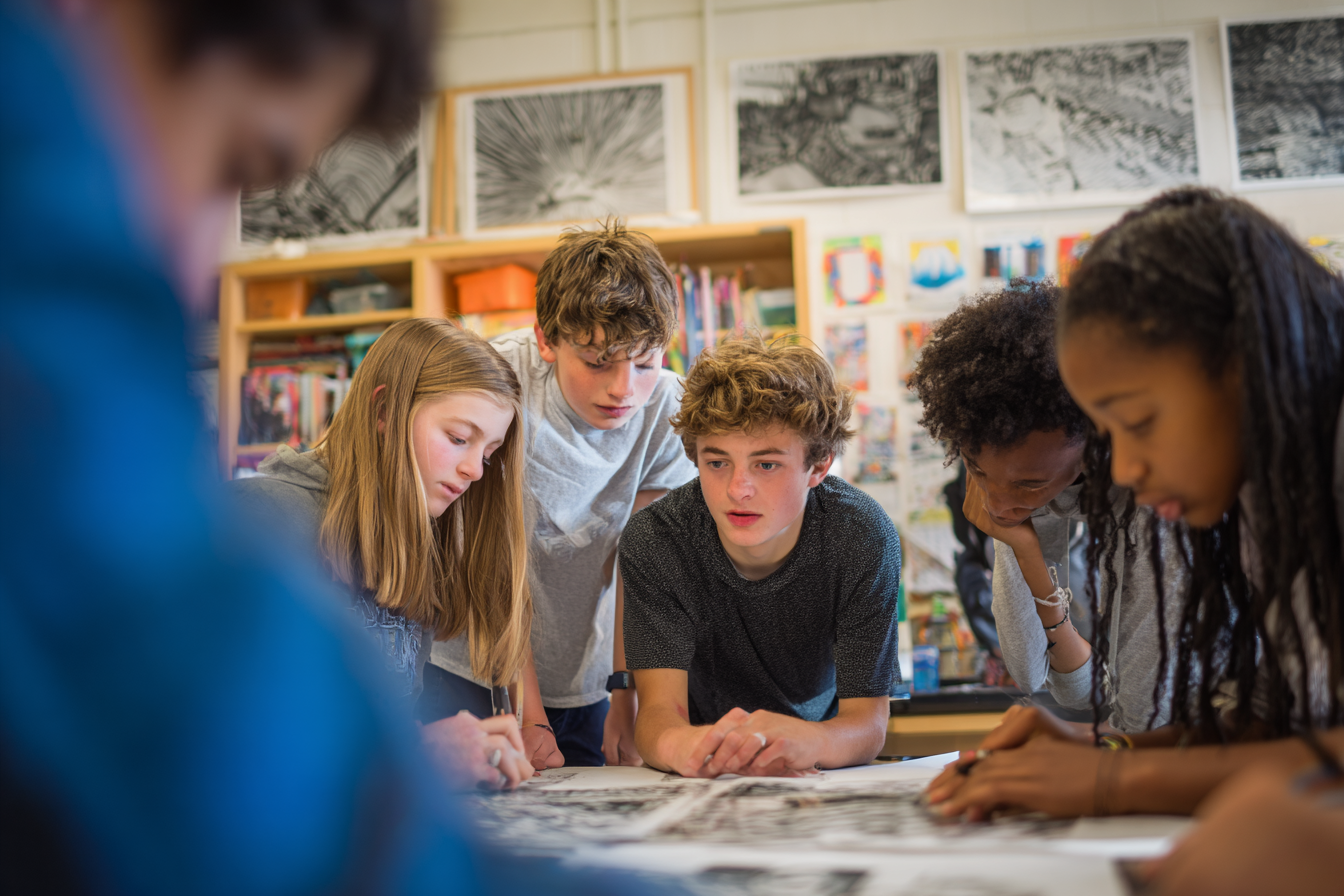
Focus: Explore personal themes, experiences, and interests to begin defining artistic identity, and set individual growth goals for the year. Use brainstorming, research, and visual planning to develop original artistic ideas that reflect who students are and who they want to become as artists.
Grade Level: 8
Subject Area: Art (Visual Arts • Studio Practice • Creative Process)
Total Unit Duration: 5 sessions (one week), 50–60 minutes per session
I. Introduction
Students begin the year by asking, “Who am I as an artist?” and “What do I care about enough to put into my art?” They explore how artists use symbolism, color, composition, and media choices to communicate identity, culture, interests, and values. Through artist examples, sketchbook prompts, and quick studies, students start a personal “visual identity bank” and draft artistic growth goals. They finish the unit by creating a small identity-based artwork and an artist statement that links their choices to personal experiences, aligning with goals for the year.
Essential Questions
- How can I use visual elements (symbols, color, composition, materials) to represent my identity, experiences, and interests?
- What does it mean to develop an original artistic idea instead of copying someone else’s?
- How can brainstorming, research, and thumbnail sketches help me plan stronger artworks?
- What are my art strengths and areas for growth, and how can I set realistic artistic goals for this year?
- How can I explain how my life experiences and personal themes influence my artistic decisions?
II. Objectives and Standards
Learning Objectives — Students will be able to:
- Analyze examples of artworks that express identity and identify how artists use symbols, color, and composition to communicate personal experiences.
- Generate brainstorm lists, mind maps, and thumbnail sketches that explore personal themes (e.g., culture, hobbies, emotions, community, values).
- Develop at least one original artistic idea (not a direct copy) by combining personal experiences with visual research and planning sketches.
- Create a small identity-based artwork (e.g., self-portrait, symbolic collage, mixed-media piece) that reflects their experiences, interests, or perspectives.
- Write a short artist statement that explains how personal influences shaped their artistic decisions (subject matter, symbols, colors, media).
- Set 1–2 concrete artistic goals for the year and describe specific actions they will take to work toward those goals.
Standards Alignment — 8th Grade (NCAS-Aligned)
- VA:Cn10.8a — Create artwork that reflects personal experiences, interests, or perspectives and explain how those influences shaped artistic decisions.
- Example: Students produce a self-portrait or symbolic composition that represents cultural background, hobbies, or values and write an artist statement about their choices.
- VA:Cr1.8a — Develop original artistic ideas by investigating themes, issues, or personal experiences through brainstorming, research, and visual planning.
- Example: Students create a page of thumbnail sketches exploring how identity can be represented visually and select one idea to develop.
Success Criteria — Student Language
- I can identify personal themes and interests that I want to explore in my artwork.
- I can use brainstorming and thumbnail sketches to create original ideas instead of copying.
- I can create an artwork that represents something true about me, using symbols, color, and composition with intention.
- I can explain in an artist statement how my experiences, culture, or interests influenced my artistic decisions.
- I can set specific, realistic goals for my art this year (e.g., “use more value,” “experiment with mixed media,” “improve anatomy,” “take more creative risks”).
III. Materials and Resources
Tasks & Tools (teacher acquires/curates)
- Visual inspiration:
- Reproductions or slides of diverse artists’ work focused on identity and self (self-portraits, symbolic works, cultural narratives, contemporary illustrators, street artists, etc.).
- Short captions or artist quotes about how their background and experiences influence their art.
- Student sketchbooks or folders of drawing paper for:
- Brainstorming, mind maps, word lists.
- Thumbnail sketches and composition studies.
- Written reflections and goal-setting.
- Art media (teacher choice; keep flexible):
- Dry media: pencils, colored pencils, markers, charcoal/pastel (if appropriate).
- Wet/media/collage: watercolor, tempera/acrylic (if available), magazines/newspapers, glue, scissors, colored paper.
- Optional: digital tablets or simple digital tools for students choosing digital art.
- Planning and reflection tools:
- “Identity & Interests Inventory” worksheet (prompts about culture, hobbies, favorite places, important people, dreams, challenges).
- “Theme & Symbol Bank” organizer (theme → possible images/symbols).
- “Artistic Goal Setting” sheet (strengths, areas for growth, specific goals, action steps).
- “Artist Statement Starter” template with sentence stems.
- Critique and discussion structures:
- TAG feedback prompts (Tell–Ask–Give).
- Sentence stems for peer feedback (e.g., “I notice…”, “I wonder…”, “Have you considered…?”).
Preparation
- Curate a balanced set of artworks from artists with diverse identities and styles to avoid a single “look” for identity-based art.
- Create anchor charts:
- “Ways to Show Identity in Art” (symbolism, environment, clothing, objects, pose, color, text).
- “Original vs. Copy” (using reference vs. tracing/imitating exactly).
- “Strong Artistic Goals” (specific, measurable, realistic, about effort/practice or skills).
- Prepare a simple rubric or checklist for the identity artwork focusing on connection to self, idea development, visual communication, and effort/craftsmanship.
- Decide which size/format the identity artwork will be (e.g., 9x12” paper, one page digital, etc.) and what media options will be available.
Common Misconceptions to Surface
- “Art about identity has to be a realistic self-portrait of my face.” → Identity can be shown through symbolic objects, places, colors, and invented characters, not just realistic portraits.
- “If I’m not good at drawing realistically, I can’t show who I am in my art.” → Many powerful artworks are stylized, abstract, or symbolic; clarity of idea is as important as realism.
- “Original art means I can’t look at any references or other artists’ work.” → Research and reference are allowed; originality comes from how students combine and transform ideas.
- “Setting goals means I’m already failing.” → Goals are about growth, not punishment; all artists set goals to improve skills and explore new directions.
- “My identity is ‘boring’ so I don’t have anything to say in my art.” → Everyday experiences, interests, and feelings can become rich visual themes when explored creatively.
Key Terms (highlight in lessons) identity, theme, symbol, composition, originality, brainstorming, thumbnail sketch, visual planning, artist statement, artistic goals, reflection
IV. Lesson Procedure
(Each day follows: Launch → Explore → Discuss → Reflect. Timing for a 50–60 minute block.)
Session 1 — Who Am I as an Artist? (VA:Cn10.8a)
- Launch (6–8 min)
- Display 3–4 artworks where artists explore identity (self-portraits, symbolic works, cultural references).
- Quick write or think-pair-share: “What do you notice about how these artists show who they are?”
- Explore (22–25 min)
- Mini-lesson: introduce identity in art and show anchor chart “Ways to Show Identity in Art.”
- Students complete an Identity & Interests Inventory in their sketchbooks (favorite places, cultural traditions, hobbies, music, important people, challenges, values).
- Begin a “visual identity bank”: students list or sketch symbols and images that could represent themselves (objects, animals, colors, locations, patterns).
- Discuss (10–12 min)
- In small groups, students share one idea from their inventory and one possible symbol or visual element they might use.
- Whole-group: What kinds of personal experiences or interests are we seeing? How could these become art themes?
- Reflect (5 min)
- Exit slip: “One personal theme I might explore in my art this year is ___ because ___.”
Session 2 — Brainstorming & Thumbnail Sketches: Turning Identity into Visual Ideas (VA:Cr1.8a • VA:Cn10.8a)
- Launch (5–7 min)
- Show 1–2 student-friendly examples of thumbnail pages or rough sketch pages from artists.
- Ask: “Why might artists draw many small sketches before committing to a final piece?”
- Explore (22–25 min)
- Students review their identity bank from Session 1.
- Using the “Theme & Symbol Bank” organizer, they choose 1–2 themes (e.g., family, gaming, cultural pride, anxiety, friendship) and list or sketch possible symbols and scenes.
- In sketchbooks, students create 4–6 thumbnail sketches exploring different ways to show one theme:
- Different compositions (close-up vs. wide view).
- Different symbol combinations.
- Different emotional tone (color/value notes).
- Encourage risk-taking and variety; thumbnails should be quick, not polished.
- Discuss (10–12 min)
- Pair-share: students show thumbnails and describe which one feels most like “them” and why.
- Brief whole-group share: what makes a thumbnail interesting or original rather than “just like everyone else’s”?
- Reflect (5 min)
- Quick write: “The thumbnail I am most interested in developing shows (theme) using (symbols/composition) because ___.”
Session 3 — Selecting and Planning an Identity Artwork (VA:Cr1.8a)
- Launch (6–8 min)
- Review the anchor chart “Original vs. Copy” and clarify that students may look at references (objects, photos) but should not trace or copy entire images from online.
- Ask: “How can we use references and still keep our ideas original?”
- Explore (22–25 min)
- Students choose one thumbnail (or combine parts of several) as the basis for their identity artwork.
- On a planning page, they:
- Redraw the composition at a slightly larger size, refining proportions and layout.
- Decide on media (pencil, color pencil, marker, collage, mixed media, digital) and make quick color tests or media swatches.
- Add notes about symbols, color choices, and background elements and how they connect to personal experiences.
- Teacher circulates to confer, asking questions like, “What part of your life are you showing here?” and “How will someone know that from your imagery?”
- Discuss (10–12 min)
- Structured peer feedback (TAG) in pairs or triads:
- Tell: “One thing that really communicates your identity is…”
- Ask: “I’m curious about this part—what does it mean?”
- Give: “You might make your idea clearer by…”
- Structured peer feedback (TAG) in pairs or triads:
- Reflect (5 min)
- Exit slip: “One change I will make to my plan after feedback is ___ because it will help communicate ___ about me.”
Session 4 — Studio Work: Creating the Identity Artwork (VA:Cr1.8a • VA:Cn10.8a)
- Launch (5–7 min)
- Brief reminder of studio norms (materials care, cleanup, respectful environment) and the focus of the project: to show something real about your identity.
- Show the rubric/checklist so students know what “success” looks like (connection to self, idea development, visual communication, craftsmanship, effort).
- Explore (30–35 min)
- Students begin or continue working on their identity artworks using chosen media and plan.
- Encourage students to periodically check their goals: “Am I making choices that match the idea in my plan?”
- Teacher circulates, giving brief conferences:
- Push for clarity (“How could you make this symbol more noticeable?”).
- Support risk-taking (“What if you try a bolder color here?”).
- Optional: midway, students take a quick photo of their in-progress work and jot a one-sentence reflection in their sketchbook: “Right now my artwork says ___ about me.”
- Discuss (5–7 min)
- Quick pair-share mid-class or at the end: “One choice I made today that shows my identity is…”
- Reflect (3–5 min)
- End-of-class reflection in sketchbook: “Something that is working well in my artwork is ___; one thing I need to focus on next time is ___.”
Session 5 — Critique, Artist Statements & Goal Setting (VA:Cn10.8a • VA:Cr1.8a)
- Launch (5–7 min)
- Explain the purpose of critique: to notice, understand, and support growth rather than to judge people.
- Review TAG feedback and sentence stems for respectful comments.
- Explore (25–30 min)
- Gallery walk or table-based share: students display their artworks with sketchbooks open to planning pages.
- Peers leave TAG feedback notes focusing on:
- How clearly the artwork communicates identity or personal theme.
- Effective symbols, composition, or color choices.
- Suggestions for future refinement or exploration.
- Students complete an Artist Statement Starter, responding to prompts such as:
- “My artwork is about…”
- “I chose these symbols/colors/composition because…”
- “This connects to my experiences or interests because…”
- Then students fill out the Artistic Goal Setting sheet:
- Identify 1–2 strengths noticed in their work or planning.
- Identify 1–2 areas for growth (skills, habits, or risk-taking).
- Set 1–2 specific goals for the year with at least one action step (e.g., “Practice shading weekly,” “Experiment with at least two new media by winter,” “Fill at least 3 sketchbook pages between projects”).
- Discuss (8–10 min)
- Optional whole-group circle: volunteers share one insight they gained about themselves as artists and one goal they are excited about.
- Teacher highlights variety of themes and affirms that there is no single “correct” way to represent identity.
- Reflect (3–5 min)
- Final reflection: “One thing my artwork reveals about me is ___, and one artistic goal I’m setting for myself this year is ___ because ___.”
V. Differentiation and Accommodations
Advanced Learners
- Encourage use of more complex symbolism (multiple layers of meaning, juxtaposition, or metaphor) or non-traditional compositions.
- Invite them to incorporate mixed media or experiment with style (e.g., combining realism with abstraction or text).
- Extend artist statement expectations: include references to artist influences, specific art vocabulary (contrast, emphasis, balance), and how this project points toward a longer-term artistic direction.
Targeted Support
- Provide structured brainstorming prompts (“Draw three objects that matter to you,” “Sketch a place where you feel most yourself”).
- Offer thumbnail templates (pre-drawn boxes) and encourage focusing on big shapes instead of small details.
- Limit media choices at first for students who get overwhelmed; suggest one or two reliable options.
- Use visual word banks with pictures to support symbol ideas (e.g., music, sports, gaming, family, nature).
- Provide sentence frames for artist statements and goals:
- “My artwork is about ___ because ___.”
- “A symbol I used is ___, which stands for ___.”
- “This year I want to improve at ___ by ___.”
Multilingual Learners
- Allow brainstorming and identity writing in home language first, then work with peers/teacher to translate essential ideas into English.
- Provide bilingual word banks for key art and identity terms where possible.
- Prioritize visual communication in assessment: clear symbolism and composition can count heavily, even if language is still developing.
- Encourage oral sharing of ideas and goals with a partner before writing.
IEP/504 & Accessibility
- Break tasks into clear, small steps (e.g., “Step 1: choose theme; Step 2: draw 2 thumbnails; Step 3: choose one and add symbols”).
- Offer alternative formats for the final artwork (digital drawing, collage, traced outlines plus original additions) based on motor or sensory needs.
- Allow oral or recorded artist statements, or bullet-point statements with teacher support, instead of full paragraphs.
- Provide visual schedules and checklists for each session.
- Adjust critique format (e.g., one-on-one feedback with teacher or small-group sharing) for students who experience anxiety in large-group settings.
VI. Assessment and Evaluation
Formative Checks (daily)
- Session 1 — Identity & Interests Inventories and visual identity banks show at least 3–5 personal themes or experiences.
- Session 2 — Thumbnail pages include multiple varied compositions that explore identity visually (not just repeats of the same idea).
- Session 3 — Planning pages show a chosen concept, refined composition, and notes linking symbols/colors to personal experiences.
- Session 4 — In-progress artworks show alignment with the plan and intentional use of chosen symbols and composition; students can verbalize what they’re trying to communicate.
- Session 5 — Artist statements and goal-setting sheets show clear connections between identity and artistic decisions and at least one specific goal.
Summative — Identity Artwork, Artist Statement & Goals (0–2 per criterion, total 10)
- Connection to Identity (VA:Cn10.8a)
- 2: Artwork clearly reflects personal experiences, interests, or perspectives; symbols and/or imagery are meaningfully tied to the student’s identity (as explained in the artist statement).
- 1: Artwork shows some personal connection, but theme or symbols feel general or only partly connected to the student’s experiences.
- 0: Little or no evidence that the artwork connects to the student’s identity.
- Idea Development & Originality (VA:Cr1.8a)
- 2: Student used brainstorming, research, and thumbnails to develop an original idea, combining references and personal themes in a unique way.
- 1: Some planning is evident, but the final idea is simple, very common, or closely imitates existing imagery.
- 0: Minimal planning or clear copying; idea is not original to the student.
- Visual Communication
- 2: Composition, symbols, and color/other visual elements work together effectively to communicate the intended theme or message about identity.
- 1: Visual choices partly communicate the theme but may be confusing, cluttered, or underdeveloped.
- 0: Visual choices do not clearly relate to the intended message, or the artwork is too incomplete to judge.
- Craftsmanship & Effort
- 2: Artwork shows consistent effort and care in use of materials (clean lines or intentional marks, controlled color application, thoughtful revision); student used class time productively.
- 1: Some areas of care and effort are visible, but other sections appear rushed or incomplete; time use was mixed.
- 0: Artwork shows minimal effort or significant lack of care in materials and time use.
- Artist Statement & Goal Setting (VA:Cn10.8a • VA:Cr1.8a)
- 2: Artist statement clearly explains how personal experiences or interests shaped artistic decisions; student sets specific, realistic goals for future growth and mentions steps to reach them.
- 1: Statement references identity or interests but is vague; goals are general (“get better at art”) with few action steps.
- 0: Statement and/or goals are missing or show little connection to identity or artistic growth.
Feedback Protocol (TAG)
- Tell one strength (e.g., “Your choice of colors really helps show the mood of your identity theme.”).
- Ask one question (e.g., “What does this symbol mean to you, and how could you make it stand out more?”).
- Give one suggestion (e.g., “You might add more background details that support your theme.”).
VII. Reflection and Extension
Reflection Prompts
- What did you learn about your own identity through planning and creating this artwork?
- Which visual choices (symbols, color, composition, media) do you feel most proud of, and why?
- How do your artistic goals for this year connect to the kind of art you want to make or the stories you want to tell?
- How might your identity-based artwork look different if you created another version at the end of the year?
Extensions
- Identity Series: Later in the year, return to this theme and create a second artwork exploring a different aspect of identity (e.g., heritage, future self, community). Display before-and-after works side by side to show growth.
- Artist Research Connection: Have students research an artist whose work resonates with their own themes and create a short visual or written response connecting that artist’s identity to their own.
- Portfolio Reflection: At midyear and year’s end, revisit the goals from this unit and have students write a brief reflection on how their work shows progress toward those goals.
Standards Trace — When Each Standard Is Addressed
- VA:Cn10.8a — Sessions 1–5 (identity inventory and symbol brainstorming; selecting themes; creating artwork that reflects personal experiences; writing artist statements; setting goals linked to identity and artistic decisions).
- VA:Cr1.8a — Sessions 2–5 (brainstorming and thumbnail sketches; planning compositions and media; developing original ideas; revising plans based on feedback; creating final identity artwork).