Unit Plan 36 (Grade 8 Art): Reflection & Artistic Growth Analysis
Grade 8 art capstone unit where students analyze portfolios, reflect on artistic identity, evaluate growth with criteria, and set goals for high school art.

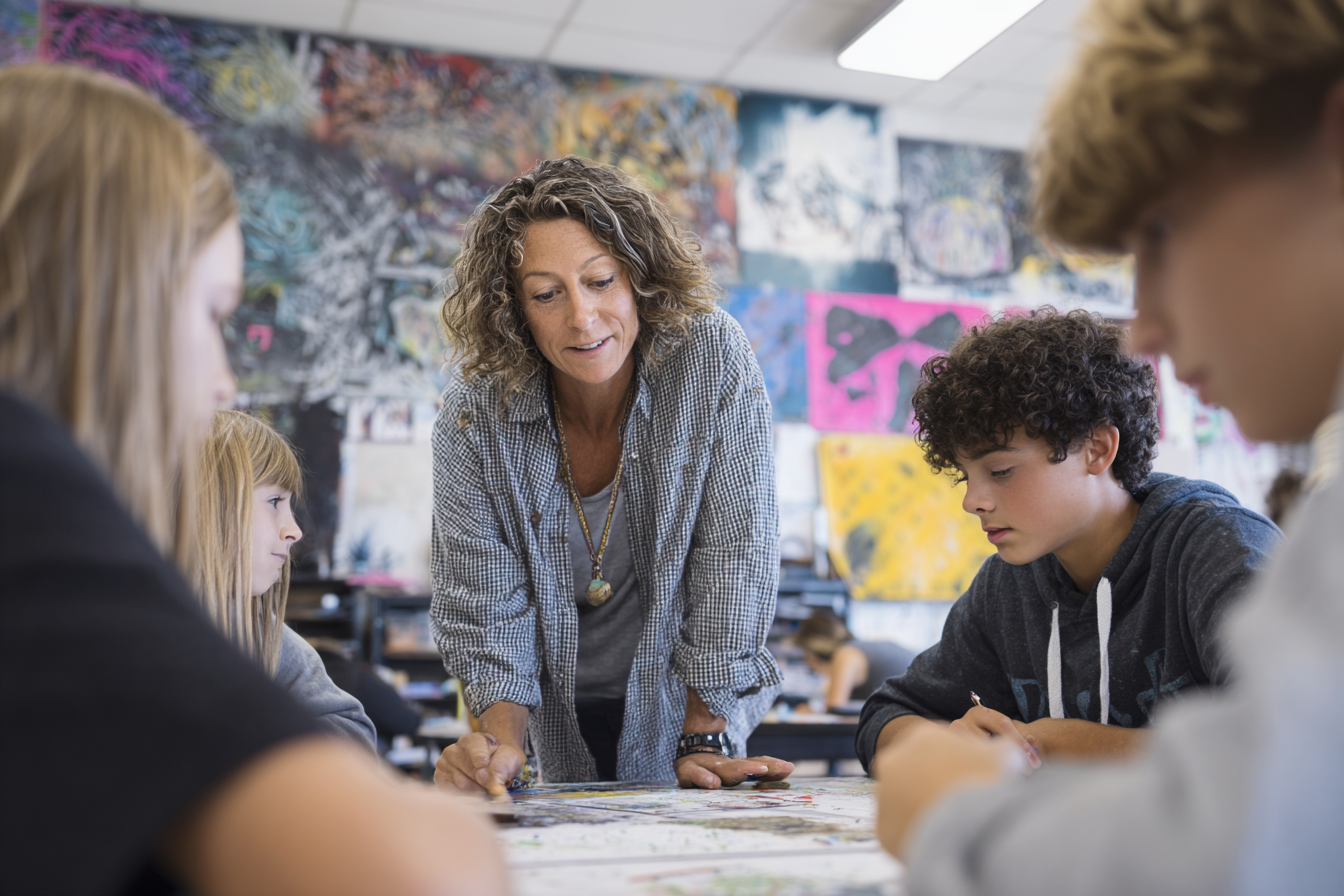
Focus: Reflect on artistic growth, identity, and readiness for high school art, using portfolios and criteria-based evaluation to connect personal experiences with artistic decisions.
Grade Level: 8
Subject Area: Art (Visual Arts • Reflection & Critique • Identity & Portfolio Development)
Total Unit Duration: 5 sessions (one week), 50–60 minutes per session
I. Introduction
In this capstone unit, students look back across their Grade 8 art journey to analyze how their skills, ideas, and artistic identity have grown. Using their portfolio and exhibition work, they revisit key projects, identify recurring themes and symbols, and evaluate their progress using established criteria such as craftsmanship, composition, originality, and communication. Students then synthesize this analysis into a written and/or visual Growth Narrative that connects personal experiences and interests to their art-making and sets goals for high school art. The unit celebrates how far students have come while helping them step confidently into the next stage of their creative path.
Essential Questions
- How has my artistic identity changed or deepened over this year?
- In what ways have my skills and craftsmanship improved, and how can I tell?
- How do my personal experiences, interests, and perspectives show up in my artistic decisions?
- How can using clear criteria help me evaluate my own artwork and growth more honestly and constructively?
- What does it mean to be ready for high school art, and what goals do I want to carry forward?
II. Objectives and Standards
Learning Objectives — Students will be able to:
- Gather and organize a portfolio of Grade 8 artworks that represent key projects, themes, and efforts.
- Identify and describe personal experiences, interests, or perspectives that influenced at least two major artworks (VA:Cn10.8a).
- Evaluate selected artworks using established criteria (craftsmanship, composition, originality, effectiveness of communication) and note evidence of growth (VA:Re9.8a).
- Create a written and/or visual Artistic Growth Narrative that connects portfolio evidence to personal identity and artistic development.
- Set specific, realistic goals for high school art based on reflection and criteria-based self-evaluation.
Standards Alignment — 8th Grade (NCAS-Aligned)
- VA:Cn10.8a — Create artwork that reflects personal experiences, interests, or perspectives and explain how those influences shaped artistic decisions.
- Example: Students reflect on how personal background and interests informed choices in at least two portfolio pieces and/or create a visual “growth artifact” that symbolizes their artistic identity.
- VA:Re9.8a — Evaluate artwork using established criteria such as craftsmanship, composition, originality, and effectiveness of communication.
- Example: Students use a rubric to critique their own portfolio pieces and provide evidence-based commentary on growth and next steps.
Success Criteria — Student Language
- I can explain how my personal experiences and interests show up in my artwork.
- I can use clear criteria (craftsmanship, composition, originality, communication) to evaluate my own work and track my growth.
- I can choose portfolio pieces that represent important moments in my development as an artist.
- I can create a Growth Narrative that uses specific examples from my artworks to tell the story of my artistic journey.
- I can name concrete goals that will help me be successful and confident in high school art.
III. Materials and Resources
Tasks & Tools (teacher acquires/curates)
- Student Grade 8 art portfolios, including:
- Major projects (identity-based, social issue, style study, personal narrative, studio projects, constraints challenge, etc.).
- Sketchbooks, thumbnails, process photos (if available).
- Exhibition documentation (photos, labels, artist statements).
- Reflection tools:
- Portfolio Inventory Sheet (title, medium, date, brief notes).
- “Identity & Influences” organizer (personal interests, experiences, and how they show up in artworks).
- Criteria-based self-evaluation rubric (craftsmanship, composition, originality, communication).
- Growth Narrative planning sheet (outline prompts).
- Writing & visual materials:
- Lined paper or digital documents for written reflections.
- Art supplies for an optional visual growth artifact (e.g., timeline collage, symbolic mini-poster): drawing paper, markers, collage materials, glue, etc.
- Anchor charts:
- “Criteria for Evaluating My Own Art” (craftsmanship, composition, originality, effectiveness of communication).
- “Evidence of Artistic Growth” (more control, risk-taking, clearer messages, stronger compositions).
- “High School Art Readiness” (skills, habits, attitudes that matter).
Preparation
- Ensure portfolios are accessible and as complete as possible (gather any remaining pieces from storage).
- Prepare and copy portfolio inventory and self-evaluation forms.
- Create an exemplar Artistic Growth Narrative (short sample paragraph or one-page mini-poster) to model expectations.
- Decide whether students will produce both written and visual reflections, or choose one primary format plus a smaller add-on.
Common Misconceptions to Surface
- “If I still see mistakes, it means I haven’t grown.” → Growth means noticing more details and higher standards, not perfection.
- “Only my ‘best-looking’ pieces count for my portfolio.” → Works that show risk-taking, problem-solving, or important learning also matter.
- “Using criteria means I have to be harsh on myself.” → Criteria help you be honest and specific, celebrating strengths as well as naming next steps.
- “My art has nothing to do with my real life.” → Personal experiences and interests often show up in subject matter, style, color, or symbols, even when we don’t realize it.
Key Terms (highlight in lessons) artistic identity, portfolio, reflection, criteria, self-evaluation, craftsmanship, composition, originality, effectiveness of communication, growth, readiness, goal-setting
IV. Lesson Procedure
(Each day follows: Launch → Explore/Work Time → Discuss → Reflect. Timing for a 50–60 minute block.)
Session 1 — Portfolio Inventory & Identity Threads (VA:Cn10.8a)
- Launch (6–8 min)
- Show a simple visual of an artist’s early work vs. later work (teacher example or famous artist).
- Ask: “What differences do you notice? What might this say about the artist’s growth and identity?”
- Explain that students will look back at their own year and build a sense of their artistic story.
- Explore / Work Time (25–30 min)
- Students spread out their portfolios (or flip through sketchbooks/digital images) and complete a Portfolio Inventory Sheet:
- Titles or short descriptions, media, approximate dates.
- Quick notes: “What was this project about? What did I learn?”
- Students then use an Identity & Influences organizer to note:
- Interests (music, sports, gaming, culture, social issues, etc.).
- Important experiences or perspectives this year.
- Which artworks connect to each interest/experience and how.
- Students spread out their portfolios (or flip through sketchbooks/digital images) and complete a Portfolio Inventory Sheet:
- Discuss (8–10 min)
- In pairs, students share one artwork that feels most personal and explain what part of their life or identity shows up in it.
- As a class, briefly list common themes (e.g., mental health, identity, community, nature, social justice).
- Reflect (3–5 min)
- Exit slip: “One way my art reflects my personal experiences or interests is ___ in the piece ___.”
Session 2 — Evaluating Growth with Criteria (VA:Re9.8a)
- Launch (5–7 min)
- Review the evaluation criteria anchor chart (craftsmanship, composition, originality, effectiveness of communication).
- Ask: “How can these same criteria help us see how we have grown over time?”
- Explore / Work Time (25–30 min)
- Students select two or three artworks that show different moments in the year (e.g., early, middle, recent).
- Using the self-evaluation rubric, students evaluate each selected piece:
- Rate each criterion (e.g., 1–4 scale or “Emerging/Developing/Proficient/Advanced”).
- Provide specific evidence (“I see smoother shading here,” “Composition is more balanced because…”).
- Students then complete a Growth Snapshot:
- “One way I improved in craftsmanship is…”
- “One way I improved in composition/originality/communication is…”
- “One area where I still want to grow is…”
- Discuss (8–10 min)
- Small-group share: each student shows one early and one later piece, summarizing one concrete way they’ve grown using criteria language.
- Groups notice patterns: e.g., “We see better use of value,” “More confident line work,” “More original ideas.”
- Reflect (3–5 min)
- Quick write: “A specific piece of evidence that shows my growth is ___ in my artwork ___. It shows growth because ___.”
Session 3 — Planning the Artistic Growth Narrative (VA:Cn10.8a • VA:Re9.8a)
- Launch (6–8 min)
- Show a short sample Artistic Growth Narrative (teacher-written example) that:
- Names artworks.
- Describes growth using criteria.
- Connects to identity/personal experiences.
- Ask: “What makes this narrative clear and powerful?”
- Show a short sample Artistic Growth Narrative (teacher-written example) that:
- Explore / Work Time (25–30 min)
- Students use a Growth Narrative Planning Sheet with prompts such as:
- Introduction: “Who am I as an artist now? What themes or media do I care about?”
- Middle: “Which 2–3 artworks show my growth? What did I learn about craftsmanship/composition/originality/communication?”
- Identity connection: “How do my experiences/interests show up in these pieces?”
- Future: “What goals do I have for high school art?”
- Students decide on their format (teacher may choose or give options):
- A 1–2 page written narrative.
- A combined visual + written mini-poster or slide (images + paragraphs).
- Begin drafting (bullet outline, sentence starters, or first paragraph).
- Students use a Growth Narrative Planning Sheet with prompts such as:
- Discuss (8–10 min)
- Pair share: students read part of their plan or early draft and get feedback on clarity and detail (“Where could I add more evidence?”).
- Teacher reminds students to use criteria vocabulary and specific examples from their portfolio.
- Reflect (3–5 min)
- Exit slip: “One idea I definitely want to include in my Growth Narrative is ___ because it shows ___ about me as an artist.”
Session 4 — Creating the Growth Narrative & Optional Visual “Growth Artifact” (VA:Cn10.8a • VA:Re9.8a)
- Launch (5–7 min)
- Briefly review expectations: name artworks, use criteria and evidence, and connect to personal experiences and future goals.
- If creating a visual component (e.g., timeline, symbolic image), show a quick example or sketch.
- Explore / Work Time (25–30 min)
- Students work on their final Growth Narrative, either:
- Writing and revising a full written reflection, OR
- Designing a visual piece (timeline, collage, symbolic self-portrait) with written captions or paragraphs embedded.
- Encourage students to:
- Reference at least 2–3 artworks by name/description.
- Use criteria vocabulary (“My craftsmanship improved when…”) and identity language (“This piece connects to my experience of…”).
- Teacher circulates to confer and remind students to be specific, not just “I got better.”
- Students work on their final Growth Narrative, either:
- Discuss (8–10 min)
- Peer review in pairs/small groups:
- Partner A reads or presents part of their narrative.
- Partner B identifies one clear strength (evidence use, connection to identity) and one question or suggestion.
- Peer review in pairs/small groups:
- Reflect (3–5 min)
- Quick write: “One part of my Growth Narrative that I am proud of is ___ because ___.”
Session 5 — Sharing Growth & Setting High School Art Goals (VA:Cn10.8a • VA:Re9.8a)
- Launch (5–7 min)
- Ask: “What do you hope high school art teachers or future classmates understand about you as an artist?”
- Explain that sharing Growth Narratives is partly about celebration and partly about launching into the next chapter.
- Explore / Work Time (25–30 min)
- Students share their Growth Narratives in one of the following ways (teacher choice):
- Small-group “roundtable” where each student shares key excerpts and shows 1–2 artworks.
- Gallery walk of visual artifacts/posters with written reflections.
- Short, informal presentations to the class.
- Students complete a High School Art Readiness & Goals sheet:
- “Three strengths I’m bringing into high school art are…”
- “Two skills or habits I want to keep improving are…”
- “One risk I want to take in my future art is…”
- Students share their Growth Narratives in one of the following ways (teacher choice):
- Discuss (8–10 min)
- Whole-class circle share: everyone names one thing they’ve improved at this year and one goal for next year.
- Teacher affirms growth, connects back to standards: understanding how personal experiences influence art and using criteria to evaluate growth.
- Reflect (3–5 min)
- Final reflection: “If I could send one message to my future high school art teacher about me as an artist, it would be: ___.”
V. Differentiation and Accommodations
Advanced Learners
- Encourage more complex Growth Narratives that:
- Compare their work to influences from historical or contemporary artists.
- Reflect on how context (social, cultural, digital) shaped their pieces.
- Invite them to create an extended portfolio statement suitable for high school applications or online portfolios.
- Have them support peers in using criteria vocabulary and organizing portfolios.
Targeted Support
- Provide sentence frames and structured organizers for reflection, such as:
- “In the beginning of the year, my artwork looked ___, but now it looks ___.”
- “One way I improved in craftsmanship/composition/originality is ___.”
- Reduce the number of portfolio pieces students must analyze in depth (e.g., focus on 2 instead of 3–4).
- Confer frequently to help students identify specific evidence of growth rather than general statements.
- Offer checklists that break down the Growth Narrative into small, manageable steps.
Multilingual Learners
- Allow brainstorming and initial reflection in the home language, followed by supported translation of key sentences into English.
- Provide a visual glossary for criteria terms and reflection verbs (evaluate, improve, communicate, represent).
- Accept mixed-media responses (images with labels, diagrams with short captions) as part of the Growth Narrative.
- Pair MLLs with supportive peers to orally rehearse reflections before writing or presenting.
IEP/504 & Accessibility
- Allow alternative formats for the Growth Narrative (audio recording, video explanation, interview-style conversation) as appropriate.
- Provide enlarged and simplified rubrics with fewer criteria if needed.
- Offer extra time and quiet workspaces for reflection tasks.
- Use structured prompts and graphic organizers to make self-evaluation less overwhelming.
VI. Assessment and Evaluation
Formative Checks (daily)
- Session 1 — Portfolio inventory and identity organizers show students can connect artworks to personal experiences or interests.
- Session 2 — Self-evaluation rubrics show students using criteria and evidence to describe strengths and growth areas.
- Session 3 — Plans for Growth Narratives show inclusion of specific artworks, criteria vocabulary, and identity connections.
- Session 4 — Draft narratives and/or visual artifacts show clear attempts to synthesize growth and use evidence.
- Session 5 — Readiness & goals sheets show thoughtful, specific planning for high school art.
Summative — Artistic Growth Narrative & Portfolio Reflection (0–2 per criterion, total 10)
- Connection to Personal Experiences & Identity (VA:Cn10.8a)
- 2: Clearly explains how personal experiences, interests, or perspectives influenced at least two artworks, with specific examples.
- 1: Mentions personal connections but in general terms or with limited detail.
- 0: Little or no reference to personal experiences or identity.
- Use of Evaluation Criteria (VA:Re9.8a)
- 2: Uses criteria (craftsmanship, composition, originality, communication) accurately to evaluate multiple artworks, citing visual evidence.
- 1: Refers to some criteria or growth areas but with vague or incomplete evidence.
- 0: Rarely uses criteria or evidence to discuss artworks.
- Evidence of Growth
- 2: Clearly identifies specific ways skills and thinking changed over time, linking early and later work with examples.
- 1: Identifies some growth but in broad terms or without strong examples.
- 0: Little or no meaningful discussion of growth.
- Clarity & Organization of Narrative/Artifact
- 2: Growth Narrative (written or visual+written) is well-organized, easy to follow, and communicates a coherent story of artistic development.
- 1: Narrative is mostly understandable but may be choppy or missing some pieces of the story.
- 0: Narrative is hard to follow or incomplete.
- High School Readiness & Goal-Setting
- 2: Articulates clear, realistic, and specific goals for high school art that connect to reflection and self-evaluation.
- 1: States some goals, but they are general or not clearly tied to reflection.
- 0: Goals are missing or do not show meaningful planning for the future.
Feedback Protocol (TAG)
- Tell one strength (e.g., “Your description of how your social-issue project connected to your life was very powerful.”).
- Ask one question (e.g., “Can you say more about how your composition improved between these two pieces?”).
- Give one suggestion (e.g., “You might add one more specific example to show your growth in craftsmanship.”).
VII. Reflection and Extension
Reflection Prompts
- How would you describe your artistic identity at the start of this year versus now?
- Which artwork or project are you most proud of, and what does it reveal about your growth and interests?
- How did using criteria and self-evaluation change the way you think about your art?
- What advice would you give to a future 8th grade art student about how to make the most of this class?
- How do you hope your art will change or stay the same in high school and beyond?
Extensions
- Portfolio Package for High School: Organize digital or physical copies of key works, Growth Narrative, and goals into a folder or simple portfolio to bring into high school.
- Letter to Future Self: Write a letter addressed to your “Future Artist Self” in 2–3 years, describing who you are now and what you hope to keep exploring.
- Artist Timeline: Create a visual timeline that includes early doodles, favorite Grade 8 pieces, and space for future artworks.
- Peer Growth Showcase: Pair up with a classmate and create a joint poster or slideshow comparing and celebrating each other’s growth.
Standards Trace — When Each Standard Is Addressed
- VA:Cn10.8a — Sessions 1, 3–5
- Session 1: Identifying personal experiences and interests connected to portfolio pieces.
- Session 3: Planning a Growth Narrative that links art to identity and lived experiences.
- Session 4: Creating written/visual reflections that highlight personal perspectives and choices.
- Session 5: Sharing Growth Narratives and setting future goals grounded in identity and interests.
- VA:Re9.8a — Sessions 2–4
- Session 2: Using criteria-based self-evaluation rubrics to assess artworks and growth.
- Session 3: Incorporating criteria language and evidence into planning for the Growth Narrative.
- Session 4: Describing growth in craftsmanship, composition, originality, and communication within the final reflection.