Unit Plan 36 (Grade 8 Band): Culminating Band Performance
Grade 8 band culminating performance showcasing musicianship, leadership, and professionalism through accurate, expressive ensemble playing.

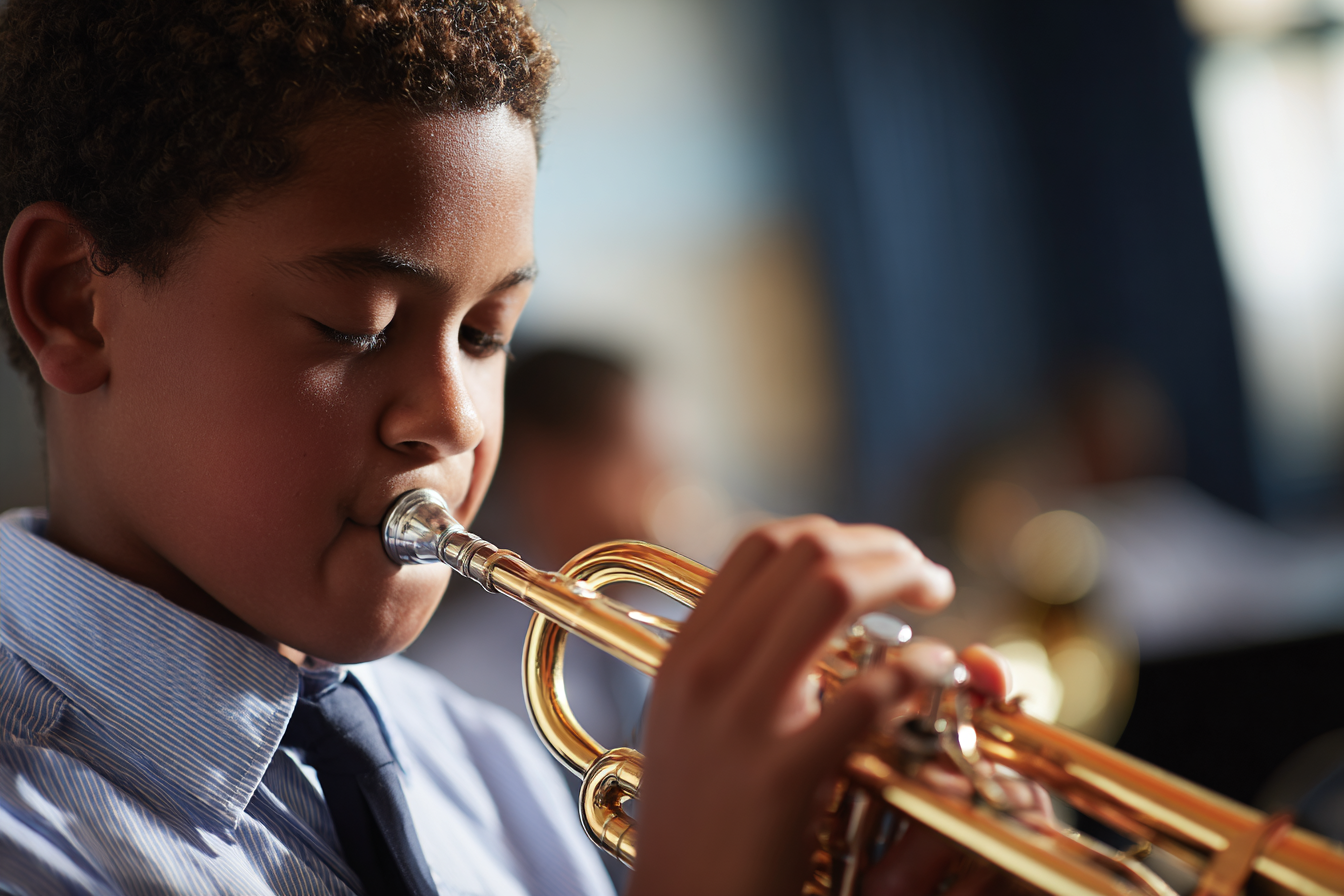
Focus: Perform band music demonstrating leadership, musicianship, and professionalism in a culminating concert or final performance event.
Grade Level: 8
Subject Area: Band (Performing • Leadership & Professionalism • Culminating Experience)
Total Unit Duration: 5 sessions (one week), 50–60 minutes per session
I. Introduction
In this final unit, students bring together everything they have learned about technique, ensemble skills, interpretation, and leadership to present a culminating band performance. They take on visible and behind-the-scenes roles—leading warm-ups, supporting younger players, managing transitions, and modeling professional stage presence. Musically, they aim for performances that are both accurate and expressive, showing clear stylistic understanding of each piece. After the performance, students reflect on their growth as musicians and leaders, and how their band experience has prepared them for future ensembles.
Essential Questions
- What does it look and sound like to perform with true musicianship and professionalism?
- How can student leadership and focus improve both the performance and the experience for the audience?
- How do we demonstrate accurate pitch, rhythm, tone, balance, and expression in a high-stakes performance?
- In what ways does this culminating performance show our individual and ensemble growth over time?
- How can the skills we use in this performance—focus, teamwork, leadership—carry into high school band and beyond?
II. Objectives and Standards
Learning Objectives — Students will be able to:
- Perform final concert repertoire with accurate pitch, rhythm, tone, balance, and expressive intent, matching stylistic expectations for each piece.
- Demonstrate leadership, focus, and professionalism throughout warm-ups, transitions, and on-stage performance.
- Take responsibility for at least one leadership or support role (e.g., section leader, warm-up leader, equipment captain, student announcer).
- Collaborate respectfully with peers to ensure smooth logistics (set-up, tuning, movement, cues) before, during, and after the performance.
- Reflect on how their musicianship and leadership developed across the year and in this culminating event.
Standards Alignment — 8th Grade Band (custom, NAfME-style)
- BD:Pr6.8a — Perform band music with accurate pitch, rhythm, tone, balance, and expressive intent, demonstrating stylistic understanding.
- Example: Students perform a Grade 2–3 band piece with clear dynamic contrast and accurate articulation.
- BD:Pr6.8b — Demonstrate leadership, focus, and professionalism in rehearsal and performance, including respectful collaboration and peer support.
- Example: Students lead section warm-ups and model rehearsal expectations.
Success Criteria — Student Language
- I can perform our music with accurate notes and rhythms and a steady tone that fits the style.
- I can show professionalism on stage through posture, focus, and respectful behavior.
- I can take on and fulfill at least one leadership role that helps our band succeed.
- I can support my section and the ensemble with encouragement, focus, and teamwork.
- I can explain how this performance shows my growth as a musician and leader.
III. Materials and Resources
Tasks & Tools (teacher acquires/curates)
- Repertoire & scores:
- Final concert program or culminating performance pieces.
- Conductor’s full scores and student parts.
- Leadership & logistics tools:
- “Leadership Role Menu” (e.g., section leader, warm-up leader, set-up crew, announcer, librarian, stage crew).
- Simple leadership responsibility checklists for student roles.
- Performance supports:
- Music stands, chairs, percussion equipment, and any necessary risers.
- Tuners, clip-on tuners, or tuner apps, plus a standard tuning routine.
- Reflection tools:
- “Culminating Performance Reflection” sheets.
- Optional program notes templates if students will introduce pieces.
- Recording & playback (optional but recommended):
- Device to record the culminating performance.
- Speakers for post-performance listening and reflection.
Preparation
- Finalize the concert program order and timing.
- Assign or allow sign-ups for student leadership roles and review expectations.
- Create an anchor chart: “Professionalism on Stage” (posture, focus, silence, respect, eye contact with conductor).
- Rehearse or assign spoken introductions if students will greet the audience or explain pieces.
Common Misconceptions to Surface
- “The director is in charge of everything; my job is just to play.” → Students share responsibility for focus, leadership, and professionalism.
- “Performance time is just like rehearsal, but in nicer clothes.” → Performance demands extra focus, consistency, and audience awareness.
- “If I’m not a first-chair player, I’m not a leader.” → Leadership includes support roles, not just solos or principal chairs.
- “Once the concert starts, I can’t help anything.” → Students can support success through active listening, watching the conductor, and encouraging peers.
- “This performance is the end of my music journey.” → Culminating performance can also be a bridge to high school band and future ensembles.
Key Terms (highlight in lessons) musicianship, professionalism, leadership, focus, ensemble, stage presence, stylistic understanding, reliability, concert etiquette, culminating performance, responsibility
IV. Lesson Procedure
(Each day follows: Launch → Explore → Discuss → Reflect. Timing for a 50–60 minute block.)
Session 1 — Defining Leadership & Professional Performance (BD:Pr6.8a • BD:Pr6.8b)
- Launch (6–8 min)
- Ask: “Think of the best performance you’ve ever seen or been part of—what made it feel professional?”
- Build two lists on the board: Musicianship (sound-related) and Professionalism (behavior and leadership).
- Explore (22–25 min)
- Review the final concert program and briefly discuss stylistic expectations for each piece (march, lyrical, fanfare, etc.).
- Introduce the Leadership Role Menu and explain each role.
- Students choose or are assigned at least one role (e.g., section leader, stand/chair crew, percussion captain, announcer, tuner helper, recording tech).
- Begin a short focused rehearsal on one concert piece, emphasizing watching the conductor, matching articulation, and ensemble balance.
- Discuss (10–12 min)
- Ask: “How can your chosen leadership role make our final performance more successful?”
- Connect student responsibilities directly to BD:Pr6.8b (leadership, focus, professionalism).
- Reflect (5 min)
- Exit slip: “My leadership role is __. I will show leadership by __ during the performance.”
Session 2 — Leadership in Rehearsal: Student-Led Warm-Ups & Section Work (BD:Pr6.8b)
- Launch (5–7 min)
- Ask: “What is one thing you can lead today that will help the band sound better?”
- Quickly review expectations for student-led warm-ups (clear cue, steady tempo, focused purpose).
- Explore (25–30 min)
- Selected students lead brief warm-ups targeting tone, tuning, or articulation (e.g., long tones, scales in concert keys, articulation patterns).
- Break into sections or choirs with section leaders guiding:
- Key entrances, tricky rhythms, or intonation spots from concert music.
- Reinforcing posture, breathing, and listening across the section.
- Reconvene for full-ensemble rehearsal of targeted passages, applying what was practiced in sectionals.
- Discuss (10–12 min)
- Ask student leaders: “What went well in your section? What could you do differently as a leader?”
- Ask the ensemble: “How did student leadership affect the way we rehearsed today?”
- Reflect (5 min)
- Quick write: “One way I showed leadership or professionalism today was __. This helped our band by __.”
Session 3 — Concert Run-Through & Stage Etiquette (BD:Pr6.8a • BD:Pr6.8b)
- Launch (5–7 min)
- Ask: “What will the audience notice before we play a single note?”
- Review stage etiquette and the “Professionalism on Stage” anchor chart (entrances, tuning, talking, focus, applause).
- Explore (25–30 min)
- Run a mock concert sequence:
- Students enter and sit as they will in performance.
- Tuning routine led by designated student(s) under director’s guidance.
- Perform through the entire program or shortened version in order, including any student announcers or short spoken intros.
- Emphasize musical accuracy and expressive intent while also watching for professional behavior.
- Run a mock concert sequence:
- Discuss (10–12 min)
- Ask: “What parts of our performance—including entrances and exits—looked truly professional? What needs polishing?”
- Invite brief comments from leadership-role students about logistics and transitions.
- Reflect (5 min)
- Exit slip: “One adjustment I personally need to make to look more professional on stage is __.”
Session 4 — Culminating Band Performance (All Standards)
(Depending on schedule, this may occur as an evening concert, in-school performance, or recorded culminating event.)
- Launch (5–7 min)
- Ask: “What is one word or phrase you want the audience to remember about our band after today?”
- Silent moment for students to recall their leadership roles and musical focus (tone, rhythm, expression).
- Explore (25–30+ min)
- Present the culminating band performance:
- Students carry out leadership roles (warm-ups, tuning, stage crew, announcing, etc.).
- Perform full concert program with emphasis on accuracy, tone, balance, and expressive style (BD:Pr6.8a).
- Demonstrate focus, teamwork, and professionalism on and off stage (BD:Pr6.8b).
- Optionally record the performance for later review or portfolios.
- Present the culminating band performance:
- Discuss (brief, if time permits in class)
- Short immediate debrief: “Name one moment during the performance that you felt especially proud of.”
- Reflect (homework or short in-class start)
- Begin the Culminating Performance Reflection: students jot quick notes while memories are fresh (complete in Session 5).
Session 5 — Reflection on Musicianship, Leadership & Next Steps (All Standards)
- Launch (5–7 min)
- Ask: “If you could send a short message about this performance to your beginning-of-year self, what would you say?”
- Optionally play a short excerpt from the recording.
- Explore (25–30 min)
- Students complete the Culminating Performance Reflection, including:
- One musical aspect (pitch, rhythm, tone, balance, expression) where they clearly improved.
- One leadership or professionalism skill they displayed.
- One part of the performance they are most proud of as an ensemble.
- One personal or musical goal they want to take into high school band or future music experiences.
- In small groups, students share highlights from their reflections, encouraging one another and recognizing leadership.
- Students complete the Culminating Performance Reflection, including:
- Discuss (10–12 min)
- Whole group: “How does this performance show who we are as a band?”
- Connect reflections back to BD:Pr6.8a (musicianship) and BD:Pr6.8b (leadership & professionalism).
- Reflect (5 min)
- Final prompt: “The most important thing I’m taking away from 8th grade band is __, and I’ll use it in the future by __.”
V. Differentiation and Accommodations
Advanced Learners
- Assign advanced students expanded leadership roles, such as:
- Coordinating a full warm-up sequence for the ensemble.
- Coaching small groups or younger ensembles on a passage.
- Supporting stage logistics (equipment maps, stage plots, etc.).
- Invite them to help identify stylistic details (phrasing, articulation, rubato, tempo choices) and communicate them clearly to peers.
- Ask them to write a short reflection comparing this year’s culminating performance with a previous concert, analyzing growth.
Targeted Support
- Provide simple leadership roles (e.g., music folder helper, stand set-up, line leader) for students who need more structure.
- Use checklists for expected behaviors (sit ready, eyes up, quiet, follow cue) during performance sequences.
- Focus some students on one main musical goal (e.g., track rests accurately, watch conductor at cut-offs) rather than many.
- Pair students with a strong peer model to help with set-up, tuning, or stage transitions.
Multilingual Learners
- Use visual supports for leadership roles and stage expectations (icons or photos of set-up, entrance, bowing).
- Provide sentence frames for reflections:
- “During the concert, I helped by __.”
- “I felt proud when __ happened in the music.”
- Allow students to draft reflections in their home language first, then convert key ideas to English with support.
- If students speak during the concert (announcements), offer written scripts and rehearsal time to build confidence.
IEP/504 & Accessibility
- Adjust leadership roles to match student strengths (e.g., a quieter student may manage music folders instead of speaking parts).
- Provide clear, step-by-step instructions for transitions; rehearse them multiple times.
- Offer options for alternative reflection formats (audio recordings, bullet lists, or teacher-assisted scribing).
- Make sure stage set-up accommodates mobility or sensory needs and that students know what to expect ahead of time.
VI. Assessment and Evaluation
Formative Checks (daily)
- Session 1 — Students can identify what professional performance looks and sounds like; leadership roles are assigned and understood.
- Session 2 — Student-led warm-ups and sectionals show evidence of peer leadership and musical focus.
- Session 3 — Run-through demonstrates improving musical accuracy and stage etiquette.
- Session 4 — Culminating performance displays strong ensemble musicianship and visible professionalism.
- Session 5 — Reflections indicate students can articulate growth in both musical and leadership skills.
Summative — Culminating Performance & Leadership Reflection (0–2 per criterion, total 10)
- Musical Accuracy & Tone (BD:Pr6.8a)
- 2: Performs with mostly accurate pitch and rhythm, maintaining a characteristic tone; errors are minor and do not disrupt musical flow.
- 1: Some noticeable inaccuracies occur, but overall pitch, rhythm, and tone remain acceptable.
- 0: Frequent inaccuracies significantly impact the performance.
- Balance, Blend & Stylistic Expression (BD:Pr6.8a)
- 2: Demonstrates appropriate balance and blend; uses dynamics, articulation, and phrasing that fit the style of each piece.
- 1: Balance or expression is inconsistent, but stylistic intent is sometimes clear.
- 0: Little attention to balance or stylistic expression; performance feels flat or unshaped.
- Leadership & Professionalism (BD:Pr6.8b)
- 2: Consistently models focus, respect, and leadership, fulfilling assigned roles and supporting peers positively.
- 1: Displays generally appropriate behavior and some leadership, with minor lapses in focus or follow-through.
- 0: Limited evidence of leadership or professionalism; behavior at times distracts from performance.
- Collaboration & Ensemble Responsibility (BD:Pr6.8b)
- 2: Actively contributes to smooth rehearsals and performance logistics (set-up, transitions, tuning), showing teamwork.
- 1: Participates but may need reminders; contribution to ensemble responsibility is moderate.
- 0: Rarely contributes to ensemble responsibilities; may rely heavily on others.
- Reflection on Growth
- 2: Reflection clearly explains personal and ensemble growth and connects the culminating performance to future goals.
- 1: Reflection mentions growth but with limited detail or connection to specific experiences.
- 0: Little or no reflection on growth; responses are vague or off-topic.
Feedback Protocol (TAG)
- Tell one performance or leadership strength (e.g., “Your posture and focus really set the tone for the whole band.”).
- Ask one question (e.g., “How did you stay calm and focused during that tricky transition?”).
- Give one suggestion (e.g., “Next time, project your dynamic contrast even more in the final piece to heighten the impact.”).
VII. Reflection and Extension
Reflection Prompts
- How did you personally show musicianship and leadership during the culminating performance?
- What part of the performance best shows how much this band has grown together?
- Which skill—technical accuracy, listening, leadership, or professionalism—do you feel improved the most for you this year?
- How has your experience in 8th grade band prepared you for high school band or other future music opportunities?
Extensions
- Year-End Portfolio: Compile recordings, programs, and written reflections into a band portfolio that documents growth across the year.
- Message to Future Band Members: Have students write short letters or record messages offering advice and encouragement to next year’s band.
- Leadership Transition: Invite students to create a list of “leadership tips” for incoming 8th graders, based on their experiences.
- Community Share: Share the culminating performance recording and a brief student-written summary with families or school administrators, highlighting musicianship, leadership, and professionalism as key outcomes of the program.
Standards Trace — When Each Standard Is Addressed
- BD:Pr6.8a — Sessions 1–4 (reviewing stylistic goals, rehearsing and refining concert repertoire, performing with accurate pitch/rhythm/tone/balance and expressive intent during the culminating performance).
- BD:Pr6.8b — Sessions 1–5 (defining and practicing leadership roles; modeling professionalism in student-led warm-ups and section work; demonstrating focus and collaboration in rehearsal and performance; reflecting on leadership and responsibility in the culminating event).