Unit Plan 4 (Grade 8 Band): Scale Fluency & Key Awareness
Build scale fluency in Grade 8 band as students master key signatures, play scales and patterns in multiple keys, and improve notation reading, rhythm accuracy, and musical confidence.

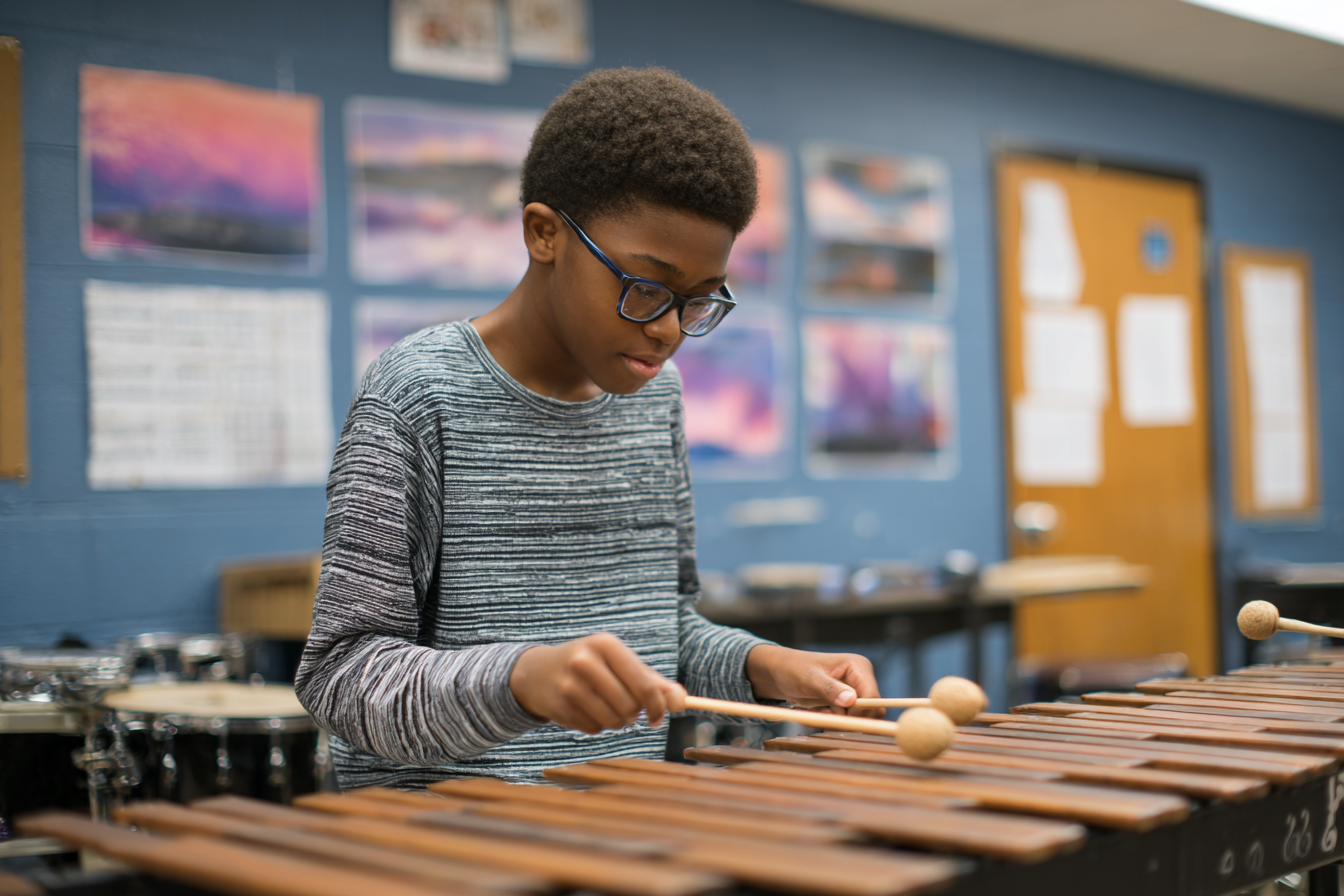
Focus: Perform scales and patterns in multiple keys with accuracy, while improving reading of key signatures, rhythms, and expressive markings in standard notation.
Grade Level: 8
Subject Area: Band (Technical Fluency • Music Literacy • Key Understanding)
Total Unit Duration: 5 sessions (one week), 50–60 minutes per session
I. Introduction
Students strengthen their scale fluency and key awareness so that reading and performing in different keys feels natural instead of scary. They practice major scales and simple patterns in several flat and sharp keys, connect these scales to key signatures they see in their band music, and work on playing with steady rhythm and accurate notation reading. By the end of the unit, students can recognize common key signatures, perform related scales and patterns with confidence, and see how scales are the “building blocks” of their concert pieces.
Essential Questions
- Why are scales and key signatures so important for confident band playing and sight-reading?
- How can I quickly figure out what key a piece is in and what that means for the notes I play?
- How does practicing scales, arpeggios, and patterns in multiple keys help me play my band music more accurately and musically?
- What strategies can I use to improve my fluency (speed + accuracy) with scales while still keeping good tone and technique?
- How does strong scale fluency prepare me for more complex rhythms, accidentals, and expressive markings in band music?
II. Objectives and Standards
Learning Objectives — Students will be able to:
- Perform at least 3–5 major scales (e.g., concert Bb, Eb, F, Ab, C, G, D) with correct notes, key-specific accidentals, and steady basic rhythm.
- Read and identify key signatures commonly used in middle school band literature (up to 3–4 sharps/flats) and name the corresponding concert keys.
- Play simple scale patterns (stepwise, thirds, arpeggios) in at least two different keys with accurate notes and rhythm.
- Use standard notation, including key signatures and accidentals, to perform short scale-based reading exercises with increasing rhythmic complexity.
- Find and label scale fragments and key centers in their band music, explaining how key awareness supports accurate performance.
- Set at least one personal scale fluency goal (tempo, range, number of keys) and track progress toward it.
Standards Alignment — 8th Grade Band (custom, NAfME-style)
- BD:Pr4.8b — Read and perform increasingly complex band music using standard notation, including varied key signatures, rhythms, and expressive markings.
- Example: Students perform music with accidentals and syncopated rhythms accurately.
Success Criteria — Student Language
- I can name and play several concert major scales with correct notes and key-specific accidentals.
- I can look at a key signature and correctly identify its concert key.
- I can perform scale patterns (stepwise, thirds, arpeggios) in at least two different keys with a steady beat.
- I can point out where my band music uses scale fragments or is clearly in a certain key.
- I can read and perform notation exercises that include accidentals and varied rhythms related to our scale keys.
- I have a clear scale fluency goal and know what I need to practice to reach it.