Unit Plan 1 (PreK Art): Welcome to Art Time
Preschool art unit introducing crayons, markers, scissors, glue, and paint while teaching safe studio routines, simple art rules, and clean-up habits through guided exploration.

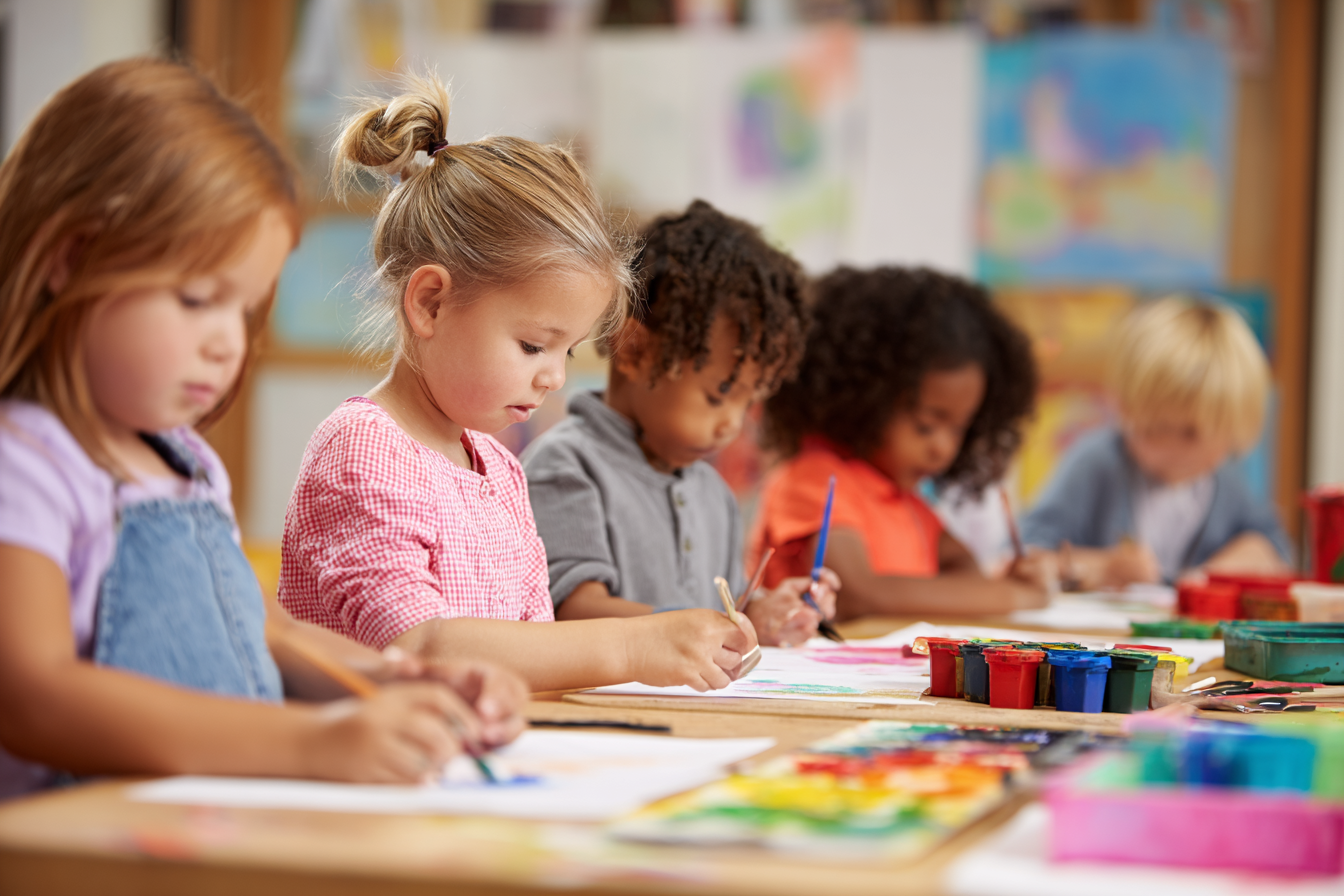
Focus: Explore art tools and learn safe studio routines with guidance.
Grade Level: PreK
Subject Area: Art (Visual Arts • Creating)
Total Unit Duration: 1–3 weeks, 20–30 minutes per session
I. Introduction
In this unit, preschool children are introduced to art time as a special part of their day. They explore basic art tools—crayons, markers, glue sticks, paintbrushes—while learning simple safety rules and routines such as carrying scissors correctly, keeping caps on markers, and cleaning up. The focus is on guided exploration and building comfort in the art space, not on finished products. By the end of the unit, children can follow a few classroom art rules, begin to use tools more safely, and feel excited about making art.
Essential Questions
- What happens during art time?
- How do I use art tools safely with my friends?
- What rules help keep our art space safe and happy?
- How can I take care of the tools we share?
II. Objectives and Standards
Learning Objectives — Children will be able to:
- Follow 2–3 simple art room rules with adult guidance (e.g., walking feet, tools stay at the table).
- Explore basic art tools (crayons, markers, glue sticks, paintbrushes) with help from an adult.
- Begin to use tools safely, such as carrying scissors point-down when prompted and keeping markers capped when not in use.
- Show emerging responsibility for clean-up routines (putting tools back in trays, throwing away scraps) with reminders.
- Share a simple idea about what they like to do at art time.
Standards Alignment — PreK (NCAS-Aligned)
- VA:Cr2.PKb — Use art tools safely with guidance.
- Example: Children practice holding scissors correctly.
Success Criteria — Child-Friendly Language
- I can remember some art rules that help keep us safe.
- I can try to use crayons, markers, glue, and brushes safely with a teacher’s help.
- I can practice carrying scissors the safe way when a grown-up reminds me.
- I can help clean up my tools when art time is done.
- I can say one thing I like about art time.
III. Materials and Resources
Tasks & Tools (teacher acquires/curates)
- Basic art tools for exploration:
- Crayons, markers, chunky colored pencils.
- Glue sticks (and glue bottles if appropriate).
- Child-safe scissors.
- Paintbrushes and tempera or watercolor paints (for a later session).
- Sturdy paper or construction paper for drawing and gluing.
- Trays, bins, or caddies for organizing tools at tables.
- Visual art rules chart with pictures:
- Walking feet.
- Tools stay at the table.
- Scissors point-down.
- “We share tools.”
- Visual clean-up chart:
- Put tools back in the bin.
- Throw scraps in the trash.
- Push in chair.
- Optional: song or short chant for transition/clean-up (“Art time is done, tools away, we’ll make more art another day!”).
Preparation
- Set up tables with small sets of tools so children can reach them easily.
- Post the art rules and clean-up charts at eye level for children.
- Decide on a simple routine for entering art time (e.g., line up, sit on spots, listen for directions).
- Prepare name spots or table spots if needed so children know where to sit.
Common Misconceptions to Surface
- “I can run when I’m excited.” → We use walking feet to keep everyone safe around tools and chairs.
- “Markers and scissors can go anywhere.” → Art tools stay at the table and in the art area.
- “I can wave scissors or brushes in the air.” → We carry scissors with points down and keep tools close to the paper.
- “Grown-ups always clean up.” → We all help put tools away and clean our space.
Key Terms (highlight in lessons) art time, tools, safe, scissors, glue, brush, rules, share, clean up
IV. Lesson Procedure
(Each session follows: Launch → Explore/Make → Discuss/Share → Reflect. Timing for a 20–30 minute class.)
Session 1 — Welcome to Art Time & Basic Rules (Core Session — Addresses Standard: VA:Cr2.PKb)
Launch (5–7 min)
- Gather children on the carpet or at a meeting spot.
- Introduce art time: “This is a special time when we make pictures and try tools together.”
- Show the art rules chart with pictures:
- “We use walking feet.”
- “Tools stay at the table.”
- “We share tools with our friends.”
- Briefly show crayons and markers and remind them that we only use them on paper, not on tables or bodies.
Explore/Make (10–15 min)
- Children move to tables with paper, crayons, and markers.
- Invite them to explore drawing lines, shapes, and colors.
- Teacher prompts:
- “Try picking one crayon and making some lines.”
- “Let’s see how we keep the markers on the paper.”
- Adult(s) circulate, gently reinforcing safety:
- “Remember, our tools stay at the table.”
- “We use walking feet when we need more paper.”
Discuss/Share (3–5 min)
- Ask children to hold up their papers and notice:
- “Look at all the colors we used today!”
- Ask a few to answer:
- “What did you like using, crayons or markers?”
Reflect (2–3 min)
- Quick call-and-response:
- Teacher: “What kind of feet do we use in the art room?”
- Children: “Walking feet!”
- Teacher: “Where do our tools stay?”
- Children: “At the table!”
Optional Session 2 — Safe Use of Scissors & Glue
Launch (5–7 min)
- Show child-safe scissors and a glue stick.
- Demonstrate safe scissor rules:
- “We sit when we use scissors.”
- “We carry scissors with points down when a teacher says it’s time to move.”
- Show how to use a glue stick: “A little glue is enough—dot, dot, not a lot.”
Explore/Make (10–15 min)
- Provide pre-drawn simple shapes on paper or small strips for children to cut with help, or let them practice cutting straight lines with guidance.
- Children glue cut pieces onto another paper to make a simple collage.
- Adults give close support at each table, guiding hands where needed.
- Teacher prompts:
- “Hold your scissors like this; let’s practice opening and closing.”
- “Remember, scissors stay at the table.”
- “Can you put just a little glue on the back of that piece?”
Discuss/Share (3–5 min)
- Children share their collages with a neighbor, saying, “I cut this piece,” or “I glued this on.”
- Teacher praises safe use:
- “I noticed you carried your scissors points down when I asked you to move.”
Reflect (2–3 min)
- Group chant:
- “Scissors sit, scissors stay, scissors point the safe way.”
Optional Session 3 — Brush & Paint Introduction + Clean-Up Routines
Launch (5–7 min)
- Show a paintbrush and small cups of paint or watercolors.
- Explain: “Brushes are tools we use gently. We don’t bang them or put them in our hair.”
- Review clean-up chart:
- Put brushes in the rinse cup.
- Put paper on the drying rack or designated spot.
- Wipe table, then wash hands.
Explore/Make (10–15 min)
- Children sit at tables with one brush, a small amount of paint, and paper.
- Encourage simple strokes and lines, focusing on handling the brush safely and gently.
- Adult prompts:
- “Dip, wipe, paint on the paper.”
- “Use soft brush strokes.”
- When time is nearly done, guide them step-by-step through clean-up:
- “First, put your brush in the cup.”
- “Next, carry your paper to the drying spot.”
- “Now, let’s wash our hands.”
Discuss/Share (3–5 min)
- Back on the carpet, ask:
- “What did it feel like to use a brush?”
- “What did we do to help clean up after painting?”
Reflect (2–3 min)
- Prompt:
- “Today I used a brush safely. I remember to put it in the cup when I was done.”
V. Differentiation and Accommodations
Advanced Learners
- Invite them to model safe tool use (e.g., showing how to carry scissors point-down) for peers.
- Ask them to help with simple jobs like handing out or collecting trays, practicing responsibility.
- Challenge them to describe one tool and one safety rule in their own words:
- “I use crayons safely by ___.”
Targeted Support
- Provide hand-over-hand guidance for children who need help gripping tools.
- Give fewer choices of tools at first to avoid overwhelm (e.g., only crayons in Session 1).
- Seat children who need extra monitoring closer to an adult.
- Use short, repeated phrases with gestures (“Tools stay at the table,” “Walking feet”).
Multilingual Learners
- Pair simple English words with gestures and pictures (e.g., point to feet when saying “walking feet”).
- Introduce key words in children’s home languages when possible (e.g., scissors, glue) and repeat them in English.
- Use call-and-response to practice simple rules:
- Teacher: “Tools stay at the…”
- Children: “Table!”
- Accept nonverbal responses (pointing to rules) as understanding while language grows.
IEP/504 & Accessibility
- Use adapted scissors (spring-loaded or loop scissors) for children with fine-motor challenges.
- Offer larger crayons or markers with easy grips.
- Allow extra time for transitions, especially during clean-up.
- Provide a quiet corner or seat for children who become overstimulated, with a simplified set of tools.
VI. Assessment and Evaluation
Formative Checks (each session)
- Session 1 — Children can follow at least one basic rule (tools stay at the table, walking feet) with reminders while using crayons/markers.
- Optional Session 2 — Children practice using scissors and glue with adult guidance and show emerging understanding of safe handling.
- Optional Session 3 — Children try using a brush and participate in a simple clean-up routine with support.
Summative — Welcome to Art Time Safety & Tools Task (0–2 per criterion, total 10)
- Following Art Room Rules
- 2: Child usually follows at least two basic rules (walking feet, tools at the table, sharing) with occasional reminders.
- 1: Child follows one rule some of the time and needs frequent reminders.
- 0: Child rarely follows rules, even with support and repetition.
- Safe Use of Tools (VA:Cr2.PKb)
- 2: Child uses tools (crayons, markers, scissors, glue, brush) mostly safely with adult guidance (e.g., sitting while cutting, scissors point-down when prompted).
- 1: Child needs frequent reminders and physical guidance to use tools safely.
- 0: Child often uses tools in unsafe ways, even with close support.
- Engagement with Tool Exploration
- 2: Child shows clear interest in exploring tools (drawing, cutting, gluing, painting) and participates actively.
- 1: Child participates briefly but may lose focus or avoid trying some tools.
- 0: Child rarely engages with tools, even with encouragement.
- Clean-Up Participation
- 2: Child attempts at least one clean-up task (putting tools away, throwing scraps, taking paper to drying area) with reminders.
- 1: Child participates in clean-up only with direct adult support or modeling.
- 0: Child does not participate in clean-up, even with help.
- Art Time Reflection
- 2: Child can express (verbally or through gestures/pointing) one thing they like about art time or one tool they enjoy.
- 1: Child shows some preference (e.g., reaches for a favorite tool) but does not clearly express it.
- 0: Child does not show or express any preference, even with prompts.
Feedback Protocol (TAG)
- Tell one strength: “You used your scissors safely at the table today.”
- Ask one question: “What was your favorite tool to try?”
- Give one suggestion: “Next time, remember to keep your tools at the table when you’re working.”
VII. Reflection and Extension
Reflection Prompts
- What is your favorite thing to use at art time (crayons, markers, glue, brush)?
- How do we keep everyone safe when we use scissors and other tools?
- What is one rule you can remember when you come to art time?
- How does it feel to have your own art spot at the table?
Extensions
- Art Rules Poster: Create a class poster with photos or drawings of children following each art rule (walking feet, tools at the table, scissors point-down).
- Tool Sorting Game: Have children help sort tools into labeled bins (crayons, markers, glue, scissors) as a warm-up or clean-up routine.
- Family Connection: Send home a short note or picture list of “Our Art Time Rules” so families can talk about using tools safely at home.
Standards Trace — When Each Standard Is Addressed
- VA:Cr2.PKb — Session 1 (children explore basic tools—crayons and markers—while learning to keep them at the table and use them on paper), Optional Session 2 (children practice holding and carrying scissors with guidance and using glue sticks safely), Optional Session 3 (children learn to handle brushes and paint gently and participate in clean-up routines for tools and materials, all with adult support).