Unit Plan 36 (PreK Music): Music Celebration Day
PreK Music Celebration unit where children perform songs and movements, practice audience skills, and connect classroom music to home, school, and real-life celebrations.

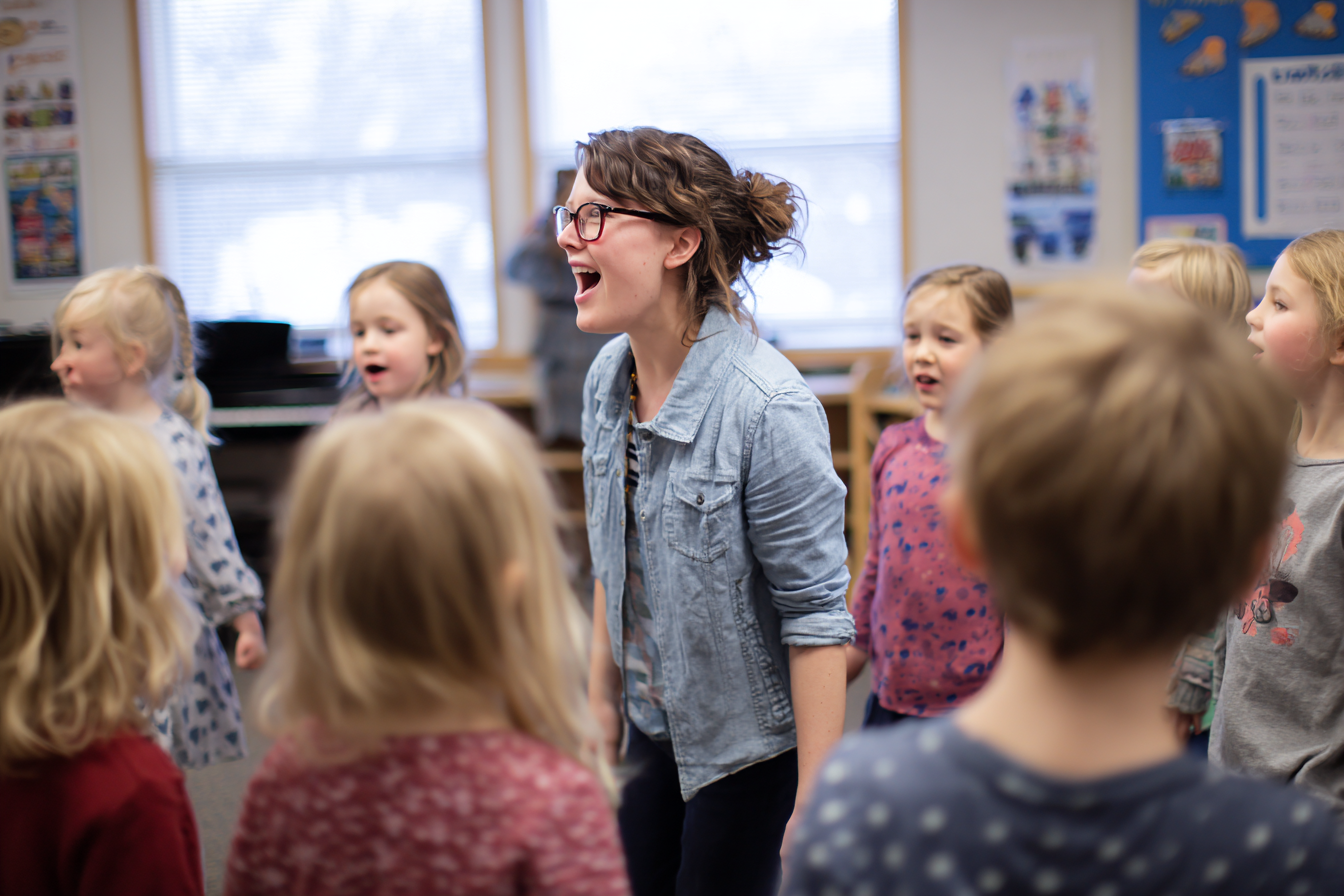
Focus: Share songs and movements in an informal performance setting while connecting music to children’s lives at home and school.
Grade Level: PreK
Subject Area: Music (Exploring • Performing • Responding • Connecting)
Total Unit Duration: 3–4 sessions (2+ weeks), 20–30 minutes per session
I. Introduction
Children wrap up their music experiences with a joyful “Music Celebration Day” that brings together favorite songs, movements, and classroom routines. They practice performing for a simple audience (classmates, stuffed animals, or another class) and learn that performances can be friendly, safe, and fun. Throughout the unit, the teacher helps children notice how the songs they sing connect to celebrations, home routines, and special moments in their lives.
Essential Questions
- How can we show that we are ready to perform and celebrate with music?
- What does it look and sound like when we share music with others respectfully?
- How does music help us remember special people, places, and celebrations?
- How can we show we are proud of our singing and movement while still being safe and kind?
II. Objectives and Standards
Learning Objectives — Children will be able to:
- Sing or chant a small set of familiar class songs with growing confidence and enjoyment.
- Use simple, safe movements (e.g., clapping, patting, swaying) that match the music and stay in their own space.
- Demonstrate basic performance behaviors, such as facing the audience, starting and stopping with the teacher, and remaining in the performance area.
- Show audience behaviors (e.g., listening quietly, watching performers, clapping at the end) during peers’ performances.
- Share simple comments about how the music connects to their home, celebrations, or favorite classroom moments.
Standards Alignment — PreK (Music)
- MU:Pr6.1.PK — Perform music for others. Children share music in informal settings.
- Example: Singing for another class, stuffed animals, or caregivers.
- MU:Cn10.0.PK — Relate music to personal experiences. Children connect music to home, play, celebrations, and emotions.
- Example: Recognizing a song sung at home, at school, or at a birthday party.
Success Criteria — Child-Friendly Language
- I can sing or move with my class to celebrate with music.
- I can show I am ready to perform by facing the front, staying in my spot, and starting and stopping with everyone.
- I can be a good audience member by listening, watching, and clapping at the end.
- I can say how a song reminds me of home, school, or a special celebration.
III. Materials and Resources
Tasks & Tools (teacher acquires/curates)
- A short “celebration set” of 2–3 familiar songs (e.g., hello/goodbye songs, movement songs, seasonal or celebration songs).
- Audio playback device (optional) for background listening, transitions, or play-along tracks.
- Open space for a “performance area” and a clear “audience area” (e.g., taped line for stage, carpet spots for audience).
- Simple props (optional): scarves, ribbons, shakers, or stuffed animals as “guests” for the celebration.
- Picture cards or icons representing each song (e.g., cake or balloon for a celebration song, sun for a morning song).
- Visual charts or icons for performer behaviors (stand, sing, smile, stay in spot) and audience behaviors (sit, listen, watch, clap).
- Drawing materials (crayons/markers, paper) for reflection drawings.
Preparation
- Select 2–3 songs children already know well and that feel celebratory or special to the class.
- Decide which songs will include movements or props and plan how to review these with children.
- Set up a clear boundary between performance and audience areas using tape, spots, or rugs.
- Prepare a simple “Performer / Audience” visual chart to model expectations.
- Arrange a possible informal audience for the final session (e.g., another PreK class, staff member, or just stuffed animals).
Common Misconceptions to Surface
- “A celebration performance means yelling or running.” → Celebrating with music means using our best singing voices and movements while staying safe and calm in our own space.
- “Only loud singing is good singing.” → Good performing can be quiet or loud; what matters is that we are together, using our singing voices.
- “Audience members can play and talk while others perform.” → A respectful audience sits, listens, watches, and saves talking for after the song, then claps to show appreciation.
Key Terms (highlight in lessons) celebration, song, performance, audience, stage, steady beat, motions, share, clap, feelings
IV. Lesson Procedure
(Each session is designed for a 20–30 minute class period.)
Session 1 — Getting Ready for Music Celebration (Pr6.1.PK • Cn10.0.PK)
Launch (5–7 min)
- Gather children in a circle and explain: “We are going to have a music celebration where we share our songs and movements with others.”
- Sing a brief hello or favorite song to set a cheerful tone; invite children to join with simple claps or pats.
Explore (10–12 min)
- Review 2–3 familiar songs one at a time:
- Sing or chant each song as a class, focusing on everyone joining in.
- Add or review simple motions (e.g., clapping on the steady beat, gentle swaying, hand motions that match lyrics).
- Show the Performer / Audience chart and demonstrate:
- Performer: stand or sit in the front, face the audience, sing or move with best effort, stay in own spot.
- Audience: sit in the audience area, eyes watching, quiet mouth, clap at the end.
- Practice short “mini performances”:
- Half the class performs while the other half is the audience.
- Switch roles, noting what each side does well.
Discuss (5–6 min)
- Ask: “What did we do with our bodies and voices when we were performers?”
- Ask: “What did we do when we were the audience?”
- Connect to home or celebrations: “When do you sing or dance at home or at parties?”
Reflect (3–5 min)
- Thumbs or hand signal check: “Show me if you feel proud of how you performed or listened today.”
- Invite 1–2 children to share a short comment: “I liked when we…”
Session 2 — Rehearsing Our Celebration Songs (Pr6.1.PK • Cn10.0.PK)
Launch (5–7 min)
- Briefly review that the class is preparing for a fun music celebration.
- Show picture cards for each song and ask children to choose the order: “Which song will we practice first?”
Explore (10–12 min)
- Practice each celebration song in “rehearsal mode”:
- Song 1: Focus on starting and stopping together with a clear teacher cue (hand up, count-in, or word).
- Song 2: Focus on expressive movement (faces, arms, swaying) that fits the feeling of the song (happy, calm, excited).
- Song 3 (if used): Focus on staying in personal space and keeping a simple steady beat with hands or feet.
- Use simple feedback language after each run:
- “I liked how you froze at the end together.”
- “Let’s try again and see if we can all start at the same time.”
Discuss (5–6 min)
- Ask: “Which song feels easiest to perform? Which one still needs more practice?”
- Invite children to share any connections: “This song reminds me of… (birthday, holiday, family time, recess).”
Reflect (3–5 min)
- Have children quietly touch their heart or head and think: “Which song makes me feel the most happy or excited to share?”
- A few children can share: “I feel happy when we sing…”
Optional Session 3 — Practice Celebration for Friends (Pr6.1.PK • Cn10.0.PK)
Launch (4–5 min)
- Explain: “Today we’ll pretend we have guests and practice our music celebration show.”
- Quickly review performer and audience expectations using the visual chart.
Explore (12–15 min)
- Set up the performance area and audience area.
- Run through the celebration set:
- Invite performers to walk safely to the “stage,” face the audience, and wait quietly.
- Give a clear start cue; perform the full song with motions.
- Signal the end and lead a freeze or bow, then cue the audience to clap.
- Rotate groups if needed so all children experience both performer and audience roles.
- Briefly pause between songs to name successes (“You all stayed together on that song!”).
Discuss (5–6 min)
- Ask: “What did we do really well as performers?” (e.g., starting together, smiling, staying in our spots).
- Ask: “What did we do well as an audience?” (e.g., quiet listening, clapping at the end).
- Choose one focus goal for next time (e.g., “We will try to remember to freeze at the end and hold still for three counts.”).
Reflect (3–4 min)
- Invite children to put a hand on their heart and say, “I feel proud when we sing together.”
- Ask a few children to share one word about how performing felt (happy, excited, brave).
Optional Session 4 — Music Celebration Day (Pr6.1.PK • Cn10.0.PK)
Launch (4–5 min)
- Tell children: “Today is our Music Celebration Day! We’re going to share our songs and movements.”
- Very quickly revisit performer and audience behaviors and point to the chart.
Explore (12–15 min)
- Invite a simple audience if possible (another class, staff member, or stuffed animals).
- Present the celebration songs in order:
- Announce or let a child help introduce each song (“Now we will sing…”).
- Encourage children to show expressive faces, movements, and confident singing.
- After each song, audience claps; the class may bow or wave.
- If time allows, add one “encore” song chosen by the children.
Discuss (5–6 min)
- Ask: “How did it feel to share our music with others?”
- Ask the audience (or pretend audience) to name something they noticed or enjoyed (“I liked your big smiles,” “I liked your clapping.”).
- Connect to real-life celebrations: “When else do we sing and celebrate with music?”
Reflect (3–4 min)
- Have children draw a quick picture of themselves singing or moving during the celebration.
- Invite a few to share their drawing and complete a sentence: “My music made me feel…”
V. Differentiation and Accommodations
Advanced Learners
- Invite confident children to help introduce songs or demonstrate motions at the front of the group.
- Ask them to suggest a small change (e.g., a new motion or a louder/softer section) that the class can try together.
- Encourage them to share short reflection statements (“We started together,” “We clapped at the same time”).
Targeted Support
- Stand near children who need extra help; gently model motions or quietly sing along beside them.
- Provide a spot marker or small visual cue (e.g., floor dot) to support staying in one place.
- Allow participation through movements only (no singing required) for children who are shy or unsure.
Multilingual Learners
- Include or reference songs in children’s home languages when possible; invite families to suggest or share.
- Pair gesture with key words like “start,” “stop,” “bow,” “clap,” and practice them like a game.
- Accept nonverbal responses (smiles, clapping, dancing) as meaningful ways of sharing music preferences.
IEP/504 & Accessibility
- Offer alternate roles such as playing a simple percussion pattern, holding a prop, or sitting in a preferred spot.
- Use clear, repeated visual and verbal cues for transitions (e.g., picture card + spoken prompt).
- Adjust noise level, group size, or lighting for sensory needs; create a quiet break space if a child becomes overwhelmed.
VI. Assessment and Evaluation
Formative Checks (ongoing)
- Session 1: Observe if children can follow simple performer vs. audience expectations and join in on at least one song.
- Session 2: Note who starts and stops with the group, stays in their space, and uses expressive motions.
- Optional Session 3: Watch for whole-group performance behaviors (facing audience, freezing at the end, clapping appropriately).
- Optional Session 4: Check overall comfort and engagement levels (singing, moving, or attentively listening).
Summative — Music Celebration Day (0–2 per criterion, total 8)
- Participation & Engagement (Pr6.1.PK)
- 2: Child actively participates in most or all songs (singing, chanting, or moving) with visible enjoyment.
- 1: Child participates in some parts of songs but may be quiet or distracted at times.
- 0: Child rarely participates or appears disengaged during the celebration.
- Performance Behaviors (Pr6.1.PK)
- 2: Child faces the audience, starts and stops with the group, and stays in their own space.
- 1: Child shows some performance behaviors but needs occasional reminders or support.
- 0: Child does not follow performance expectations and requires continuous adult support.
- Use of Movements/Props (Pr6.1.PK)
- 2: Child uses simple motions or props that mostly match the song and beat.
- 1: Child attempts motions or prop use but they may be inconsistent or delayed.
- 0: Child rarely joins in motions or prop use, even with encouragement.
- Audience Skills & Connections (Cn10.0.PK)
- 2: Child listens quietly when others perform, claps at the end, and can share at least one simple connection (e.g., “This song is like my birthday song”).
- 1: Child shows some audience skills but may talk or move during performances; needs prompting to share a connection.
- 0: Child has difficulty remaining in the audience role and does not respond to reflection prompts.
Feedback Protocol (TAG)
- Tell one strength: “You stayed in your spot and sang the whole time—that was wonderful.”
- Ask one question: “How did you know when it was time to stop and freeze?”
- Give one suggestion: “Next time, try keeping your eyes on the audience while you clap at the end.”
VII. Reflection and Extension
Reflection Prompts (teacher-guided)
- “Which song was your favorite to perform today, and why?”
- “How did your music show happy, excited, or calm feelings?”
- “What did you notice when your friends were performing?”
Extensions
- Celebration Corner: Set up a small center with song picture cards, scarves, and stuffed animals so children can recreate mini music celebrations during free choice time.
- Home Connection: Ask families to talk about times they sing or listen to music at home (e.g., bedtime, car rides, birthdays) and have children share one example in the next class.
- Art & Music Link: Invite children to draw their favorite celebration song and how it makes them feel, then briefly “perform” their drawing by singing or moving a short part for the class.
Standards Trace — When Each Standard Is Addressed
- MU:Pr6.1.PK — Sessions 1–4 (preparing favorite songs, practicing performer vs. audience roles, practice celebration, and final Music Celebration Day performance).
- MU:Cn10.0.PK — Sessions 1–4 (discussing where they hear music in their lives, connecting songs to home and celebrations, and reflecting on how music makes them feel).