Lesson Plan (Grades 6-8): Math in Motion—Kinematics Relay
Hands-on kinematics relay where students test ramp slopes, measure motion, graph speed and acceleration, and apply math to real-world physics experiments.

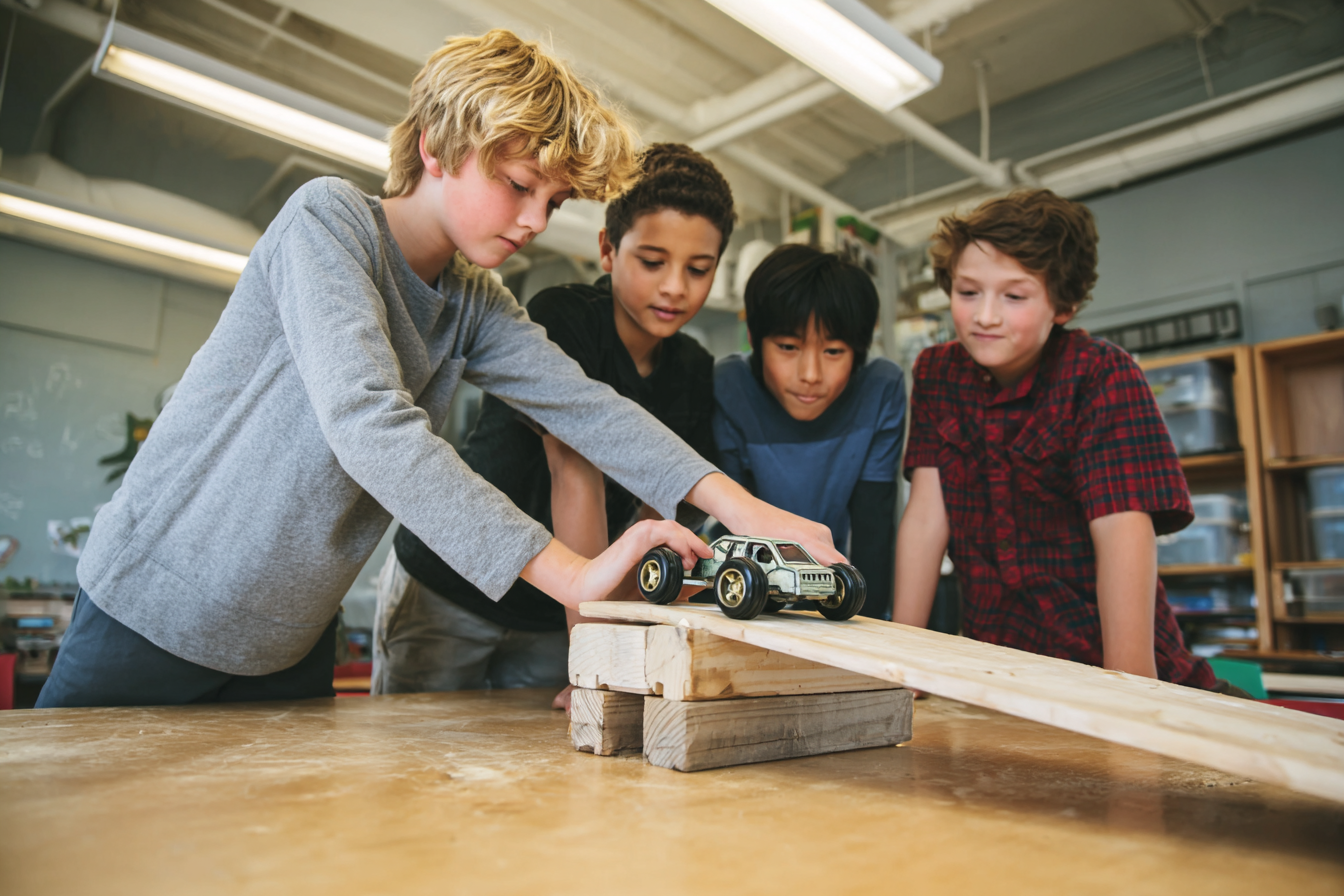
Lesson Title: Math in Motion—Kinematics Relay
Grade Levels: 6–8
Subject Area: Mathematics & Physics
1. Introduction
In Math in Motion—Kinematics Relay, students become junior physicists and mathematicians as they investigate how slope affects the motion of a rolling object. Working in teams of three or four, learners construct adjustable ramps, release identical toy cars down each incline, and meticulously measure both distance and time. This hands‐on exploration requires students to think critically about experimental design, practice precise measurement techniques, and apply mathematical formulas to real data.
Throughout the lesson, teams will model average speed and average acceleration, graph their results on distance–time and velocity–time plots, and present evidence‐based recommendations on which ramp design optimized motion. The relay format—with each team rotating through setup, data collection, analysis, and presentation stations—keeps students engaged and ensures active participation. By the end of the activity, learners will have deepened their understanding of kinematic relationships, honed collaborative scientific skills, and experienced firsthand how mathematics provides powerful tools for describing physical phenomena.
2. Learning Targets
By the conclusion of this lesson, every student will be able to:
- Design Controlled Experiments Construct stable ramps at three different angles (e.g., 15°, 30°, 45°) and implement a consistent release mechanism so that each trial is reproducible.
- Accurately Collect Data Use meter sticks or measuring tapes and stopwatches (or timing apps) to record distances traveled and elapsed times to an appropriate level of precision (0.01 s for time, ±0.5 cm for distance).
- Compute Kinematic Quantities Calculate average speed using
v_{\text{avg}} = \frac{\Delta x}{\Delta t}
a_{\text{avg}} = \frac{\Delta v}{\Delta t}.
- Graph and Interpret Motion Plot distance–time graphs and velocity–time graphs, interpret the slope of each plot, and link those slopes to physical quantities—speed from the distance–time graph and acceleration from the velocity–time graph.
- Evaluate Design Effectiveness Analyze which ramp slope produced the smoothest and fastest motion, using quantitative evidence to justify conclusions.
- Communicate Scientific Findings Prepare and deliver a concise team presentation that details experimental setup, data analysis, graphical evidence, and design recommendations to peers.
Each team member will take responsibility for at least one role—setup engineer, timekeeper, data recorder, or presenter—ensuring equitable involvement and accountability.
3. Standards Alignment
This lesson reinforces and integrates the following standards:
- CCSS.MATH.CONTENT.6.EE.A.2 Write, read, and evaluate numerical expressions in which letters stand for numbers, as applied to expressions for speed and acceleration.
- CCSS.MATH.CONTENT.8.F.B.4 Interpret the slope of a line as a rate of change; connect the concept of slope to average speed and average acceleration in motion graphs.
- NGSS.MS-PS2-2 Plan and conduct an investigation to provide evidence that the motion of an object is determined by net force and mass, here demonstrated by gravity on a ramp at different angles.
- NGSS.MS-ETS1-4 Develop a model to generate data for iterative testing and refinement of a ramp design, refining experimental protocols for accuracy.
- MP.4 (Model with Mathematics) Translate raw distance and time measurements into equations, graphs, and predictive models.
- MP.5 (Use Appropriate Tools Strategically) Employ measuring instruments—meter sticks, protractors, stopwatches—and digital tools for graphing to enhance data accuracy and interpretation.