Lesson Plan (Grades 3-5): Snack Science Factory - Investigating Mixtures, States of Matter, and Food Chemistry
Investigate snack science with grades 3-5 through mixtures, solids, liquids, dissolving, matter properties, measurement, and evidence-based explanations.

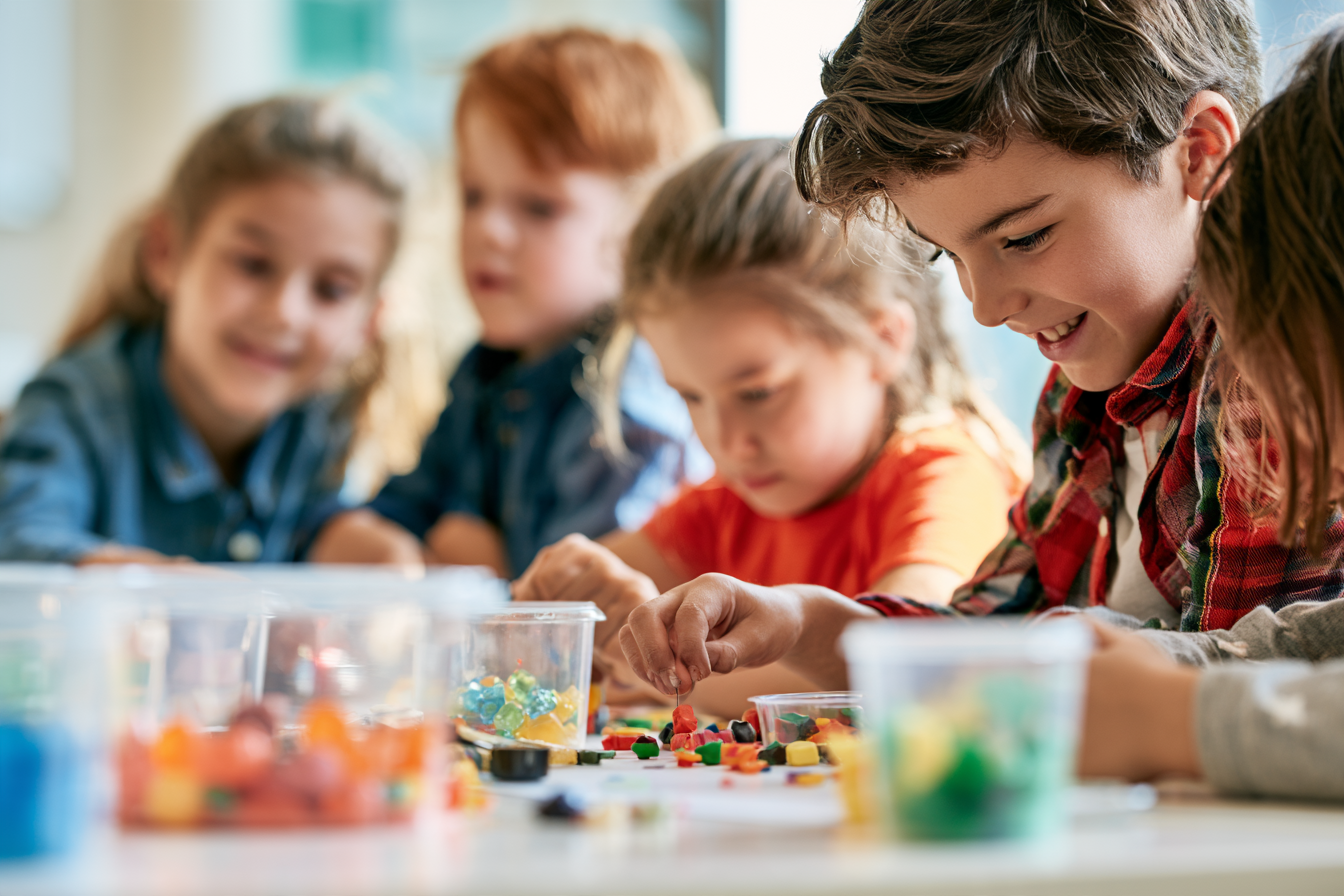
Focus: Engage students in a hands-on physical science and food chemistry investigation where they act as scientists in a Snack Science Factory. Students combine safe food ingredients, observe mixtures, compare properties before and after mixing, investigate solids and liquids, and determine whether changes appear to create new substances or simply rearrange existing materials. Students record evidence and explain the science behind a snack-making process rather than treating the activity as cooking alone.
Grade Level: 3-5
Subject Area: Science/Physical Science • Math/Measurement & Data • ELA/Scientific Writing • Speaking & Listening
Total Unit Duration: 1 core lesson with 2 optional extension lessons
I. Introduction
Students become food scientists in a Snack Science Factory, where familiar ingredients provide evidence about matter, mixtures, properties, and change. Instead of simply following a recipe, students investigate what happens when different materials are combined. They observe color, texture, state of matter, particle distribution, dissolving, and other properties before and after mixing.
The lesson emphasizes careful scientific observation. Students learn that combining ingredients does not always create a new substance: cereal mixed with raisins remains a mixture whose components can still be identified, while other food processes may produce evidence that substances have changed in more significant ways. Students use observations, measurements, and claims supported by evidence to explain what happens during their snack investigation.
Essential Questions
- What happens to materials when we mix them together?
- How can we distinguish a mixture from a process that may form new substances?
- How do solids and liquids behave differently when combined?
- What properties can scientists observe and measure before and after mixing?
- How can evidence help us explain the science behind preparing food?
II. Objectives and Standards
Learning Objectives — Students will be able to:
- Identify and describe observable properties of food-safe materials before they are combined.
- Classify materials as solids or liquids and explain relevant differences in their observable behavior.
- Create and examine mixtures in which individual components remain identifiable or become distributed throughout another material.
- Compare properties before and after mixing to determine whether evidence suggests only a physical mixture or the formation of different substances.
- Record measurements and observations systematically during an investigation.
- Construct an evidence-based explanation of what happened during a snack-making process.
Standards Alignment
- NGSS 5-PS1-1
- Develop a model to describe that matter is made of particles too small to be seen.
- NGSS 5-PS1-2
- Measure and graph quantities to provide evidence that regardless of the type of change that occurs when heating, cooling, or mixing substances, the total weight of matter is conserved.
- NGSS 5-PS1-3
- Make observations and measurements to identify materials based on their properties.
- NGSS 5-PS1-4
- Conduct an investigation to determine whether the mixing of two or more substances results in new substances.
- CCSS.MATH.CONTENT.3.MD.B.3
- Draw scaled picture graphs and bar graphs to represent a data set and solve problems using information presented in graphs.
- CCSS.MATH.CONTENT.4.MD.A.1
- Know relative sizes of measurement units within one system and express measurements in larger and smaller units as appropriate.
- CCSS.ELA-LITERACY.W.3.2 / W.4.2 / W.5.2
- Write informative/explanatory texts to examine a topic and convey ideas and information clearly.
- CCSS.ELA-LITERACY.SL.3.1 / SL.4.1 / SL.5.1
- Engage effectively in collaborative discussions with diverse partners, building on others’ ideas and expressing their own clearly.
Success Criteria — Student Language
- I can describe the properties of an ingredient before it is mixed.
- I can identify whether a material is a solid or liquid.
- I can explain what happens when different ingredients are combined.
- I can use observations and measurements as evidence.
- I can explain whether my investigation created a mixture or showed evidence of a different kind of change.
III. Materials and Resources
Tasks & Tools (teacher acquires/curates)
- Teacher-selected, allergy-safe food ingredients appropriate for school policies, such as:
- cereal
- pretzels
- crackers
- dried fruit
- chocolate chips or another approved ingredient
- water
- sugar
- salt
- oil
- Clear cups or bowls.
- Spoons or craft sticks for stirring.
- Measuring cups and spoons.
- Digital or balance scales if available.
- Magnifying glasses.
- Ingredient observation cards.
- Snack Science Factory investigation sheet with sections for:
- ingredient
- state of matter
- color
- texture
- other properties
- prediction
- observation after mixing
- evidence
- conclusion
- Optional teacher-prepared samples demonstrating dissolving or other physical changes.
- Chart paper or graphing sheets.
- Gloves or serving tools as required by school procedures.
Preparation
- Review all school food, allergy, sanitation, and classroom safety policies before choosing materials.
- Confirm student allergies and dietary restrictions before using any food products.
- Treat ingredients as science materials first; tasting is not required for the investigation.
- Preportion ingredients to reduce contamination and simplify measurement.
- Select mixtures that demonstrate different outcomes, such as:
- visible heterogeneous mixtures
- materials dissolving in liquids
- liquids that do not easily mix
- If including an example that may demonstrate formation of new substances, use a teacher-controlled, developmentally appropriate investigation rather than relying on taste as evidence.
- Prepare one model showing how scientists distinguish an observation from an explanation.
Common Misconceptions to Surface
- “If two things are mixed, they become a new substance.” → Many mixtures contain the same substances arranged or distributed differently.
- “If something disappears in water, it is gone.” → Dissolved matter is still present even when individual particles cannot be seen.
- “Only liquids are matter.” → Solids, liquids, and gases are all forms of matter.
- “A change in shape means a new substance formed.” → Cutting, crushing, or rearranging a material does not necessarily change what substance it is.
- “Taste tells us what happened scientifically.” → Scientists rely on observable and measurable evidence, and laboratory materials should never be tasted unless explicitly approved for food use.
Key Terms (highlight in lessons) matter, solid, liquid, particle, property, mixture, solution, dissolve, substance, physical change, chemical change, measurement, mass, evidence, observation, claim
IV. Lesson Procedure
(Lesson flow uses 1 core lesson with 2 optional extension lessons.)
Session 1 — Build and Investigate a Snack Mixture
- Launch (8–10 min)
- Introduce the challenge: “Today you are scientists working in the Snack Science Factory. Your job is not just to mix ingredients. Your job is to figure out what happens to matter when those ingredients are combined.”
- Display two or three ingredients separately.
- Ask students to describe observable properties such as color, texture, shape, state of matter, and size.
- Mix two easily identifiable solid ingredients together.
- Ask: “Did we create a new substance, or can we still find the original materials? What evidence supports your answer?”
- Explore (25–30 min)
- Students work in pairs or small laboratory teams.
- Teams observe and record the properties of each ingredient before mixing.
- Students classify each material as a solid or liquid.
- Students create a teacher-approved mixture using measured quantities.
- Depending on available materials, students might investigate:
- cereal + dried fruit
- pretzels + crackers
- salt + water
- sugar + water
- oil + water
- Students record what happens after mixing:
- Can the individual materials still be seen?
- Did something dissolve?
- Did color or texture change?
- Did the material remain solid or liquid?
- Could the components reasonably be separated again?
- If scales are available, students may compare total mass before and after combining materials in a controlled container.
- Teacher circulates and asks:
- “What changed?”
- “What stayed the same?”
- “Where do you think the dissolved material went?”
- “What evidence suggests this is a mixture?”
- Discuss (10–12 min)
- Groups compare results from different mixtures.
- Prompt with questions such as:
- “Which mixture made the ingredients easiest to identify?”
- “What happened when a solid dissolved?”
- “Did mixing automatically mean a new substance formed?”
- “What evidence would scientists need before claiming a new substance formed?”
- Emphasize that scientists distinguish observations from interpretations.
- Reflect (5 min)
- Students complete: “Our materials formed a ___, and my evidence is ___.”
Optional Session 2 — Dissolving, Separation, and the Mystery of the Missing Ingredient
- Launch (5–7 min)
- Show a clear cup of water and add a teacher-approved soluble substance.
- After stirring, ask: “Where did it go?”
- Explain that something can become too small to see while still remaining part of the matter in the system.
- Explore (20–25 min)
- Students compare two or more mixtures, such as:
- soluble solid + water
- insoluble solid + water
- oil + water
- Students record whether each material:
- dissolves
- settles
- floats
- remains visibly separate
- Students consider possible methods for separating mixtures, such as:
- picking components apart
- filtering
- settling
- evaporation as a teacher demonstration or conceptual discussion
- Students create a simple particle model showing how they think a dissolved material is distributed through the liquid.
- Students compare models and revise them after discussion.
- Students compare two or more mixtures, such as:
- Discuss (8–10 min)
- Teacher prompts:
- “Why can we no longer see the dissolved material?”
- “How is dissolving different from disappearing?”
- “Which mixture would be easiest to separate?”
- “What does your model suggest about matter?”
- Teacher prompts:
- Reflect (5 min)
- Students respond: “When something dissolves, it does not disappear because ___.”
Optional Session 3 — Food Chemistry Investigation and Science Explanation
- Launch (5–7 min)
- Review the difference between simply mixing materials and finding evidence that new substances may have formed.
- Present a teacher-controlled example, demonstration, video, or dataset involving a food-related process such as browning, cooking, or another safe transformation.
- Explore (20–25 min)
- Students compare evidence from the new example with their earlier mixtures.
- Students look for possible evidence of change, such as:
- unexpected color change
- production of gas
- new odor
- temperature change
- formation of a material with noticeably different properties
- Students complete a Claim-Evidence-Reasoning response:
- Claim: Was this simply a mixture, or is there evidence that different substances formed?
- Evidence: What observations support the claim?
- Reasoning: Why does that evidence support the conclusion?
- Students may create a final Snack Science Factory product card explaining the science of one investigation.
- Discuss (8–10 min)
- Students present their claims.
- Listeners ask questions such as:
- “What observation is your strongest evidence?”
- “Could there be another explanation?”
- “How is this different from the mixture in Session 1?”
- “What additional test could strengthen your conclusion?”
- Reflect (5 min)
- Students complete: “Scientists can determine whether materials changed by looking for ___.”
V. Differentiation and Accommodations
Advanced Learners
- Ask students to compare mass before and after mixing and explain the results using conservation of matter.
- Challenge students to create particle models for both a visible mixture and a solution.
- Invite students to design a fair test investigating which conditions affect dissolving.
- Ask students to distinguish between evidence of physical change and evidence that new substances may have formed.
Targeted Support
- Provide picture-based property cards for solid, liquid, rough, smooth, clear, cloudy, and dissolved.
- Limit investigations to two simple mixtures.
- Offer sentence frames such as:
- “Before mixing, I observed ___.”
- “After mixing, ___ changed.”
- “The ingredients can/cannot still be seen.”
- “I think this is a mixture because ___.”
- Use teacher modeling before students complete investigations independently.
Multilingual Learners
- Pre-teach vocabulary such as matter, solid, liquid, mix, dissolve, property, evidence, and change with objects and visuals.
- Provide labeled diagrams and illustrated observation choices.
- Allow students to rehearse conclusions orally with a partner before writing.
- Accept annotated drawings, particle models, or short oral explanations alongside written responses.
IEP/504 & Accessibility
- Provide premeasured ingredients and easy-grip containers or measuring tools.
- Use visual step cards for the investigation procedure.
- Assign flexible laboratory roles such as observer, mixer, measurer, recorder, or reporter.
- Allow speech-to-text, teacher scribing, or oral Claim-Evidence-Reasoning responses.
- Reduce the number of mixtures while preserving comparison of properties and changes.
- Provide nonfood alternatives when allergies, sensory needs, or medical requirements make food materials inappropriate.
VI. Assessment and Evaluation
Formative Checks (during lesson)
- Students accurately identify observable properties of materials.
- Students distinguish solids and liquids.
- Students document changes before and after mixing.
- Students recognize that dissolving does not mean matter disappears.
- Students use evidence to distinguish a mixture from possible formation of new substances.
Summative — Snack Science Factory Investigation and Scientific Explanation (0–2 per criterion, total 10)
- Properties of Matter
- 2: Accurately identifies and describes multiple observable or measurable properties of the materials.
- 1: Identifies some appropriate properties but descriptions may be incomplete.
- 0: Properties are missing or mostly inaccurate.
- Mixture and States of Matter Understanding
- 2: Clearly explains how solids and/or liquids behave when combined and correctly identifies relevant mixture characteristics.
- 1: Shows basic understanding but explanation contains minor confusion or limited detail.
- 0: Explanation of states or mixtures is missing or inaccurate.
- Investigation Evidence
- 2: Records clear observations or measurements before and after mixing and uses them appropriately as evidence.
- 1: Records some useful evidence but observations or measurements are limited.
- 0: Evidence is missing or does not support the investigation.
- Scientific Explanation
- 2: Makes an appropriate claim and clearly connects evidence to whether the process represents a mixture, physical change, or possible formation of different substances.
- 1: Makes a reasonable claim but the evidence or reasoning connection needs development.
- 0: Claim is missing, unsupported, or scientifically inaccurate.
- Communication and Collaboration
- 2: Works safely and effectively with others and communicates scientific findings clearly.
- 1: Participates with some support or provides a limited explanation.
- 0: Participation or communication is incomplete or unclear.
Feedback Protocol (TAG)
- Tell one strength (e.g., “Your observations clearly showed that the original ingredients could still be identified in the mixture.”).
- Ask one question (e.g., “What evidence could show that the dissolved material is still present?”).
- Give one suggestion (e.g., “Add one specific observation to strengthen your claim about whether a new substance formed.”).
VII. Reflection and Extension
Reflection Prompts
- What surprised you when the ingredients were mixed?
- How is dissolving different from disappearing?
- What evidence helped you decide whether you had a mixture?
- How do scientists determine whether mixing materials may have produced new substances?
Extensions
- Mystery Mixture Lab: Students receive several safe mixtures and classify them based on observable properties and possible separation methods.
- Dissolving Challenge: Students investigate how variables such as stirring or particle size influence how quickly an approved substance dissolves.
- Matter Conservation Investigation: Students measure a closed system before and after mixing to explore whether total mass changes.
- Food Science Product Card: Students create an informational card explaining the states of matter, mixtures, and changes involved in making a familiar snack.
Standards Trace — When Each Standard Is Addressed
- NGSS 5-PS1-1 — Session 1 and Optional Session 2 (using observations and particle models to explain how matter remains present even when substances dissolve and become too small to see).
- NGSS 5-PS1-2 — Session 1 and the Matter Conservation Extension (measuring quantities before and after mixing to investigate conservation of matter).
- NGSS 5-PS1-3 — Session 1 and Optional Session 2 (making observations and measurements of properties such as state, color, texture, solubility, and other characteristics).
- NGSS 5-PS1-4 — Session 1 and Optional Session 3 (investigating mixtures and evaluating evidence to determine whether combining substances results in different substances).
- CCSS.MATH.CONTENT.3.MD.B.3 — Session 1 and Extensions (organizing class investigation results into graphs and interpreting patterns where appropriate).
- CCSS.MATH.CONTENT.4.MD.A.1 — Session 1 (using appropriate measurement units when portioning, comparing, or measuring investigation materials).
- CCSS.ELA-LITERACY.W.3.2 / W.4.2 / W.5.2 — Optional Session 3 (writing scientific explanations that communicate observations, evidence, and conclusions clearly).
- CCSS.ELA-LITERACY.SL.3.1 / SL.4.1 / SL.5.1 — Session 1 discussion and Optional Sessions 2–3 (collaborating during investigations and discussing claims, evidence, models, and conclusions).