Unit Plan 36 (Grade 5 Band): Band Reflection & Growth
Celebrate a year of Grade 5 band growth with reflection tools, student-friendly checklists, and goal-setting for middle school band—helping students name progress, cite evidence, and set clear next-step musical goals.

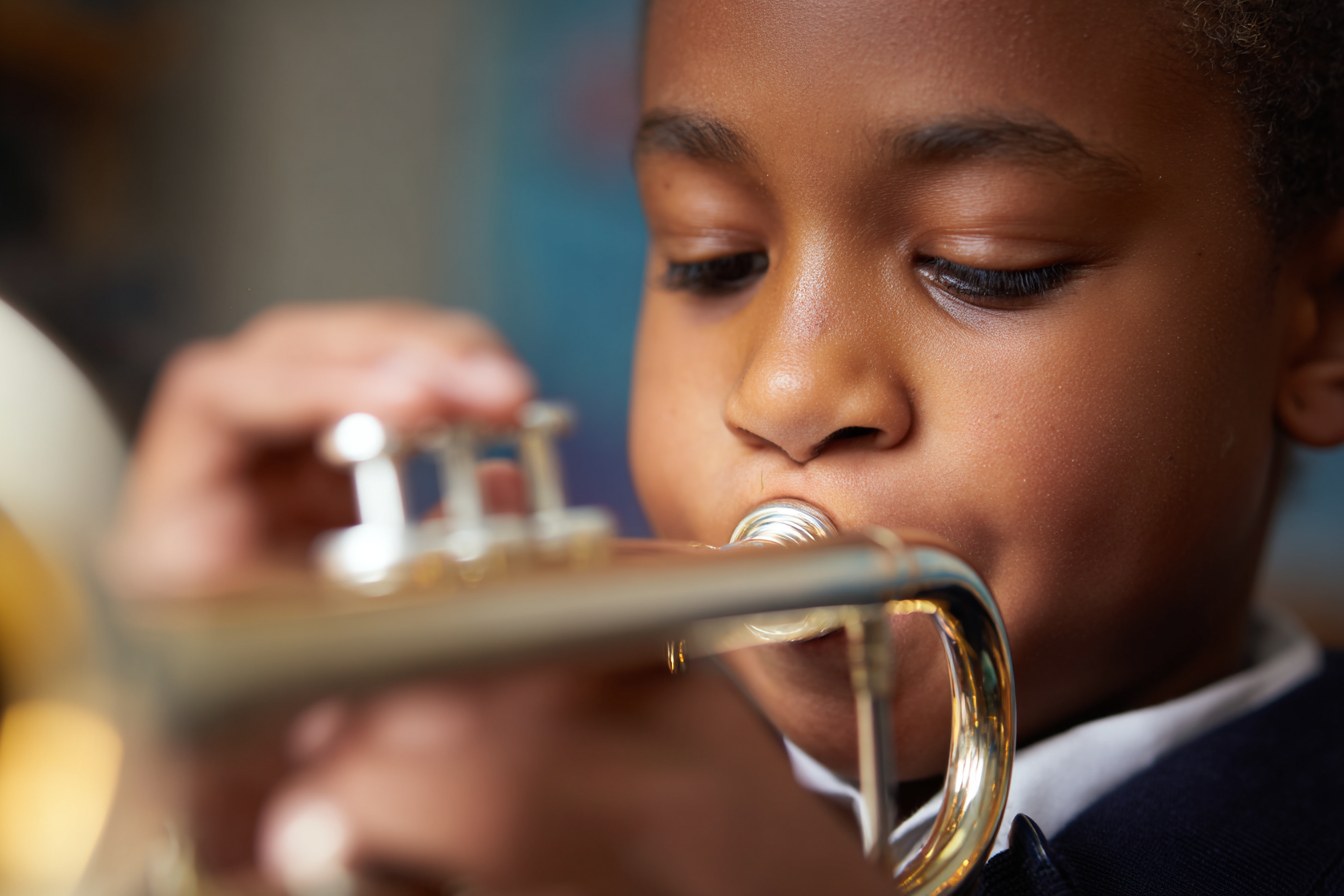
Focus: Reflect on musical growth, ensemble experiences, and set goals for middle school band.
Grade Level: 5
Subject Area: Band (Ensemble • Performance • Reflection)
Total Unit Duration: 1–2 weeks, 30 minutes per session
I. Introduction
Students look back on their first year of band, noticing how their tone, rhythm, reading skills, and confidence have changed. Through guided discussions, writing, and simple checklists, they identify strengths, challenges, and moments they are proud of (first concert, tricky song, solo, or leadership moment). Finally, students set one or two specific goals for middle school band, connecting those goals to their interests and long-term musical growth.
Essential Questions
- How have I grown as a band musician this year (tone, rhythm, reading, ensemble skills, confidence)?
- What moments or experiences in band stand out as especially important or meaningful to me?
- How do my interests and goals shape what I want to do next in middle school band?
- How can reflecting on my progress help me become a more independent and responsible musician?
II. Objectives and Standards
Learning Objectives — Students will be able to:
- Identify at least three areas of growth in their band musicianship (e.g., tone, rhythm, reading, ensemble skills).
- Describe specific evidence of growth using examples from rehearsals, performances, or practice experiences.
- Explain how their personal interests and goals influence their musical choices and future plans in middle school band.
- Set at least one short-term and one long-term musical goal that is clear, realistic, and connected to their growth.
- Create a simple Band Reflection & Growth Plan that combines written reflection, a checklist, and goal-setting statements.
Standards Alignment — Grade 5 Band (custom, NAfME-style)
- BD:Cn10.5a — Describe how personal interests and goals influence instrument choice and musical growth.
- Example: Students explain why they chose their instrument and set one goal for improvement.
Success Criteria — Student Language
- I can name specific ways I have improved as a band musician this year and give examples.
- I can explain why I chose my instrument and how my interests and goals affect what I want to do in band.
- I can set clear goals for middle school band and explain how they connect to my strengths and challenges.
- I can complete a Band Reflection & Growth Plan that shows I understand my progress and next steps.
III. Materials and Resources
Tasks & Tools (teacher acquires/curates)
- Copies of a Band Reflection & Growth graphic organizer (sections for “My Growth,” “Evidence,” “Challenges,” “Goals”).
- Simple checklist or rating scale (e.g., 1–4) for: tone, rhythm, note reading, ensemble skills, practice habits, focus.
- Prompt cards for reflection questions (e.g., “A moment I’m proud of…”, “A time I showed leadership was…”).
- Performance artifacts: video or audio clips of early-year and recent performances (class or small group).
- Chart paper or slides for class anchor charts (e.g., “Ways We Grow in Band”).
- Optional: student practice logs or notebooks (if used during the year).
Preparation
- Create an anchor chart titled “Ways We Grow in Band” (tone, rhythm, reading, ensemble skills, confidence, responsibility).
- Prepare a side-by-side example (early vs. recent performance clip) that highlights obvious growth.
- Model a sample reflection & goal sheet for yourself (Teacher Example: “Mrs. K’s Clarinet Growth Plan”).
- Prepare sentence stems on chart or slide:
- “One way I have grown as a band musician is…”
- “A challenge for me this year was…”
- “In middle school band, I want to…”
Common Misconceptions to Surface
- “If I’m not the best player, I didn’t grow.” → Growth is about improvement, not being the top student.
- “Goals should be huge or impossible.” → Goals should be realistic, specific, and reachable.
- “Reflection is just saying ‘I did good.’” → Reflection includes specific examples and evidence.
- “My interests and goals don’t matter in band.” → Personal interests and goals help shape future choices in music.
Key Terms (highlight in lessons) reflection, growth, goal, strength, challenge, evidence, practice, confidence, ensemble, future, middle school band
IV. Lesson Procedure
(Each day is designed for a 30-minute class. Standards are directly addressed in Sessions 1 and 2; Optional Sessions 3–5 extend and deepen learning.)
Session 1 — Looking Back: How Have We Grown? (BD:Cn10.5a)
- Launch (5–7 min)
- Play a short recording from early in the year and a recent performance.
- Ask: “What is different between these two performances?” Record student observations (tone, steadiness, togetherness, confidence) on the board.
- Introduce the idea that the class has been on a growth journey and now it’s time to reflect.
- Explore (15–18 min)
- Display the anchor chart “Ways We Grow in Band” and briefly discuss each category.
- Distribute the Band Reflection & Growth organizer and the simple checklist/rating scale.
- Students independently rate themselves (1–4) on tone, rhythm, reading, ensemble skills, practice habits, and focus.
- Students then complete the first section of the organizer:
- “Three ways I have grown as a band musician this year are…”
- Encourage them to use specific language (e.g., “I can now play higher notes,” “I can keep a steady beat”).
- Discuss (3–5 min)
- Quick pair-share: students tell a partner one area of growth they feel proud of.
- Invite a few volunteers to share a growth example with the class.
- Reflect (2–3 min)
- Exit slip (on organizer or sticky note): “One way I have grown in band this year is ___ because ___.”
Session 2 — Looking Forward: Goals for Middle School Band (BD:Cn10.5a)
- Launch (5–7 min)
- Review: “Yesterday we looked at how we grew. Today, we’ll set goals for middle school band.”
- Brief class discussion: “What do middle school band students need to be able to do well?” (tone, reading many notes, independence, practice, leadership).
- Explore (15–18 min)
- Students complete the second part of their organizer:
- “A moment I am most proud of in band this year was…”
- “One challenge I faced this year was… and how I responded…”
- Introduce goal-setting using a simple model (clear, realistic, and tied to growth).
- Students write:
- Short-term goal (near future, e.g., “By the first middle school concert, I want to…”).
- Long-term goal (bigger idea, e.g., “By the end of 6th grade band, I want to…”).
- Students briefly explain why each goal matters and how it connects to their interests (“I like playing fast songs,” “I want to feel more confident”).
- Students complete the second part of their organizer:
- Discuss (3–5 min)
- In small groups, students share one goal and receive “TAG”-style peer feedback:
- Tell one strength: “That goal is clear because…”
- Ask one question: “How will you practice for that?”
- Give one suggestion: “Maybe you could practice ___ minutes three times a week.”
- In small groups, students share one goal and receive “TAG”-style peer feedback:
- Reflect (2–3 min)
- Students complete: “One goal I am excited about is ___ because ___.”
Optional Session 3 — Building a Growth Portfolio (BD:Cn10.5a)
- Launch (3–5 min)
- Explain: “Today we’ll collect evidence of our growth into a mini band portfolio.”
- Show a sample page with a checklist, reflection sentence, and small artifact (photo, ticket, program, or drawn symbol of a concert).
- Explore (18–20 min)
- Students assemble a simple Band Portfolio page (paper or digital):
- A self-rating section (checklist from Session 1).
- A short paragraph: “This year I grew most in…”
- One or two artifacts:
- A copy of a favorite line or piece.
- A program or drawing of a concert moment.
- A small photo or sketch of themselves playing.
- Students label each artifact with a short caption explaining what it shows about their growth.
- Students assemble a simple Band Portfolio page (paper or digital):
- Discuss (3–5 min)
- Quick “museum walk”: students quietly view 2–3 peers’ portfolio pages and leave one positive sticky note at each stop (e.g., “I like how you mentioned your first solo!”).
- Reflect (2–3 min)
- Students write: “One piece of evidence that shows my growth is ___ because ___.”
Optional Session 4 — Sharing My Band Story (BD:Cn10.5a)
- Launch (3–5 min)
- Explain that students will create a short “My Band Story” presentation, connecting their growth and goals.
- Explore (18–20 min)
- Students use their organizer and portfolio to prepare a 1–2 minute “My Band Story,” including:
- Why they chose their instrument.
- One or two growth highlights from the year.
- One challenge and how they worked through it.
- One goal for middle school band.
- Students may create a simple cue card or mini-poster with key words and pictures.
- Students use their organizer and portfolio to prepare a 1–2 minute “My Band Story,” including:
- Discuss (3–5 min)
- In small groups, students share their “My Band Story” and offer one positive comment to each peer.
- Reflect (2–3 min)
- Students complete: “Something I want my middle school band teacher to know about me is ___.”
Optional Session 5 — Letters to Future Selves or Directors (BD:Cn10.5a)
- Launch (3–5 min)
- Explain that students will write a short letter either to their future middle school band self or to their future band director.
- Explore (18–20 min)
- Students write a letter that includes:
- A brief description of who they are as a musician now.
- One or two strengths they want to keep building.
- One or two goals or hopes for middle school band.
- A short reminder or motivational line (e.g., “Don’t forget to practice slowly!”).
- Students may decorate the page or add a small drawing of themselves playing their instrument.
- Students write a letter that includes:
- Discuss (3–5 min)
- Volunteers share one sentence from their letter with the class.
- Teacher collects letters (to send to middle school teacher, save for next year’s visit, or return later).
- Reflect (2–3 min)
- Final prompt: “One way band has helped me grow as a person is ___.”
V. Differentiation and Accommodations
Advanced Learners
- Encourage students to set more detailed goals (e.g., specific tempo targets, scales, or audition plans).
- Invite them to write a longer reflection essay comparing their first and most recent performances.
- Allow them to create a mini-presentation (poster, slideshow, or audio recording) summarizing their growth and goals for middle school band.
Targeted Support
- Provide sentence frames for reflections:
- “At the beginning of the year, I could ___; now I can ___.”
- “One thing that is still hard for me is ___, and I will work on it by ___.”
- Offer a guided conference with the teacher or support adult to talk through strengths and challenges before writing.
- Use a simplified two-star-and-a-wish structure: “Two things I’m proud of…” and “One thing I want to improve…”
Multilingual Learners
- Allow students to brainstorm in their home language before writing in English; accept bilingual notes when helpful.
- Provide a visual glossary for key words (growth, goal, challenge, confident, future).
- Permit students to record an audio reflection in addition to or instead of a long written paragraph, as long as key ideas are expressed.
IEP/504 & Accessibility
- Break tasks into small steps, checking off: rating checklist → naming strengths → describing evidence → setting goals.
- Offer options for typed responses, speech-to-text, or drawing plus labels if writing stamina is a concern.
- Give extended time or quiet space for reflection, and allow students to share verbally instead of writing long sentences.
VI. Assessment and Evaluation
Formative Checks (daily)
- Session 1 — Reflection organizers show at least two specific growth statements and a completed self-rating checklist.
- Session 2 — Students write one short-term and one long-term goal with brief explanations of why they matter.
- Optional Session 3 — Portfolio pages include at least one artifact and a caption explaining what it shows about growth.
- Optional Session 4 — “My Band Story” notes include references to growth, challenges, and goals.
- Optional Session 5 — Letters mention at least one strength and one goal for middle school band.
Summative — Band Reflection & Growth Plan (0–2 per criterion, total 10)
- Reflection on Growth (BD:Cn10.5a)
- 2: Clearly describes at least three ways they have grown as a band musician, using specific examples.
- 1: Mentions one or two areas of growth but with limited detail or vague examples.
- 0: Provides little or no reflection on growth.
- Use of Evidence
- 2: Cites specific evidence (performances, pieces, skills) to support statements about growth.
- 1: Includes some details but connections between evidence and growth are weak or incomplete.
- 0: Gives no meaningful evidence to support claims.
- Goal Setting for Middle School Band (BD:Cn10.5a)
- 2: Sets at least one short-term and one long-term goal that are clear, realistic, and clearly connected to their interests and growth.
- 1: Sets one or more goals, but they are vague, unrealistic, or not clearly connected to growth.
- 0: Does not set meaningful goals.
- Connection to Personal Interests and Identity (BD:Cn10.5a)
- 2: Explains how personal interests, experiences, or identity (why they chose their instrument, what they enjoy) connect to their goals and growth.
- 1: Mentions interests or experiences but does not clearly link them to goals or growth.
- 0: No mention of personal interests or experiences.
- Communication & Organization
- 2: Reflection and growth plan are neat, organized, and easy to follow; writing and/or visuals clearly communicate ideas.
- 1: Work is mostly understandable but may be missing sections or be somewhat disorganized.
- 0: Work is hard to follow, incomplete, or does not communicate key ideas.
Feedback Protocol (TAG)
- Tell one strength (e.g., “Your goals are very clear and connected to your strengths.”).
- Ask one question (e.g., “How will you practice to reach this middle school goal?”).
- Give one suggestion (e.g., “Maybe you could add an example of a piece that shows your growth in tone.”).
Standards Trace — When Each Standard Is Addressed
- BD:Cn10.5a — Sessions 1–2 (identifying growth, connecting interests to goals, writing Band Reflection & Growth Plan); Optional Sessions 3–5 (portfolios, “My Band Story,” letters to future selves/directors tying interests and goals to future middle school band participation).