Unit Plan 1 (Grade 5 Orchestra): Orchestra Routines & Expectations
Grade 5 orchestra unit builds rehearsal routines, instrument care, etiquette, and personal goals to support confident ensemble playing and growth.

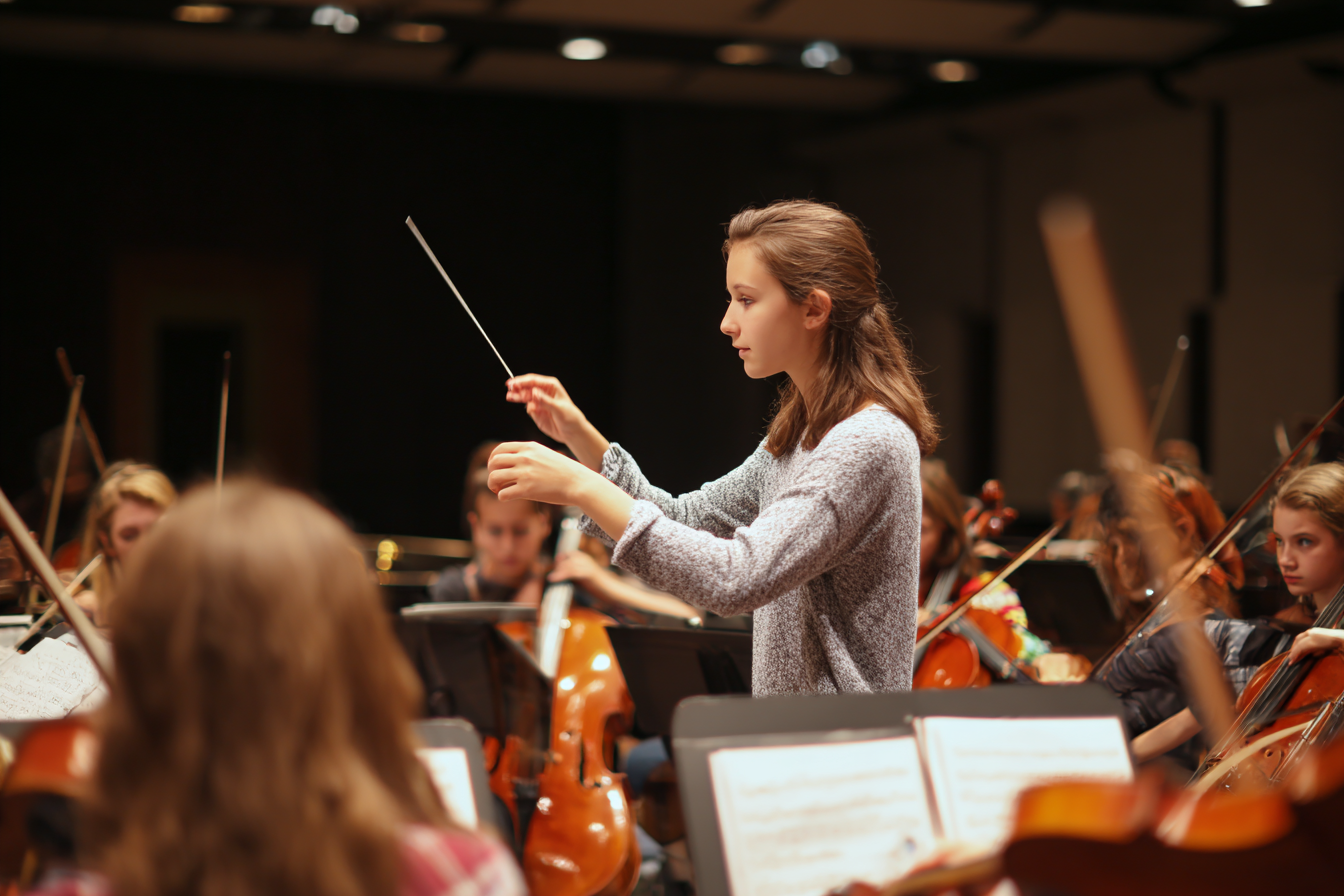
Focus: Establish rehearsal procedures, instrument care routines, and ensemble behavior while connecting to students’ interests and goals as string players.
Grade Level: 5
Subject Area: Orchestra (Performance • Routines • Identity/Goals)
Total Unit Duration: 1–2 weeks, 30-minute sessions
I. Introduction
In this opening unit, Grade 5 students build the foundation for a successful year in orchestra. They learn and practice rehearsal routines (entering the room, setting up, tuning, putting instruments away), instrument care expectations, and ensemble behavior, including watching the conductor, tracking rests, and working respectfully with their section. Students also share why they chose violin, viola, cello, or bass and set a simple growth goal, connecting their personal interests to their role in orchestra.
Essential Questions
- What does respectful and focused rehearsal etiquette look and sound like in a Grade 5 orchestra?
- How do routines for entering, setting up, and caring for instruments help us play better and learn more?
- How do my interests and goals influence the way I practice, behave, and grow as a string player?
- How can we work together so that every rehearsal feels safe, productive, and musical for the whole ensemble?
II. Objectives and Standards
Learning Objectives — Students will be able to:
- Demonstrate basic rehearsal and performance etiquette, including entering the room calmly, setting up correctly, watching the conductor, and collaborating respectfully with their section.
- Follow conductor cues, track simple rests, and start/stop together with the ensemble during short warm-ups or pattern exercises.
- Describe why they chose their instrument (violin, viola, cello, or bass) and identify at least one personal goal for growth in orchestra.
- Explain at least two orchestra routines (e.g., case placement, bow care, end-of-class cleanup) and why these help keep instruments safe and rehearsals efficient.
- Create a simple “Orchestra Promise” or goal card that links rehearsal expectations, instrument care, and personal musical growth.
Standards Alignment — Grade 5 Orchestra (custom, NAfME-style)
- OR:Pr6.5b — Demonstrate appropriate rehearsal and performance etiquette, including watching the conductor, tracking rests, and respectful collaboration.
- Example: Students follow bowings, enter together, and support section success.
- OR:Cn10.5a — Describe how personal interests and goals influence instrument choice and musical growth as a string player.
- Example: Students explain why they chose violin, viola, cello, or bass and set one goal.
Success Criteria — Student Language
- I can follow our orchestra routines for entering, setting up, and putting away my instrument safely.
- I can show good rehearsal etiquette by watching the conductor, tracking rests, and working respectfully with my section.
- I can explain why I chose my instrument and name at least one goal I have for myself as a string player.
- I can describe how doing my routines (like rosining my bow and sitting in playing position) helps me sound better and learn more.
- I can write or share an Orchestra Promise that connects my behavior, instrument care, and growth in orchestra.
III. Materials and Resources
Tasks & Tools (teacher acquires/curates)
- Classroom orchestra setup: clearly marked chair/stand placements, case storage area, and conductor podium.
- Sample rehearsal routine chart (visual schedule): Enter → Get instrument → Tune (as appropriate) → Warm-up → Rehearse → Pack up.
- Instrument care visuals: posters or slides illustrating safe handling, bow tightening/loosening, rosin use, and end-of-class care.
- Short warm-up patterns or simple unison lines appropriate for Grade 5 (open strings, D major scale, etc.) for practicing entrances and watching.
- Goal/identity cards or half-sheets for students to write why they chose their instrument and one or two goals.
- Anchor charts:
- “Our Orchestra Routines” (enter, set up, play, pack up).
- “Rehearsal Etiquette” (eyes on conductor, quiet signals, rest counting, kindness).
- “Why I Play Strings” (interests, favorite music, goals).
Preparation
- Arrange the room so students immediately see where to sit and where cases go.
- Create a step-by-step routine poster to display and reference during Sessions 1 and 2.
- Prepare a quick teacher model of a filled-out “Why I Play ___” card and a simple Orchestra Promise.
- Decide how you will signal attention (e.g., raised hand, soft clap pattern) and practice it consistently.
Common Misconceptions to Surface
- “Routines are just rules and don’t affect how we sound.” → Clear routines free up energy for better playing and fewer distractions.
- “Watching the conductor is only for concerts.” → Watching helps us start, stop, and play together every day.
- “Instrument care is only the teacher’s job.” → Students share responsibility to protect instruments and keep them playable.
- “Goals are only for advanced players.” → Every string player, at any level, can set and work toward a growth goal.
Key Terms (highlight in lessons) orchestra, rehearsal, routine, expectation, etiquette, conductor, cue, rest, section, instrument care, case, bow, fingerboard, goal, growth, ensemble
IV. Lesson Procedure
(Each session is designed for a 30-minute class period. Sessions 1 and 2 are core; Sessions 3–5 are optional extensions.)
Session 1 — Welcome to Orchestra: Routines & Why We Play (OR:Pr6.5b, OR:Cn10.5a)
- Launch (6–8 min)
- Greet students at the door and guide them to assigned seats.
- Brief talk: “Today we start building the habits that make our orchestra sound great.”
- Ask: “What do you think a great rehearsal looks like? What about a not-so-great one?” Capture a few ideas on the board.
- Explore (15–18 min)
- Walk students through the Orchestra Routines anchor chart:
- Enter quietly → Place cases in the correct area → Get out instrument/bow carefully → Sit in rest position → Move to playing position on cue.
- Teacher demonstrates safe instrument care: how to carry, where to put the case, basic bow handling (no touching hair, careful tightening/loosening).
- Model a short call-and-response warm-up: students move from rest to playing position when the conductor signals; then back to rest. Emphasize watching and listening.
- Distribute “Why I Play ___” goal cards. Students begin filling in:
- “I chose (instrument) because…”
- “One goal I have for myself in orchestra is…”
- Walk students through the Orchestra Routines anchor chart:
- Discuss (5–6 min)
- Invite a few students to share why they chose their instrument or a goal.
- Connect to OR:Cn10.5a: explain that their interests and goals will shape how they practice and participate this year.
- Reflect (3–4 min)
- Quick exit prompt: “One orchestra routine I learned today is ___ and it helps us because ___.”
Session 2 — Etiquette in Action: Watching, Rests, and Ensemble Behavior (OR:Pr6.5b, OR:Cn10.5a)
- Launch (5–6 min)
- Review Orchestra Routines briefly: ask volunteers to name each step.
- Introduce the Rehearsal Etiquette anchor chart: eyes on the conductor, no talking while tuning/playing, tracking rests, helping neighbors quietly.
- Explore (15–18 min)
- Practice a short warm-up pattern (e.g., open-string rhythms or a simple scale) where students must:
- Start only when the conductor cues.
- Stop together on a cut-off.
- Sit in rest position between repetitions.
- Add rests into the pattern (e.g., quarter/half rests) and have students count silently while watching the conductor.
- Role-play: teacher (or a student volunteer) briefly demonstrates poor etiquette (talking, looking away, not ready). Class identifies what went wrong and how to fix it.
- Students finish or revise their goal cards, making sure the goal is specific (e.g., “watch the conductor more,” “hold bow correctly,” “keep fingers curved”).
- Practice a short warm-up pattern (e.g., open-string rhythms or a simple scale) where students must:
- Discuss (5–6 min)
- Whole-group debrief: “How did watching the conductor and counting rests change our sound?”
- Tie back to goals: ask, “Which of our orchestra routines or etiquette habits will help you reach your goal?”
- Reflect (3–4 min)
- Students write or share: “One rehearsal habit I will focus on this month is ___ because ___.”
- Collect goal cards to reference in future units.
Optional Session 3 — Instrument Care Circuits (OR:Pr6.5b, OR:Cn10.5a)
- Launch (4–5 min)
- Brief review: “Yesterday we talked about routines and goals. Today we’ll practice instrument care that protects our goals.”
- Explore (18–20 min)
- Set up care stations (demo-based, no risky tasks for students):
- Station 1: Case & placement — where to keep cases, how to open/close safely.
- Station 2: Bow & rosin basics — teacher demo with students observing correct tightening/loosening, rosin application.
- Station 3: Rest vs. playing position and how to hold the instrument safely when not playing.
- At each station, students identify one way the routine supports their sound and instrument longevity.
- Set up care stations (demo-based, no risky tasks for students):
- Discuss (3–4 min)
- Quick share: “At my favorite station, I learned that if we ___, it helps our instruments by ___.”
- Reflect (3–4 min)
- Students add a sentence or symbol to their goal card or reflection notebook about instrument care they want to remember.
Optional Session 4 — Ensemble Scenarios & Problem-Solving (OR:Pr6.5b, OR:Cn10.5a)
- Launch (4–5 min)
- Ask: “What problems might happen in an orchestra rehearsal, and how can we respond in a respectful, musical way?”
- Explore (18–20 min)
- In small groups, students receive short rehearsal scenarios, such as:
- Someone talks loudly while the conductor gives directions.
- A student forgets to loosen their bow at the end of class.
- A player misses their entrance because they weren’t watching.
- Groups discuss:
- What went wrong?
- How should we handle it next time, using our routines and etiquette?
- Each group shares a quick role-play of the “before” and “after” solutions.
- In small groups, students receive short rehearsal scenarios, such as:
- Discuss (3–4 min)
- Class identifies the common habits that solve most problems (watching, listening, kindness, asking for help).
- Reflect (3–4 min)
- Students write or share: “When something goes wrong in rehearsal, I can still reach my goal by ___.”
Optional Session 5 — My Identity as a String Musician (OR:Cn10.5a)
- Launch (4–5 min)
- Prompt: “When someone says, ‘You’re a musician,’ what does that mean to you?”
- Explore (18–20 min)
- Students create a small “This Is Me in Orchestra” one-pager including:
- Instrument name and a simple drawing or symbol.
- Three words that describe them as a musician (e.g., “curious,” “brave,” “hard-working”).
- One favorite moment or musical style they enjoy.
- Their orchestra goal from earlier.
- Optional: play a short excerpt of different string styles (classical, folk, movie score) and let students note which connects most to them.
- Students create a small “This Is Me in Orchestra” one-pager including:
- Discuss (3–4 min)
- Volunteers share something from their one-pager. Celebrate different interests and strengths in the ensemble.
- Reflect (3–4 min)
- Final thought: “One way I want to grow as a string player this year is ___, and I will use our routines and etiquette by ___.”
V. Differentiation and Accommodations
Advanced Learners
- Give students leadership roles (e.g., section routine leaders) to model entering, setting up, and packing up.
- Ask them to help create or revise the Rehearsal Etiquette anchor chart with more detailed language.
- Invite them to set two-tier goals (a short-term habit like “watch the conductor on every entrance” and a longer-term skill like “improve intonation on D major”).
Targeted Support
- Use visual checklists with icons for each routine step (case → chair → posture → eyes on conductor).
- Practice routines using call-and-response and physical modeling for students who benefit from repetition.
- Provide sentence frames for goals and reflections, such as:
- “I chose my instrument because ___.”
- “My orchestra goal is to get better at ___ by ___.”
Multilingual Learners
- Provide a bilingual word bank for key terms like rest, conductor, bow, case, goal, routine.
- Allow students to first discuss or draft their goals and reasons in their home language, then translate with support.
- Accept labeled drawings or diagrams (e.g., showing proper setup with simple words) as part of their reflection.
IEP/504 & Accessibility
- Offer step-by-step visual supports for instrument handling and transitions between rest and playing positions.
- Allow extra time and small-group practice for routines like carrying instruments, placing cases, and moving chairs/stands.
- Provide alternative formats for reflection (e.g., audio recording, short interview) instead of written paragraphs when needed.
- Adjust seating and physical expectations for students with mobility or sensory needs while still reinforcing clear routines.
VI. Assessment and Evaluation
Formative Checks (each core session)
- Session 1 — Teacher observation checklist: students follow basic routines for entering, setting up, and putting instruments away; goal cards are started.
- Session 2 — Students demonstrate watching the conductor, tracking simple rests, and starting/stopping together during warm-ups; etiquette anchor chart is referenced correctly.
- Optional Sessions — Students explain at least one instrument care routine, propose solutions to rehearsal problems, and express personal connections and goals as string players.
Summative — Routines, Etiquette & Goal-Setting Snapshot (0–2 per criterion, total 10)
- Rehearsal Routines & Instrument Care (OR:Pr6.5b)
- 2: Consistently follows classroom routines (entering, setup, pack-up) and handles the instrument with clear care and attention.
- 1: Usually follows routines and basic care but occasionally needs reminders or support.
- 0: Often ignores or forgets routines; instrument care is unsafe or careless.
- Rehearsal & Performance Etiquette (OR:Pr6.5b)
- 2: Regularly watches the conductor, tracks rests, and collaborates respectfully with peers; behavior supports ensemble success.
- 1: Shows some appropriate etiquette but is inconsistent with watching, counting, or respectful behavior.
- 0: Rarely demonstrates appropriate etiquette; behavior distracts from rehearsal.
- Personal Interests & Instrument Choice (OR:Cn10.5a)
- 2: Clearly explains why they chose their instrument and connects this to personal interests or musical preferences.
- 1: Gives a reason for their instrument choice but only loosely connects it to interests.
- 0: Provides little or no explanation of instrument choice or interests.
- Goal Setting for Musical Growth (OR:Cn10.5a)
- 2: States at least one specific, realistic goal for growth (e.g., “watch the conductor more,” “improve bow hold”) and explains why it matters.
- 1: States a general or vague goal with limited explanation.
- 0: No meaningful goal is stated.
- Communication & Reflection
- 2: Uses simple but clear language (written or spoken) to describe routines, etiquette, and goals; reflection shows honest thought about growth.
- 1: Reflection is understandable but brief, with limited detail about routines or goals.
- 0: Reflection is incomplete, off topic, or missing.
Feedback Protocol (TAG)
- Tell one strength (e.g., “You always set up quietly and are ready before we start.”).
- Ask one question (e.g., “What routine helps you the most with staying focused?”).
- Give one suggestion (e.g., “Try watching the conductor on every cutoff so our section can end together.”).
VII. Reflection and Extension
Reflection Prompts
- Which orchestra routine is easiest for you? Which one is hardest, and how can you improve?
- How does watching the conductor and tracking rests help you feel more confident when you play?
- Why did you choose your instrument, and how does that choice make you feel when you are in orchestra?
- What is one goal you are most excited to work on this year, and how will rehearsal routines help you reach it?
Extensions
- Orchestra Poster Project: Students create a mini-poster that teaches one important rehearsal routine or etiquette rule to new orchestra members.
- Practice Habit Plan: Students design a simple home practice routine that connects to their in-class goal (e.g., “3 times a week: 5 minutes on bow hold, 5 minutes on open-string tone”).
- Family Share: Students take home a brief note or drawing explaining why they chose their instrument and one goal, inviting families to support their growth as string players.
Standards Trace — When Each Standard Is Addressed
- OR:Pr6.5b — Sessions 1–2 (core) and Optional Sessions 3–4 (establishing and practicing rehearsal routines, etiquette, watching the conductor, tracking rests, respectful collaboration).
- OR:Cn10.5a — Sessions 1–2 (core) and Optional Sessions 3–5 (exploring reasons for instrument choice, setting goals, connecting interests and routines to musical growth).