Unit Plan 36 (Grade 8 Orchestra): End-of-Year Performance & Reflection
Grade 8 orchestra capstone performance builds musicianship, leadership, and reflection skills while preparing students for high school ensemble success.

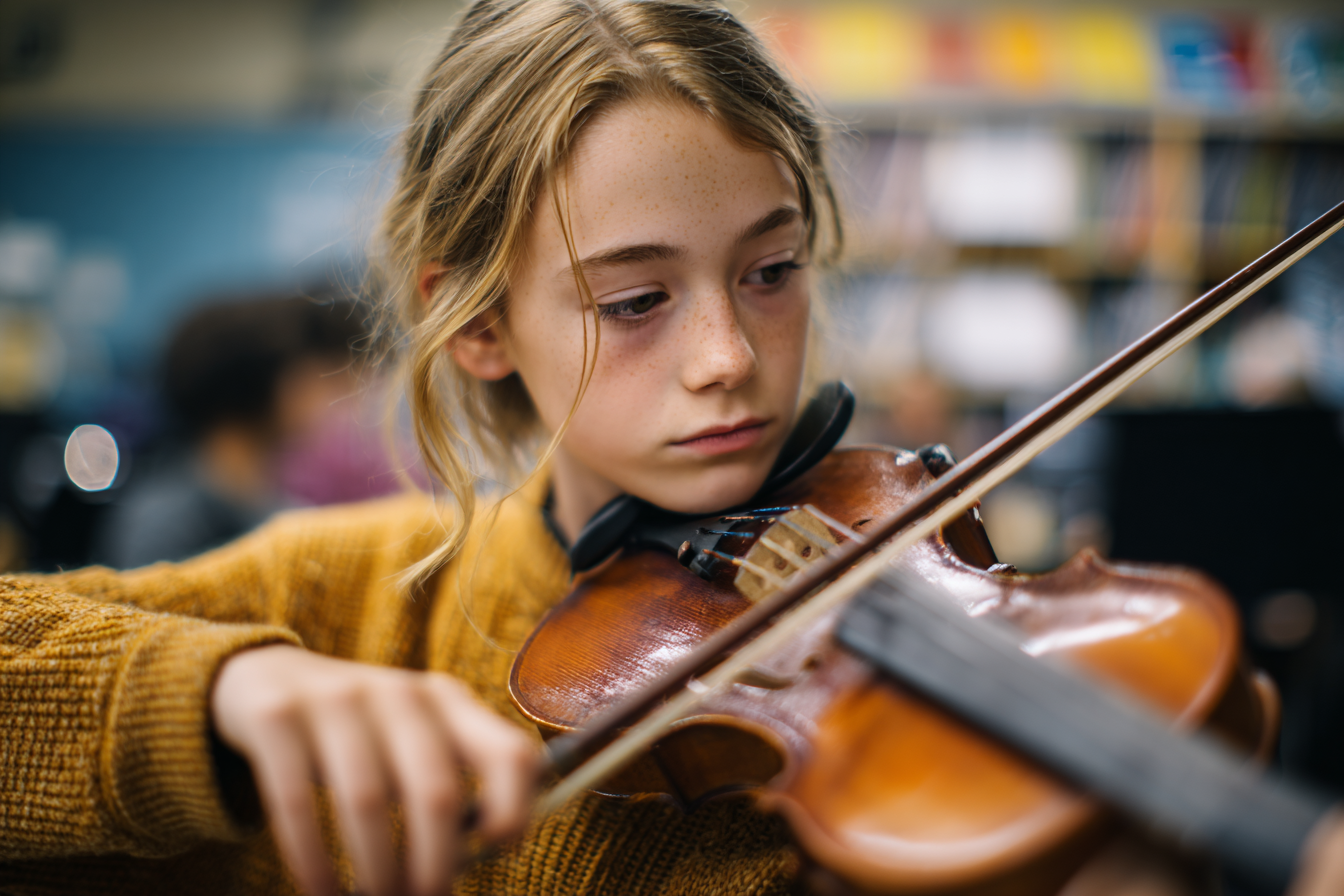
Focus: Perform polished concert repertoire while demonstrating professional rehearsal/performance etiquette and section leadership, then reflect on musicianship, leadership, and readiness for high school orchestra in light of personal interests and goals.
Grade Level: 8
Subject Area: Orchestra (Performance • Leadership • Identity & Reflection)
Total Unit Duration: 5 sessions (one week), 50–60 minutes per session
I. Introduction
In this capstone unit, Grade 8 orchestra students bring together everything they have learned about technique, ensemble skills, interpretation, and leadership. They prepare for and/or present an end-of-year concert performance, focusing on accurate pitch/rhythm, refined tone, unified bowing, balance/blend, and expressive intent, while modeling professional etiquette and section leadership. After the performance, students engage in guided reflection on how their personal interests, experiences, and goals have shaped their musical growth and what this means for their readiness for high school orchestra. The week ends with students creating a personal musician profile and concrete goals for their next ensemble chapter.
Essential Questions
- How can we show our best musicianship and professionalism during an end-of-year performance?
- What does effective section leadership and rehearsal/performance etiquette look like in a real concert setting?
- How have my interests, experiences, and goals shaped the kind of string musician and leader I am today?
- In what ways am I ready for high school orchestra, and what goals will help me keep growing?
- How can reflecting on this year’s journey help me become a more confident, independent musician in the future?
II. Objectives and Standards
Learning Objectives — Students will be able to:
- Perform concert repertoire with accurate pitch and rhythm, refined tone, unified bowing, balance/blend, and expressive intent.
- Demonstrate professional rehearsal and performance etiquette, including punctuality, focus, readiness, and supportive section leadership during the performance event.
- Describe specific moments where they led, supported, or adapted to help the ensemble succeed (e.g., cueing entrances, helping peers, adjusting balance).
- Reflect on how their personal interests, experiences, and goals have influenced their musical growth and decision-making this year.
- Create a High School Readiness & Goals Profile summarizing strengths, growth areas, and next-step goals as a string musician and leader.
Standards Alignment — Grade 8 Orchestra (custom, NAfME-style)
- OR:Pr6.8a — Perform orchestra music with accurate pitch and rhythm, refined tone, unified bowing, balance/blend, and expressive intent in an ensemble setting.
- Example: Students perform a three-part arrangement with strong dynamic contrast and consistent intonation.
- OR:Pr6.8b — Demonstrate professional rehearsal and performance etiquette, including leadership within sections, responsibility for independent parts, and support for ensemble success.
- Example: Students cue section entrances, track long rests, and adjust in real time to maintain ensemble unity.
- OR:Cn10.8a — Describe how personal interests, experiences, and goals influence musical growth, leadership, and decision-making as a string musician.
- Example: Students set a goal (clean shifting, expressive phrasing, leadership) and explain how it supports future music plans.
Success Criteria — Student Language
- I can perform our concert music with accurate notes and rhythms, refined tone, unified bowing, and expressive intent.
- I can show professional etiquette before, during, and after the performance (ready on time, focused, supportive, respectful).
- I can give examples of times when I led or supported my section or the ensemble.
- I can explain how my interests, experiences, and goals have shaped my playing and leadership this year.
- I can create a clear set of goals that will help me succeed in high school orchestra or my next ensemble.
III. Materials and Resources
Tasks & Tools (teacher acquires/curates)
- Concert repertoire & logistics:
- Final concert program with all pieces and running order.
- Fully marked parts with bowings, dynamics, cues, and page-turn solutions.
- Any performance logistics: seating chart, stage diagram, concert order, tuning procedures, stand partner roles.
- Recording & reflection tools:
- Device for recording the concert or an in-class performance run.
- Playback device for listening to highlights post-concert.
- Performance Reflection forms (individual and ensemble-level prompts).
- High School Readiness & Goals Profile templates.
- Visual supports:
- Anchor chart: “Concert Etiquette & Leadership” (before/during/after lists).
- Anchor chart: “My Year as a Musician” (skills, moments, challenges, breakthroughs).
Preparation
- Finalize all concert logistics (venue, order, tuning plan, transitions, announcements).
- Create/print reflection and readiness templates for use after the performance.
- Decide which recorded segments (or in-class performance) will be replayed to prompt reflection.
- Prepare a short teacher note or “Year-in-Review” summary to prime students for personal reflection.
Common Misconceptions to Surface
- “The concert is the end; reflection doesn’t matter.” → Reflection helps transfer learning into future ensembles and goals.
- “Only the teacher is responsible for how the concert goes.” → Every player has a role in intonation, balance, etiquette, and leadership.
- “Leadership only means being the loudest or most advanced player.” → Leadership includes quiet support, modeling professionalism, and helping others succeed.
- “High school orchestra will be completely different from this.” → Many skills (tone, reading, etiquette, self-reflection) carry directly into high school ensembles.
Key Terms (highlight in lessons) performance, etiquette, leadership, musicianship, tone, intonation, rhythm accuracy, bow unity, balance, blend, expression, reflection, readiness, goals, musical identity
IV. Lesson Procedure
(Each day follows: Launch → Explore → Discuss → Reflect. Timing for a 50–60 minute block.)
Session 1 — Concert Mindset & Leadership Roles (OR:Pr6.8b • OR:Pr6.8a)
- Launch (6–8 min)
- Ask: “Think of the best performance you’ve ever seen or been in—what behaviors and habits made it feel so strong and professional?”
- Students brainstorm ideas; teacher introduces the Concert Etiquette & Leadership anchor chart (before/during/after).
- Explore (22–25 min)
- Walk through concert logistics: stage layout, entrances/exits, tuning process, tuning leader(s), who cues what, where stands go, etc.
- Assign or confirm section leadership roles (e.g., tuning helper, page-turn planner, section cue leader, backstage checklist).
- Run a short in-class “performance simulation” of one piece:
- Students practice walking into “performance positions,” focusing quietly, tuning quickly, and performing with concert-level focus.
- Pause briefly to adjust any logistics (e.g., who watches conductor for cutoffs, who helps with stand moves).
- Discuss (10–12 min)
- Whole-group debrief: “What felt professional about our simulation? What needs tightening before the concert?”
- Connect explicitly to OR:Pr6.8b: professional etiquette and leadership in real-time performance contexts.
- Reflect (5 min)
- Exit slip: “One leadership or etiquette habit I will focus on for our concert is __ because __.”
Session 2 — End-of-Year Performance (Concert or In-Class Performance) (OR:Pr6.8a • OR:Pr6.8b)
Note: If the actual concert occurs outside class, adapt this session as a final in-class performance run with a “concert” mindset and record it for later reflection.
- Launch (5–7 min)
- Quick grounding: “What is one musical word (e.g., ‘confident,’ ‘warm,’ ‘connected’) you want to describe our performance today?”
- Students share a few words; teacher reminds them of concert etiquette expectations.
- Explore (30–35 min)
- Perform the end-of-year concert or a full in-class performance run of the program, recording the performance.
- Students practice all aspects of OR:Pr6.8a and OR:Pr6.8b:
- Tuning, entrances, focus, bow unity, listening for balance, expressive intent.
- Leadership actions like quiet cueing, supporting section intonation, modeling posture and attention.
- Discuss (8–10 min)
- Immediately after (or next class if time/setting requires), brief “hot take” circle:
- “Name one moment that felt especially strong.”
- “Name one moment that surprised you (good or challenging).”
- Keep tone celebratory but honest, setting up deeper reflection in later sessions.
- Immediately after (or next class if time/setting requires), brief “hot take” circle:
- Reflect (3–5 min)
- Quick ticket: “Right now, I feel __ about our performance because __.”
Session 3 — Performance Playback & Leadership Reflection (OR:Pr6.8a • OR:Pr6.8b)
- Launch (6–8 min)
- Ask: “What’s the difference between just re-living a performance and learning from it?”
- Students share ideas; teacher stresses using recordings as a mirror for both musicianship and leadership.
- Explore (22–25 min)
- Play selected recording excerpts from the concert/in-class performance:
- A strong section
- A challenging section (intonation, rhythm, balance, or entrances)
- Students complete a Performance Reflection form that prompts them to note:
- Where they heard accurate pitch/rhythm, refined tone, balance/blend, expressive intent (OR:Pr6.8a).
- Where they noticed good etiquette and leadership (focus, cueing, helping peers, stage presence) (OR:Pr6.8b).
- A specific moment they personally contributed to ensemble success.
- Play selected recording excerpts from the concert/in-class performance:
- Discuss (10–12 min)
- Small groups share highlights from their reflection forms:
- “A moment where we sounded our best…”
- “A leadership action I saw or did that helped…”
- Whole-group: name 2–3 “signature strengths” of this year’s ensemble (e.g., warmth of tone, tight endings, supportive culture).
- Small groups share highlights from their reflection forms:
- Reflect (5 min)
- Exit slip: “One way I showed leadership or professionalism in our performance was __, and it mattered because __.”
Session 4 — My Year as a Musician & High School Readiness (OR:Cn10.8a)
- Launch (6–8 min)
- Prompt: “Think back to the beginning of the year. How have you changed as a musician and as a leader since then?”
- Brief partner share; teacher introduces “My Year as a Musician” theme and High School Readiness & Goals Profile.
- Explore (22–25 min)
- Students complete sections of the Readiness & Goals Profile, guided by prompts such as:
- “Three musical skills I improved this year are…”
- “An experience that changed how I think about playing in an orchestra was…”
- “My personal interests (styles, composers, favorite pieces) that influence how I want to play are…”
- “One leadership moment I’m proud of is…”
- “For high school orchestra, my top 2–3 goals are…”
- Encourage students to connect to OR:Cn10.8a explicitly: how their interests, experiences, and goals have shaped their growth and decisions.
- Students complete sections of the Readiness & Goals Profile, guided by prompts such as:
- Discuss (10–12 min)
- Optional “gallery walk” or small-group share where students highlight:
- One strength they’re bringing to high school.
- One goal they’re excited (or nervous) about.
- Teacher affirms that each student has a place and role in future ensembles, regardless of level.
- Optional “gallery walk” or small-group share where students highlight:
- Reflect (5 min)
- Quick write: “The most important way I have grown as a musician/leader this year is __, and it will help me in high school because __.”
Session 5 — Legacy, Celebration & Next Steps (All standards)
- Launch (5–7 min)
- Ask: “What kind of legacy do you want our 8th-grade orchestra to leave for next year’s group?”
- Brainstorm ideas: sound quality, culture, traditions, values.
- Explore (25–30 min)
- Option 1: Letter to Future Self or Future Orchestra
- Students write a short letter to their future high school musician self or to next year’s 8th-grade orchestra that includes:
- One memory from this year’s performance(s).
- One piece of advice about etiquette or leadership.
- One personal music goal for the next year.
- Students write a short letter to their future high school musician self or to next year’s 8th-grade orchestra that includes:
- Option 2 (or add-on): Short performance for a small audience (e.g., another class or staff), focusing on expressive, relaxed playing and enjoying the music one more time.
- Students can share excerpts from their letters or goals if comfortable.
- Option 1: Letter to Future Self or Future Orchestra
- Discuss (10–12 min)
- Whole group:
- “What are you most proud of from this year’s orchestra experience?”
- “What do you hope your high school director notices about you when you join their ensemble?”
- Teacher shares closing reflections, affirming students’ readiness and potential.
- Whole group:
- Reflect (5 min)
- Final reflection: “One word or short phrase that captures who I am now as a string musician is __. I chose it because __.”
V. Differentiation and Accommodations
Advanced Learners
- Invite advanced students to take on more visible leadership roles at the concert (tuning, announcements, section cues).
- Ask them to set specific high school goals, such as auditioning for a select group or taking on mentoring roles in future ensembles.
- Encourage them to analyze the performance recording with a deeper lens (style authenticity, phrase shaping, inner voice clarity) in their reflections.
Targeted Support
- Provide checklists for concert etiquette and readiness (instrument, music, pencil, tuning, focus).
- Use simplified reflection prompts with sentence stems like:
- “One way I helped the group was…”
- “Next year, I want to get better at…”
- Allow shorter written responses or bullet points for students who struggle with longer writing.
- Pair students with supportive peers for the reflection and goals-writing process.
Multilingual Learners
- Allow students to draft reflections or letters in a home language first, then translate key parts into English if appropriate.
- Provide a vocabulary chart for key terms (performance, leadership, etiquette, goal, growth, readiness).
- Accept audio or video reflections in addition to written ones.
- Encourage peer or teacher conferencing to help students express complex ideas about growth and goals with language support.
IEP/504 & Accessibility
- Reduce performance-related anxiety by previewing concert procedures with visuals and, if possible, a quick stage walk-through.
- Offer choices for how to share reflections (written, typed, audio-recorded, one-on-one conversation).
- Provide extra time or adult support to complete the Readiness & Goals Profile.
- Allow flexible seating or sensory supports (earplugs, fidgets) for students who need them in loud rehearsal/performance environments.
VI. Assessment and Evaluation
Formative Checks (daily)
- Session 1 — Observation of rehearsal simulation shows students practicing concert etiquette and leadership roles.
- Session 2 — Performance behaviors and initial reflections show application of OR:Pr6.8a (musicianship) and OR:Pr6.8b (professionalism).
- Session 3 — Performance Reflection forms show that students can identify strengths and challenges in both playing and leadership.
- Session 4 — Readiness & Goals Profiles demonstrate students’ ability to connect personal interests/experiences/goals to musical growth.
- Session 5 — Legacy letters and final reflections show thoughtful ownership of identity and next steps as musicians.
Summative — End-of-Year Performance & Readiness Profile (0–2 per criterion, total 10)
- Concert Musicianship (OR:Pr6.8a)
- 2: Performs concert repertoire with generally accurate pitch/rhythm, refined tone, unified bowing, and solid balance/blend, demonstrating clear expressive intent.
- 1: Shows emerging musicianship; noticeable strengths but with some ongoing pitch, rhythm, or balance issues.
- 0: Performance shows limited evidence of refined ensemble skills.
- Concert Etiquette & Leadership (OR:Pr6.8b)
- 2: Consistently demonstrates professional etiquette (on time, prepared, focused) and engages in positive leadership or support for the ensemble.
- 1: Usually responsible and professional, with occasional lapses or limited visible leadership.
- 0: Frequent issues with etiquette or lack of responsibility; minimal contribution to ensemble culture.
- Reflection on Performance & Leadership (OR:Pr6.8a • OR:Pr6.8b)
- 2: Clearly explains specific performance moments and leadership behaviors, showing insight into strengths and areas for growth.
- 1: Reflection mentions performance/leadership generally but lacks specific examples or deeper insight.
- 0: Reflection is very brief, off-topic, or missing.
- Connection to Personal Interests/Experiences/Goals (OR:Cn10.8a)
- 2: Readiness Profile strongly connects personal interests, experiences, and goals to musical growth and decision-making.
- 1: Some connection is made, but it remains general or incomplete.
- 0: Little or no connection is shown between personal background and musical growth/goals.
- Clarity of High School Readiness & Goals (OR:Cn10.8a)
- 2: Identifies clear, realistic strengths and goals for high school orchestra, showing a strong sense of musical identity and next steps.
- 1: Goals are present but vague or not clearly linked to specific strengths/needs.
- 0: Goals are missing, unrealistic, or not thoughtfully considered.
Feedback Protocol (TAG)
- Tell one strength (e.g., “Your leadership in tuning and focus really helped set a professional tone for the concert.”).
- Ask one question (e.g., “What is one specific way you’ll work toward your shifting or tone goal next year?”).
- Give one suggestion (e.g., “Consider joining a small ensemble or practicing sight-reading weekly to support your high school goals.”).
VII. Reflection and Extension
Reflection Prompts
- How did this year in orchestra shape who you are as a musician and leader?
- What part of our final performance are you proudest of, and why?
- What skills and habits from this class will be most helpful when you join a high school ensemble?
- How will you continue to connect your personal interests and goals to your musical decisions in the future?
Extensions
- High School Welcome Portfolio: Compile a short portfolio (favorite excerpt recording, reflection paragraph, goals sheet) that can be shared with a high school director or private teacher.
- Mentor-in-Training: Volunteer to help a younger ensemble (live or via a written guide) by sharing tips on etiquette, practice, and leadership you learned this year.
- Summer Plan: Create a simple summer practice and listening plan aligned with your goals (e.g., scales, favorite pieces, recordings to explore) to keep growing before high school.
Standards Trace — When Each Standard Is Addressed
- OR:Pr6.8a — Sessions 1–3, 5 (concert simulation, performance event/run, recording playback and reflection on tone/intonation/rhythm/balance, final celebratory performance).
- OR:Pr6.8b — Sessions 1–3, 5 (concert etiquette and leadership roles, performance professionalism, identifying and reflecting on leadership behaviors).
- OR:Cn10.8a — Sessions 3–5 (connecting personal interests/experiences/goals to performance choices, leadership reflections, High School Readiness & Goals Profile, legacy letters and future plans).