Unit Plan 1 (Grade 8 Orchestra): Ensemble Culture & Leadership
Grade 8 orchestra unit builds rehearsal culture, section leadership, and personal growth goals to guide a focused, high-level ensemble year.

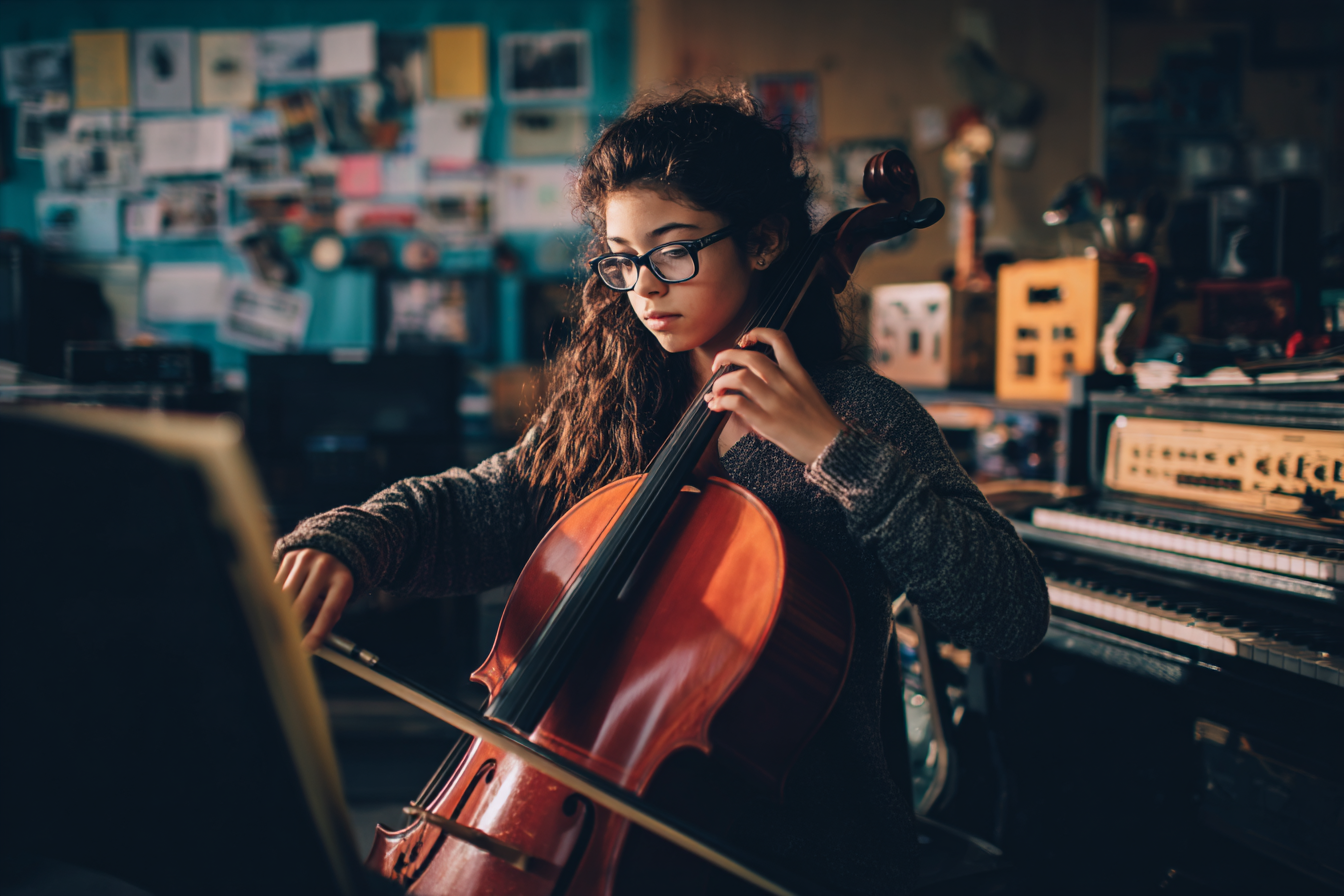
Focus: Establish high-level rehearsal expectations, clear section leadership roles, and meaningful personal growth goals that will guide the ensemble for the year.
Grade Level: 8
Subject Area: Orchestra (Performing • Connecting)
Total Unit Duration: 5 sessions (one week), 50–60 minutes per session
I. Introduction
Students enter Grade 8 Orchestra as the leaders of the program, responsible for modeling professional rehearsal etiquette, strong section leadership, and intentional personal practice habits. In this unit, they co-create ensemble norms, define what it means to be a section leader or “lead player,” and set concrete musicianship and leadership goals for the year. Through guided discussions, short playing tasks, reflection, and planning, students connect their personal interests and future plans to the kind of string musician and leader they want to become this year.
Essential Questions
- What does professional rehearsal and performance etiquette look and sound like in a Grade 8 orchestra?
- How can section leaders and experienced players support both their own part and the success of the full ensemble?
- How do my interests, experiences, and goals shape who I am as a string musician and leader?
- What daily habits and rehearsal systems will help us reach our musical goals this year?
- How can we build an ensemble culture where everyone feels responsible for growth and excellence?
II. Objectives and Standards
Learning Objectives — Students will be able to:
- Describe and demonstrate professional rehearsal etiquette (entering/exiting, posture, listening, marking music, responding to conductor cues) appropriate for Grade 8 Orchestra.
- Explain at least three section leadership responsibilities (e.g., cueing entrances, modeling bowings, helping with fingerings/rhythms, supporting peers) and practice them in short ensemble excerpts.
- Analyze their own strengths and areas for growth as string musicians, using recent experiences and teacher/peer feedback.
- Set at least two specific, measurable personal goals (one technical/musical, one leadership or ensemble-focused) and outline a simple practice or rehearsal plan to work toward them.
- Collaboratively develop an Ensemble Culture & Leadership Charter that outlines norms, roles, and shared commitments for the year.
- Reflect in writing or discussion on how their personal interests, experiences, and future music plans influence their goals and leadership choices in orchestra.
Standards Alignment — Grade 8 Orchestra (custom, NAfME-style)
- OR:Pr6.8b — Demonstrate professional rehearsal and performance etiquette, including leadership within sections, responsibility for independent parts, and support for ensemble success.
- Example: Students cue section entrances, track long rests, and adjust in real time to maintain ensemble unity.
- OR:Cn10.8a — Describe how personal interests, experiences, and goals influence musical growth, leadership, and decision-making as a string musician.
- Example: Students set a goal (clean shifting, expressive phrasing, leadership) and explain how it supports future music plans.
Success Criteria — Student Language
- I can show professional rehearsal etiquette with my body, instrument, and attention from the moment I enter the room.
- I can explain and practice specific section leadership moves (like cueing, helping with bowings, and supporting my stand partner) that help the ensemble.
- I can name my strengths and next steps as a string player and leader, using examples from my own playing.
- I can set clear, realistic goals for my playing and leadership and describe how I will work toward them.
- I can help create and follow our Ensemble Culture & Leadership Charter and hold myself accountable to it.
III. Materials and Resources
Tasks & Tools (teacher acquires/curates)
- Music & excerpts:
- Short, level-appropriate orchestra excerpts that highlight different sections (violins, violas, cellos, basses) and require clear entrances, bowings, and leadership.
- Simple sight-reading or chorale-style pieces for ensemble listening and etiquette practice.
- Planning & reflection tools:
- Ensemble Culture & Leadership Charter template (shared document or poster to finalize by Session 5).
- Personal Goal-Setting worksheet (space for strengths, goals, action steps, checkpoints).
- Quick self-assessment checklist for rehearsal behaviors and leadership.
- Visuals & prompts:
- Anchor chart examples:
- “Professional Rehearsal Etiquette” (before, during, after rehearsal).
- “What Section Leaders Do” (cues, support, communication).
- “From Interests → Goals → Habits” (connecting passions to practice).
- Short quotes or statements from professional orchestral musicians or advanced student leaders about leadership and ensemble culture (optional).
- Anchor chart examples:
- Other materials:
- Sticky notes, index cards, markers for brainstorming and feedback.
- Projector or board for capturing student ideas and final charter language.
Preparation
- Plan which excerpts will be used for:
- Demonstrating etiquette (starting/ending pieces, transitions).
- Practicing section leadership (entrances, bowings, dynamic contrast).
- Decide on section leader structure for your program (formal roles vs. rotating leadership responsibilities) and how that will be presented to students.
- Prepare a simple self-assessment checklist that students can complete quickly (e.g., “I arrive with instrument ready,” “I mark my part when the conductor gives notes,” etc.).
- Set up a draft Ensemble Culture & Leadership Charter framework with headings like Norms, Section Roles, Personal Responsibility, and Growth.
Common Misconceptions to Surface
- “Leadership is only for the first chair or ‘best’ players.” → Leadership can be shared and practiced by many; every player influences the ensemble.
- “Rehearsal etiquette just means being quiet.” → It also includes active listening, marking parts, watching the conductor, and supporting peers.
- “My personal goals don’t affect the ensemble.” → Individual growth in intonation, rhythm, tone, and leadership raises the whole group’s level.
- “Section leaders should tell people what to do, not listen.” → Effective leaders model, listen, and support, not just direct others.
- “Goals are just big statements (‘get better at violin’) and don’t need a plan.” → Strong goals are specific, measurable, and connected to daily habits.
Key Terms (highlight in lessons) ensemble, rehearsal etiquette, performance etiquette, section, section leader, leadership, cue, independent part, ensemble unity, personal goal, musical growth, feedback, ensemble culture
IV. Lesson Procedure
(Each day follows: Launch → Explore → Discuss → Reflect. Timing for a 50–60 minute block.)
Session 1 — What Does a Professional Ensemble Look Like? (OR:Pr6.8b)
- Launch (6–8 min)
- Prompt: “Think about the best ensemble you’ve ever seen (live, video, or imagined). What did they do that made them look and sound ‘professional’?”
- Students jot ideas individually, then share a few examples (body language, focus, silence, communication).
- Explore (22–25 min)
- Brief teacher demonstration/model: enter the room “sloppy” vs. “professional,” then quickly rehearse a short excerpt both ways.
- Class brainstorms specific rehearsal etiquette behaviors and the teacher records on the board under “Before / During / After Rehearsal.”
- As a group, students play through a simple excerpt focusing only on etiquette and ensemble procedure (set-up, ready position, watching, stopping together) rather than musical perfection.
- Discuss (10–12 min)
- Whole-group: “Which behaviors helped the group most? Which habits do we need to let go of this year?”
- Introduce OR:Pr6.8b and connect behaviors directly to this standard.
- Start a draft list of non-negotiable rehearsal norms to be refined later in the charter.
- Reflect (5 min)
- Exit slip: “One rehearsal habit I already do well is ___ and one I want to improve this year is ___.”
Session 2 — Section Leadership: Roles, Cues & Support (OR:Pr6.8b)
- Launch (6–8 min)
- Ask: “What do you think a section leader or lead player actually does during rehearsal?”
- Students list roles on sticky notes (cues, bowings, counting, helping others) and post them under “Leadership.”
- Explore (22–25 min)
- Teacher reviews and organizes student ideas into 3–4 core categories:
- Musical modeling (tone, rhythm, bowings).
- Communication (cues, eye contact, calm problem-solving).
- Responsibility (knowing part, tracking rests, marking changes).
- Support (helping stand partner, encouraging others).
- In sections, students rotate through short leadership drills using a brief excerpt:
- One student cues the entrance; others follow.
- One student models bowings while the section matches.
- One student silently tracks rests and gives a subtle cue at re-entry.
- All students practice at least one leadership move, even if they are not official first chair.
- Teacher reviews and organizes student ideas into 3–4 core categories:
- Discuss (10–12 min)
- Sections share: “Which leadership moves felt natural? Which felt awkward or new?”
- Whole-group: connect back to OR:Pr6.8b, highlighting that leadership is part of professional etiquette.
- Add a “Section Leadership” section draft to the Ensemble Culture & Leadership Charter with student input.
- Reflect (5 min)
- Quick write: “One leadership skill I want to practice more this year is ___ because ___.”
Session 3 — Personal Interests, Experiences & Goals (OR:Cn10.8a)
- Launch (6–8 min)
- Prompt: “Why do you play your instrument? What do you hope orchestra does for you this year or in the future?”
- Students respond on an index card (interests: styles, pieces, future plans, emotions, community).
- Explore (22–25 min)
- Mini-lesson: introduce OR:Cn10.8a and explain that who they are (interests, experiences, goals) should shape what they work on as musicians and leaders.
- Students complete a Personal Goal-Setting worksheet:
- Identify 2–3 strengths (e.g., strong rhythm, expressive vibrato, leadership, organization).
- Identify 2–3 growth areas (e.g., shifting accuracy, sight-reading, confidence speaking up, consistency in practice).
- Draft two specific goals:
- One technical/musical (e.g., “play 2-octave D major scale at ♩=96 with consistent tone”).
- One leadership/ensemble (e.g., “give at least one clear cue per rehearsal in my section,” “check in weekly with a younger player”).
- Discuss (10–12 min)
- In pairs or trios, students share at least one strength and one goal.
- Whole-group: discuss how personal interests (e.g., loving film scores, wanting to audition for high school orchestra) can guide goal choices and leadership style.
- Reflect (5 min)
- Exit slip: “One way my personal interests or future plans influence my orchestra goals is ___.”
Session 4 — Systems for Growth: Habits, Feedback & Accountability (OR:Pr6.8b • OR:Cn10.8a)
- Launch (6–8 min)
- Ask: “What gets in the way of actually reaching our goals during the year (for both playing and leadership)?”
- Students brainstorm obstacles (time, motivation, forgetting, not knowing what to practice) and share.
- Explore (22–25 min)
- Mini-lesson: introduce the idea of systems and habits (e.g., warm-up routines, practice logs, rehearsal routines) that support their goals.
- Students return to their Personal Goal-Setting sheet and:
- Add specific action steps (e.g., “3x/week 10 minutes of shifting drills,” “after each rehearsal, write one note about leadership in my planner”).
- Identify one feedback source (teacher, peer, recording, tuner/metronome) for each goal.
- Short playing activity: students play a scale or excerpt connected to their goal, then jot a quick self-note (“Today I noticed…”).
- Discuss (10–12 min)
- Whole-group: share examples of small habits that could become class norms (e.g., tuning quietly, always having a pencil, quick pair check-ins at the end of rehearsal).
- As a class, refine the Ensemble Culture & Leadership Charter with sections for:
- Daily rehearsal habits.
- Section leadership practices.
- Personal accountability and goal check-ins.
- Reflect (5 min)
- Quick write: “One habit I will commit to that supports both my playing and our ensemble culture is ___.”
Session 5 — Ensemble Culture & Leadership Charter (All standards)
- Launch (5–7 min)
- Review the draft charter from previous sessions. Ask: “If we stick to this, what could our orchestra sound and feel like by concert time?”
- Explore (25–30 min)
- In small groups, students review sections of the charter (Norms, Section Leadership, Personal Responsibility, Growth Systems) and suggest final wording or additions.
- The class collaborates to finalize the Ensemble Culture & Leadership Charter, then all students sign (physically or digitally) as a commitment.
- Students write a brief Leadership & Growth Statement connecting:
- One rehearsal/leadership behavior they will model consistently.
- Their two personal goals and how they will track them.
- How this connects to their future music plans or interests.
- Discuss (10–12 min)
- Volunteers share parts of their statements.
- Whole-group: How do OR:Pr6.8b (professional etiquette, leadership) and OR:Cn10.8a (personal interests/goals) show up in our charter and individual plans?
- Reflect (5 min)
- Final reflection: “As an 8th grade string player, the kind of leader I want to be in this orchestra is ___, and this matters because ___.”
V. Differentiation and Accommodations
Advanced Learners
- Encourage students to mentor younger players (if part of a larger program) by planning one specific outreach or coaching action.
- Ask them to design a more detailed practice plan with weekly checkpoints and self-recordings to track progress toward technical goals.
- Invite them to draft a short proposal for a student-led warm-up, sectional routine, or leadership initiative to present to the class.
Targeted Support
- Provide examples of strong goals and sentence frames such as:
- “One strength I bring to the ensemble is ___.”
- “A specific goal I have is to improve ___ by ___ date by practicing ___.”
- Offer a simplified checklist for rehearsal etiquette and have students choose one behavior at a time to focus on.
- Pair students with supportive peers for leadership drills so they feel safe trying cues and speaking roles.
Multilingual Learners
- Use visuals and gestures to model rehearsal etiquette and leadership moves (e.g., bow, eye contact, counting in).
- Allow students to brainstorm interests and goals in their home language first, then work with a partner or the teacher to add English phrases.
- Provide bilingual or icon-supported versions of the goal-setting and self-assessment tools where possible.
- Emphasize demonstration-based evidence of learning (showing leadership moves on the instrument) alongside written reflections.
IEP/504 & Accessibility
- Break tasks into smaller steps with checklists (e.g., “Step 1: List strengths; Step 2: Choose one goal; Step 3: Add one action step”).
- Allow alternative ways to participate in leadership (e.g., quietly cueing with breath/eyes, organizing music, supporting peers one-on-one) for students who are uncomfortable speaking in front of the full group.
- Provide printed copies of the Ensemble Culture & Leadership Charter and highlight the most important expectations for individual students as needed.
- Offer options for audio or short video reflections instead of all written responses.
VI. Assessment and Evaluation
Formative Checks (daily)
- Session 1 — Students identify and begin to demonstrate key rehearsal etiquette behaviors during playing activities.
- Session 2 — Section leadership drills show that students can practice at least one leadership move (cueing, modeling bowings, tracking rests).
- Session 3 — Goal-setting sheets include at least one specific technical goal and one leadership/ensemble goal connected to personal interests or experiences.
- Session 4 — Students refine their goals with action steps and contribute ideas to the draft Ensemble Culture & Leadership Charter.
- Session 5 — Leadership & Growth Statements show clear connections between personal goals, ensemble culture, and the standards.
Summative — Ensemble Culture & Leadership Portfolio (0–2 per criterion, total 10)
- Rehearsal Etiquette & Professionalism (OR:Pr6.8b)
- 2: Consistently demonstrates professional rehearsal behaviors (setup, focus, responsiveness, marking parts) and can describe why they matter for ensemble success.
- 1: Shows some professional behaviors but with inconsistency or limited reflection.
- 0: Rarely demonstrates or reflects on rehearsal etiquette.
- Section Leadership & Ensemble Support (OR:Pr6.8b)
- 2: Clearly describes and has practiced specific section leadership roles; demonstrates at least one leadership move (cue, model, support) and reflects on its impact.
- 1: Identifies some leadership roles but has limited demonstration or reflection on their use.
- 0: Little evidence of understanding or practicing section leadership.
- Personal Goal-Setting & Planning (OR:Cn10.8a)
- 2: Sets at least two specific, realistic goals (technical and leadership) with clear action steps and checkpoints; connects them to personal interests or future plans.
- 1: Goals are present but vague or missing action steps and/or clear connection to interests.
- 0: Goals are absent or extremely general with no plan.
- Reflection on Interests, Experiences & Growth (OR:Cn10.8a)
- 2: Thoughtful reflections explain how personal interests, past experiences, and aspirations influence musical growth and leadership choices.
- 1: Some reflection is present but stays surface-level or disconnected from actual goals and behaviors.
- 0: Little or no meaningful reflection on personal influences.
- Communication & Ownership of Ensemble Culture
- 2: Leadership & Growth Statement and participation in the charter process show clear ownership of ensemble norms and a commitment to contributing positively all year.
- 1: Some ownership is evident, but commitments or communication are incomplete or vague.
- 0: Minimal evidence of engagement with ensemble culture or leadership commitments.
Feedback Protocol (TAG)
- Tell one strength (e.g., “Your goal to model steady counting for your section shows strong awareness of leadership.”).
- Ask one question (e.g., “How will you know if you’ve met your shifting goal by concert time?”).
- Give one suggestion (e.g., “Consider adding one small daily habit that connects your leadership goal to every rehearsal.”).
VII. Reflection and Extension
Reflection Prompts
- How is being an 8th grade orchestra member different from earlier years in terms of leadership and responsibility?
- Which rehearsal or leadership habit do you think will make the biggest difference for our ensemble this year, and why?
- How do your personal interests (favorite styles, pieces, future goals) influence the kind of leader and musician you want to be?
Extensions
- Leadership in Action: Throughout the semester, keep a short log of moments when you practiced leadership (helping a peer, cueing, modeling, encouraging) and how it affected the ensemble.
- Mentor Moments: If your program includes younger groups, design a short “welcome & leadership” mini-clinic that 8th graders could lead for younger string players.
- Concert Reflection: After the first concert, revisit your goals and charter, reflecting on which parts you followed well and where the ensemble can grow before the next performance.
Standards Trace — When Each Standard Is Addressed
- OR:Pr6.8b — Sessions 1–2, 4–5 (defining and practicing professional rehearsal etiquette; section leadership drills; charter development; ongoing leadership commitments).
- OR:Cn10.8a — Sessions 3–5 (connecting interests and experiences to goals; creating personal plans; writing Leadership & Growth Statements that link identity, goals, and leadership).