Walking Seminars and Mobile Math: Learning That Happens on the Move
Explore Walking Seminars and Mobile Math to boost engagement, discussion, and rigor by turning movement into a powerful part of classroom learning.

I. Introduction
A lot of school learning is still built around sitting still. Students are expected to discuss, solve, explain, and reflect while remaining in the same chair for long stretches of time, even when attention is fading and energy is dropping. Walking Seminars and Mobile Math offer a different rhythm. Instead of treating movement as a break from learning, they treat movement as part of the learning design itself.
In this model, classes head to hallways, playgrounds, courtyards, sidewalks, or outdoor spaces to complete academic tasks tied to clear objectives. Students might do walk-and-talk literature circles, chalk-based math proofs, vocabulary relays, science observation walks, or mobile review stations. Research on physically active learning and outdoor learning suggests that movement-integrated lessons can support academic performance, engagement, and classroom energy when they are intentionally structured rather than used as loose activity for its own sake.
Want done-for-you lesson plans for less than $2? Click Here to explore.
This article explores how Walking Seminars and Mobile Math can work in real classrooms without becoming chaotic or superficial. You will find practical design principles, research-based case studies, implementation ideas, and a manageable framework for helping students think more clearly by learning on the move.
II. Why Learning on the Move Can Work
Movement changes the feel of a lesson. When students are walking, rotating, observing, or physically building an idea in space, they often become more alert and more willing to talk through their thinking. A recent systematic review and meta-analysis found that a single bout of physical activity can improve academic outcomes in school-aged youth, suggesting that movement can support learning rather than compete with it.
That matters especially in mathematics and discussion-heavy classes. Physically active math lessons have shown promising results in primary settings. In one randomized crossover trial, students learning multiplication through playground-based active lessons improved more on multiplication performance than students in seated lessons, while also accumulating substantially more physical activity during class.
Outdoor and mobile learning can also shift participation patterns. When students are walking in pairs or talking beside one another instead of speaking across rows, some feel less exposed and more willing to contribute. Higher education evidence from walking seminars found improved perceived seminar quality and well-being, which does not automatically prove identical effects in K–12 classrooms, but it does support the broader idea that walking discussion formats can positively affect how academic conversation feels.
III. What Walking Seminars and Mobile Math Actually Are
Walking Seminars are structured academic discussions that happen while students move through a defined space. The discussion questions, text references, and partner rotations are planned in advance. Students are not just “talking while outside.” They are engaging in a seminar format that has been adapted to walking, movement, and observation.
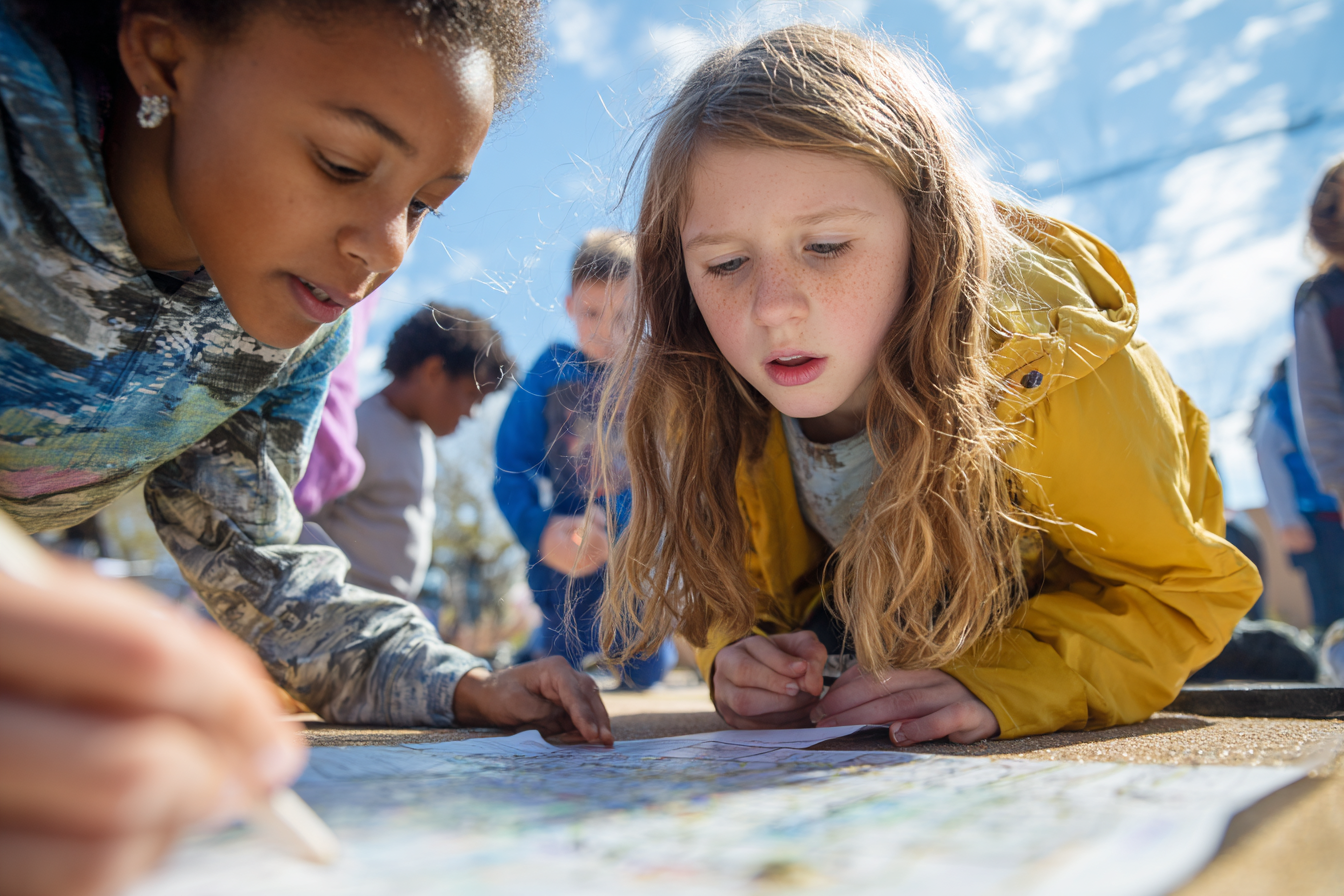
Mobile Math uses movement to make mathematical thinking visible and active. Students might solve at stations around the building, justify solutions with sidewalk chalk, match representations posted along a fence or hallway, or physically model number relationships and geometric ideas. The point is not to make math flashy. The point is to connect movement with reasoning, attention, and repeated academic practice.
The strongest versions of both approaches still protect core instructional clarity. Students need a learning target, a pathway through the task, and a way to capture thinking. Research-based outdoor learning models emphasize that positive results depend on the interaction between environment, learner, and teacher design. In other words, the setting matters, but the pedagogy matters more.
IV. What Students Gain from Learning in Motion
Walking Seminars and Mobile Math can support several outcomes at once when the lesson is designed well.
- Stronger attention and alertness Moving during academic work can help break the passive rhythm that often causes energy to dip during long seated blocks.
- More active discussion Pair walking and rotating conversations can lower the social pressure of whole-group speaking and increase verbal participation.
- Better math engagement Physically active math lessons have shown gains in targeted math outcomes, especially when movement is directly tied to content rather than added on afterward.
- Clearer connection between body and thinking Students can map ideas onto space, move between representations, and use the environment as part of the lesson.
- More variety in access points Some learners benefit when discussion, observation, and problem-solving are not all confined to desks and paper.
These benefits do not mean every moving lesson outperforms every seated lesson. The evidence is encouraging but not magical. What it does suggest is that movement can be a legitimate instructional tool when it is tied to academic purpose, manageable routines, and thoughtful follow-up.
V. Designing Strong Walking Seminars
A good Walking Seminar starts with tight questions. Students need prompts that can sustain real thinking while they move, such as a theme question in literature, a cause-and-effect question in history, or a claim-evidence question in science. Broad prompts usually lead to shallow conversation. Focused prompts create better dialogue.
It also helps to structure talk in rounds. For example, students might walk with one partner for three minutes, pause to jot one idea, then rotate and respond to a follow-up question with a new partner. This keeps the seminar from drifting and makes the movement part of the academic flow instead of background noise. The walking seminar study in higher education used reorganized seminar preparation around walking and found stronger perceived seminar quality, which supports the idea that movement plus structure can improve discussion conditions.
Check out our engaging printable posters. CLICK HERE to explore!
Teachers should also build in visible accountability. Students can carry a note card, discussion tracker, or quotation slip so they have to bring evidence into the walk. Without that layer, the lesson can easily become pleasant conversation without enough academic precision.
VI. Designing Mobile Math That Still Feels Rigorous
Mobile Math works best when students are moving because the math demands it, not because movement is forced into the lesson. A hallway number line makes sense for integer comparison. Sidewalk chalk proofs make sense for geometry, fraction models, and multi-step explanation. Rotating problem stations make sense when students need repeated practice with immediate checking or peer comparison.
The best lessons also keep the mathematics visible. Students should write, sketch, label, explain, or defend while moving. In the physically active multiplication study, the movement was not separate from the lesson content; it was embedded into how students practiced and retrieved math facts. Similarly, long-term physically active mathematics lessons in primary school were associated with gains in arithmetic and cognition, which suggests that sustained integration can matter more than occasional novelty.
A useful planning question is this: what does movement allow students to do here that a desk lesson does not do as well? If the answer is “nothing,” keep the lesson seated. If the answer is “compare faster, model better, discuss more, notice more, or stay more engaged,” then mobility may be worth it.
VII. Research-Based Case Studies
Case Study: Playground Multiplication Lessons in Australia Vetter and colleagues studied Year 3 students in a randomized crossover trial comparing seated classroom instruction with physically active multiplication lessons delivered in the playground. The active condition led to significantly greater improvement in multiplication scores, while also increasing total physical activity and moderate-to-vigorous physical activity during lessons. This is one of the clearest examples of Mobile Math working without sacrificing academic focus.
Case Study: Two Years of Active Mathematics in Primary School Magistro and colleagues examined a two-year intervention in which primary students completed physically active mathematics lessons. The intervention group showed greater improvements across multiple cognitive measures, arithmetic performance, and gross motor skills than the control group. This study is especially useful because it suggests the model can be sustained over time rather than functioning only as a short-term engagement boost.
Case Study: The Walking Classroom in Upper Elementary Erwin, Weight, and Harry studied fourth- and fifth-grade students using The Walking Classroom platform. In focus groups, students described feeling happier, healthier, smarter, and more alert while learning during short walking sessions. This does not prove academic gains on every outcome, but it does show that students experienced movement-based learning as more energizing and emotionally positive than standard seated routines.
Case Study: Walking Seminars in Higher Education Bälter and colleagues studied university seminars reorganized around outdoor walking. Participants reported improved perceived seminar quality and a stronger sense of well-being. Because this study involved adult learners, it should be applied cautiously to K–12 settings, but it remains useful evidence that walking discussion formats can strengthen how learners experience academic conversation.
Case Study: Outdoor Learning as a Broader Pedagogical Model Neville and colleagues synthesized peer-reviewed outdoor learning literature and developed a model emphasizing the relationship among environment, learner, and educator. Their work is valuable here because it shows that successful learning outside the classroom depends on planning, transitions, task design, and teacher facilitation, not simply on taking students outdoors.
VIII. A Simple Lesson Flow That Keeps Things Manageable
A strong moving lesson usually follows a predictable sequence.
Launch the target State the objective clearly before anyone moves. Students should know exactly what they are discussing, solving, or observing.
Set the route and norms Define where students will walk, how long each round will last, what materials they carry, and what voice level is expected. Clear logistics reduce chaos.
Move through short academic rounds Use timed discussion rounds, problem stations, observation checkpoints, or chalk response spots. Shorter cycles usually keep the lesson tighter than one long wandering block.
Capture thinking Have students write one takeaway, solve one proof, annotate one observation, or submit one response after each round. This keeps learning visible.
Debrief back in place Bring the class together to synthesize what changed, what was learned, and what still needs clarification. That closing step is what turns movement into instruction rather than just activity.
IX. Common Pitfalls and How to Avoid Them
Walking Seminars and Mobile Math can be powerful, but they are easy to weaken.
- Pitfall: Movement becomes the lesson Fix: Start with the academic objective and only use movement when it clearly strengthens the task.
- Pitfall: Students move without evidence Fix: Require note cards, written checkpoints, chalk solutions, or discussion trackers.
- Pitfall: The space is poorly chosen Fix: Use routes and areas that match the activity. Hallways may work better for station math; courtyards may work better for paired seminars.
- Pitfall: The lesson is too long Fix: Keep active academic rounds short and focused. A tight 12–20 minute sequence often works better than a full drifting period.
- Pitfall: Teachers assume outdoors automatically improves learning Fix: Build preparation, facilitation, and follow-up into the design. Outdoor space is a context, not a shortcut.
X. FAQ
Do Walking Seminars only work for ELA or humanities classes? No. They fit especially naturally with text discussion, but they can also work for science claim-evidence conversations, historical source analysis, and even oral math reasoning if prompts are tight and evidence is carried along. The key is structuring the talk, not the subject label.
Does Mobile Math really improve math learning, or does it just make class more fun? There is evidence it can do more than boost enjoyment. In one randomized crossover trial, active multiplication lessons improved multiplication performance more than seated lessons, and in a two-year study, physically active math lessons were linked to gains in arithmetic and cognition.
Do I need outdoor space to do this well? No. Hallways, common areas, taped floor spaces, or classroom perimeter stations can work. Outdoor areas help in some lessons, but the real issue is whether the space supports the task and can be managed safely.
What if students get distracted when they move? That usually means the routine is too loose, the rounds are too long, or the accountability is too thin. Short timed segments, concrete prompts, and visible written capture points make a big difference.
Is there evidence for walking-based learning beyond elementary school? Yes, though the evidence is thinner and comes from different settings. The walking seminar study was conducted in higher education and found improved perceived seminar quality and well-being. That should be applied carefully to K–12, but it supports the broader idea that academic discussion can benefit from movement.
How often should I use moving lessons? They do not need to replace every seated lesson. The evidence base supports intentional, repeated use, especially when the format fits the task. A few well-designed routines used regularly are more valuable than occasional movement for movement’s sake.
XI. Conclusion
Walking Seminars and Mobile Math remind students that thinking does not have to stay trapped at a desk. When classes discuss while walking, prove with chalk, rotate through academic stations, or observe the world as part of a lesson, movement becomes a tool for attention, participation, and clearer understanding. The strongest evidence suggests that physically active learning can support academic outcomes, especially when the lesson is focused and the movement is truly tied to the content.
The best part of this model is that it can start small. One hallway seminar. One sidewalk math task. One outdoor observation round. Teachers do not need to rebuild the whole day to make learning more mobile. They just need to ask where movement could make the thinking sharper, more visible, and more memorable.
Want to save time on lesson planning this week? CLICK HERE to explore our library of 1000s of lesson plans for less than $2!
Transform your classroom into an inspiring, vibrant learning space with our beautifully designed printable posters! Perfect for engaging your students and enhancing your teaching environment, our poster bundles cover everything from historical philosophers to animals. CLICK HERE to explore our exclusive collections on Teachers Pay Teachers and give your students the motivational boost they need!
Sources
Bälter, O., Hedin, B., Tobiasson, H., & Toivanen, S. (2018). Walking outdoors during seminars improved perceived seminar quality and sense of well-being among participants. International Journal of Environmental Research and Public Health, 15(2), 303. https://doi.org/10.3390/ijerph15020303
Erwin, H., Weight, E., & Harry, M. (2021). “Happy, healthy, and smart”: Student responses to the Walking Classroom education program aimed to enhance physical activity. Journal of School Health, 91(3), 195–203. https://doi.org/10.1111/josh.12990
Magistro, D., Cooper, S. B., Carlevaro, F., Marchetti, I., Magno, F., Bardaglio, G., & Musella, G. (2022). Two years of physically active mathematics lessons enhance cognitive function and gross motor skills in primary school children. Psychology of Sport and Exercise, 62, 102254. https://doi.org/10.1016/j.psychsport.2022.102254
Muntaner-Mas, A., Palou, P., Vidal-Conti, J., Esteban-Cornejo, I., & Vidal-Alaball, J. (2024). Acute effect of physical activity on academic outcomes in school-aged youth: A systematic review and multivariate meta-analysis. Scandinavian Journal of Medicine & Science in Sports, 34(1), e14479. https://doi.org/10.1111/sms.14479
Neville, I. A., Petrass, L. A., Ben, F., & Drew, R. (2023). Cross disciplinary teaching: A pedagogical model to support teachers in the development and implementation of outdoor learning opportunities. Journal of Outdoor and Environmental Education, 26, 245–268. https://doi.org/10.1007/s42322-022-00109-x
Vetter, M., O’Connor, H. T., O’Dwyer, N., Chau, J., & Orr, R. (2020). ‘Maths on the move’: Effectiveness of physically-active lessons for learning maths and increasing physical activity in primary school students. Journal of Science and Medicine in Sport, 23(8), 735–739. https://doi.org/10.1016/j.jsams.2019.12.019