Parent Tips: When Behavior Notes Come Home—Responding in Ways That Help, Not Escalate
Learn how to respond to school behavior notes calmly, build trust with teachers, support your child, and turn tough moments into real behavior growth.

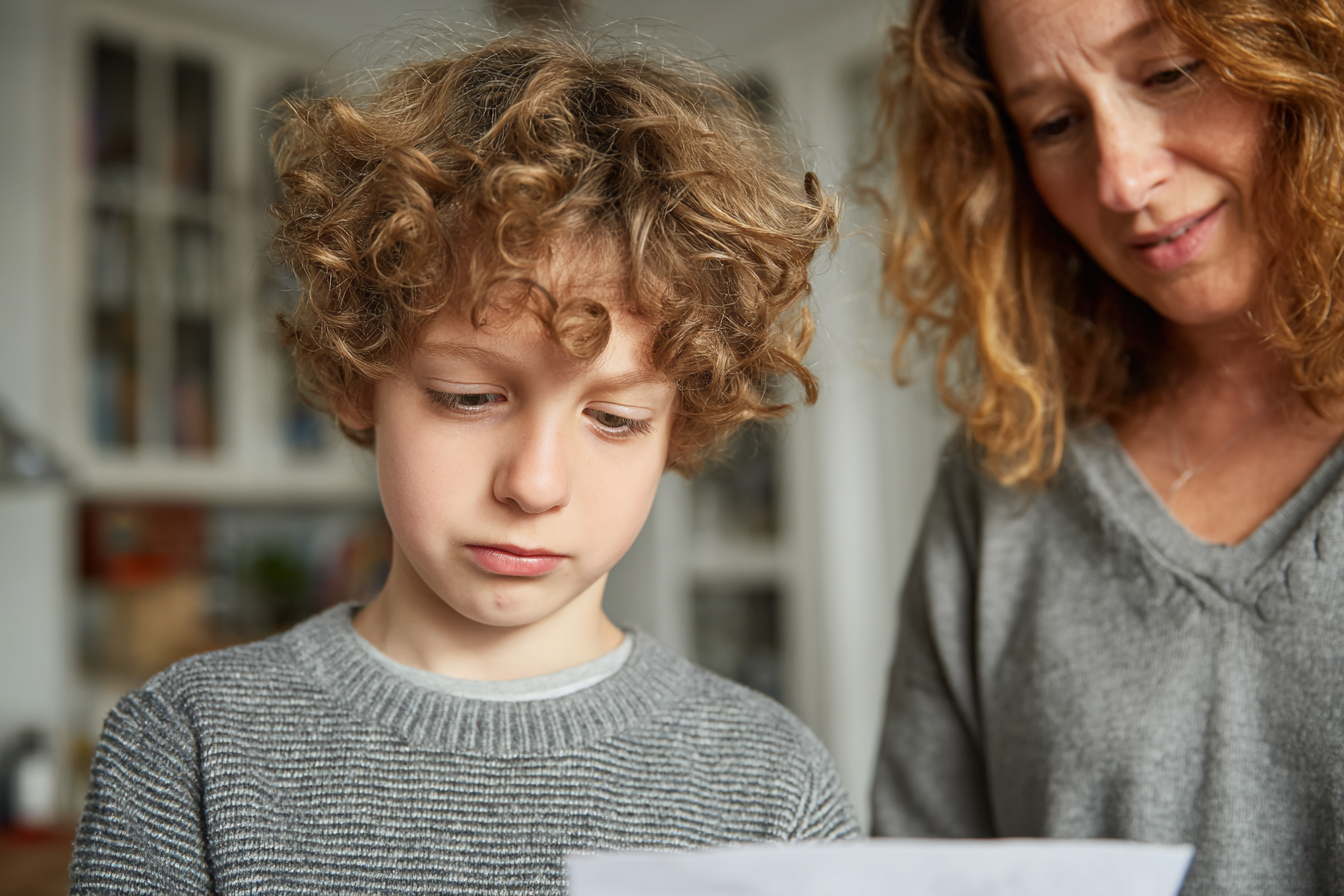
A behavior note from school can hit a parent like a punch to the stomach. Maybe it says your child was talking constantly, refusing directions, disrupting class, or being disrespectful. Sometimes the message is short and vague. Sometimes it arrives right as you are finishing work, picking up kids, or trying to get dinner on the table. In that moment, it is easy to react from embarrassment, anger, or panic.
That reaction makes sense. Behavior notes often stir up several fears at once: fear that your child is struggling more than you realized, fear that the teacher is frustrated, fear that you are expected to “fix it” immediately, or fear that your child is being labeled as a problem. But the first response you send—and the first conversation you have with your child—can either calm the situation down or make it much harder to solve.
Research on family–school partnerships suggests that communication works best when it is collaborative, consistent, and built on trust. Family–school interventions that include communication and behavioral supports have been linked with better social-behavioral outcomes for students, and stronger teacher–parent relationships are associated with better student functioning.
Want done-for-you lesson plans for less than $2? CLICK HERE to explore.
This article will help you respond to behavior notes in a way that protects trust and builds problem-solving. You’ll get a 24-hour response plan, restorative questions to ask your child, a script for asking “What support does the teacher need from me?”, and examples of replies that help instead of escalate. The goal is not to excuse behavior. The goal is to respond in a way that actually improves it.
Why Behavior Notes Can Escalate So Quickly
Behavior notes often create tension because everyone involved is already carrying emotion. Teachers may be tired, parents may feel blindsided, and children may feel ashamed or defensive. If the first response is rushed or accusatory, the conversation can shift away from the actual problem and toward who feels blamed.
Research supports the idea that the quality of family–school relationships matters. Adams and Christenson found that trust between parents and teachers is a vital part of the family–school relationship, and that the perceived quality of interaction was a stronger predictor of trust than the sheer frequency of contact. That matters because a quick, defensive email may feel efficient in the moment, but it can weaken the trust you need for future problem-solving.
The same principle shows up in intervention research. Sheridan and colleagues found that family–school partnership approaches such as Conjoint Behavioral Consultation improved student behavioral outcomes and teacher–parent relationships, suggesting that how adults work together can directly affect how children do.
So when a behavior note comes home, the goal is not just to “respond.” The goal is to respond in a way that keeps the relationship usable.
The 24-Hour Response Plan
One of the simplest and most effective things parents can do is avoid trying to solve everything in the first ten emotional minutes. A behavior note deserves attention, but not necessarily an instant reaction.
A helpful 24-hour plan looks like this:
Step 1: Read the message twice before responding. The first read is emotional. The second read is for information. Ask yourself:
- What does the teacher actually say happened?
- What details are clear?
- What details are missing?
- Is this about one incident, or a pattern?
Step 2: Regulate yourself before contacting anyone. If you feel angry, embarrassed, or shaky, wait. Take a walk, finish the current task, or talk to another calm adult first. A pause protects your relationship with both the teacher and your child.
Step 3: Talk to your child with curiosity, not accusation. Before sending your reply, hear your child’s side. That does not mean assuming the teacher is wrong. It means collecting information.
Step 4: Decide whether the note calls for:
- a quick thank-you and check-in,
- a clarifying question,
- or a bigger follow-up conversation.
Step 5: Respond within 24 hours if possible. That keeps communication timely without making it reactive.
This kind of pause is not avoidance. It is strategy.
What to Ask Your Child First
The first home conversation after a behavior note matters just as much as the first parent email. If a child expects a lecture, they may lie, shut down, or blame everyone else. If they expect a calm but serious conversation, you are more likely to get useful information.
Try opening with something like:
- “I got a note from school, and I want to understand what happened from your perspective.”
- “I’m not here to yell. I do need to figure out what went wrong and what needs to change.”
- “Tell me the story from the beginning, not just the part where you got caught.”
Once they start talking, use restorative-style questions that focus on responsibility and impact rather than just punishment.
Helpful questions include:
- “What was happening right before this started?”
- “What were you feeling at the time?”
- “What choice did you make?”
- “Who was affected by that choice?”
- “What do you think your teacher needed from you in that moment?”
- “What could you try next time before it gets to that point?”
- “How can we repair this?”
These questions do two things at once: they show your child you care about understanding the situation, and they shift the conversation toward ownership and next steps.
When to Listen for Patterns, Not Just the Incident
Sometimes the behavior note is really about one rough moment. Other times, it points to a repeating pattern. That distinction matters.
Things to listen for when you talk to your child or reread the note:
- Was the behavior connected to a specific subject or teacher?
- Did it happen during a transition, group work, independent work, or the end of the day?
- Was your child confused, embarrassed, overstimulated, hungry, or tired?
- Is this the first note of this kind, or one of several?
- Is the behavior the same every time, or does it show up differently depending on the context?
Research on family involvement and communication around behavioral concerns suggests that a child’s functioning improves more when adults work from shared understanding rather than isolated reactions. Semke and colleagues found that family involvement for children with disruptive behaviors is tied in part to parent beliefs and stress, which is a good reminder that home responses matter too.
If you treat every behavior note like a completely separate event, you may miss the underlying issue. If you look for patterns, you can start solving the actual problem.
How to Reply to the Teacher Without Sounding Defensive
You do not need to write a long email to be effective. In fact, shorter is often better. The strongest replies usually do three things:
- thank the teacher for the communication,
- show that you are taking it seriously,
- and ask one useful next-step question.
Here is a response that keeps trust intact:
Subject: Re: [Child’s Name] behavior today
Hi [Teacher Name],
Thank you for letting me know. I appreciate the heads-up and I’m taking this seriously. I’m going to talk with [Child’s Name] tonight so I can better understand what happened from their perspective as well.
Is there anything specific you’d like me to reinforce at home, or any support that would help you in class if this starts building again?
Thank you, [Your Name]
That reply does not deny, excuse, or overreact. It invites problem-solving.
A Better Script: “What Support Does the Teacher Need From Me?”
Parents often ask, “What should I do with my child at home?” That can be a good question, but an even stronger one is: “What support does the teacher need from me?”
That question changes the tone of the conversation from “Tell me what punishment to give” to “How can we coordinate?”
You can ask it like this:
“I’d like to support what you’re doing in class. What would be most helpful for me to reinforce at home?”
Or:
“If this behavior shows up again, what response from me would make your work easier instead of harder?”
That might lead to practical answers such as:
- reinforcing a specific replacement behavior like raising a hand or asking for a break,
- checking your child’s planner every afternoon,
- practicing a calm transition routine at home,
- helping your child come to school with needed materials,
- or following up on sleep, food, or device use if those are affecting school behavior.
Family–school partnership research has found that relational and communication components matter, not just formal interventions. In their 2020 meta-analysis, Smith and colleagues found that bi-directional communication, collaboration, and behavioral supports were among the components associated with positive child outcomes.
Check out our engaging printable posters. CLICK HERE to explore!
That means your role is not only to correct your child. It is also to strengthen the adult partnership around them.
Responses That Build Trust Instead of Defensiveness
When parents feel embarrassed or protective, they sometimes send messages that unintentionally shut down collaboration. Here are a few common traps and stronger alternatives.
Instead of: “My child says that’s not what happened.”
Try: “Thank you for sharing your perspective. I’m also talking with [Child’s Name] so I can understand the full picture.”
Instead of: “This sounds unlike them.”
Try: “This is concerning to hear. I’d like to understand what led up to it and what would help prevent it next time.”
Instead of: “What exactly did you do before this happened?”
Try: “Can you tell me what was happening in class right before the behavior started? I’m trying to identify any patterns.”
Instead of: “I’ll punish them when they get home.”
Try: “I’ll be following up at home and would appreciate knowing what skill or expectation is most important to reinforce.”
These shifts matter. Garbacz and colleagues found that congruence in parent–teacher communication was linked to better effects of family–school behavioral consultation for students with behavioral concerns. In other words, when parents and teachers are more aligned in how they communicate and understand the issue, outcomes improve.
What to Do at Home That Night
Parents often feel pressure to make the home consequence dramatic enough to “send a message.” But if the home response is all punishment and no coaching, you may get compliance in the moment without building any better skill.
A stronger same-night response usually has four parts:
1. Review what happened. Keep this focused and short. Revisit the basic facts and your child’s role in them.
2. Identify the skill gap. Was the issue:
- impulse control,
- frustration tolerance,
- following directions,
- attention,
- organization,
- respectful tone,
- or something else?
3. Practice the replacement behavior. If your child was blurting, practice waiting and hand-raising. If they were off-task, practice a short focus routine. If they were disrespectful, rehearse a better sentence.
4. Make repair part of the plan. That might mean:
- an apology note,
- a calmer conversation the next day,
- returning prepared with the needed materials,
- or a commitment to use a specific strategy.
This keeps the response connected to the behavior instead of becoming a general punishment storm.
When a Bigger Follow-Up Is Needed
Some notes are minor and one-time. Others suggest that the issue is repeating or getting more disruptive. That is when a short email may not be enough.
It may be time to ask for a call or meeting if:
- behavior notes are becoming frequent,
- the same issue keeps coming up in different forms,
- your child is beginning to dread school,
- the teacher seems overwhelmed,
- or you suspect there is more underneath the behavior than simple defiance.
You can write something like:
Hi [Teacher Name],
Thank you again for keeping me updated. Since this seems to be part of a pattern, I’d appreciate a brief call or meeting so we can look at what may be driving it and what support plan might help. I’d like to make sure we’re responding in ways that are consistent and useful both at school and at home.
Thank you, [Your Name]
This is especially important because family engagement remains highly relevant even as children get older, though the form of parent involvement should change. Jensen and Minke’s review of secondary-level engagement notes that adolescents still benefit from family engagement, but parents need to support autonomy rather than overtake the process. That means even when behavior notes come home for older students, the goal is still strong involvement—just not “helicopter” involvement.
A Simple Home–School Tracking Sheet
If the same behavior keeps showing up, it can help to track it in a calm, simple way for one or two weeks. This makes future conversations more specific.
You can make a small note page with these headings:
- Date
- Behavior noted
- What was happening before it
- What happened after
- What we practiced or reinforced at home
- Any improvement or repeated pattern
For example:
- Monday — talking during directions — end of lunch/reentry to class — teacher redirected twice — practiced “eyes on teacher, hands still” at home
- Wednesday — off-task during writing — independent work time — child avoided start — practiced “first sentence only” start routine
- Friday — disrespectful tone — group work conflict — teacher sent note — practiced respectful disagreement script
This does not need to be a permanent system. It is just enough structure to help you stop guessing.
FAQ
Should I always give a consequence when a behavior note comes home? Not always in the same way, and not always dramatically. A response should include accountability, but the most useful question is often, “What skill needs to be taught or reinforced here?” Sometimes that includes a consequence. Sometimes it is more about repair and practice.
What if my child says the teacher is exaggerating? Stay neutral. Listen to your child, but do not assume either side is fully right or wrong before you gather more information. Your role is to understand the pattern and support a solution.
What if the teacher’s message is vague? It is okay to ask for clarification. A simple response such as, “Can you tell me a little more about what happened right before the behavior?” can be very helpful.
Should I make my child apologize every time? Not automatically and not performatively. If repair is needed, it should be specific and meaningful. Sometimes that means an apology. Sometimes it means practicing a replacement behavior or correcting the impact in another way.
What if behavior notes keep coming home? That is a sign to move from one-off reactions to a more structured plan. Ask for a call or meeting and look for patterns, triggers, and supports that may help.
How do I avoid being too harsh or too soft? Aim for warm but firm. Take the issue seriously, but do not respond from panic or shame. Calm accountability is usually more effective than either yelling or brushing it off.
What if the teacher seems frustrated with my child? That may be true—and it is still possible to build a better partnership. Keep your language respectful, ask useful questions, and focus on what both of you can do next.
Conclusion
Behavior notes are never fun to receive, but they do not have to become mini-crises that damage trust. When parents slow down, gather information, ask restorative questions, and respond with curiosity instead of defensiveness, they create much better conditions for actual change. Research suggests that family–school partnerships, strong communication, and trust all matter for student behavioral and social-emotional outcomes.
You do not need a perfect script or a perfectly behaved child to do this well. You just need a steadier plan. A 24-hour pause, one good conversation with your child, and one calm email to the teacher can shift the tone from blame to collaboration. And in the long run, that tone is often what helps behavior improve.
Want to save time on lesson planning this week? CLICK HERE to explore our library of 1000s of lesson plans for less than $2!
Transform your classroom into an inspiring, vibrant learning space with our beautifully designed printable posters! Perfect for engaging your students and enhancing your teaching environment, our poster bundles cover everything from historical philosophers to animals. CLICK HERE to explore our exclusive collections on Teachers Pay Teachers and give your students the motivational boost they need!
Sources
Adams, K. S., & Christenson, S. L. (2000). Trust and the family–school relationship: Examination of parent–teacher differences in elementary and secondary grades. Journal of School Psychology, 38(5), 477–497. https://doi.org/10.1016/S0022-4405(00)00048-0
Garbacz, S. A., Sheridan, S. M., Koziol, N. A., Kwon, K., & Holmes, S. R. (2015). Congruence in parent–teacher communication: Implications for the efficacy of CBC for students with behavioral concerns. School Psychology Review, 44(2), 150–168. https://doi.org/10.17105/spr-14-0035.1
Jensen, K. L., & Minke, K. M. (2017). Engaging families at the secondary level: An underused resource for student success. School Community Journal, 27(2), 167–191.
Semke, C. A., Garbacz, S. A., Kwon, K., Sheridan, S. M., & Woods, K. E. (2010). Family involvement for children with disruptive behaviors: The role of parenting stress and motivational beliefs. Journal of School Psychology, 48(4), 293–312. https://doi.org/10.1016/j.jsp.2010.04.001
Sheridan, S. M., Witte, A. L., Holmes, S. R., Coutts, M. J., Dent, A. L., Kunz, G. M., & Wu, C. (2017). A randomized trial examining the effects of Conjoint Behavioral Consultation in rural schools: Student outcomes and the mediating role of the teacher–parent relationship. Journal of School Psychology, 61, 33–53. https://doi.org/10.1016/j.jsp.2016.12.002
Smith, T. E., Sheridan, S. M., Kim, E. M., Park, S., & Beretvas, S. N. (2020). The effects of family-school partnership interventions on academic and social-emotional functioning: A meta-analysis exploring what works for whom. Educational Psychology Review, 32(2), 511–544. https://doi.org/10.1007/s10648-019-09509-w