Lesson Plan (Grades 6–8): Fractal Forest Art
Explore self-similarity through geometry and art as students design, measure, and paint recursive fractal trees while analyzing ratios, perimeter, and natural patterns.

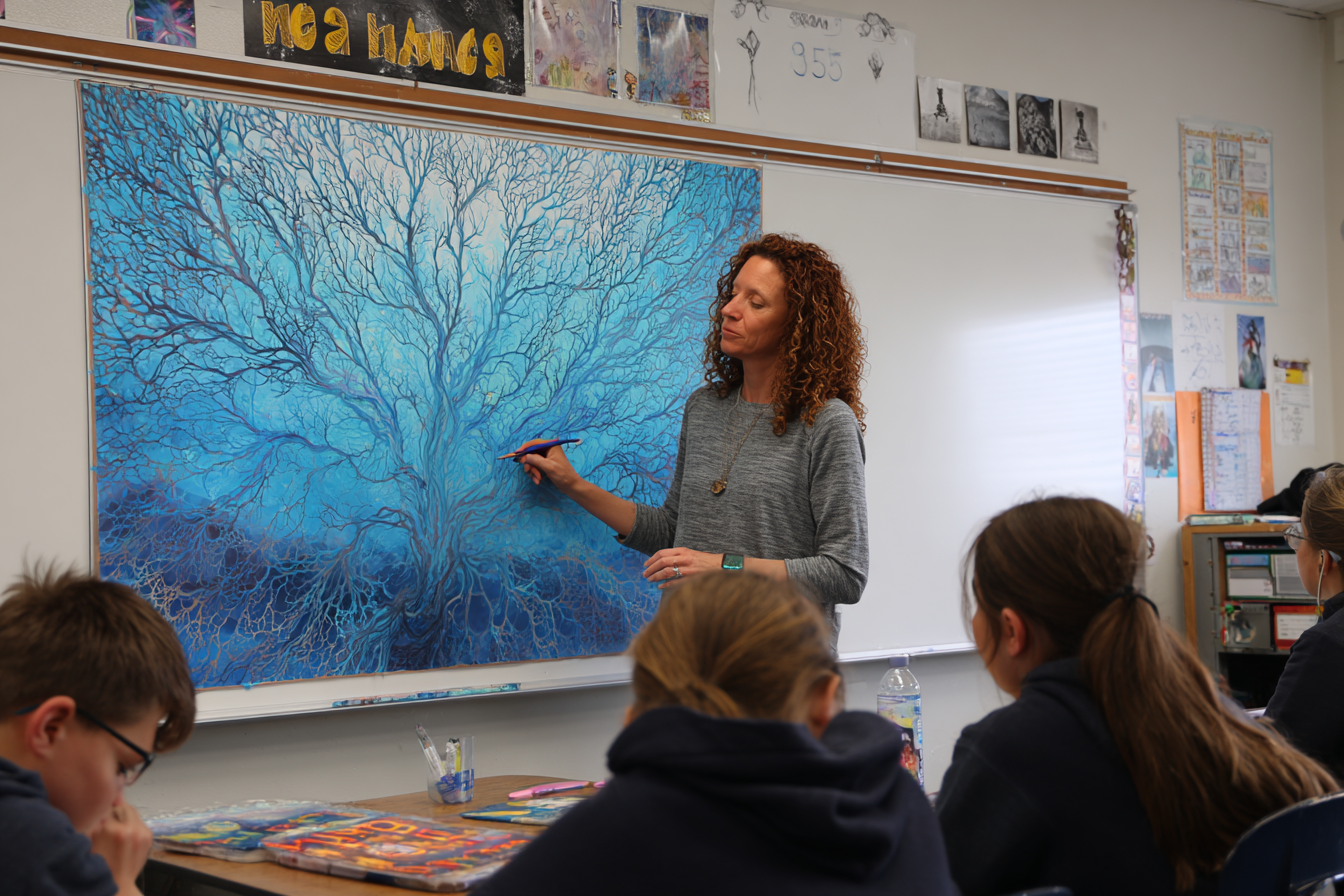
I. Introduction
Lesson Title: Fractal Forest Art
Grade Level: 6–8
Subject Area: Mathematics (Geometry & Recursive Structures)
Overview Fractals are infinitely repeating patterns that appear in nature and mathematics alike. From the branching of trees and blood vessels to the spirals of seashells and snowflakes, self-similarity underpins many organic structures. In Fractal Forest Art, students will experience this phenomenon firsthand by constructing and decorating their own fractal “trees.” Beginning with a simple trunk (a straight line segment), learners will apply a precise subdivision rule—splitting each segment into two smaller branches at a fixed angle—across multiple iterations to generate intricate, self-similar patterns.
Over the course of five sessions, students will refine their skills in measurement, angle construction, and proportional reasoning. They will:
- Understand and articulate the concept of recursion and self-similarity.
- Employ rulers and protractors to draw accurate fractal iterations.
- Explore aesthetic choices—color gradients, line thickness, composition—to transform their mathematical designs into visual art.
- Quantify their creations by calculating branching ratios and approximating total perimeter length, drawing connections to infinite series and convergence.
- Reflect on real-world applications, from botanical branching to computer graphics and antenna design.
By blending precise geometric construction with open-ended artistic expression, Fractal Forest Art engages both analytical and creative learners, deepening their appreciation for the mathematics that underlies natural beauty.
II. Objectives and Standards
Learning Objectives Students will be able to:
- Define and explain self-similarity and recursion in the context of fractal geometry.
- Apply a consistent subdivision rule—scaling factor and branching angle—to generate at least four iterations of a fractal tree.
- Use geometric tools (ruler, protractor, compass) with accuracy to measure and draw line segments and angles.
- Create a multi-colored fractal design that visually indicates iteration depth (e.g., gradient or hue shift).
- Calculate the branching ratio (length of child segment ÷ length of parent segment) and average that ratio across multiple branches.
- Approximate the total perimeter length by summing all segment lengths at each iteration and discuss the concept of convergence in an infinite process.
- Connect fractal patterns to natural phenomena (e.g., plant morphology, river networks) and technological uses (e.g., fractal antennas).
- Communicate their methodology, calculations, and reflections both in written form and through an oral “gallery walk” presentation.
Standards Alignment
- CCSS.MATH.CONTENT.8.G.A.2: Understand that a two-dimensional figure is congruent to another if it can be obtained via rigid motions; use this to describe self-similarity in fractals.
- CCSS.MATH.CONTENT.8.G.A.3: Describe the effect of dilations, rotations, and translations on two-dimensional figures, including scaled and rotated branches in fractal trees.
- CCSS.MATH.PRACTICE.MP7: Look for and make use of structure by identifying recursive patterns and self-similarity in iterative fractal constructions.
- NGSS.MS-LS1-5 (cross-curricular): Develop and use models to describe how structural features (branching patterns) serve functions in living things, linking fractal branching to efficient nutrient transport.
- SEL – Relationship Skills & Responsible Decision-Making: Collaborate respectfully during group drawing and reflections; plan and carry out complex multi-step tasks with precision and persistence.