Lesson Plan (Grades 3-5): Museum Heist Reading Challenge - Solving Clues Through Main Idea, Inference, and Evidence
Turn reading into a museum heist mystery for grades 3–5 as students use main idea, inference, and text evidence to solve the case.

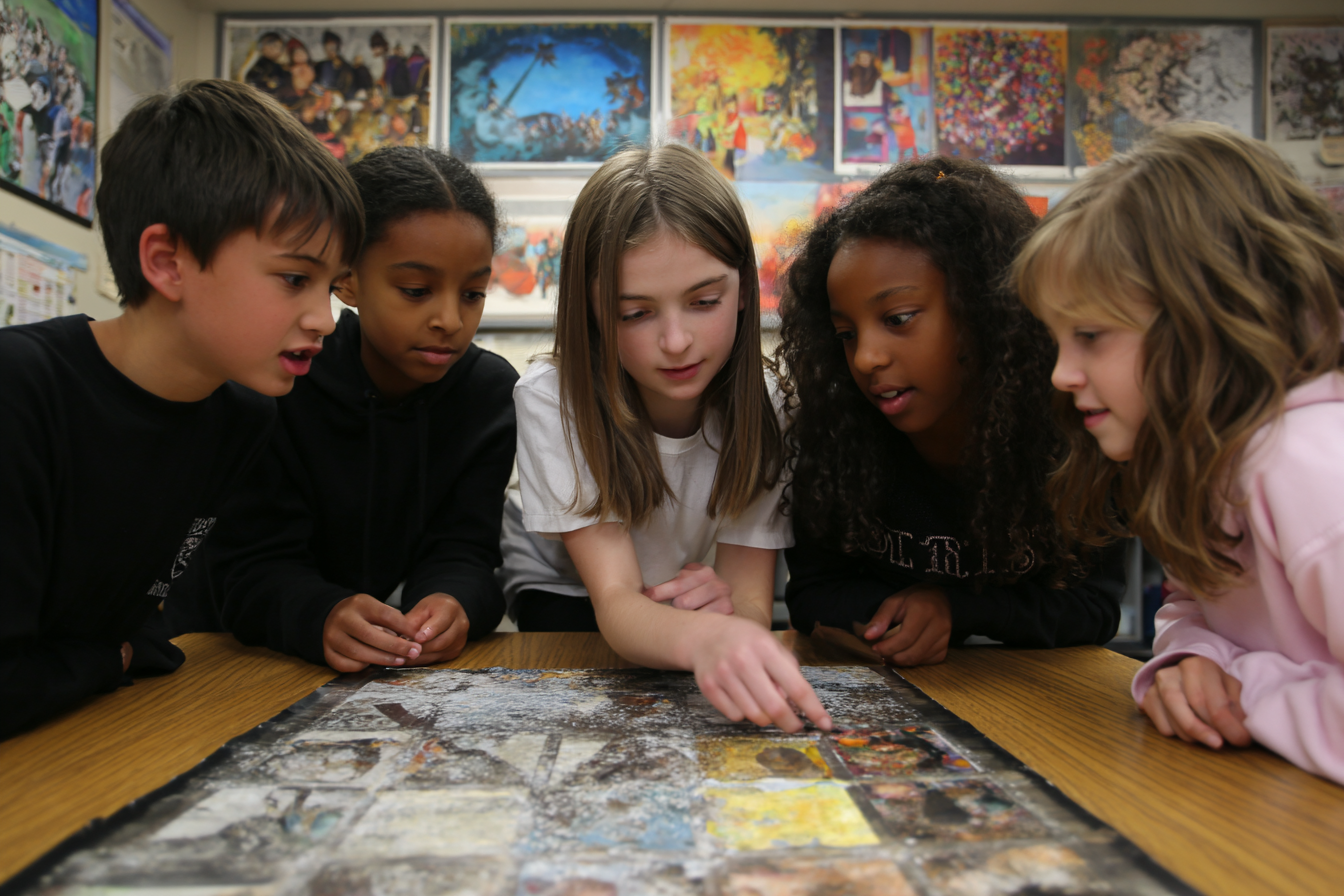
Focus: Turn reading comprehension into a high-interest mystery investigation as students read short clue passages, identify main idea, make inferences, and use text evidence to solve a staged museum heist. Students work like reading detectives by tracking details, ruling out possibilities, and defending conclusions with evidence from the text.
Grade Level: 3-5
Subject Area: ELA • Reading Comprehension • Inquiry/Skills
Total Unit Duration: 1 core lesson with 2 optional extension lessons
I. Introduction
Students become reading detectives in a puzzle-driven Museum Heist Reading Challenge where careful comprehension—not guessing—solves the case. In the core lesson, students read a series of short museum-themed passages, clue cards, witness notes, artifact descriptions, and suspect statements to figure out what happened during a fictional museum theft. As they read, students identify the main idea of each text, make inferences about what is implied but not directly stated, and cite text evidence to narrow down suspects, locations, or missing objects. The lesson feels like an escape-room style challenge, but it remains deeply academic because students must build every conclusion from reading evidence.
Essential Questions
- How can finding the main idea help us understand an important clue?
- What does it mean to make an inference, and how is it different from a guess?
- How can text evidence help us prove our thinking?
- Why do good readers combine details from more than one source before making a conclusion?
- How can solving a mystery help us become stronger readers?
II. Objectives and Standards
Learning Objectives — Students will be able to:
- Identify the main idea of short passages related to the museum mystery.
- Use key details to support the main idea of a text.
- Make inferences based on clues that are implied rather than directly stated.
- Cite or refer to specific text evidence to support conclusions about the mystery.
- Work collaboratively to compare clues, discuss possibilities, and defend reasoning.
- Communicate a final solution to the mystery using a clear claim supported by evidence from the reading.
Standards Alignment
- CCSS.ELA-LITERACY.RI.3.1 / RI.4.1 / RI.5.1
- Ask and answer questions to demonstrate understanding of a text, referring explicitly to the text as the basis for the answers.
- CCSS.ELA-LITERACY.RI.3.2 / RI.4.2 / RI.5.2
- Determine the main idea of a text and explain how it is supported by key details; summarize the text.
- CCSS.ELA-LITERACY.RL.3.1 / RL.4.1 / RL.5.1
- Ask and answer questions about key details in a text and refer to details and examples when explaining what the text says explicitly and when drawing inferences.
- CCSS.ELA-LITERACY.SL.3.1 / SL.4.1 / SL.5.1
- Engage effectively in a range of collaborative discussions with diverse partners, building on others’ ideas and expressing their own clearly.
- CCSS.ELA-LITERACY.W.3.1 / W.4.1 / W.5.1
- Write opinion pieces or short arguments supporting a point of view with reasons and evidence.
Success Criteria — Student Language
- I can figure out the main idea of a clue passage.
- I can use details from the text to explain my thinking.
- I can make an inference that makes sense based on the clues.
- I can tell the difference between a guess and an idea supported by evidence.
- I can work with others to solve the mystery and explain our answer clearly.