Lesson Plan (Grades 6-8): Urban Garden Blueprint - Planning a School Growing Space for Food, Pollinators, and Community
Design a grades 6-8 school garden using ecosystem science, plant research, area calculations, spacing, biodiversity, and community needs.

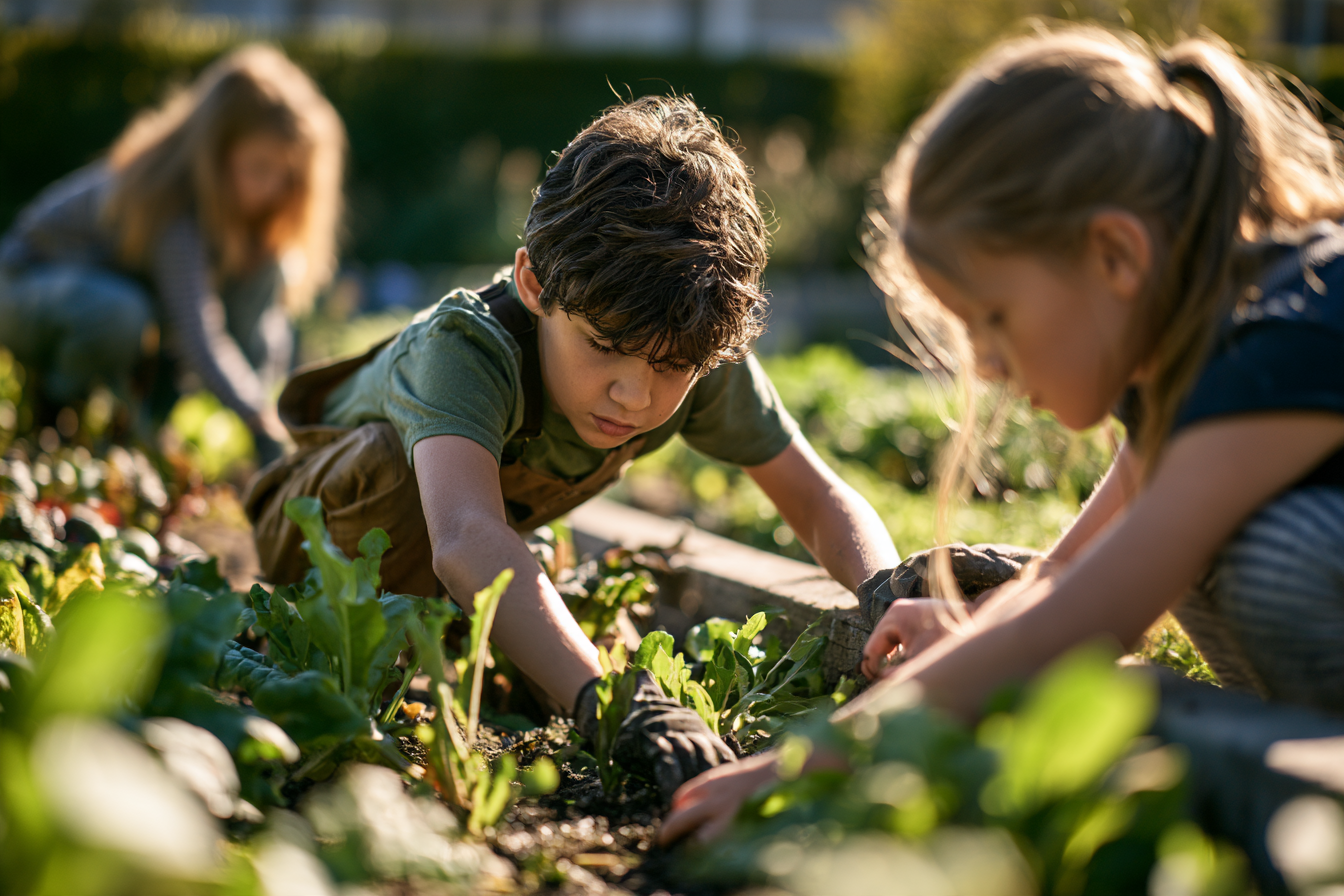
Focus: Engage students in a cross-curricular science, math, research, and community design challenge where they plan a realistic school garden that serves a defined purpose such as food production, pollinator support, beautification, outdoor learning, or a combination of goals. Students analyze environmental conditions, research plant needs, calculate spacing and growing area, consider resource availability, and defend their design choices based on ecosystem needs and community priorities.
Grade Level: 6-8
Subject Area: Science • Math • Engineering Design • Research/Writing • Community Planning
Total Unit Duration: 1 core lesson with 2 optional extension lessons
I. Introduction
Students become environmental planners in an Urban Garden Blueprint challenge where science and mathematics are used to design a growing space for a real or imagined school community. Instead of simply drawing a garden, students must determine what the space should accomplish, analyze environmental conditions, select appropriate plants, calculate how much space those plants require, and explain how their choices support organisms and people.
The project allows students to explore the relationship between resource availability, biodiversity, ecosystem services, and human decision-making. A food-production garden may prioritize vegetables and efficient spacing, while a pollinator garden may emphasize flowering diversity and seasonal resources. A community garden might need pathways, gathering areas, accessibility features, or educational spaces. The final proposal requires students to balance these competing needs and use evidence to justify their decisions.
Essential Questions
- How does the availability of space, sunlight, water, nutrients, and shelter affect organisms?
- How can a garden support food production, pollinators, biodiversity, and people at the same time?
- How do measurement, ratios, area, and spacing calculations help create a realistic garden plan?
- What trade-offs do designers make when space and resources are limited?
- How can research and evidence help us defend a community design decision?
II. Objectives and Standards
Learning Objectives — Students will be able to:
- Analyze how resources such as sunlight, water, soil, nutrients, and space affect plant and pollinator success.
- Research plant characteristics and environmental needs using reliable sources.
- Calculate garden dimensions, planting space, quantities, or proportions using grade-appropriate mathematics.
- Design a scaled or clearly measured garden blueprint that meets defined community goals.
- Compare possible design choices and explain how they affect biodiversity, ecosystem services, food production, or human use.
- Present and defend a garden proposal using scientific evidence, mathematical reasoning, and research findings.
Standards Alignment
- NGSS MS-LS2-1
- Analyze and interpret data to provide evidence for the effects of resource availability on organisms and populations of organisms in an ecosystem.
- NGSS MS-LS2-5
- Evaluate competing design solutions for maintaining biodiversity and ecosystem services.
- NGSS MS-ETS1-1
- Define the criteria and constraints of a design problem with sufficient precision to ensure a successful solution.
- NGSS MS-ETS1-2
- Evaluate competing design solutions using a systematic process to determine how well they meet the criteria and constraints of the problem.
- CCSS.MATH.CONTENT.6.RP.A.3
- Use ratio and rate reasoning to solve real-world and mathematical problems.
- CCSS.MATH.CONTENT.7.G.B.6
- Solve real-world and mathematical problems involving area, volume, and surface area of two- and three-dimensional objects.
- CCSS.ELA-LITERACY.WHST.6-8.7
- Conduct short research projects to answer a question, drawing on several sources and generating additional related questions for further research and investigation.
- CCSS.ELA-LITERACY.SL.6.4 / SL.7.4 / SL.8.4
- Present claims and findings in a focused, coherent manner with relevant evidence and appropriate details.
Success Criteria — Student Language
- I can explain how resources affect plants and other organisms in a garden.
- I can research plants and choose ones that fit the conditions of the space.
- I can use math to calculate garden area, plant spacing, or quantities.
- I can create a garden blueprint that meets a clear community goal.
- I can defend my design using science, math, and research evidence.