Peer Research Review Boards: Students Giving Academic Feedback Like Scholars
Transform peer editing with student research review boards that strengthen claims, evidence, source credibility, critical thinking, and academic writing.

I. Introduction
Students regularly complete essays, research reports, science investigations, historical arguments, and project proposals. They develop claims, locate evidence, organize information, and submit finished assignments for teachers to evaluate. Yet one of the most valuable parts of academic work often happens before publication: having someone else examine the ideas, question the evidence, identify weaknesses, and suggest improvements.
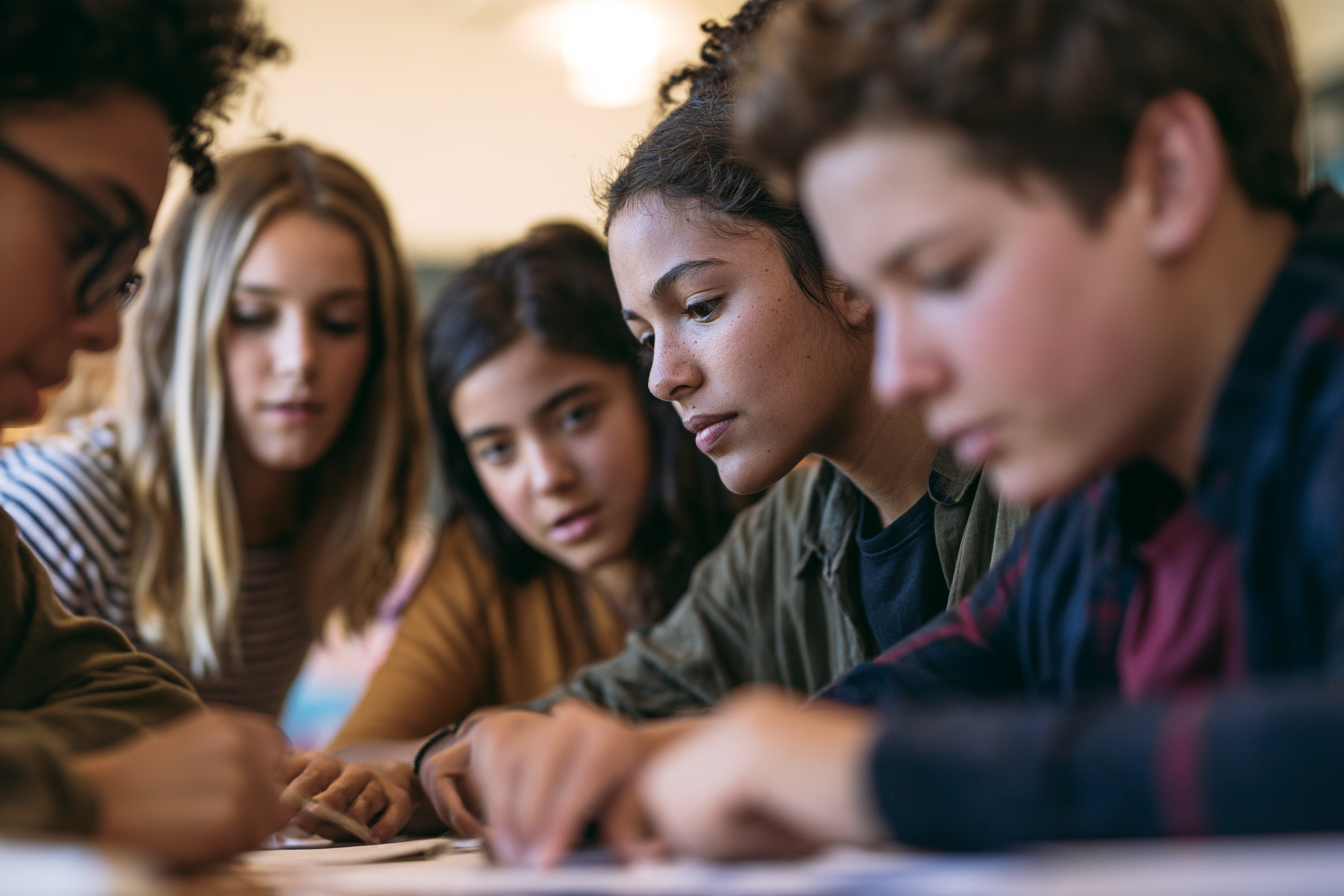
Peer Research Review Boards bring that process into the classroom. Instead of asking students to exchange papers and correct spelling mistakes, teachers organize small review teams that evaluate the quality of academic reasoning. Students investigate whether claims are supported, sources are credible, arguments are logical, explanations are clear, and conclusions actually follow from the evidence presented.
The goal is to help students experience academic work as a process of investigation, critique, and revision rather than a single attempt to produce a correct final product. Students learn that strong ideas should withstand thoughtful questions and that constructive criticism is part of intellectual growth.
Want done-for-you lesson plans for less than $2? Click Here to explore.
Research supports several components of this model. Double et al. (2020) examined 54 studies of peer assessment and found an overall positive effect on academic performance across educational settings. Graham et al. (2015) found that formative feedback from peers could improve writing quality among students in Grades 1–8. Meanwhile, McGrew et al. (2018) demonstrated that many students struggle to evaluate online information, reinforcing the importance of explicit instruction in source credibility and evidence evaluation.
Peer Research Review Boards combine those priorities into a practical classroom system. Students become authors, researchers, reviewers, and revision specialists who learn to strengthen academic work before it reaches its final audience.
II. Why Traditional Peer Editing Often Falls Short
Peer editing is common in classrooms, but it frequently operates at the surface level.
Students exchange papers, circle misspelled words, suggest punctuation changes, and perhaps write a compliment at the bottom. These activities have value, particularly when students are learning writing conventions. However, they do not necessarily require students to examine the quality of an argument.
A paper can contain perfect grammar and still present a weak claim. A science report can be beautifully formatted while drawing conclusions unsupported by its data. A historical essay can use impressive vocabulary while relying on unreliable or misinterpreted sources.
Peer Research Review Boards move beyond proofreading by asking students to investigate the thinking behind the work.
The distinction is important because feedback does not automatically improve performance simply because students receive it. In their study of middle school writing, Neumann and Kopcha (2019) found that peer feedback produced significant improvement in writing conventions, while subsequent teacher feedback supported improvements in additional writing areas. The study illustrates both the potential of peer feedback and the need to teach students how to move beyond surface-level corrections.
A research review board asks more demanding questions:
- Is the central claim specific and defensible?
- Does the evidence actually support the conclusion?
- Are the sources credible and relevant?
- Are important perspectives missing?
- Does the reasoning contain unsupported assumptions?
- Can the reader follow the organization of the argument?
- What should the author revise before submitting the work?
These questions teach students to evaluate the intellectual quality of academic products rather than simply their appearance.
III. What a Peer Research Review Board Actually Is
A Peer Research Review Board is a small group of students responsible for evaluating another student's academic work using clearly defined criteria.
The board does not assign the final grade, determine whether the author is intelligent, or rewrite the project on the author's behalf. Instead, reviewers provide evidence-based feedback that helps the author make informed revisions.
A typical board might include three or four students. Each reviewer examines the same draft through a different lens, allowing the author to receive several forms of feedback without expecting every reviewer to notice everything.
The process resembles a simplified version of scholarly peer review.
A student submits a draft. Reviewers examine the work, identify strengths and weaknesses, ask questions, and recommend revisions. The author considers the feedback and explains which changes will be made.
Check out our engaging printable posters. CLICK HERE to explore!
This does not mean students are performing professional academic peer review. Published research is evaluated by subject-matter experts with substantial specialized knowledge. Classroom review boards are instructional simulations that teach related habits: questioning claims, evaluating evidence, recognizing limitations, and improving communication.
The educational strength comes from making the process explicit.
Double et al. (2020) found that peer assessment was associated with improved academic performance across a wide range of educational contexts. Their meta-analysis supports using peer assessment as a formative instructional practice while recognizing that implementation details matter.
A review board gives that formative process a predictable structure.
IV. The Five Lenses of Academic Review
Students need clear criteria before they can provide meaningful feedback. One practical approach is organizing the review process around five lenses.
1. Claim Quality
Reviewers examine what the author is trying to establish.
They ask whether the main claim is understandable, appropriately narrow, and supported by the information provided.
A weak claim might state, "School gardens are good." A stronger claim could explain a specific educational benefit and identify the circumstances under which that benefit might occur.
The reviewer asks whether the claim can actually be defended.
2. Evidence Quality
Reviewers evaluate the information supporting the argument.
They determine whether examples, data, quotations, observations, or research findings are relevant and sufficient.
A reviewer might notice that an author makes a broad conclusion based on a single example or includes a statistic without explaining what it measures.
3. Source Credibility
Reviewers investigate where information came from.
They consider the author's qualifications, the publication or organization, the date, the original context, and whether independent evidence supports the claim.
This lens is particularly important in an environment where students encounter online misinformation and AI-generated text. McGrew et al. (2018) found that students across middle school, high school, and college settings often struggled to evaluate digital claims and sources effectively.
4. Organization and Reasoning
Reviewers examine how the argument develops.
They consider whether ideas follow logically, whether sections connect, whether counterarguments receive appropriate attention, and whether the conclusion follows from the evidence.
5. Clarity and Communication
Reviewers evaluate whether the intended audience can understand the work.
They examine terminology, explanation, sentence structure, visuals, and the accessibility of the final presentation.
These five lenses prevent the review process from becoming a vague exchange of opinions. Every comment should connect to something observable in the work.
V. Teaching Students to Evaluate Evidence Rather Than Just Find It
Finding evidence and evaluating evidence are different academic skills.
Students can easily locate a quotation, statistic, or internet article without understanding whether it provides meaningful support for a claim.
For example, a student writing about the benefits of school gardens might find a promotional article from a gardening company. The article may include useful information, but the student should recognize the organization's commercial interests and investigate whether independent research supports the claims.
A reviewer should ask more than, "Does the paper have three sources?"
Better questions include:
- Who created this information?
- What expertise or evidence supports it?
- Is the source reporting original findings or repeating another source?
- Does the evidence directly address the author's claim?
- Is the information current enough for the topic?
- Does the author acknowledge meaningful limitations?
- Would an independent source support or challenge the conclusion?
The goal is not to teach students that certain website endings or professional-looking pages automatically guarantee credibility.
McGrew et al. (2018) documented significant difficulties with civic online reasoning across grade levels. Their work reinforces the importance of teaching students to investigate the source itself rather than relying on superficial credibility signals.
A Peer Research Review Board can make those habits part of ordinary research assignments.
Instead of asking students to verify sources only when beginning a project, the board provides a second opportunity to test whether the final argument uses those sources responsibly.
VI. Assigning Meaningful Review Board Roles
Clear roles help students concentrate on important academic features without becoming overwhelmed.
A four-student review board might include the following responsibilities.
Claim and Reasoning Reviewer
This student identifies the central argument and examines whether the explanation logically supports it.
The reviewer looks for unclear claims, unsupported conclusions, and gaps in reasoning.
Evidence Reviewer
This student examines the relevance, sufficiency, and interpretation of evidence.
The reviewer asks whether the author has enough information to justify the conclusions and whether conflicting evidence deserves attention.
Source Verification Reviewer
This student checks a manageable selection of citations and investigates source credibility.
The goal is not to independently verify every detail in a lengthy research paper. Instead, the student practices checking important claims and identifying missing or questionable documentation.
Clarity and Organization Reviewer
This student focuses on how understandable the product is to its intended audience.
The reviewer examines sequencing, transitions, definitions, visuals, and whether the final conclusion connects back to the research question.
For smaller groups, students can combine roles. In elementary classrooms, teachers might assign just two responsibilities: evidence and clarity.
Roles should rotate during the year. Every student deserves opportunities to examine claims, question sources, and evaluate reasoning rather than becoming permanently assigned to grammar or formatting.
VII. Teaching Students How to Give Scholarly Feedback
Students should not be expected to provide sophisticated academic feedback without instruction.
The first review sessions should involve teacher modeling.
A teacher might provide a fictional research paragraph containing a reasonable claim, one strong supporting detail, one weak source, and an unsupported conclusion.
Students identify what works before discussing what needs improvement.
The teacher then demonstrates how to turn a criticism into a useful revision suggestion.
Instead of:
"This paragraph is bad."
A reviewer might write:
"Your claim is clear, but the paragraph includes only one example. Could you add another source showing whether the same pattern occurs in different situations?"
Instead of:
"This source is unreliable."
A student might write:
"The article comes from a company selling the product being discussed. Could you compare its claims with an independent source?"
Instead of:
"This doesn't make sense."
A reviewer might write:
"I understand the evidence in the first section, but I cannot see how it supports the conclusion. Could you explain the connection more directly?"
The difference is substantial.
The second set of responses identifies a specific concern and gives the author a way to improve the work.
Cho and MacArthur (2011) found that, among undergraduate students, reviewers who evaluated peers' writing demonstrated stronger subsequent writing performance than students who only read sample papers or received no comparable treatment. The researchers also found positive relationships between reviewers' later writing outcomes and feedback that identified problems and suggested solutions.
Although the study involved college students, its findings offer a useful design principle for K–12 classrooms: students benefit from learning to recognize weaknesses and propose meaningful revisions.
VIII. Building a Classroom Culture Where Critique Is Safe
Peer review becomes ineffective when students confuse evaluating work with judging classmates.
Some students may respond defensively to criticism. Others may avoid giving honest feedback because they are afraid of hurting someone's feelings. A few may offer unnecessarily harsh comments.
Teachers must explicitly teach the difference between productive critique and personal judgment.
A strong review board should operate under several expectations:
- We critique the work, not the person.
- We identify strengths as well as areas for improvement.
- We support concerns with specific evidence.
- We ask questions before making assumptions.
- We recognize that reasonable reviewers may disagree.
- We provide suggestions the author can actually use.
- We respect the author's responsibility for final decisions.
- We treat shared drafts as confidential classroom work.
Teachers should also avoid requiring students to publicly reveal deeply personal writing or sensitive experiences.
Personal narratives, trauma-related assignments, private reflections, and projects involving confidential information may be inappropriate for general peer review. Teachers can use fictional examples, anonymized excerpts, or alternative review arrangements.
The goal is academic courage without unnecessary exposure.
A strong review culture teaches students that disagreement can be respectful and that criticism of an argument does not diminish the person making it.
IX. Making Peer Review Work Across Subjects
Peer Research Review Boards are valuable because the quality of evidence and reasoning matters across disciplines.
English Language Arts
Students can review literary analysis essays, argumentative writing, research papers, and informational texts.
Reviewers examine the thesis, textual evidence, interpretation, organization, and whether the analysis goes beyond summary.
Science
Students can evaluate lab reports, scientific explanations, research posters, and claim-evidence-reasoning responses.
They examine whether observations support conclusions, whether variables are addressed appropriately, and whether alternative explanations have been considered.
Social Studies
Students can review historical arguments, primary-source interpretations, civic proposals, and research projects.
Reviewers investigate sourcing, historical context, perspective, chronology, and the strength of supporting evidence.
Mathematics
Students can evaluate mathematical modeling reports, written justifications, proofs, and explanations of problem-solving strategies.
Reviewers examine assumptions, calculations, representations, and whether conclusions follow logically from the mathematics.
Career and Technical Education
Students can review business proposals, design plans, technical reports, marketing analyses, and feasibility studies.
They can consider cost, safety, practicality, evidence, and whether the recommendations address the stated problem.
Capstone and Project-Based Learning
Review boards can examine final projects before presentations, exhibitions, or community sharing.
Students evaluate whether the product addresses the driving question and whether its conclusions are supported.
The structure stays consistent, but the academic criteria change with the discipline.
X. Research-Based Case Studies
Case Study: Peer-Then-Teacher Review in Middle School Writing
Neumann and Kopcha (2019) studied 21 middle school language arts students who used Google Docs to develop argumentative letters. Students received peer feedback on an initial draft and teacher feedback on a subsequent draft.
The researchers found that students actively interacted with peer comments and that peer feedback was associated with statistically significant improvements in writing conventions. Later teacher feedback was associated with improvements in organization, language and vocabulary, and conventions.
The study also revealed an important limitation: much of the feedback focused on conventions and organization rather than deeper argumentative reasoning.
For Peer Research Review Boards, the lesson is clear. Peer feedback can contribute to revision, but students need explicit criteria and modeling if teachers want reviewers to examine evidence, claims, and reasoning rather than concentrating primarily on proofreading.
Case Study: Learning by Reviewing Other Students' Work
Cho and MacArthur (2011) studied 61 undergraduate students randomly assigned to reviewing, reading, or control conditions.
Students in the reviewing group evaluated and commented on peers' papers. Students in the reading group examined the same papers without providing feedback. All participants then completed their own writing task.
The reviewing group produced stronger written work than the comparison groups. Researchers also found that comments identifying problems and suggesting solutions were positively associated with writing outcomes among reviewers.
This study demonstrates an important potential benefit of review boards: the reviewer may learn as much as the author. Although the participants were university students, the underlying instructional idea is valuable for schools. Evaluating another person's reasoning can encourage students to notice similar strengths and weaknesses in their own work.
Case Study: Critical Questions in Middle School Science
Nussbaum et al. (2024) investigated the use of structured critical questions to strengthen scientific argumentation in middle school classrooms. Six science teachers participated in the research, examining how critical questions could extend traditional claim-evidence-reasoning instruction.
The researchers reported evidence suggesting growth in students' confidence with argument critique and teachers' confidence in argumentation instruction. However, only four of the six teachers were sufficiently comfortable implementing the critical-question approach, highlighting the importance of teacher preparation and manageable instructional structures.
For Peer Research Review Boards, the study offers a practical lesson. Students should not merely identify the claim, evidence, and reasoning. They should learn to challenge how those components connect, question assumptions, and consider alternative explanations.
These studies examine related peer feedback and argumentation practices, not the exact Peer Research Review Board model proposed here. Together, however, they support several of its central instructional features.
XI. An Example Review Board in Action
Imagine a Grade 8 science class investigating how different lighting conditions affect plant growth.
One student writes a report concluding that blue light produces faster growth than white light.
The report contains measurements from an experiment, a graph of plant height, and a short explanation.
During peer review, students examine the report through their assigned lenses.
The Claim Reviewer notices that the conclusion is broader than the experiment justifies. The experiment tested only one plant type under a limited set of conditions.
The reviewer asks whether the conclusion should refer specifically to the plants and conditions studied.
The Evidence Reviewer notices that the report includes measurements but does not explain how many plants were tested or whether the differences were consistent.
The reviewer asks whether the author has enough observations to support the claim.
The Source Reviewer notices that one supporting article is a promotional page from a company selling specialized growing lights.
The reviewer recommends comparing that claim with independent scientific information.
The Clarity Reviewer notices that the graph is missing a clear unit label and that the written explanation does not identify the experimental conditions.
The reviewer suggests improving the graph labels and explaining the procedure more clearly.
After reviewing the feedback, the author realizes that the original conclusion was too certain.
The revised report acknowledges the limited sample, explains what the measurements actually show, and identifies questions requiring additional investigation.
The review board has not merely improved the grammar.
It has helped the student develop a more responsible scientific argument.
This example illustrates the kind of critical questioning emphasized by Nussbaum et al. (2024), in which students move beyond identifying parts of an argument and begin evaluating its strength.
XII. The Peer Research Review Board Protocol
A predictable review process helps teachers maintain rigor and prevent the activity from becoming an unstructured conversation.
Step 1: Submit the Draft
Students complete an initial research product that contains enough evidence and reasoning to evaluate.
The draft should be developed enough for meaningful feedback but unfinished enough that revision remains possible.
Step 2: Assign Review Roles
Students receive one or two specific criteria to investigate.
Each reviewer uses a short checklist or feedback guide aligned with the assignment's learning goals.
Step 3: Conduct Independent Review
Students examine the draft and record evidence-based observations.
Reviewers should identify at least one strength, one concern, and one actionable suggestion.
Step 4: Hold the Board Discussion
Reviewers briefly discuss their findings.
The goal is not to vote on whether the work is good or bad. The goal is to identify the most important improvements.
Step 5: Deliver the Review Memo
The board produces a concise response summarizing its recommendations.
For example:
Strength: Your claim is specific, and the first two paragraphs contain relevant evidence.
Major Concern: The conclusion makes a broader claim than the collected data supports.
Suggested Revision: Narrow the conclusion and explain the limitations of the investigation.
Question for the Author: What additional evidence would help determine whether the pattern applies in other situations?
Step 6: Author Response
The author reviews the feedback and identifies which suggestions will be adopted, adapted, or declined.
The author should briefly justify major decisions rather than blindly accepting every comment.
Step 7: Revision and Submission
Students revise the work and submit both the final product and a short reflection identifying the most meaningful changes.
This structure ensures that peer feedback leads to an instructional decision rather than ending as a collection of comments.
XIII. The Author Response Letter
One of the most useful additions to Peer Research Review Boards is a short author response letter.
In academic publishing, authors often respond to reviewer comments and explain how their manuscripts were revised. A simplified classroom version can help students develop ownership over revision.
The response does not need to be lengthy.
Students might complete three prompts:
1. Which recommendation improved your work the most?
Students identify a specific change and explain why it strengthened the assignment.
2. Which recommendation did you decide not to use?
Students explain why the suggestion was unnecessary, inaccurate, or inconsistent with the project's purpose.
3. What did reviewing another student's work teach you about your own?
Students reflect on how evaluating another person's argument changed their understanding of academic quality.
This final question matters because peer assessment is not only about receiving feedback.
Cho and MacArthur (2011) found that students who actively reviewed others' writing benefited in their own subsequent writing performance. Their study suggests that the process of noticing weaknesses and recommending improvements can itself become a learning experience.
A response letter helps make that learning visible.
XIV. A Five-Day Classroom Implementation Cycle
A Peer Research Review Board can fit into one school week without requiring an additional major project.
Day 1: Introduce Academic Review
Teachers model how scholars examine claims, evidence, and reasoning.
Students practice identifying strengths and weaknesses in a sample paragraph or project excerpt.
Day 2: Train Reviewers
Students learn the five review lenses and practice writing evidence-based feedback.
The class compares vague comments with actionable recommendations.
Day 3: Conduct the Review Boards
Students exchange drafts, complete individual reviews, and hold brief board discussions.
Teachers circulate to monitor accuracy and ensure feedback remains respectful.
Day 4: Revise and Respond
Authors evaluate the feedback, revise their work, and complete a short response letter.
Students should have sufficient class time to act on the recommendations.
Day 5: Submit and Reflect
Students submit the revised academic product and identify how the review process influenced its development.
Teachers assess the final work while also examining the quality of students' feedback and revision decisions.
This cycle can be repeated during major writing assignments, laboratory reports, research projects, and capstone experiences.
For smaller assignments, teachers can condense the process into one or two class periods.
XV. Measuring Whether the Review Board Is Working
The success of Peer Research Review Boards should not be measured by the number of comments students produce.
Ten superficial corrections are not necessarily more valuable than one thoughtful question that exposes a major weakness in an argument.
Teachers should examine the quality of both the feedback and the subsequent revision.
Useful indicators include:
- Specificity: Does the reviewer identify an exact part of the work?
- Evidence: Does the feedback explain why a claim, source, or explanation needs attention?
- Actionability: Can the author understand what to improve?
- Academic Accuracy: Is the recommendation consistent with the assignment and relevant disciplinary knowledge?
- Revision Quality: Does the final product meaningfully improve?
- Reflection: Can the student explain why a revision strengthened the work?
Teachers can also compare early and later review memos to determine whether students become more sophisticated in their analysis.
A broader research foundation supports this approach. Graham et al. (2015) found that feedback from peers was associated with improved writing quality among students in Grades 1–8. Double et al. (2020) similarly found positive effects of peer assessment across primary, secondary, and tertiary educational settings.
The findings support the value of formative peer assessment, but they do not mean every peer review activity will be effective. Instructional quality, feedback accuracy, and opportunities for revision remain essential.
XVI. Making Review Boards Inclusive and Manageable
Teachers should design review boards so students can participate meaningfully regardless of confidence, reading level, language background, or previous experience with academic criticism.
Use Smaller Review Tasks
Younger students may review only the claim and evidence rather than all five criteria.
Provide Sentence Frames
Students can use prompts such as "Your strongest evidence is..." or "I need more explanation about..." while developing academic language.
Allow Multiple Feedback Formats
Students might record spoken feedback, annotate a digital document, complete a paper checklist, or participate in a structured conversation.
Protect Individual Accountability
Every student should submit an initial draft and make final revision decisions. The board should not become responsible for completing another student's assignment.
Use Anonymous Examples During Training
Before students review classmates' work, they can practice with teacher-created drafts or samples whose authors are not identified.
Pair Students Thoughtfully
Teachers should avoid repeatedly placing one student in the role of expert or making students with stronger writing skills responsible for fixing everyone else's work.
Preserve Teacher Oversight
Peer reviewers may overlook factual errors, misunderstand an assignment, or make incorrect suggestions. Teachers remain responsible for academic accuracy, evaluation, and instruction.
The goal is not to create an additional layer of student grading. It is to develop a learning environment where more students can participate in serious academic conversations.
XVII. Common Pitfalls and How to Avoid Them
Peer Research Review Boards can become meaningful instructional routines, but several problems can weaken implementation.
- Pitfall: Students only correct grammar and spelling
Fix: Assign specific review lenses and prioritize claim quality, evidence, reasoning, and source credibility before editing conventions.
- Pitfall: Students offer vague praise
Fix: Require comments to identify a specific strength and explain why it improves the work.
- Pitfall: Students make inaccurate recommendations
Fix: Use teacher modeling, subject-specific criteria, and adult review for complex or high-stakes content.
- Pitfall: Students become overly critical
Fix: Establish clear norms separating criticism of academic work from criticism of classmates.
- Pitfall: The author accepts every suggestion automatically
Fix: Require an author response identifying which recommendations were used and why.
- Pitfall: Students spend more time reviewing than revising
Fix: Protect dedicated revision time. Feedback is only useful when students have opportunities to act on it.
- Pitfall: Source verification becomes superficial
Fix: Teach students to investigate authorship, context, original evidence, and independent corroboration rather than relying on website appearance.
- Pitfall: Students assume peer review guarantees accuracy
Fix: Explain that peer review is a quality-improvement process, not a guarantee that every claim is correct.
- Pitfall: Teachers turn review boards into popularity contests
Fix: Avoid public rankings, peer-assigned final grades, or competitive judgments about whose research is best.
The central principle is that peer review must support learning, not simply reproduce the pressure of formal evaluation.
XVIII. FAQ
Can Peer Research Review Boards work in elementary classrooms?
Yes. Younger students can review simpler products using two or three criteria such as a clear main idea, supporting evidence, and understandable explanations. Teachers should model the process with short sample paragraphs before introducing student drafts. Graham et al. (2015) found that formative peer feedback could support writing improvement in elementary and middle grades.
How is this different from traditional peer editing?
Traditional peer editing often focuses on spelling, grammar, and formatting. Peer Research Review Boards examine the academic reasoning behind the work, including claims, evidence, source credibility, organization, and the relationship between conclusions and supporting information.
Should students give one another grades?
Usually, no. The recommended model is formative rather than summative. Students provide evidence-based recommendations while the teacher retains responsibility for formal evaluation. This reduces the risk of unfair grading and keeps attention on improvement.
What if students do not know enough about the topic to evaluate the research?
Teachers can assign review criteria that match students' knowledge and provide appropriate source materials or checklists. Students should be encouraged to flag uncertainty rather than invent judgments. Complex factual questions should remain subject to teacher or expert verification.
Can students use AI to help review research papers?
AI tools may help students generate possible questions or check clarity when school policies permit, but they should not replace independent reasoning or source verification. Any AI-generated factual criticism needs to be checked against reliable evidence, and students should never enter confidential classmate information into unapproved systems.
How many students should serve on each board?
Three or four reviewers can work well for substantial assignments. Two students may be sufficient for shorter tasks, while larger capstone projects could involve more reviewers. The number matters less than whether each student has a clear responsibility.
What if a student disagrees with the board's feedback?
Disagreement can be productive when supported by evidence. Authors should be able to explain why they are declining a recommendation. The purpose is not blind compliance but thoughtful revision based on academic reasoning.
Does peer review really improve student achievement?
Research generally supports formative peer assessment, although effects vary across tasks and contexts. Double et al. (2020) found an overall positive effect on academic performance across 54 studies, while Graham et al. (2015) found improvements in writing quality associated with peer feedback. Results are not guaranteed for every implementation.
Can this work with science investigations and mathematical explanations?
Yes. Science review boards can question experimental design, data interpretation, and alternative explanations. Mathematics review boards can examine assumptions, representations, justifications, and calculations. Nussbaum et al. (2024) provide a useful example of structured critical questions supporting scientific argumentation.
How often should teachers use review boards?
Begin with major assignments where revision is genuinely valuable. Once students understand the process, teachers can use shorter review routines for essays, lab reports, project proposals, and other academic products. Frequent but purposeful practice is more useful than making every assignment go through a lengthy review process.
XIX. Conclusion
Peer Research Review Boards help students experience academic work as something that can be questioned, strengthened, and improved through collaboration. Rather than simply submitting an assignment and waiting for a grade, students examine one another's claims, investigate evidence, evaluate source quality, and offer recommendations grounded in academic reasoning.
The process also changes how students understand criticism. A thoughtful question becomes an opportunity to clarify an idea. An identified weakness becomes a reason to investigate further. A disagreement becomes an opportunity to compare evidence rather than defend a position automatically.
Research provides a meaningful foundation for the model. Peer assessment has demonstrated positive effects on academic performance across educational settings (Double et al., 2020). Formative feedback can support improvements in student writing (Graham et al., 2015), and structured critique can help students think more carefully about scientific arguments (Nussbaum et al., 2024). Research also reinforces the need to explicitly teach source evaluation rather than assuming students can reliably distinguish credible evidence from misleading information (McGrew et al., 2018).
The model does not require schools to reproduce every feature of professional scholarly publishing. Teachers can begin with one assignment, two reviewers, and a short checklist examining claims and evidence. As students gain experience, the review process can expand to include source verification, organization, alternative explanations, and formal author responses.
Over time, students develop a more sophisticated understanding of academic quality. They learn that strong research is not simply work that looks complete. Strong research involves defensible claims, trustworthy evidence, clear reasoning, responsible conclusions, and a willingness to revise when better information becomes available.
The most important outcome may not be the improved essay, science report, or capstone project. It may be the habits students carry into future classrooms, professional environments, and civic life.
They learn to question confidently presented claims.
They learn to distinguish evidence from opinion.
They learn to evaluate information before accepting it.
And they learn that thoughtful criticism is not the opposite of collaboration—it is one of the ways meaningful collaboration makes ideas stronger.
When students learn to review academic work like scholars, they begin developing the judgment required to produce stronger scholarship themselves.
Want to save time on lesson planning this week? CLICK HERE to explore our library of 1000s of lesson plans for less than $2!
Transform your classroom into an inspiring, vibrant learning space with our beautifully designed printable posters! Perfect for engaging your students and enhancing your teaching environment, our poster bundles cover everything from historical philosophers to animals. CLICK HERE to explore our exclusive collections on Teachers Pay Teachers and give your students the motivational boost they need!
XX. Sources
Cho, K., & MacArthur, C. (2011). Learning by reviewing. Journal of Educational Psychology, 103(1), 73–84. https://doi.org/10.1037/a0021950
Double, K. S., McGrane, J. A., & Hopfenbeck, T. N. (2020). The impact of peer assessment on academic performance: A meta-analysis of control group studies. Educational Psychology Review, 32, 481–509. https://doi.org/10.1007/s10648-019-09510-3
Graham, S., Hebert, M., & Harris, K. R. (2015). Formative assessment and writing: A meta-analysis. The Elementary School Journal, 115(4), 523–547. https://doi.org/10.1086/681947
McGrew, S., Breakstone, J., Ortega, T., Smith, M., & Wineburg, S. (2018). Can students evaluate online sources? Learning from assessments of civic online reasoning. Theory & Research in Social Education, 46(2), 165–193. https://doi.org/10.1080/00933104.2017.1416320
Neumann, K. L., & Kopcha, T. J. (2019). Using Google Docs for peer-then-teacher review on middle school students' writing. Computers and Composition, 54, Article 102524. https://doi.org/10.1016/j.compcom.2019.102524
Nussbaum, E. M., Van Winkle, M. S., Tian, L., Putney, L. G., Huerta, M., Perera, H. N., Dove, I. J., Herrera, A. N., & Carroll, K. R. (2024). Extending science instruction beyond the CER: Use of critical questions in the argumentation of middle school science students. Science Education, 108(5), 1420–1447. https://doi.org/10.1002/sce.21877