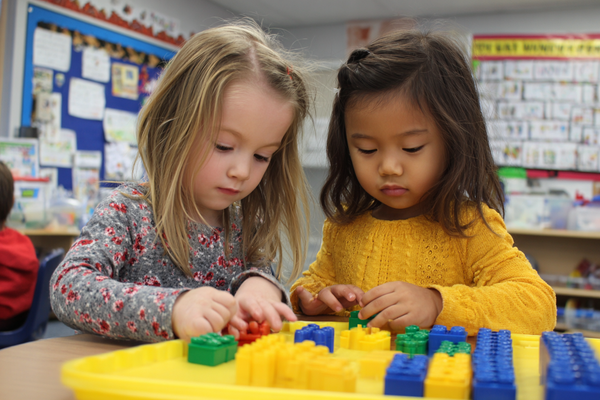
Paid-members only Pre-Kindergarten Math Units Unit Plan 11 (PreK Math): Decompose to 5 Explore multiple ways to break numbers within 5 into parts using counters, cubes, and five-frames; name the whole and parts to build early number sense.
Paid-members only Pre-Kindergarten Math Units Unit Plan 10 (PreK Math): Add & Take Away Stories Act out join and take-away stories within 5 using toys or fingers; model what changed, say how many now, and explain thinking with simple words and mats.
Paid-members only Pre-Kindergarten Math Units Unit Plan 9 (PreK Math): Subitize Small Sets Recognize how many in small sets (to 3–5) instantly; use dot, domino, finger, and five-frame patterns to match numerals and explain part–part–whole thinking.
Paid-members only Pre-Kindergarten Math Units Unit Plan 8 (PreK Math): Counting in Motion—1 to 10 Count to 10 through movement and play; use one-to-one actions to match each count to objects and tell “how many,” then connect totals to numerals or ten-frames.
Paid-members only Pre-Kindergarten Math Units Unit Plan 7 (PreK Math): Compose with Shapes Compose simple pictures by combining shapes; name the parts and whole, check for gaps or overlaps, and notice how pieces fit to build early geometric structure.
Paid-members only Pre-Kindergarten Math Units Unit Plan 6 (PreK Math): Build & Draw Shapes Build and draw circles, squares, triangles, and rectangles using hands-on tools; describe straight/curved sides and corners to compare shapes and connect models to real-world objects.
Paid-members only Pre-Kindergarten Math Units Unit Plan 5 (PreK Math): Position Words & Play Use positional words (in, on, under, next to, behind) to describe and model where objects are; follow and give simple directions through play, maps, and hands-on activities.
Paid-members only Pre-Kindergarten Math Units Unit Plan 4 (PreK Math): Shapes in Our World Identify and compare circles, squares, triangles, and rectangles in real-world objects; sort, build, and describe shapes using simple attributes like sides, corners, straight and curved lines.
Paid-members only Pre-Kindergarten Math Units Unit Plan 3 (PreK Math): Comparing to 5 Compare sets and numerals 0–5 using one-to-one matching, five-frames, and dot pictures; describe which has more, fewer, or the same to build early comparison language.
Paid-members only Pre-Kindergarten Math Units Unit Plan 2 (PreK Math): Numbers 0–5—See It, Say It, Show It Recognize, represent, and write numerals 0–5 through one-to-one counting, five-frames, drawings, and multi-sensory writing to build early number sense and cardinality.
Pre-Kindergarten Math Units Unit Plan 1 (PreK Math): Math Routines & Counting to 5 Build counting routines to 5 using one-to-one strategies, five-frames, songs, and play; children show “how many,” compare small sets, and use math talk to build early number sense.
Kindergarten Math Units Unit Plan 36 (Grade K Math): Cumulative Synthesis & Exhibition Showcase counting, comparing, operations to 10, teen numbers, shapes, and data through hands-on challenges and math talks, using clear evidence and multiple representations.
Paid-members only Kindergarten Math Units Unit Plan 35 (Grade K Math): Measure & Compare Review Describe and compare length and weight by aligning endpoints and using balance scales; make clear claims—longer/shorter, heavier/lighter—and justify each with visible evidence.
Paid-members only Kindergarten Math Units Unit Plan 34 (Grade K Math): Sort–Count–Compare (Data Project) Sort objects by one attribute, count each category, and compare using more, fewer, or same; record results with simple charts and justify comparisons with clear math language.
Paid-members only Kindergarten Math Units Unit Plan 33 (Grade K Math): Teen Numbers—Show & Tell Represent teen numbers (11–19) as ten and some ones using multiple models—ten-frames, cubes, drawings—and justify how each model matches with a 10 + n equation.
Paid-members only Kindergarten Math Units Unit Plan 32 (Grade K Math): Make Ten & Decompose Blend “make ten” and decomposing numbers ≤10 using ten-frames, number bonds, and equations; find complements to 10, show part–whole pairs, and explain tool choice to build fluency.
Paid-members only Kindergarten Math Units Unit Plan 31 (Grade K Math): Add/Sub within 10—Choice of Tools Choose counters, drawings, or equations to solve addition and subtraction within 10, then explain why the tool fits and how the model and equation match the story.
Paid-members only Kindergarten Math Units Unit Plan 30 (Grade K Math): Compare & Justify (0–20) Compare sets and numerals within 0–20 using matching, counting, and ten-frames to decide greater, less, or equal, and justify each comparison with clear math talk.
Paid-members only Kindergarten Math Units Unit Plan 29 (Grade K Math): Read/Write 0–20 & Match Sets Read and write numerals 0–20, then match or create sets with one-to-one counting, saying the last number to tell “how many” and checking with ten-frames or number lines.
Paid-members only Kindergarten Math Units Unit Plan 28 (Grade K Math): Count to 100 Count to 100 by ones and tens, and count on from any number within 100 using charts, number lines, and counting collections to track one-more and ten-more patterns.
Paid-members only Kindergarten Math Units Unit Plan 27 (Grade K Math): Compose with Shapes Compose larger shapes and pictures using triangles, rectangles, and squares; trace parts, check for no gaps or overlaps, and explore multiple ways to make the same whole.
Paid-members only Kindergarten Math Units Unit Plan 26 (Grade K Math): Model & Draw Shapes Build and draw shapes from verbal attributes; identify sides, corners, and curves; and name shapes correctly in any size or orientation.
Paid-members only Kindergarten Math Units Unit Plan 25 (Grade K Math): Analyze & Compare Shapes Compare 2D and 3D shapes by naming shared attributes (sides, corners, faces, edges, flat/curved surfaces), describing similarities and differences, and justifying shape sorts.
Paid-members only Kindergarten Math Units Unit Plan 24 (Grade K Math): Positions & Paths Use positional words (above, below, next to, in front of, behind) to describe object locations and give/follow simple routes using mats, pictures, and classroom obstacle paths.
Paid-members only Kindergarten Math Units Unit Plan 23 (Grade K Math): Decompose & Record Decompose numbers 6–10 in multiple ways using models (ten-frames, number bonds), then record matching equations and explain that “=” means the same total even when addends switch.