Unit Plan 36 (Grade 2 Music): Music Sharing Day
Grade 2 music unit where students perform confidently for peers, showing expression, accuracy, and respectful performer and audience behavior.

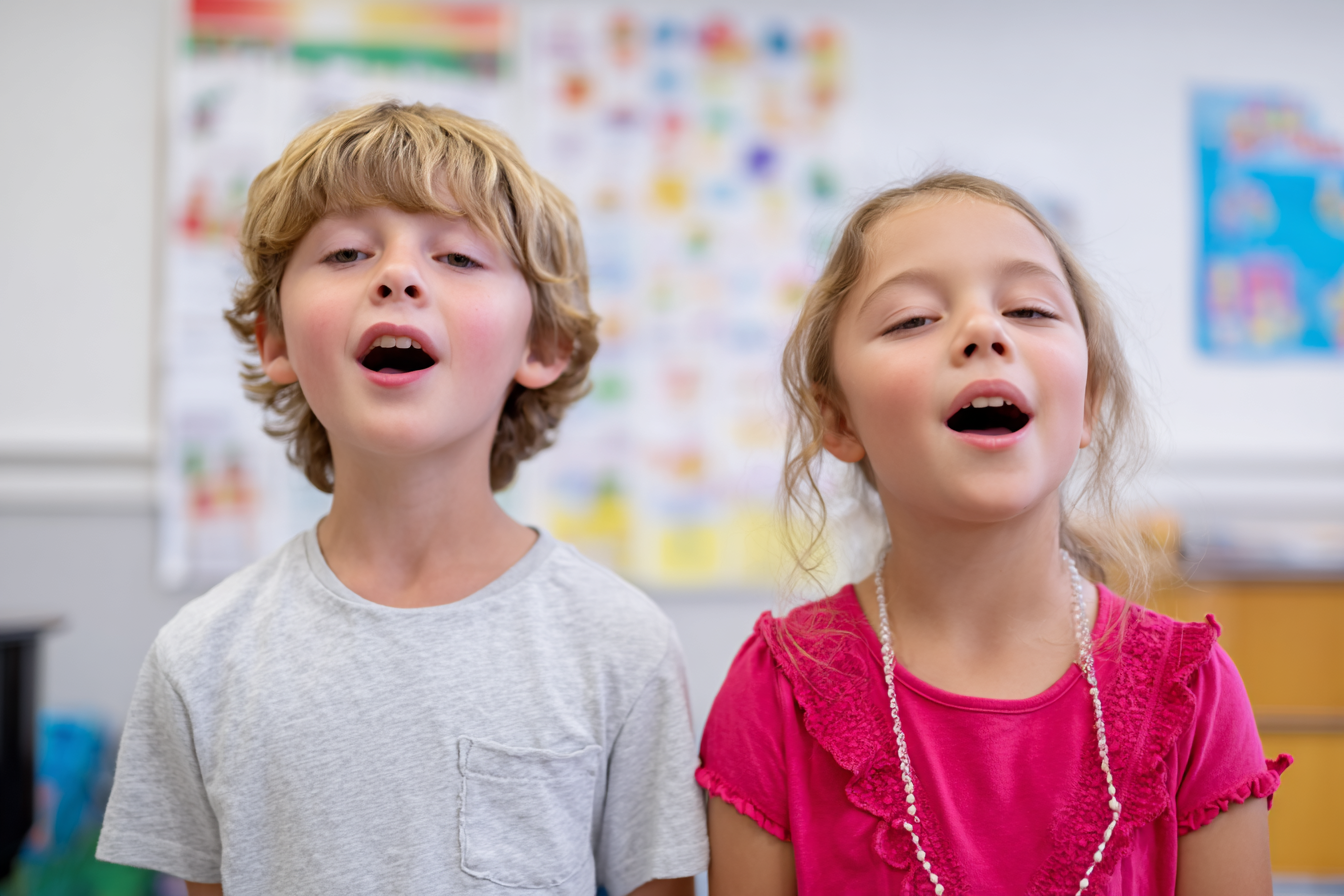
Focus: Perform music confidently for peers, showing expression, technical accuracy, and appropriate audience/performer behavior.
Grade Level: 2
Subject Area: Music (Performing • Expression • Decorum)
Total Unit Duration: 1–3 sessions (3+ weeks), 50–60 minutes per session
I. Introduction
In this unit, students participate in a Music Sharing Day, performing songs or patterns they have rehearsed in previous units. They focus on performing for a specific purpose—sharing music with classmates—using clear voices or instruments, steady beat, and simple expressive choices (loud/soft, fast/slow). Students also learn and practice performance decorum and audience etiquette, including posture, focus, and kind listening. The goal is for students to feel proud and confident as they share music in a supportive environment.
Essential Questions
- What does it mean to perform music for a purpose (such as sharing with our class)?
- How can we show expression and accuracy when we perform?
- What does it look and sound like to be a respectful performer and a thoughtful audience member?
- How does performing for others help us grow as musicians and classmates?
II. Objectives and Standards
Learning Objectives — Students will be able to:
- Perform a familiar song or pattern for classmates with mostly accurate beat, rhythm, and pitch.
- Use at least one expressive choice (loud/soft, fast/slow, smooth/short) that fits the purpose of the music.
- Demonstrate performance decorum (ready position, focus, starting and ending together) while performing.
- Demonstrate audience etiquette (quiet listening, appropriate applause, kind responses) during peers’ performances.
- Reflect on their performance, naming one strength and one goal for future performances.
Standards Alignment — Grade 2 Music (NAfME-Aligned)
- MU:Pr6.1.2a — Perform music for a specific purpose with expression and technical accuracy.
- Example: Performing a welcome song clearly and confidently.
- MU:Pr6.1.2b — Perform appropriately for the audience and purpose.
- Example: Adjusting volume and posture when performing for guests.
Success Criteria — Student Language
- I can perform a song or pattern with mostly correct beat, rhythm, and pitch.
- I can use expression (like loud/soft or fast/slow) that matches the song.
- I can show good performer behavior (ready posture, focus, starting and ending together).
- I can show good audience behavior (listening quietly, clapping kindly).
- I can say something I did well and something I want to improve next time.
III. Materials and Resources
Tasks & Tools (teacher acquires/curates)
- Repertoire
- 2–4 familiar songs or patterns from earlier units (welcome songs, seasonal songs, simple ostinatos, or rhythm pieces).
- Optional: short student-created rhythms or sound pictures for small-group performances.
- Performance supports
- Simple performance checklist for performers:
- Steady beat?
- Clear words or rhythms?
- Some expression?
- Start and stop together?
- Simple audience checklist:
- Eyes on performers.
- Quiet during songs.
- Clap at the end.
- “Performer & Audience Rules” anchor chart with icons (standing tall, sitting quietly, eyes watching, hands still, clap at the end).
- Simple performance checklist for performers:
- Classroom setup
- A small performance area (front of room, carpet, or taped line).
- Space for class to sit facing the performers.
- Optional: simple decorations (sign that says “Music Sharing Day”).
Preparation
- Choose which songs or pieces students will perform (whole-group, small groups, or both).
- Decide on order of performances (by class section, group, or type of piece).
- Prepare and post the Performer & Audience Rules chart.
- Make copies of or project performance and audience checklists.
Common Misconceptions to Surface
- “If I make one mistake, the whole performance is bad.” → Mistakes are part of learning; we keep going and do our best.
- “Performing louder is always better.” → We adjust volume to fit the song and the room; loud does not always mean better.
- “Audience members can talk softly during songs.” → Good audience etiquette means silent listening during performances.
- “Performance decorum only matters for big concerts.” → We practice good decorum any time we share music with others.
Key Terms (highlight in lessons) performance, expression, technical accuracy, decorum, audience, etiquette, steady beat, rhythm, confidence
IV. Lesson Procedure
(Each session is designed for a 50–60 minute class period.)
Session 1 — Getting Ready for Music Sharing Day (Pr6.1.2a & Pr6.1.2b)
- Launch (8–10 min)
- Ask: “Have you ever shared something you worked hard on (a drawing, a story, a project)? How did it feel?”
- Explain that in this unit, students will have a Music Sharing Day where they perform for classmates.
- Introduce the idea of performing for a specific purpose: “We are sharing music to celebrate what we’ve learned and to bring joy to the class.”
- Explore, Part A: Performer & Audience Rules (10–12 min)
- Present the Performer & Audience Rules anchor chart:
- Performers: stand or sit tall, look at the teacher or conductor, start and stop together, keep trying even if there is a mistake.
- Audience: sit still, listen quietly, watch performers, clap at the end.
- Invite a few students to act out correct and incorrect examples for the class to discuss.
- Present the Performer & Audience Rules anchor chart:
- Explore, Part B: Whole-Class Practice Performance (15–18 min)
- Choose one familiar class song.
- First, perform it “practice style” (students remain seated, not focusing on decorum).
- Discuss: “What would we need to change to make this a real performance?”
- Practice:
- Standing or sitting in performance position.
- Watching the teacher for the start signal.
- Singing or playing with steady beat and some expression.
- Ending together and holding the ending in silence.
- Repeat the song once more using the performance checklist.
- Explore, Part C: Audience Role Practice (5–7 min)
- Have a small group perform just the first part of the song while the rest of the class practices audience etiquette.
- Afterward, ask:
- “What did the performers do well?”
- “What did the audience do well?”
- Discuss (5–7 min)
- Whole-class:
- “What helps us feel confident when we perform?”
- “How can the audience help performers feel supported?”
- Whole-class:
- Reflect (3–5 min)
- Quick check-in:
- “Today I felt most confident when __.”
- “One performer or audience behavior I want to remember is __.”
- Quick check-in:
Optional Session 2 — Small-Group Performance Practice (Pr6.1.2a & Pr6.1.2b)
- Launch (5–7 min)
- Review performer and audience rules using the anchor chart.
- Explain that today students will practice performing in smaller groups to get ready for the big sharing day.
- Explore, Part A: Group Rehearsal (12–15 min)
- Divide students into small groups (e.g., 3–5 students) and assign each group a short song or pattern.
- In groups, students:
- Sing or play through their piece once.
- Decide on one expressive choice (e.g., softer at the beginning, louder at the end, slower in the middle).
- Practice starting and ending together.
- Teacher circulates, reminding groups about steady beat and expression.
- Explore, Part B: Group Performance Circles (15–18 min)
- Half the groups perform while the other half are the audience; then switch roles.
- For each group performance:
- Audience practices quiet listening and kind clapping.
- Teacher or a student shares one positive comment about expression or decorum.
- Explore, Part C: Quick Peer Feedback (5–7 min)
- In their small groups, students share:
- “One thing we did well in our performance was __.”
- “One thing we want to do better next time is __.”
- In their small groups, students share:
- Discuss (5–7 min)
- Ask:
- “How was performing in a small group the same as performing as a whole class? How was it different?”
- “What helped you feel more ready for Music Sharing Day?”
- Ask:
- Reflect (3–5 min)
- Silent or partner reflection:
- “Next time I perform, I want to remember to __ so I feel more confident.”
- Silent or partner reflection:
Optional Session 3 — Music Sharing Day (Pr6.1.2a & Pr6.1.2b)
- Launch (5–7 min)
- Announce: “Today is Music Sharing Day!”
- Review the purpose: to share music we have learned and to celebrate everyone’s work.
- Quickly revisit performer and audience expectations.
- Explore, Part A: Final Warm-Up (8–10 min)
- Lead a short vocal or body percussion warm-up to get bodies and voices ready.
- Invite students to think: “What is one word that describes how you want your performance to feel (happy, calm, strong, gentle)?”
- Explore, Part B: Class Performances (20–25 min)
- Organize performances by:
- Whole-class songs, and/or
- Small-group or section performances.
- After each performance:
- Audience claps kindly.
- Teacher or one student shares one positive observation (e.g., “They started together,” “I heard a nice soft beginning”).
- Emphasize that everyone’s job is to be a supportive performer or audience member.
- Organize performances by:
- Explore, Part C: Closing Song & Appreciation (5–7 min)
- End with one song performed by the entire class.
- Have students turn to a partner and say “Thank you for sharing your music.”
- Discuss (5–7 min)
- Whole-class circle:
- “How did it feel to perform for your classmates?”
- “What did you notice about how our performances changed from the beginning of the year?”
- Whole-class circle:
- Reflect (3–5 min)
- Final individual reflection (oral or written):
- “One thing I am proud of in my performance is __.”
- “The next time I perform for an audience, I want to work on __.”
- Final individual reflection (oral or written):
V. Differentiation and Accommodations
Advanced Learners
- Invite students who are ready to:
- Add a simple bordun, ostinato, or motion pattern to their performance piece.
- Take a leadership role (e.g., starting the song, giving the starting signal, modeling decorum).
- Reflect using more specific music vocabulary (steady beat, rhythm, dynamics, tempo).
Targeted Support
- Allow some students to:
- Perform in larger groups or whole-class settings rather than alone or in very small groups.
- Perform shorter sections of a song instead of the entire piece.
- Practice performer and audience behaviors using role-play before the actual sharing day.
- Provide sentence frames:
- “I felt confident when __.”
- “Our group did well at __.”
- “Next time, I want to __.”
Multilingual Learners
- Use pictures and gestures to show key ideas: performer posture, clapping, quiet listening, expressive faces.
- Allow students to express how they felt about their performance with faces/emojis or by choosing from word cards (happy, proud, nervous).
- Encourage short English phrases for reflection (e.g., “Good beat,” “Too fast,” “Very loud”), while allowing fuller discussion in their home language with peers.
IEP/504 & Accessibility
- Provide flexible options:
- Students may perform seated or with adapted instruments.
- Reduce performance length or complexity if needed.
- Offer extra support and modeling before the sharing day: practice entering/leaving the performance area, where to look, and how to stand or sit.
- For students sensitive to attention, allow participation in group performances rather than solo features.
VI. Assessment and Evaluation
Formative Checks (ongoing in all sessions)
- Are students:
- Showing steady beat and mostly accurate rhythms/pitches during practice and performances?
- Using at least one expressive quality (dynamics or tempo) intentionally?
- Following performer decorum and audience etiquette expectations?
- Able to name something they did well and something they might change next time?
Summative — Music Sharing Day Performance (0–2 per criterion, total 10)
- Technical Accuracy (MU:Pr6.1.2a)
- 2: Performance shows mostly accurate beats, rhythms, and pitches; any mistakes do not disrupt the piece.
- 1: Several errors occur but the song remains recognizable.
- 0: Frequent errors make the piece difficult to recognize.
- Expression & Purpose (MU:Pr6.1.2a)
- 2: Student clearly uses expression (loud/soft, fast/slow, etc.) that fits the song and the sharing purpose.
- 1: Some expressive intent is present but inconsistent or not clearly connected to the song’s purpose.
- 0: Little or no expressive intent is evident.
- Performance Decorum (MU:Pr6.1.2b)
- 2: Student shows appropriate decorum: ready posture, focus, appropriate start/end behavior, and respectful presence throughout.
- 1: Some decorum shown, but with occasional lapses (fidgeting, looking away, talking).
- 0: Frequent off-task or distracting behavior during performance.
- Audience Etiquette (MU:Pr6.1.2b)
- 2: Student listens quietly, watches performers, and uses appropriate applause without reminders.
- 1: Generally appropriate audience behavior with 1–2 reminders.
- 0: Frequent talking or disruptive behavior during others’ performances.
- Student Reflection
- 2: Student can clearly name one strength and one goal using simple musical or behavior language.
- 1: Student can name either a strength or a goal, but not both, or gives only general comments.
- 0: Student is unable or unwilling to reflect on their performance.
Feedback Protocol (TAG)
- Tell one strength (e.g., “Your group started together and kept a steady beat.”).
- Ask one question (e.g., “How did you decide to sing softer at the beginning?”).
- Give one suggestion (e.g., “Next time, try looking up a little more at the audience.”).
VII. Reflection and Extension
Reflection Prompts
- How did you feel before, during, and after Music Sharing Day?
- What did you learn about yourself as a performer? As an audience member?
- What would you like to do the same in your next performance, and what would you like to do differently?
- How can the respect and focus we used in Music Sharing Day help us in other parts of school and life?
Extensions
- Recording & Replay: Record performances (audio or video) and, on a later day, let students listen/watch and share one strength and one goal.
- Family Share: Send a note encouraging families to ask children to sing or play their sharing day song at home and practice good family audience etiquette.
- Cross-Curricular Connection: Have students draw a picture of their favorite performance moment and write a short caption (e.g., “We started together and sang softly at the end”).
Standards Trace — When Each Standard Is Addressed
- MU:Pr6.1.2a — Session 1 (whole-class performance practice with expression and accuracy), Optional Session 2 (small-group performance practice), Optional Session 3 (Music Sharing Day performances with purposeful expression and accuracy).
- MU:Pr6.1.2b — Session 1 (introducing and modeling performer and audience rules), Optional Session 2 (practicing decorum and etiquette in small-group performances), Optional Session 3 (Music Sharing Day with full-class attention to performance decorum and audience etiquette).