Unit Plan 1 (Grade 5 Library): Welcome to Grade 5 Library
Launch Grade 5 Library with routines for reading, inquiry, discussion, checkout, and respectful participation that build independence and community.

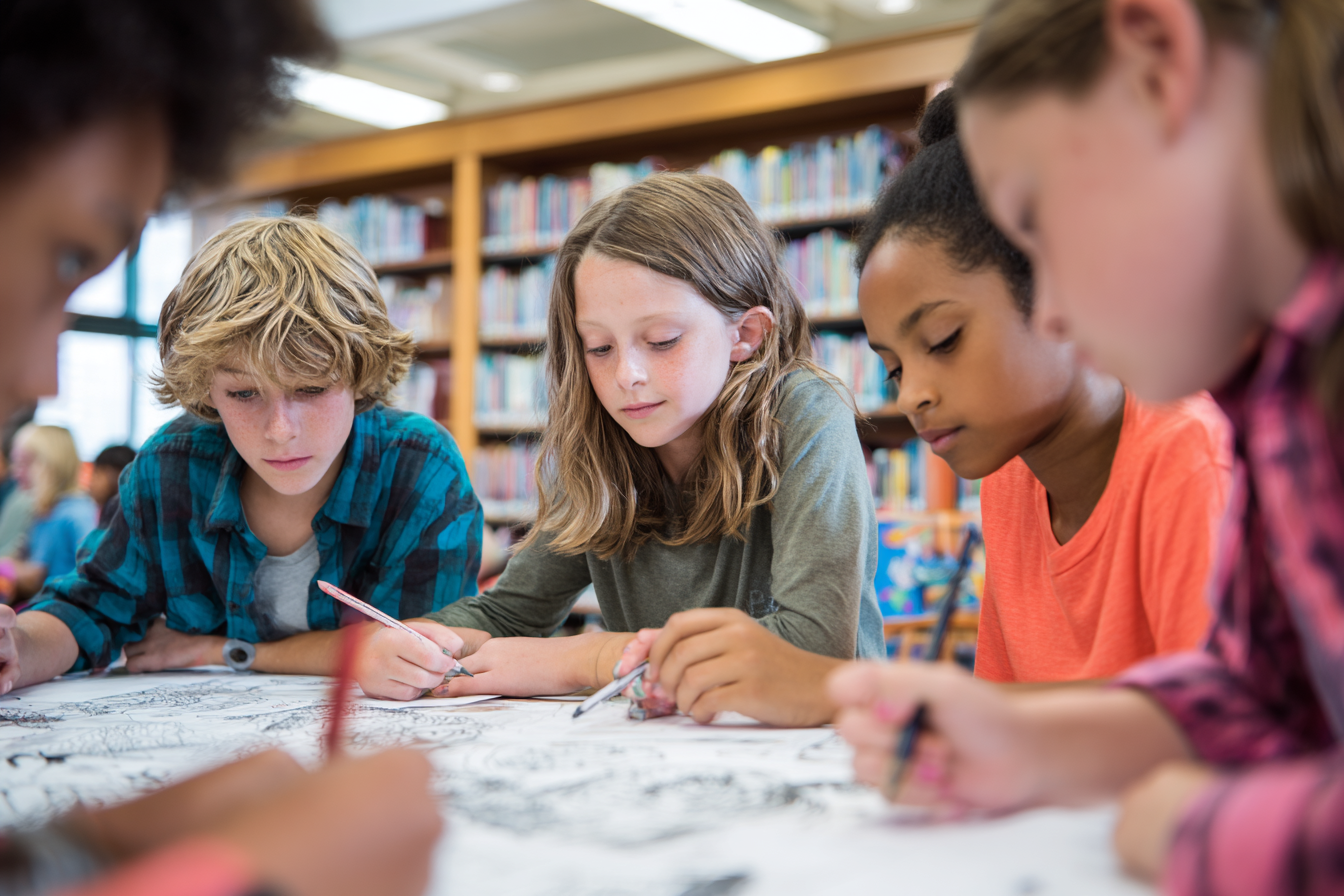
Focus: Establish Grade 5 Library as a place for independent reading, inquiry, discussion, and creative communication. Students learn routines for checkout, independent work, discussion, technology use, and shared care of the library, while practicing the maturity and thoughtful participation expected of upper elementary learners.
Grade Level: 5
Subject Area: Library (Reading • Inquiry • Community/Participation)
Total Unit Duration: 1–3 weeks, 50–60 minutes per session
I. Introduction
This opening unit helps students understand that Grade 5 Library is not just a place to borrow books, but a space for reading, thinking, discussing, creating, and learning independently. Because students are nearing middle school, the librarian introduces expectations that emphasize maturity, responsibility, respectful discussion, and self-direction. Through a short shared read-aloud or article discussion, a browsing/selection task, and a reflection on what successful Grade 5 library learning looks like, students begin to see the library as a place where different perspectives are welcomed and routines support deeper learning.
Essential Questions
- What does it look like to be a mature and independent Grade 5 library learner?
- How can different readers respond to the same text in different ways, and why does that strengthen discussion?
- What routines and habits help a library class run smoothly during checkout, discussion, inquiry, technology use, and independent work?
- How can I contribute respectfully to reading, listening, viewing, creating, and sharing in the library?
II. Objectives and Standards
Learning Objectives — Students will be able to:
- Describe the purpose of Grade 5 Library as a space for independent reading, inquiry, discussion, and creative communication.
- Follow routines for checkout, discussion, independent work, technology use, and transitions with minimal prompting.
- Participate respectfully in a shared read-aloud, article discussion, or viewing task by listening actively and responding thoughtfully.
- Recognize that classmates may choose different texts, notice different ideas, or interpret the same text in different ways.
- Reflect on what successful Grade 5 library learning looks like and identify personal goals for participation and responsibility.
- (Optional Sessions) Strengthen routines for checkout and discussion, practice more independent browsing/selection, and apply respectful participation in additional library activities.
Standards Alignment — 5th Grade (AASL-based Custom)
- L:S2.5c — Recognize that readers and learners may select different texts, interpret them differently, and value different perspectives, and that these differences strengthen library learning.
- Example: A student understands that classmates may form different conclusions from the same article or novel excerpt and that these differences can deepen discussion.
- L:S6.5a — Follow library routines and expectations during checkout, discussion, inquiry, technology use, transitions, and independent work.
- Example: A student begins work promptly, follows directions across stations, and manages transitions with little or no teacher prompting.
- L:S6.5c — Participate respectfully in reading, listening, discussing, viewing, creating, and sharing in the library.
- Example: A student contributes thoughtfully to a discussion, listens actively, and responds respectfully to peers during presentations or group work.
Success Criteria — Student Language
- I can explain what Grade 5 Library is for and how it is different from “just getting a book.”
- I can follow library routines during checkout, discussion, independent work, and technology use.
- I can listen carefully, share respectfully, and respond thoughtfully during library discussions and activities.
- I can understand that other students may choose different texts or have different ideas from me, and that those differences are valuable.
- I can reflect on how I want to grow as a Grade 5 library learner this year.
III. Materials and Resources
Tasks & Tools (teacher acquires/curates)
- Shared text options:
- Short read-aloud excerpt, article, picture book for older readers, or short multimedia text that invites more than one interpretation.
- A text that supports discussion about perspective, habits, or community expectations works especially well.
- Library orientation materials:
- Visuals or slides showing library spaces, checkout routines, shelf organization, discussion norms, technology expectations, and independent work expectations.
- Optional “library jobs” or responsibility cards for table groups or checkout helpers.
- Student materials:
- Reflection sheet: “What Successful Grade 5 Library Learning Looks Like.”
- Browsing checklist or “How I Choose a Book” card.
- Sticky notes or note cards for quick responses during discussion.
- Checkout materials:
- Book bins, shelf labels, checkout system, bookmarks, due-date reminders, and any device or scanner needed for circulation.
Preparation
- Choose a short anchor text or article that allows for multiple responses or perspectives.
- Create anchor charts:
- “Grade 5 Library Looks Like / Sounds Like” (independent, thoughtful, respectful, responsible).
- “Discussion Norms” (listen, build on ideas, disagree respectfully, include others).
- “Checkout & Browsing Routines” (browse with purpose, care for books, return shelves to order, know what to do if you’re unsure).
- “Technology Expectations” (log in responsibly, stay on task, use tools appropriately, ask before switching tasks).
- Prepare a reflection form and, if desired, a simple student goal-setting section for library habits.
Common Misconceptions to Surface
- “Library is just for getting books.” → Library is also for reading, inquiry, discussion, creating, and sharing.
- “If someone understood the text differently than I did, one of us must be wrong.” → Different perspectives can strengthen learning and discussion.
- “Being independent means being silent all the time.” → Independence means using time and routines well; respectful discussion is also an important part of library learning.
- “Checkout time means I can stop thinking about expectations.” → Checkout is part of learning and requires responsibility, care, and good choices.
Key Terms (highlight in lessons) independent reading, browse, checkout, perspective, interpretation, discussion, inquiry, expectations, responsibility, participation
IV. Lesson Procedure
(Each session follows: Welcome/Focus → Mini-Lesson/Shared Reading → Work Time → Discussion/Sharing → Reflect → Check-Out. Timing for a 50–60 minute library class.)
Session 1 — Welcome to Grade 5 Library (Core Session — Addresses All Standards: L:S2.5c, L:S6.5a, L:S6.5c)
- Welcome/Focus (5–8 min)
- Greet students and introduce the purpose of Grade 5 Library as a place for reading, inquiry, discussion, technology use, and shared responsibility.
- Ask: “What do you think a successful Grade 5 library class should look and sound like?” Record a few ideas to revisit later.
- Briefly explain that Grade 5 students are expected to show growing maturity, independence, and thoughtful participation.
- Mini-Lesson/Shared Reading (10–15 min)
- Read aloud a short excerpt or article, or share a brief multimedia text that invites different interpretations.
- Model one response such as:
- “One thing I noticed…”
- “One question I have…”
- “One way someone else might see this differently…”
- Introduce the idea that readers may interpret differently, and those differences help make library discussions stronger (L:S2.5c).
- Work Time (15–20 min)
- Lead a short “Library Learning in Action” practice rotation or guided task:
- Students respond to the shared text on a sticky note or quick response card.
- Students complete a brief “What Successful Grade 5 Library Learning Looks Like” reflection, naming behaviors for discussion, independent work, transitions, and technology use.
- Students practice a quick browsing routine: locating a section, previewing a few books, and considering what makes a good choice for themselves.
- Librarian reinforces library expectations during movement and task time (L:S6.5a).
- Lead a short “Library Learning in Action” practice rotation or guided task:
- Discussion/Sharing (8–10 min)
- Facilitate a short discussion about the text and invite more than one perspective:
- “What stood out to you?”
- “Did anyone have a different reaction or interpretation?”
- Emphasize respectful participation: listening, waiting, building on others’ ideas, and responding kindly (L:S6.5c).
- Connect discussion back to the library as a place where different readers and thinkers can grow together.
- Facilitate a short discussion about the text and invite more than one perspective:
- Reflect (3–5 min)
- Students finish the sentence on their reflection sheet or verbally:
- “One way I can show I am ready for Grade 5 Library is ___.”
- “One discussion habit I want to practice this year is ___.”
- Students finish the sentence on their reflection sheet or verbally:
- Check-Out (8–10 min)
- Model or review realistic checkout routines: browsing with purpose, keeping shelves orderly, handling books carefully, and moving through checkout calmly and independently.
- Librarian can conference briefly with a few students about book choices, reading interests, or how to pick a just-right book.
- Students check out materials and practice ending class responsibly.
Optional Session 2 — Practicing Routines, Discussion, and Book Choice (Extension — Deepen L:S2.5c, L:S6.5a, L:S6.5c)
- Welcome/Focus (5–7 min)
- Review anchor charts: “Grade 5 Library Looks Like / Sounds Like” and “Checkout & Browsing Routines.”
- Ask: “What went well last time? What should we improve as a class?”
- Mini-Lesson/Shared Reading (8–12 min)
- Read another short text, article, or excerpt that allows for multiple interpretations.
- Model the difference between “I disagree” and “I disagree respectfully because…”
- Reinforce that different interpretations can deepen understanding (L:S2.5c).
- Work Time (15–20 min)
- Students complete a short task such as:
- Sorting sample responses into “respectful discussion moves” vs. “unhelpful discussion moves.”
- Practicing a “book talk” note where they record one title they are interested in and why.
- Completing a quick browsing challenge (find a book by interest, genre, or question).
- Librarian focuses on independent task management, transitions, and technology or space expectations (L:S6.5a).
- Students complete a short task such as:
- Discussion/Sharing (8–10 min)
- Students share one interpretation, one book choice, or one text connection.
- Encourage them to respond to classmates with prompts such as:
- “I noticed that too…”
- “I saw it differently because…”
- “That makes me think…”
- Reinforce active listening and thoughtful participation (L:S6.5c).
- Reflect (3–5 min)
- Students respond to a quick prompt:
- “One routine I am getting stronger at is ___.”
- “One thing I can do better during discussion or work time is ___.”
- Students respond to a quick prompt:
- Check-Out (8–10 min)
- Students browse and check out with increased independence.
- Librarian may pull a small group for quick help with book choice, series suggestions, or genre exploration while others practice responsible checkout behavior.
Optional Session 3 — Building Independence and Library Community (Extension — Solidify L:S2.5c, L:S6.5a, L:S6.5c)
- Welcome/Focus (5–7 min)
- Open with a quick question: “What makes a library community strong?”
- Review the idea that strong library communities include different perspectives, respectful participation, and shared responsibility.
- Mini-Lesson/Shared Reading (8–12 min)
- Share a short text, video clip, or article excerpt connected to reading, inquiry, or community.
- Invite students to think about how different readers might focus on different ideas or ask different questions.
- Work Time (15–20 min)
- Students complete a final reflection/goal activity such as:
- “My Grade 5 Library Goals” (e.g., choose books more independently, speak more during discussions, stay more focused during work time).
- A short “library learner profile” page where they identify strengths and areas to grow.
- Students may also browse or preview texts connected to their interests, recording one title they may want to borrow later.
- Students complete a final reflection/goal activity such as:
- Discussion/Sharing (8–10 min)
- Students share one goal or one thing they’ve learned about being a Grade 5 library learner.
- Encourage peers to respond respectfully and supportively, building a sense of shared responsibility for the library environment.
- Reflect (3–5 min)
- Final reflection prompt:
- “This year in library, I want to be a student who ___.”
- “One way I can help our library community is ___.”
- Final reflection prompt:
- Check-Out (8–10 min)
- Students complete checkout with minimal prompting, showing growth in routine and responsibility.
- Librarian can use this time for brief one-on-one check-ins about reading habits, book interests, or library goals.
V. Differentiation and Accommodations
Advanced Learners
- Invite students to take on small leadership roles during routines (e.g., discussion starter, shelf helper, model participant).
- Encourage deeper reflection on how different perspectives improve library discussions and inquiry.
- Ask students to set a personal library learning goal that goes beyond behavior (e.g., “I want to try more nonfiction this year” or “I want to ask stronger discussion questions”).
Targeted Support
- Provide clear visual routines for checkout, discussion, and transitions.
- Use sentence stems for discussion and reflection, such as:
- “I noticed ___.”
- “I interpreted the text this way because ___.”
- “One routine I will practice is ___.”
- Offer structured browsing support with a short checklist or librarian-guided selection.
Multilingual Learners
- Provide visual word banks for library, checkout, discussion, perspective, independent work, and responsibility.
- Allow oral responses before writing reflections.
- Encourage students to share ideas about texts and book interests in paired conversation before whole-group discussion.
- Support understanding with gestures, visuals, and modeled examples during routines.
IEP/504 & Accessibility
- Break routines into smaller steps with a visible checklist or schedule.
- Allow students to use verbal rather than written reflections when needed.
- Provide extra support during browsing/checkout, including clearly labeled areas or pre-selected book bins if helpful.
- Use structured discussion supports (e.g., turn cards, speaking order cues, discussion stems) to lower participation barriers.
VI. Assessment and Evaluation
Formative Checks (each session)
- Session 1 — Students show understanding of Grade 5 library expectations through reflection sheets, participation in discussion, and initial checkout routines.
- Optional Session 2 — Students demonstrate improving independence in work time, transitions, and checkout; discussion responses show awareness of different interpretations.
- Optional Session 3 — Students can reflect on personal library habits and identify ways to contribute positively to the library community.
Summative — Welcome to Grade 5 Library Reflection & Participation (0–2 per criterion, total 10)
- Understanding of Library Purpose and Expectations (L:S6.5a)
- 2: Student clearly explains that the library is a place for reading, inquiry, discussion, and responsible participation, and follows routines with little prompting.
- 1: Student shows partial understanding of library purpose and can follow some routines, but still needs reminders.
- 0: Student shows limited understanding of the purpose of library learning and frequently needs redirection to follow routines.
- Respectful Participation in Discussion and Sharing (L:S6.5c)
- 2: Student participates respectfully by listening, sharing thoughtfully, and responding appropriately to others.
- 1: Student participates some of the time but may need support with listening or responding respectfully.
- 0: Student rarely participates respectfully or frequently interrupts/disengages during discussion.
- Recognition of Different Perspectives (L:S2.5c)
- 2: Student recognizes that classmates may have different interpretations or preferences and understands that these differences add value to library learning.
- 1: Student shows some awareness that others may think differently, but explanation is basic or inconsistent.
- 0: Student shows little awareness of or respect for different interpretations or reading preferences.
- Reflection on Grade 5 Library Learning
- 2: Student gives a thoughtful reflection about what successful Grade 5 library learning looks like and identifies at least one specific personal goal.
- 1: Student gives a simple reflection and/or goal, but it is general or underdeveloped.
- 0: Student provides little or no meaningful reflection or goal.
- Checkout and Independent Work Habits
- 2: Student uses checkout and independent work time responsibly, following routines and making purposeful choices.
- 1: Student is generally responsible but still needs occasional reminders during checkout or independent work.
- 0: Student has difficulty managing checkout or independent work routines even with support.
Feedback Protocol (TAG)
- Tell one strength (e.g., “You listened carefully and added your own thoughtful idea during discussion.”).
- Ask one question (e.g., “How might you challenge yourself more as a Grade 5 library learner?”).
- Give one suggestion (e.g., “Try using your browsing time more purposefully by starting with one clear interest or genre.”).
VII. Reflection and Extension
Reflection Prompts
- What does it mean to be a mature and independent Grade 5 library student?
- How can different perspectives make a reading or article discussion stronger?
- What routine or habit will help you most this year in library?
Extensions
- Library Learner Goals Display: Create a class chart of anonymous student goals for Grade 5 Library (e.g., “listen better,” “try new genres,” “ask stronger questions”).
- Book Interest Survey: Have students complete a short reading-interest survey that can help with future book recommendations and independent reading support.
- Discussion Practice Routine: Build a recurring short routine in future classes where students respond to a shared text with one interpretation and one respectful response to a peer.
Standards Trace — When Each Standard Is Addressed
- L:S2.5c — Session 1 (shared text discussion and recognition of different interpretations), Optional Session 2 (deeper practice with discussion and multiple responses), Optional Session 3 (reflecting on differences in reading and learning within the library community).
- L:S6.5a — Session 1 (introduction to checkout, discussion, independent work, transitions, technology expectations), Optional Session 2 (practice and strengthening of routines), Optional Session 3 (greater independence with library habits and self-management).
- L:S6.5c — Session 1 (respectful discussion and listening), Optional Session 2 (practicing respectful responses and sharing), Optional Session 3 (supportive sharing, goal reflection, and community-building participation).